Neotuberostemonin: a multi-target natural product derived from traditional cough suppressants
1. Overview
Neotuberostemonin (NTS), CAS number 143120-46-1, is a traditional medicinal plant derived from the plant Berberine(Stemona tuberosa The alkaloids extracted from the roots of Lour. have significant biological activity. As one of the main cough suppressant alkaloids in Baibu, it has long been used in folk medicine to treat cough, asthma, and parasitic infections. Modern pharmacological research has not only confirmed its traditional cough suppressant and expectorant effects, but also revealed its new potential in combating pulmonary fibrosis, antibacterial and other fields, transforming it from a traditional drug ingredient into a highly anticipated candidate molecule in modern drug development. In particular, its mechanism of alleviating bleomycin induced pulmonary fibrosis by regulating macrophage function provides a new approach for treating this deadly disease that currently lacks effective treatment methods. This article will provide a systematic professional popularization of this natural product from its chemical essence, traditional sources, modern pharmacological mechanisms, drug evaluation, and future prospects.
2. Chemical structure and physicochemical properties
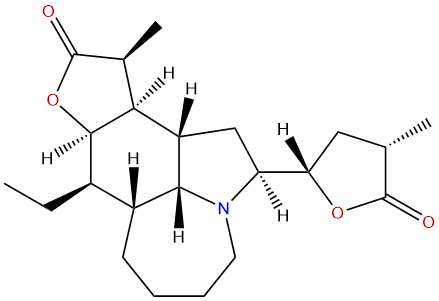
The molecular formula of Xindui Baibu alkaloid is C22H33NO4, with a molecular weight of 375.5090 g/mol. Structurally speaking, it belongs to the family of hundred part alkaloids, characterized by a complex condensed polycyclic system, including a pyrrolo nitrogen-containing framework, and connected by multiple chiral centers. Its SMILES string (CC [C @ @ H] 1 [C @ H] 2CCCCN3 [C @ H] 2)C@@H[C @ H] 2 [C @ @ H] 1OC (=O) [C @ H] 2C) clearly demonstrates the complexity of its stereochemistry, with multiple "@" symbols indicating specific absolute configurations, which are crucial for its biological activity.
Analyzing its physicochemical properties from the parameters of drug properties:
- Fat solubility and water solubility The calculated LogP value is 2.5894 and LogD is 2.3939, indicating that the compound has moderate to high lipid solubility. Its theoretical water solubility is 0.1418 mg/mL, which is slightly soluble. This moderate lipophilic hydrophilic balance is beneficial for its penetration through biological membranes.
- Polar Surface Area The topological polar surface area (TPSA) is 55.84 Å ², which is relatively low and usually indicates good membrane permeability.
- Absorption and distribution The permeability data of Caco-2 cells is 9.4370 × 10 ⁻⁶ cm/s, indicating its good intestinal absorption potential. More noteworthy is that its blood-brain barrier (BBB) penetration is predicted to be "high," indicating that it may act on central nervous system targets, which is consistent with its potential cough suppressing effect (possibly involving central mechanisms).
- Protein binding rate The plasma protein binding rate (PPB) is about 64.77%, which is at a moderate level, indicating that it has a certain degree of binding in the blood and a considerable proportion exists in free form, which is conducive to the efficacy of the drug.
These physical and chemical properties lay the material foundation for its subsequent biological activity.
3. Plant sources and traditional applications
The source of the new Baiye alkaloid comes from the Baiye family plant Baiye(Stemona tuberosa Dried tubers of Lour. As a traditional Chinese medicinal herb, Baibu has been used for over a thousand years. It is recorded in classic medical books such as "Record of Famous Doctors" and "Compendium of Materia Medica" that it has a mild nature, sweet and bitter taste, and belongs to the lung meridian. Its main functions are to moisten the lungs and lower qi, relieve cough, and kill insects.
In traditional Chinese medicine practice, Bai Bu is commonly used for treating:
1. Cough and asthma Whether it's chronic cough, pertussis, or tuberculosis cough, Bai Bu is a commonly used medicine. Often combined with Aster, Winter Flower, Platycodon grandiflorum, etc. to enhance the effect of moistening the lungs and stopping cough. Its cough suppressing effect has been fully validated in modern pharmacology.
2. Parasitic diseases External application can treat head lice, body lice, pubic lice, and scabies; Oral administration (with caution in compatibility and dosage) can be used for pinworm disease. This is mainly attributed to the contact and toxic effects of alkaloids in Baibu.
3. Other There are also records of using it to treat skin diseases such as eczema and dermatitis in the folk.
As one of the many alkaloids isolated from Bai Bu, Xin Dui Ye Bai Bu alkaloid is considered as one of the key active ingredients for its cough stopping effect. The clarification from traditional experience to modern monomeric compounds reflects the classic path of modernization research in traditional Chinese medicine.
4. Pharmacological activity and mechanism of action
Modern research has revealed the diverse pharmacological activities and intricate mechanisms of action of the new compound Epiphyllum far beyond traditional understanding.
4.1 Core pharmacological activity: anti pulmonary fibrosis and cough suppression
- Anti pulmonary fibrosis This is the most notable research finding on NTS in recent years. Pulmonary fibrosis is a fatal interstitial lung disease characterized by fibroblast proliferation and excessive deposition of extracellular matrix, with diverse causes and limited treatment options. Research has shown that NTS has a significant protective effect on the mouse pulmonary fibrosis model induced by bleomycin (BLM). The core mechanism lies in Inhibition of macrophage recruitment and M2 polarization。
- Detailed explanation of mechanism In the early stages of lung injury, a large number of macrophages are recruited to the site of injury. These macrophages can polarize into pro-inflammatory M1 type (clearing pathogens and necrotic cells) and anti-inflammatory/pro fibrotic M2 type. M2 macrophages activate fibroblasts by secreting cytokines such as TGF - β 1 and PDGF, promoting their transformation into myofibroblasts and synthesizing large amounts of collagen, ultimately leading to the formation of fibrotic scars. NTS can effectively inhibit the infiltration of macrophages into lung tissue and prevent their transformation into the pro fibrotic M2 phenotype, thereby cutting off the key driving factors of fibrosis process at the source. This effect does not rely on direct anti-inflammatory or antioxidant effects, but on precise regulation of the immune microenvironment.
- Cough suppression Research has confirmed that NTS exhibits significant antitussive effects in both the citric acid induced cough model and capsaicin induced cough model in guinea pigs. Its cough suppression mechanism may involve multiple links in the peripheral and central nervous system, including inhibiting the sensitivity of cough receptors and affecting the nerve conduction of cough reflex. Its good BBB penetration supports its potential action on central cough related nuclei.
4.2 Potential antibacterial activity and target analysis
The database information suggests that the new compound Leuciscinae is associated with multiple bacterial targets, including GYRA, GYRB (DNA gyrase subunit), FTSZ (bacterial cell division protein), DHFR (dihydrofolate reductase), and PBP2 (penicillin binding protein 2). This strongly suggests that NTS may have Multi targeted antibacterial The potential.
- Speculation on the mechanism of action:
- GYRA/GYRB DNA gyrase is a key enzyme essential for bacterial DNA replication and a classic target of quinolone antibiotics. NTS may inhibit bacterial DNA synthesis by interfering with the function of this enzyme.
- FTSZ As the "engine" protein for bacterial cell division, it is a popular target for developing new antibiotics. Interference with FTSZ can prevent bacterial division.
- DHFR It is a key enzyme in the folate synthesis pathway, and drugs such as trimethoprim exert antibacterial effects by inhibiting DHFR.
- PBP2 Participating in the synthesis of peptidoglycans in bacterial cell walls, it is a target of β - lactam antibiotics.
This multi-target mode of action may make it difficult for NTS to induce bacterial resistance caused by single target mutations, but it also puts higher demands on the study of its mechanism of action and selectivity (distinguishing bacterial and human homologous targets). At present, 'related diseases' are only labeled as' antibacterial', and the specific antibacterial spectrum and efficacy need further clarification through experiments.
5. Evaluation of drug properties
Based on the provided pharmacological parameters and the Lipinski's Rule of Five in medicinal chemistry, we can conduct a preliminary assessment of the potential of the new compound for the development of Leuciscinae
-
Lipinski Five Rule Compliance:
- Molecular weight (MW): 375.51<500 (compliant)
- Calculate LogP: 2.59<5 (compliant)
- Hydrogen bond donor (HBD, approximately 1-2 inferred from structural formula, such as OH or NH):<5 (compliant)
- Hydrogen bond acceptor (HBA, inferred as 5 from the number of N and O atoms in the molecular formula):<10 (compliant)
- Number of rotatable keys (inferred from structure): Moderate.
- Conclusion The new berberine fully complies with Lipinski's five rules and has good oral absorption potential.
-
ADMET property analysis:
- Absorption (A)Moderate LogP, low TPSA, and good Caco-2 permeability data all support its excellent oral absorption properties.
- Distribution (D)High BBB penetration prediction is its significant feature, which is beneficial for developing indications related to the central nervous system (such as stubborn cough). Moderate plasma protein binding rate is beneficial for tissue distribution.
- Metabolism (M)The parameters are not directly provided, but their structure contains ester bonds that may be metabolized and potential metabolic sites, which need to be further evaluated through in vitro liver microsomal experiments.
- Excretion (E)Parameter not provided.
- Toxicity (T):
- Genotoxicity The Ames test result is 0.6 (usually>1.5-2.0 is considered to have mutagenic risk), indicating a low risk under this testing system. But labeling 'chromosomal aberration' as' present 'is a highly vigilant concern Potential risk signals It must be confirmed and evaluated through more comprehensive genetic toxicity testing (such as micronucleus assay) in subsequent development.
- cardiotoxicity The inhibition of hERG as' no 'reduces the risk of cardiac toxicity associated with QT interval prolongation and apical torsion transition ventricular tachycardia, which is positive information.
- Hepatotoxicity The serum markers AST and ALT show "yes", indicating that signs of liver cell damage may be observed under testing conditions, and further in vivo liver toxicity assessment is needed.
- Other No skin/respiratory sensitization, no phototoxicity, no elevation of serum alkaline phosphatase/γ - glutamyltransferase.
- Synthetic accessibility The SyneAccessibility index is 5.18, indicating that its synthetic route has moderate complexity. Considering its multiple chiral centers, total synthesis poses significant challenges, and currently plant extraction and semi synthesis may still be the main sources.
Summary of Medicinal Properties The new berberine exhibits good characteristics in oral absorption, brain distribution, and cardiac safety, in accordance with the basic rules of drug likeness. However, it Potential chromosomal aberrations, genetic toxicity, and hepatotoxicity signals are key obstacles that must be addressed and closely monitored on the future path of drug development Before pushing it into clinical practice, it is necessary to clarify the nature, dose dependence, and reversibility of these risks through systematic toxicological studies.
6. Research Status and Application Prospects
At present, research on the new berberine has progressed from early chemical isolation and structural identification to the exploration of pharmacological mechanisms and preliminary pharmacological evaluation. Its unique immune regulatory mechanism in anti pulmonary fibrosis makes it a highly distinctive candidate molecule in this field, unlike traditional anti-inflammatory or anti fibrotic drugs. The potential for multi-target antibacterial activity is also worth further exploration.
Future research directions and prospects:
1. Deepening mechanism:
-Is the upstream signaling pathway of NTS inhibiting macrophage recruitment and M2 polarization acting on chemokines such as CCL2, or directly affecting polarization key signaling molecules such as STAT6 and PPAR - γ within macrophages?
-Conduct experimental verification of its antibacterial activity, clarify its antibacterial spectrum and minimum inhibitory concentration (MIC), and confirm its direct interaction with targets such as GYRA and FTSZ through molecular docking, target knockout/overexpression techniques.
2. structural optimization Conduct a systematic structure-activity relationship study on its potential toxic side effects, particularly genetic toxicity and hepatotoxicity. By chemical modification, its safety can be improved while retaining its core pharmacological activity. For example, modifying structural fragments that may produce toxic metabolites.
3. Formulation development For lung diseases such as pulmonary fibrosis, local administration methods such as inhalation can be explored to increase drug concentration in the lungs while potentially reducing the toxicity risk caused by systemic exposure.
4. Exploration of combination therapy Given its immunomodulatory properties, explore the possibility of combining NTS with existing anti fibrotic drugs (such as nintedanib, pirfenidone) or other mechanism of action drugs, in order to achieve synergistic effects and reduce toxic side effects.
5. Preclinical systematic review After completing sufficient pharmacological and preliminary safety assessments, it is necessary to conduct GLP (Good Laboratory Practice) toxicology studies that comply with regulations, comprehensively evaluate their repeated administration toxicity, reproductive toxicity, carcinogenicity, etc., and provide a basis for possible clinical trial applications.
In short, Xindui Yebai alkaloid is a natural product with a unique chemical structure and novel mechanism of action discovered from the treasure trove of traditional Chinese medicine. It bridges the gap between traditional cough suppressants and modern treatment of refractory lung diseases. Despite facing challenges in terms of safety and other aspects on the path towards drugs, its unique pharmacological activity and good drug like basis make it worth further research and development as a lead compound. In the future, through interdisciplinary modern research methods, this ancient plant component is expected to rejuvenate and bring new hope to patients with diseases such as pulmonary fibrosis.