


Synonym name: Zanthotoxin; Ammoidin; Meloxine; Methoxa-Dome; Geroxalen; Oxsoralen; Puvalen; Puvamet; Methoxalen
Catalogue No.: BP0936
Cas No.: 298-81-7
Formula: C12H8O4
Mol Weight: 216.192
Botanical Source: Cnidium dubium, Cryptodiscus didymus (preferred genus name Prangos), Evodia hupehensis, Selinum tenuifolium, Aegle marmelos, Xanthoxylum senegalense, Psoralea sp., Ruta graveolens, Heracleum sp., Ammi majus, Limonia acidissima, Glehnia littor
Purity: 95%~99%
Analysis Method: HPLC-DAD or/and HPLC-ELSD
Identification Method: Mass, NMR
Packing: Brown vial or HDPE plastic bottle
Can be supplied from milligrams to grams.
For Reference Standard and R&D, Not for Human Use Directly.
Inquire for bulk scale.
HPLC of Xanthotoxin
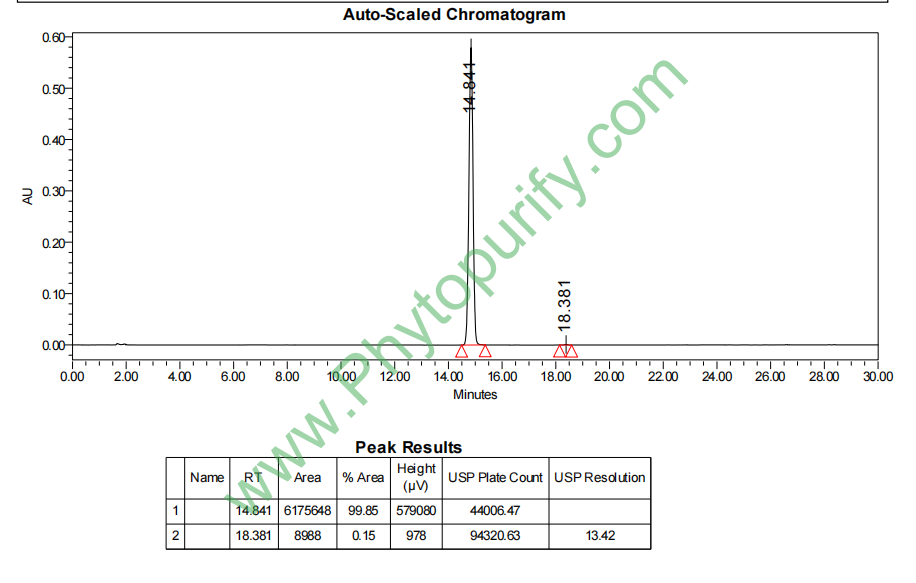
Storage conditions:Short-term storage at 2~8℃, long-term storage at -20 ~ -80℃
52.5800
2.0089
2.0089
.0248
4.4144
30.0075
High
82.2941
2.5215
Yes
No
Yes
No
Yes
Yes
1.5
Yes
No
Yes
Yes
Xanthotoxin, also known as trimethoprim, is a typical natural product of the psoralen class. Its chemical structure is 7H-furan [3,2-g] chromen-7-one, with a methoxy group at position 9 (CAS number: 298-81-7). As an important active ingredient in Ammi majus fruit, Sichuan pepper toxin plays an important role in the treatment of skin diseases, especially in the phototherapy of vitiligo and severe psoriasis, due to its unique photosensitive activity and pharmacological properties. It induces skin photosensitivity by synergistically interacting with the UV-A band, thereby promoting the recovery of pigment cell function and inflammation regulation. In recent years, with the advancement of natural product pharmacology and molecular biology technology, the mechanism of action, molecular targets, and pharmacological evaluation of Sichuan pepper toxin have been systematically and deeply studied, providing theoretical basis and technical support for its clinical application and new drug development.
This article will provide a systematic review of the chemical structure and physicochemical properties, plant sources, and extraction methods of Sichuan pepper toxin, with a focus on analyzing its pharmacological activity and mechanism of action. Combined with the research progress of molecular targets, the pharmacological properties and pharmacokinetic characteristics of Sichuan pepper toxin will be evaluated, and its clinical application prospects and future research directions will be discussed. The aim is to provide comprehensive and authoritative reference materials for researchers and clinical physicians in the field of natural product pharmacology.
The chemical name of Sichuan pepper toxin is 7H-furan [3,2-g] chromen-7-one, a 9-methoxy substituted psoralen compound. Its molecular formula is C12H8O4 and its molecular weight is 216.1920. Structurally, Sichuan pepper toxin belongs to the furan coumarin class, with a fusion structure of furan ring and coumarin core. The introduction of methoxy group endows it with specific electronic properties and spatial conformation, affecting its binding ability with biological targets.
In terms of physical and chemical properties, the LogP value of Sichuan pepper toxin is 2.0089, indicating moderate lipid solubility, which is beneficial for its penetration of cell membranes and skin barriers. Its topological polar surface area (TPSA) is 52.58 Å ², indicating that the molecule has certain polar groups that facilitate affinity binding with protein targets. Low water solubility (0.0248 mg/mL) suggests limited solubility in aqueous phase, which may affect oral absorption and formulation design. The high permeability of the blood-brain barrier indicates its ability to enter the central nervous system, which should be taken into consideration when evaluating potential neurotoxicity or central effects. The hERG channel inhibition experiment showed a negative result, indicating a low risk of cardiac toxicity. The Ames test result is 1.5, indicating a low risk of genotoxicity and meeting drug safety requirements.
Sichuan pepper toxin mainly exists in the fruits of Ammi majus, a plant in the Umbelliferae family. Ammi majus is an annual herbaceous plant widely distributed along the Mediterranean coast, and its fruit is rich in various psoralen compounds. Traditionally, Ammi majus fruit has been used in traditional Chinese medicine and folk therapy to treat skin and inflammatory diseases.
The process of extracting Sichuan pepper toxin generally adopts organic solvent extraction combined with chromatographic separation technology. Common extraction solvents include ethanol, methanol, or ethyl acetate, which can effectively extract Sichuan pepper toxins by utilizing their good solubility. The extraction steps usually include:
In recent years, green and efficient technologies such as supercritical CO2 extraction and microwave-assisted extraction have also been applied to the extraction of Sichuan pepper toxins, significantly improving extraction efficiency and purity, reducing the use of organic solvents, and in line with the sustainable development trend of modern natural product extraction.
The main pharmacological activities of Sichuan pepper toxin are concentrated in its photosensitization, anti-inflammatory, and immune regulatory functions. As a typical photosensitizer, Sichuan pepper toxin absorbs UV-A light energy, generates reactive oxygen species (ROS) and free radicals, induces photochemical reactions in skin cells, promotes the proliferation of melanocytes and pigment synthesis, and achieves the goal of treating vitiligo.
Under UV-A irradiation, Sichuan pepper toxin can form photoactive intermediates, leading to DNA cross-linking and cell cycle regulation, activating the melanin synthesis pathway. Its photosensitizing effect not only promotes the recovery of pigment cell function, but also enhances the skin's tolerance to ultraviolet radiation and reduces pigment deficiency in vitiligo patients.
Sichuan pepper toxin exhibits significant anti-inflammatory activity and can inhibit the release of various inflammatory mediators, such as tumor necrosis factor alpha (TNF - α), prostaglandins (PTGS2), etc., reducing skin inflammatory reactions. In addition, it regulates immune cell function, promotes immune tolerance, and reduces pathological damage in autoimmune skin diseases.
Some studies have shown that Sichuan pepper toxin has antioxidant, anti-tumor, and neuroprotective effects, and may exert its effects by regulating oxidative stress and cell apoptosis pathways, expanding its potential medicinal value.
The pharmacological effects of Sichuan pepper toxin depend on its interactions with multiple molecular targets, especially playing a key regulatory role in the pathological processes of skin diseases such as photosensitive dermatitis. Through modern molecular biology and computational pharmacology techniques, the following main targets have been identified:
Through the synergistic regulation of the above targets, Sichuan pepper toxin has achieved multi-target and multi pathway effects in photothermal therapy, reflecting its advantages in multi-target pharmacology as a natural product.
The pharmacological evaluation of Sichuan pepper toxin shows that it has good potential for drug development. Its molecular weight is moderate (216.1920) and conforms to Lipinski's rule. LogP is 2.0089, indicating moderate lipid solubility, which is beneficial for membrane permeation and in vivo distribution. The TPSA is 52.58 Å ², supporting good cell membrane permeability.
The low water solubility (0.0248 mg/mL) is a challenge in the development of its formulation, and its bioavailability needs to be improved through techniques such as nanocarriers, liposomes, or solid dispersions. The high permeability of the blood-brain barrier suggests a potential risk of central nervous system side effects, which requires special attention in preclinical toxicology studies.
HERG channel inhibition is negative, reducing the risk of cardiac toxicity. The Ames test result is 1.5, indicating a low risk of genotoxicity and meeting safety requirements.
In terms of pharmacokinetics, Sichuan pepper toxin has good oral absorption, but its bioavailability is limited due to water solubility limitations. Its metabolism is mainly carried out through the liver cytochrome P450 enzyme system, and the metabolites are mostly hydroxylation and methoxy removal products. Widely distributed in the body, with a moderate half-life, suitable for daily administration. The excretion pathway is mainly through the kidneys.
Further systematic pharmacokinetic and toxicological studies are needed in the future to optimize administration routes and dosage form design, and improve the safety and efficacy of clinical applications.
Sichuan pepper toxin, as a classic photosensitizer, has been widely used in phototherapy for vitiligo and severe psoriasis, showing significant therapeutic effects. It enhances the sensitivity of the skin to UV-A, promotes the recovery of pigment cell function and immune regulation, and has become an important component of phototherapy.
In the future, with the in-depth analysis of molecular targets and mechanisms of action, Sichuan pepper toxin has broad clinical application prospects in the following fields:
In addition, safety and tolerability remain key factors for clinical promotion, and there is a need to strengthen toxicology monitoring and dose optimization research for long-term medication.
Sichuan pepper toxin, as a representative of natural products of the psoralen class, has shown significant value in the field of skin phototherapy due to its unique chemical structure and multi-target pharmacological effects. Its photosensitizing effect, anti-inflammatory and immune regulatory function, and good drug properties make it an effective drug for treating photosensitive skin diseases such as vitiligo and psoriasis.
In the future, by combining modern pharmacology, molecular biology, and medicinal chemistry techniques, we will deeply analyze the mechanism of action of Sichuan pepper toxin, optimize its pharmacokinetic properties, and develop new dosage forms, which will further promote its clinical application and new drug research and development. As an important research object in the field of natural product pharmacology, the study of Sichuan pepper toxin not only enriches the scientific connotation of natural products such as psoralen, but also provides new ideas and strategies for the treatment of photosensitive diseases.
In summary, Sichuan pepper toxin has broad research and application prospects, and is worthy of continuous investment in basic research and clinical translation to promote it as a safe and effective clinical drug, bringing good news to patients.
