Pseudoaspidin: A Pharmacological Review of Natural Products from Ferns to Antibacterial Lead Compounds
Introduction/Overview
Natural products, as an important source of drug discovery, play an irreplaceable role in the long history of human fight against diseases. From artemisinin to paclitaxel, from penicillin to atorvastatin, the chemical diversity inherent in nature provides a constant source of inspiration and lead compounds for modern drug development. Among numerous natural products, ferns, as one of the oldest terrestrial plant groups on Earth, have always attracted the attention of medicinal chemists and pharmacologists for their unique secondary metabolite libraries. Pseudoaspidin, as a type of phloroglucinol compound isolated from ferns, has gradually entered the field of researchers in recent years due to its significant antibacterial activity.
Pseudo Mianma Su belongs to the category of filinic acid derivatives, which are known for their complex polycyclic structures and diverse biological activities. As early as the early 20th century, Mianma plants were used in traditional medicine to treat intestinal parasitic infections, and pseudo Mianma Su, as one of its active ingredients, has only been systematically explored for its antibacterial potential in recent years. With the increasingly severe problem of antibiotic resistance worldwide, the search for antibiotics with novel mechanisms of action has become an urgent need in the pharmaceutical field. The unique chemical skeleton and multi-target mode of action of pseudomyxin make it a potential candidate molecule for the development of novel antibacterial drugs.
This article will provide a systematic review of the current research status of pseudoephedrine from multiple dimensions, including chemical structure and physicochemical properties, plant sources and extraction methods, pharmacological activity research, mechanism of action and molecular targets, pharmacological evaluation and pharmacokinetics, clinical application prospects and prospects, in order to provide reference for the in-depth development and transformation research of this natural product.
Chemical structure and physicochemical properties
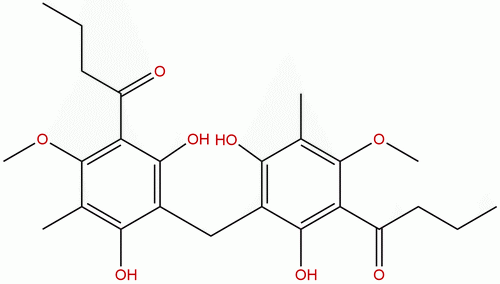
The chemical name of pseudo Mianma Su is 2-acetyl-4-butyryl-3,5-dihydroxy-4,6,6-trimethyl-2-cyclohexene-1-one, with a molecular formula of C ₂₄ H ∝₂ O ₉ and a molecular weight of 460.5230. Structurally, pseudo Mianma Su belongs to the class of triphenylphenols, with its core skeleton being a highly substituted cyclohexenone ring system, which is connected to multiple functional groups such as hydroxyl, acetyl, and butyryl groups. This unique structure endows pseudo berberine with rich chemical properties and potential biological activity.
In terms of physical and chemical properties, the lipid water partition coefficient (LogP) of pseudolanobis is 3.7918, indicating its lipophilicity, which facilitates its penetration into biofilm structures. The topological polar surface area (TPSA) is 133.5200 Å ², which is at a moderate level, indicating that the molecule may have some membrane permeability but will not easily penetrate the blood-brain barrier. In fact, the blood-brain barrier penetration ability of pseudoephedrine has been evaluated as "low", which to some extent limits its application in central nervous system diseases, but also reduces the potential risk of neurotoxicity. In terms of water solubility, the water solubility value of pseudo Mianma Su is 0.1832 mg/mL, which is a poorly soluble compound, posing challenges to its formulation development and in vivo bioavailability.
It is worth noting that the pseudo berberine molecule contains multiple phenolic hydroxyl groups, which not only give it a certain acidity, but also enable it to chelate metal ions. In addition, the β - diketone structural units in the molecule may participate in various chemical reactions, including covalent or non covalent interactions with biomolecules. These structural features lay the chemical foundation for the multi-target mode of action of pseudo berberine.
Plant sources and extraction methods
Pseudo Mianma Su mainly comes from ferns, especially the genus Dryopteris(Dryopteris)Plants. The genus Dryopteris is widely distributed worldwide, with over 200 species, many of which have a long history of application in traditional medicine. For example, the European fern fern(Dryopteris filix-mas)The root and stem of Guanzhong are used as deworming drugs in traditional European medicine, while those produced in China are commonly used(Dryopteris crassirhizoma)It is used in traditional Chinese medicine for clearing heat and detoxifying, killing insects and stopping bleeding. These traditional applications provide important clues for modern researchers to search for active ingredients.
The content of pseudo gossypol in plants is usually low, and it often coexists with other structurally similar phloroglucinol compounds, such as filicic acid and aspidinol. Therefore, efficient extraction and purification methods are crucial for obtaining sufficient amounts of pseudo berberine for research. Traditional extraction methods usually use organic solvents for extraction, such as using polar solvents such as ethanol, methanol, or acetone for cold soaking or hot reflux extraction of dried plant materials. After concentration, the extract is preliminarily separated by liquid-liquid extraction (such as petroleum ether, chloroform, ethyl acetate, etc.).
Modern separation technology has greatly improved the purification efficiency of pseudo berberine. Silica gel column chromatography is the most commonly used separation method, typically using gradient elution systems such as n-hexane ethyl acetate or chloroform methanol. For compounds with similar structures, high-performance liquid chromatography (HPLC) or preparative thin layer chromatography (PTLC) can provide higher separation efficiency. In recent years, new separation technologies such as high-speed counter current chromatography (HSCCC) and supercritical fluid chromatography (SFC) have also been applied to the separation of Mianma compounds, which have the advantages of high separation efficiency and low solvent consumption.
It is worth noting that the content of pseudolanobis in plants is influenced by various factors, including plant species, growth environment, harvest season, and storage conditions. Therefore, establishing standardized extraction processes and quality control methods is of great significance for ensuring the reproducibility of pseudo berberine research.
Pharmacological activity research
The pharmacological activity research of pseudo Mianma Su mainly focuses on the antibacterial field, which is also its most promising direction for development. In recent years, multiple studies have confirmed that pseudomycin has significant inhibitory effects on various pathogenic bacteria, including Gram positive bacteria, Gram negative bacteria, and fungi.
In terms of antibacterial activity, pseudo Mianma Su is effective against Staphylococcus aureus(Staphylococcus aureus)Methicillin resistant Staphylococcus aureus (MRSA) exhibits strong inhibitory effects, with the minimum inhibitory concentration (MIC) typically at the micromolar level. In addition, it also has good activity against Gram positive bacteria such as Staphylococcus epidermidis, Streptococcus, and Enterococcus. It is worth noting that pseudomycin has an effect on certain Gram negative bacteria such as Escherichia coli(Escherichia coli)And Pseudomonas aeruginosa(Pseudomonas aeruginosa)It also exhibits certain inhibitory activity, although its efficacy is usually lower than that against Gram positive bacteria. This broad-spectrum antibacterial activity is relatively rare in natural products and deserves further research.
In terms of antifungal activity, pseudomycin has been shown to be effective against Candida albicans(Candida albicans)And Aspergillus fumigatus(Aspergillus fumigatus)Common pathogenic fungi in clinical practice have also shown inhibitory effects. Considering the high incidence and treatment difficulty of fungal infections in immunocompromised patients, the antifungal activity of pseudomycin has added new possibilities for its clinical application.
In addition to its direct antibacterial effect, pseudo Mianma Su also exhibits certain anti-inflammatory and antioxidant activities. Research has shown that pseudomyxin can inhibit lipopolysaccharide (LPS) - induced macrophage inflammatory response and reduce the expression levels of pro-inflammatory cytokines such as TNF - α, IL-6, and IL-1 β. In addition, the phenolic hydroxyl structure in its molecule endows it with the ability to scavenge free radicals, which may play an auxiliary role in reducing oxidative stress damage caused by infection.
Mechanism of action and molecular targets
The study of the mechanism of action of pseudo Mianma Su reveals its multi-target characteristics, which are closely related to its complex chemical structure. According to existing research, pseudomycin may exert antibacterial effects by interfering with multiple key bacterial physiological processes.
Firstly, pseudo Mianma Su can inhibit the activity of bacterial DNA topoisomerase (DNA gyrase). DNA gyrase is composed of GyrA and GyrB subunits and is a key enzyme in bacterial DNA replication and transcription processes. Pseudo Mianma Su interferes with the supercoiling process of DNA by binding to the GyrA subunit, thereby inhibiting bacterial DNA replication. It is worth noting that pseudo Mianma Su exhibits a certain affinity for both GyrA and GyrB, and this dual targeting effect may help reduce the development of drug resistance.
Secondly, pseudo Mianma Su can target the bacterial cell division protein FtsZ. FtsZ is a key protein that forms the Z-ring during bacterial cell division, and its function is similar to microtubule proteins in eukaryotic cells. Pseudo Mianma Su inhibits bacterial cell division by binding to FtsZ, interfering with its polymerization and GTPase activity. This mechanism of action is different from commonly used antibiotics in clinical practice, providing new ideas for the development of novel antibacterial drugs.
In addition, pseudo Mianma Su can also inhibit the key enzyme FabI (enynyl ACP reductase) in the bacterial fatty acid synthesis pathway. Fatty acid synthesis is the basis of bacterial cell membrane biosynthesis, and inhibiting FabI can lead to damage to bacterial cell membrane integrity. At the same time, pseudoephedrine also exhibits inhibitory effects on dihydrofolate reductase (DHFR), interfering with bacterial folate metabolism pathways and subsequently affecting nucleic acid synthesis.
In terms of antifungal mechanisms, pseudolanobis can target fungal cytochrome P450 enzyme systems, particularly lanosterol 14 α - demethylase (ERG11/CYP51A1), which is a key enzyme in fungal ergosterol biosynthesis. Inhibition of ERG11 can lead to obstruction of ergosterol synthesis, disrupting the integrity and function of fungal cell membranes. In addition, pseudomycin can also affect the expression or function of fungal multidrug resistance protein CDR1, which may help overcome fungal resistance.
The effect of pseudo Mianma Su on MECA (gene encoding penicillin binding protein 2a) and PENA (gene encoding penicillin binding protein) related targets suggests that it may interfere with bacterial cell wall synthesis. This multi targeted mode of action makes pseudomycin less likely to induce bacterial resistance, which is its important advantage as an antibacterial lead compound.
Evaluation of drug properties and pharmacokinetics
The evaluation of drug properties is a crucial step in the transition of natural products from laboratory research to clinical applications. The pharmacological parameters of pseudo Mianmasu indicate its potential for development, but it also faces some challenges.
In terms of molecular weight, the molecular weight of pseudo Mianma Su is 460.5230, slightly higher than the upper limit of the "500 rule" for traditional small molecule drugs, but still within an acceptable range. The LogP value is 3.7918, which meets the lipid solubility requirements for oral medications (usually LogP between 1-5). The TPSA is 133.5200 Å ², slightly higher than the ideal range for oral medications (usually<140 Å ²), but still within an acceptable range. The water solubility (0.1832 mg/mL) is low, which may affect its oral absorption and bioavailability, and needs to be improved through formulation technology.
In terms of safety evaluation, the hERG inhibition risk of pseudomimetics is "no", indicating a lower risk of causing QT interval prolongation in the heart, which is an important safety advantage. The Ames test result is 0.6, indicating a low risk of genetic toxicity, but further in vivo mutagenicity studies are needed to confirm. The low penetration ability of the blood-brain barrier limits its application in central nervous system diseases, but also reduces potential neurotoxicity.
Pharmacokinetic research is a weak link in the development of pseudoephedrine. At present, there is insufficient research on the absorption, distribution, metabolism, and excretion (ADME) process of pseudoephedrine in the body. Preliminary studies suggest that the stability of pseudoephedrine in the gastrointestinal tract may be affected by pH and enzymatic hydrolysis, and its oral bioavailability may be low. Intravenous administration may be a more effective route of administration, but suitable formulation forms need to be developed. In terms of metabolism, pseudoephedrine may be mainly metabolized through the liver cytochrome P450 enzyme system, and its metabolites may have different biological activities and toxicity.
In order to improve the pharmacological properties of pseudo Mianmasu, researchers are exploring various strategies, including prodrug design, nano formulations, liposome encapsulation, etc. For example, combining pseudo berberine with amino acids or sugar groups can improve its water solubility and bioavailability; The use of nanocarrier technology can improve its targeting and sustained-release properties. These studies will lay the foundation for the clinical translation of pseudoephedrine.
Clinical application prospects and prospects
Pseudo Mianma Su, as a natural product with multi-target antibacterial activity, has shown broad prospects in clinical applications, but also faces many challenges.
In the field of antibacterial therapy, the most direct application prospect of pseudomycin is for the treatment of drug-resistant bacterial infections. Especially for clinically challenging pathogens such as MRSA, vancomycin resistant Enterococcus (VRE), and multidrug-resistant Mycobacterium tuberculosis, pseudomycin may provide a new treatment option. Its multi-target mode of action reduces the risk of drug resistance, which is an advantage that traditional single target antibiotics do not possess. In addition, the combined use of pseudo Mianma Su and existing antibiotics may produce synergistic effects, improve treatment efficacy, and reduce drug dosage.
In terms of antifungal therapy, the activity of pseudomycin against Candida albicans and Aspergillus, especially its effect on drug-resistant fungal strains, makes it a candidate molecule for the development of new antifungal drugs. Considering the high mortality rate of invasive fungal infections in immunosuppressed patients, this direction has important clinical value.
However, there are still many challenges in the development of pseudoephedrine from laboratory research to clinical application. Firstly, the issues of poor water solubility and low oral bioavailability need to be addressed through formulation technology. Secondly, the metabolic stability and toxicity characteristics of pseudoephedrine in vivo need to be systematically evaluated. In addition, the optimization of large-scale production and purification processes is also a necessary condition for achieving clinical translation.
Future research directions should include: 1) in-depth elucidation of the mechanism of action of pseudoephedrine, particularly its interaction patterns with multiple targets; 2) Optimize its pharmacological activity and pharmacokinetic properties through structural modification and structure-activity relationship studies; 3) Develop efficient synthetic or semi synthetic methods to solve the problem of limited natural source yields; 4) Conduct systematic in vivo pharmacological and toxicological studies to evaluate their clinical application potential; 5) Explore the synergistic effects of pseudoephedrine and other drugs, and develop combination therapy plans.
Conclusion
As a natural product of phloroglucinol isolated from ferns, pseudo berberine provides valuable lead compounds for the development of new antibacterial drugs due to its unique chemical structure and multi-target antibacterial activity. From chemical structure to pharmacological activity, from mechanism of action to evaluation of drug properties, significant progress has been made in the research of pseudoephedrine, but there is still a considerable distance to clinical application.
Against the backdrop of the increasingly severe global antibiotic resistance crisis, the multi-target mode of action represented by pseudomycin provides new ideas for the development of antibacterial drugs. It can not only inhibit multiple key physiological processes such as bacterial DNA replication, cell division, and fatty acid synthesis, but also overcome the resistance mechanism of fungi. This "multi pronged" strategy is expected to delay the development of drug resistance.
However, we must also be aware that the development of natural product drugs is a long and challenging process. The issues of water solubility, bioavailability, and in vivo metabolic stability of pseudoephedrine need to be addressed through innovation in medicinal chemistry and formulation. Meanwhile, a systematic evaluation of its toxicological characteristics and pharmacokinetic behavior is also a necessary condition for promoting its clinical translation.
Looking ahead to the future, with advances in structural biology, computational chemistry, and drug design technologies, we have reason to believe that pseudoephedrine, an ancient natural product, will bring new vitality to modern drug development. Through interdisciplinary collaborative research, pseudoephedrine and its derivatives are expected to become a new weapon against drug-resistant bacterial infections and contribute to human health.