


Product name: Eupatilin
Synonym name:
Catalogue No.: BP0576
Cas No.: 22368-21-4
Formula: C18H16O7
Mol Weight: 344.319
Botanical Source: Eupatorium semiserratum, Tanacetum vulgare (tansy) and Liatris punctata
Physical Description: Yellow powder
Type of Compound: Flavonoids
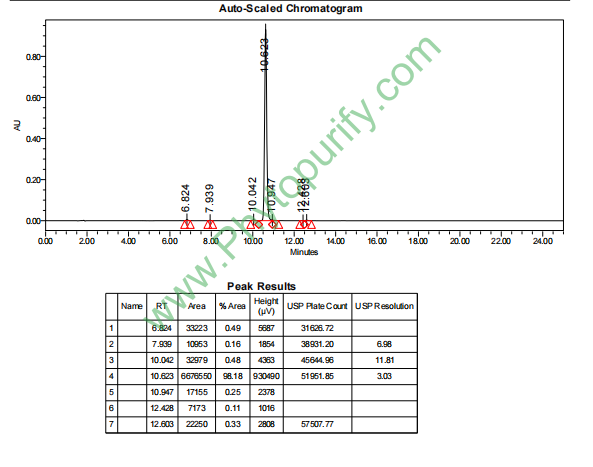
Purity: 95%~99%
Analysis Method: HPLC-DAD or/and HPLC-ELSD
Identification Method: Mass, NMR
Packing: Brown vial or HDPE plastic bottle
Storage: Store in a well closed container, protected from air and light. Put into refrigerate or freeze for long term storage.
Whenever possible, you should prepare and use solutions on the same day. However, if you need to make up stock solutions in advance, we recommend that you store the solution as aliquots in tightly sealed vials at -20℃. Generally, these will be useable for up to two weeks.
The product could be supplied from milligrams to grams, up to kilograms
Inquire for bulk scale.
Descriptions:
Eupatilinthe has anti-proliferative effect in MCF10A- ras cells, is associated with its blockade of cell cycle progression which appears to be attributable in part to inhibition of ERK1/2 activation.[1]
Eupatilin attenuates bile acid-induced hepatocyte apoptosis by suppressing bile acid-induced kinase activation, it might be therapeutically efficacious in a variety of human liver diseases associated with cholestasis.[2]
Eupatilin and jaceosidin have effects on cytochrome p450 enzyme activities in human liver microsomes, have potential pharmacokinetic drug interactions in vivo due to inhibition of CYP1A2 and CYP2C9.[3]
Eupatilin is a potent anti-atherogenic agent that inhibits PDGF-BB-induced proliferation and migration in HASMCs as well as aortic sprouting, which is likely mediated through the attenuation of PI3K, MKK3/6, and MKK4 activation.[4]
Eupatilin suppresses oxidative damage and reciprocally enhances extracellular matrix production in articular chondrocytes, making eupatilin a promising therapeutic option for the treatment.[5]
Eupatilin improves the acute hepatic IRI by reducing inflammation and apoptosis, it is a promising therapeutic agent against acute IR-induced hepatic damage.[6]
Eupatilin protects against tumor necrosis factor-α-mediated inflammation inhuman umbilical vein endothelial cells.[7]
Eupatilin induces Sestrin2-dependent autophagy to prevent oxidative stress.[8]
References:
[1] Kim D H, Na H K, Oh T Y, et al. Biochem Pharmacol, 2004, 68(6):1081-7.
[2] Su C P, Yoon J H, Kim W, et al. J Gastroenterol, 2006, 41(8):772-8.
[3] Ji H Y, Kim S Y, Kim D K, et al. Molecules, 2010, 15(9):6466-75.
[4] Son J E, Lee E, Seo S G, et al. Planta Med, 2013, 79(12):1009-16.
[5] Jeong J H, Moon S J, Jhun J Y, et al. Plos One, 2015, 10(6):e0130882.
[6] Lee H M, Jang H J, Kim S S, et al. Transpl P, 2016, 48(4):1226-33.
[7] Yu K, Li X M, Xu X L, et al. Int J Clin Exp Med, 2016, 8(12):22191-7.
[8] Jegal K H, Ko H L, Sang M P, et al. Apoptosis, 2016, 21(5):1-15.
[9] Zhou Q, Sun L L, Jiang B, et al. China Pharm, 2013, 24(47):4464-6.
HPLC of Eupatilin
Storage conditions:Short-term storage at 2~8℃, long-term storage at -20 ~ -80℃
98.3600
2.5236
2.2528
.0085
3.8923
21.3195
Low
92.0508
2.3515
Yes
No
Yes
No
Yes
No
0.6
No
No
Yes
No
Natural products have always been an important treasure trove for innovative drug discovery, among which flavonoids have attracted much attention due to their broad biological activity and low toxicity. Eupatilin, also known as 5,7-dihydroxy-3 ', 4', 6-trimethoxyflavone, is a lipophilic flavonoid with a unique trimethoxy substitution pattern. Its CAS number is 22368-21-4, mainly isolated from Artemisia argyi, a plant in the Asteraceae family, as well as various plants in the Citrus and Salvia genera. Since its discovery, isoflavones have gradually become a hot molecule in natural product pharmacology research due to their significant multiple pharmacological activities such as anti-inflammatory, antioxidant, anti ulcer, and anti-tumor.
Traditionally, Artemisia argyi has been commonly used in East Asian traditional medicine to treat inflammation, bleeding, and abdominal pain, and some of its medicinal effects are believed to be closely related to active ingredients such as isoflavones. Modern pharmacological research has confirmed that isoquercetin is not only an agonist of peroxisome proliferator activated receptor alpha (PPAR alpha), but also exerts a wide range of cellular protective and anti disease effects by regulating multiple key signaling pathways and molecular targets. Especially in the field of cancer, its multi-target mechanism of action shows promising therapeutic potential. This article aims to systematically review the chemical properties, plant sources, pharmacological activities, molecular mechanisms of action, pharmacological evaluation, and clinical application prospects of isoquercetin, in order to provide comprehensive scientific references for the in-depth research and future drug development of this compound.
Isocyanin belongs to the flavonoid class, and its basic parent nucleus is 2-phenylchromenone. The specific chemical structural feature is that the C-5 and C-7 positions of the flavonoid skeleton are replaced by hydroxyl groups (- OH), while the C-6, C-3 ', and C-4' positions are respectively replaced by methoxy groups (- OCH3), forming a 5,7-dihydroxy-3 ', 4', 6-trimethoxyflavonoid structure. This specific substitution pattern has a decisive impact on its physicochemical properties and biological activity.
From the analysis of physical and chemical properties, the molecular weight of isoquercetin is 344.3190 g/mol. Its lipophilicity is strong, and the calculated lipid water partition coefficient (LogP) is 2.5236, indicating that the compound is more soluble in organic solvents and belongs to lipophilic molecules. This characteristic is consistent with its form of existence in plants (often related to lipids) and its transmembrane transport capacity. Its topological polar surface area (TPSA) is 98.36 Å ², which is relatively moderate. The water solubility is poor, about 0.0085 mg/mL, which to some extent limits its direct application in aqueous systems, but also suggests that it may have good membrane permeability.
From the spectroscopic characteristics, isoquercetin exhibits typical flavonoid absorption peaks in the UV visible region. The crystal structure analysis shows that there are intramolecular hydrogen bonds (such as between C5-OH and C4 carbonyl groups) within the molecule, which helps to stabilize the molecular conformation. These clear chemical structural information provide a solid foundation for studying structure-activity relationships, structural modifications, and quality control.
Isocyanin is relatively widely distributed in nature, but mainly enriched in a few types of plants.
1. Main plant sources:
* Asteraceae plants:Artemisia argyi It is the most important and famous source. Artemisia argyi has a long history of medicinal use in Chinese folk culture, and isoflavones are considered one of its key active ingredients.
* Rutaceae plants: Multiple types Citrus spp Isocyanin is also present in the skin or leaves of the plant.
* Lamiaceae plants As follows:Salvia pubescens Waiting for plants of the Salvia genus.
*In addition, it has also been detected in some other plants of the Artemisia genus in the Asteraceae family.
In recent years, some green extraction technologies such as supercritical CO2 extraction have also been explored, aiming to improve efficiency and reduce the use of organic solvents.
A large number of in vitro and in vivo studies have confirmed that isoflavones have diverse and significant pharmacological activities.
Anti inflammatory and antioxidant activity:
This is the core activity of isoquercetin that was first recognized. In various acute and chronic inflammation models (such as lipopolysaccharide induced macrophage inflammation, mouse ear swelling model, colitis model), isoflavones can effectively inhibit the production of pro-inflammatory mediators (such as tumor necrosis factor - α, interleukin-6, nitric oxide, prostaglandin E2). Its antioxidant effect is manifested by its strong free radical scavenging ability, which can enhance the activity of endogenous antioxidant enzymes such as superoxide dismutase and glutathione peroxidase, and reduce the levels of oxidative stress markers such as malondialdehyde. These functions are the basis for its application in fields such as gastric mucosal protection (anti ulcer) and neuroprotection.
Anti ulcer and gastrointestinal protective effects:
Isocyanine is a Korean marketed gastric medicine called Stillen ®” The main active ingredient is used to treat gastritis and gastric ulcers. Its function not only stems from anti-inflammatory and antioxidant effects, but also from increasing gastric mucosal blood flow, promoting mucus secretion, inhibiting gastric acid secretion, and regulating the balance of mucosal cell apoptosis and proliferation, thereby protecting the gastric mucosa from damage caused by ethanol, stress, or nonsteroidal anti-inflammatory drugs through multiple pathways.
Antitumor activity:
This is currently the most active field of research. Isoeupatorium flavin has growth inhibition and apoptosis induction effects on a variety of human cancer cell lines, including gastric cancer, liver cancer, colorectal cancer, breast cancer, lung cancer, prostate cancer, ovarian cancer, etc. Its anti-tumor effect is multifaceted:
Other pharmacological activities:
The pharmacological effects of isoflavones, especially their anti-tumor activity, are achieved by regulating a complex molecular network involving multiple key signaling pathways and specific targets.
Regulation of core signaling pathways:
Key molecular targets:
In summary, isoflavones exert their effects through a "multi-target, multi pathway" approach, which is not only the advantage of their therapeutic potential, but also brings complexity to their mechanism research. The core of its functional network is to synergistically induce apoptosis, inhibit proliferation, and block invasion and metastasis.
Although isoflavones have significant biological activity, their development as drug candidate molecules requires systematic pharmacological evaluation.
Analysis of drug properties parameters:
Pharmacokinetic study:
Animal and partial human studies have revealed the pharmacokinetic characteristics of isoflavones:
Formulation strategy:
To improve its bioavailability, researchers are exploring various advanced drug delivery systems, such as:
Isocyanin has evolved from a traditional medicinal plant to modern clinical practice, demonstrating multiple potential applications, but also facing challenges.
Current and potential clinical applications:
challenges faced:
Future research directions and prospects:
Isocyanin, as a natural flavonoid compound derived from traditional medicinal plants, has shown great potential in anti-inflammatory, antioxidant, anti ulcer, and especially anti-tumor fields due to its unique chemical structure and multi-target, multi pathway pharmacological mechanisms. From Artemisia argyi leaves to the laboratory, from studying its mechanism of action to exploring its medicinal properties, our understanding of isoflavones is constantly deepening. Although it still faces challenges in terms of bioavailability and clinical translation, these challenges are gradually being overcome through the cross fusion of modern medicinal chemistry, pharmacy, and pharmacology methods. In the future, with deeper mechanism research, more optimized formulation development, and more rigorous clinical validation, isoflavones and their derivatives are expected to develop from potential lead compounds into innovative drugs for treating gastrointestinal diseases, tumors, and other inflammation related diseases, fully demonstrating the sustained value of natural products in modern medicine. Its research process has also provided valuable paradigms for the development of other natural active ingredients.
