


Product name: Atractyloside potassium salt
Synonym name:
Catalogue No.: BP0219
Cas No.: 102130-43-8
Formula: C30H44K2O16S2
Mol Weight: 802.983
Botanical Source: Siberian Cocklour Fruit
Physical Description:
Type of Compound: Diterpenoids
Purity: 95%~99%
Analysis Method: HPLC-DAD or/and HPLC-ELSD
Identification Method: Mass, NMR
Packing: Brown vial or HDPE plastic bottle
Storage: Store in a well closed container, protected from air and light. Put into refrigerate or freeze for long term storage.
Whenever possible, you should prepare and use solutions on the same day. However, if you need to make up stock solutions in advance, we recommend that you store the solution as aliquots in tightly sealed vials at -20℃. Generally, these will be useable for up to two weeks.
The product could be supplied from milligrams to grams
Inquire for bulk scale.
Chengdu Biopurify Phytochemicals Ltd. is a leading company in the research, development, manufacture and marketing of High Quality Phytochemicals and Extracts(especially Active Ingredients from Traditional Chinese Medicine,TCM), Natural Active Pharmaceutical Ingredients worldwide.
The main services:
A. Supply active ingredients and reference standards of TCM, from mgs to kgs scale
B. Custom extraction and purification, target Herb Active Ingredients
C. Custom synthesis and semi-synthesis for Natural Active Ingredients
D. CR(contract research), CM(contract manufacture) and PD(process development) services from lab scale, pilot scale to commercial scale(GMP is also available)
E. TCM compounds library for drug screen,more than 3000 compounds available, many of them are rare and unique.
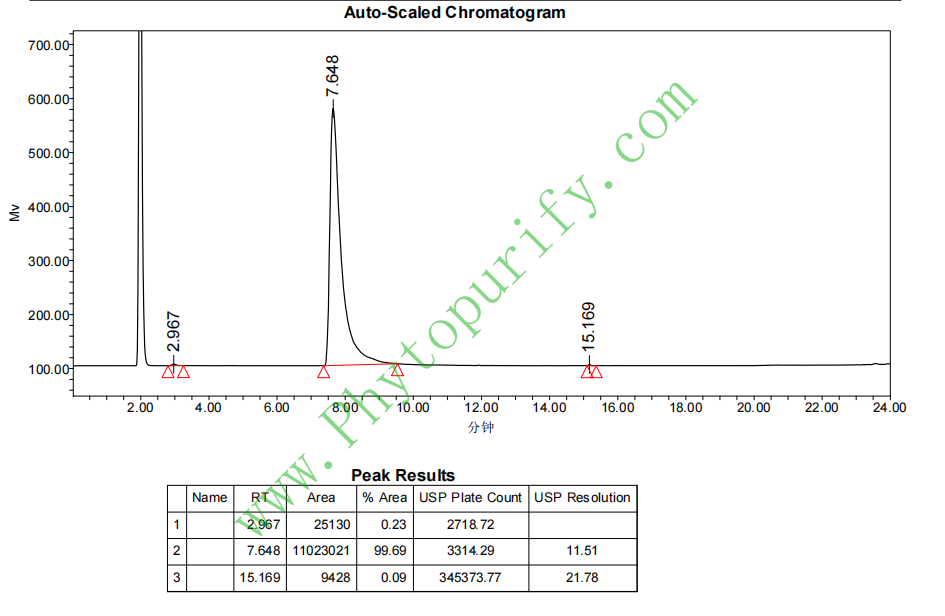
HPLC of Atractyloside potassium salt
Storage conditions:Short-term storage at 2~8℃, long-term storage at -20 ~ -80℃
Atractyloside potassium salt (CAS number 102130-43-8), as a bioactive compound derived from natural products, has attracted widespread attention in the field of pharmacology research in recent years. Its main mechanism of action is to efficiently and specifically inhibit mitochondrial ADP/ATP transporter (ANT), thereby affecting cellular energy metabolism and apoptosis signaling pathways. The potassium salt of Atractylodes macrocephala not only serves as a molecular tool for regulating mitochondrial function in basic biological research, but also exhibits various potential pharmacological activities, including autophagy activation, tumor inhibition, and intervention in metabolic diseases. This article aims to systematically review the chemical structure, sources, pharmacological activity, mechanism of action, and pharmacological evaluation of potassium salt of Atractylodes macrocephala, explore its potential and challenges in clinical applications, and provide theoretical basis and reference direction for subsequent research.
The molecular formula of potassium salt of Atractylodes macrocephala is C35H58K2O16, with a molecular weight of 795.0300, belonging to the natural glycoside compounds with high molecular weight. The core of its structure is atractyloside, which forms a potassium salt through potassium ion coordination, enhancing its water solubility and stability. In terms of physical and chemical properties, the potassium salt of Atractylodes macrocephala exhibits low lipophilicity (LogP about -3.0), indicating strong hydrophilicity, a polar surface area (TPSA) of up to 300, and contains 16 hydrogen bond receptors, which limit its ability to cross the blood-brain barrier (BBB negative). In addition, potassium salt of Atractylodes macrocephala did not exhibit significant hepatotoxicity, cardiotoxicity, or hERG channel inhibition, indicating that its safety is somewhat controllable.
Structurally, the potassium salt of Atractylodes macrocephala contains multiple hydroxyl groups and glycosidic bonds, endowing it with strong water solubility and binding potential with protein targets. Its ability to specifically inhibit mitochondrial ADP/ATP transporters is closely related to the precise matching of the glycosidic portion in its molecule with the protein binding site.
The potassium salt of Atractylodes lancea mainly comes from the Asteraceae plant Atractylodes lancea and its related species. Atractylodes lancea is a traditional Chinese medicinal herb widely distributed in East Asia, including China, Japan, and South Korea. The rhizome of Atractylodes macrocephala contains abundant polysaccharides, volatile oils, and various glycosides, among which Atractylodes macrocephala glycosides are one of its important active ingredients.
The extraction method usually uses water extraction combined with alcohol precipitation or column chromatography purification technology. The specific steps include: crushing the dried rhizomes of Atractylodes macrocephala, extracting them by reflux with water or 70% ethanol, concentrating them, separating and purifying them by ion exchange resin or silica gel column chromatography, and finally obtaining high-purity potassium salt of Atractylodes macrocephala glycoside. Modern extraction processes are gradually introducing ultrasound assisted extraction and high-performance liquid chromatography (HPLC) purification techniques to improve yield and purity.
The pharmacological activity of potassium salt of Atractylodes macrocephala mainly revolves around its regulation of mitochondrial function. As an efficient and specific mitochondrial ADP/ATP transport inhibitor, potassium salt of Atractylodes macrocephala can block the exchange of ADP and ATP on the mitochondrial membrane, directly affecting cellular energy metabolism and regulating cell apoptosis, autophagy, and metabolic homeostasis.
Potassium salt of Atractylodes macrocephala has shown significant anti-tumor activity in non-small cell lung cancer (NSCLC) models. Research has shown that it induces energy crisis in tumor cells by inhibiting mitochondrial ADP/ATP transport, activating the AMPK signaling pathway, inhibiting mTOR activity, promoting autophagy and apoptosis, thereby inhibiting tumor cell proliferation. In addition, potassium salt of Atractylodes macrocephala has a regulatory effect on mitochondrial membrane potential and ROS levels in tumor cells, further enhancing its anti-cancer effect.
Potassium salt of Atractylodes macrocephala can inhibit hepatic steatosis and improve lipid metabolism disorders. It activates the AMPK pathway, inhibits the expression of fat synthesis related enzymes, promotes fatty acid oxidation, and reduces liver fat deposition. In addition, Atractyloside potassium salt shows potential in the regulation of glucose metabolism by regulating a variety of hyperglycemia related targets (such as AMPK, SGLT2, GCK, etc.), providing new ideas for the treatment of metabolic syndrome and diabetes.
The potassium salt of Atractylodes macrocephala can effectively activate cellular autophagy, and the mechanism involves inhibiting the mTOR signaling pathway and promoting p-AMPK activation. Autophagy, as an important homeostatic regulatory mechanism within cells, helps to clear damaged mitochondria and protein aggregates, maintaining cellular functional stability. Potassium salt of Atractylodes macrocephala glycoside exhibits potential cellular protective effects by regulating autophagy pathways, particularly in the inhibition of chloride ion channels in cardiac mitochondrial membranes.
Although potassium salt of Atractylodes macrocephala has multiple pharmacological activities, its nephrotoxicity cannot be ignored. Research suggests that potassium salt of Atractylodes macrocephala may induce damage to renal tubular cells through mitochondrial dysfunction, limiting its safe window for clinical application. Therefore, in-depth analysis of its toxicity mechanism and search for effective detoxification strategies are important directions for future research.
The core mechanism of action of potassium salt of Atractylodes macrocephala is the specific inhibition of mitochondrial ADP/ATP transporter (ANT). ANT, as a key transport protein on the inner membrane of mitochondria, is responsible for transporting ADP from the cytoplasm into the mitochondrial matrix, while also transporting ATP produced by mitochondria to the cytoplasm, maintaining cellular energy balance. The potassium salt of Atractylodes macrocephala binds to ANT, blocking ADP/ATP exchange and causing mitochondrial energy metabolism disorders, inducing cellular energy depletion and apoptosis signals.
In addition, potassium salt of Atractylodes macrocephala inhibits the expression of ANT2 subtype and regulates cellular metabolic status. ANT2 is highly expressed in various tumor cells and participates in regulating cell proliferation and metabolic reprogramming. Inhibiting ANT2 helps to suppress tumor growth.
In addition to mitochondrial function regulation, potassium salt of Atractylodes macrocephala activates the AMPK (5 'AMP activated protein kinase) signaling pathway, which acts as a cellular energy sensor to regulate metabolic balance and autophagy processes. Potassium salt of Atractylodes macrocephala promotes the phosphorylation activation of AMPK (p-AMPK), inhibits the mTOR (mammalian target protein of rapamycin) signaling pathway, thereby initiating autophagy, promoting cell self repair and metabolic regulation.
The inhibitory effect of potassium salt of Atractylodes macrocephala on chloride ion channels in rat heart mitochondrial membrane suggests that it may stabilize mitochondrial membrane potential by regulating ion channels, affecting cell apoptosis and oxidative stress response.
In terms of targets related to hyperglycemia, potassium salt of Atractylodes macrocephala has potential regulatory relationships with various proteins such as EHMT2, UBP2, PAI1, SGLT2, GCK, APP, BACE1, CES1, PTPN1, etc., indicating that it may regulate glucose metabolism, inflammatory response, and cellular metabolic stability through multi-target synergistic effects.
The medicinal properties of potassium salt of Atractylodes macrocephala are significantly influenced by its physicochemical properties. Its high polarity and high molecular weight limit its oral bioavailability and tissue penetration, especially its inability to pass through the blood-brain barrier, which limits its potential application in central nervous system diseases. However, the potassium salt of Atractylodes macrocephala does not exhibit hepatotoxicity, cardiotoxicity, or hERG channel inhibition, demonstrating a good safety profile.
In terms of pharmacokinetics, the potassium salt of Atractylodes macrocephala has good water solubility and is easily distributed in hydrophilic tissues such as blood and kidneys in vivo, but its metabolic pathway has not been fully elucidated. Given its nephrotoxicity, future research should focus on its renal metabolism and excretion mechanisms, and optimize the dosing regimen to reduce low toxicity and side effects.
Through structural modification and drug carrier technologies such as nanoparticle encapsulation and liposome delivery, it is expected to improve the pharmacokinetic properties of potassium salt of Atractylodes macrocephala, enhance its in vivo stability and targeting, and increase its clinical application potential.
The potassium salt of Atractylodes macrocephala, as a mitochondrial functional regulator, has shown broad application prospects in the fields of tumor treatment, metabolic diseases, and cardiovascular diseases. The potential of its anti non-small cell lung cancer provides a new approach for targeted therapy of tumor metabolism, especially in combination with traditional chemotherapy or targeted drug therapy, which may exert synergistic effects.
In terms of metabolic diseases, atractyloside potassium salt has the ability to regulate glucose and lipid metabolism by activating AMPK and inhibiting steatosis, and is expected to become a new drug candidate for the treatment of nonalcoholic fatty liver disease (NAFLD), diabetes and related metabolic syndrome.
However, the nephrotoxicity and pharmacological properties of potassium salt of Atractylodes macrocephala limit its direct clinical application. Future research needs to focus on reducing toxicity, optimizing administration methods, and structural modifications to enhance safety and efficacy. At the same time, in-depth analysis of its multi-target mechanism of action will help to accurately design combination therapy strategies.
In addition, the instrumental value of potassium salt of Atractylodes macrocephala in autophagy regulation and mitochondrial function research cannot be ignored, which can help promote basic research and new drug development of mitochondrial related diseases.
As a naturally derived mitochondrial ADP/ATP transport inhibitor, potassium salt of Atractylodes macrocephala has shown significant research and application value in the fields of anti-tumor, metabolic disease, and autophagy regulation due to its unique mechanism of action and diverse pharmacological activities. Despite the challenges of nephrotoxicity and drug formation, with the development of extraction and purification techniques, structural optimization, and drug delivery systems, potassium salt of Atractylodes macrocephala is expected to become an important candidate for future novel therapeutic drugs. Future research should focus on in-depth analysis of its mechanism of action, safety assessment, and clinical translation, promoting its widespread application in natural product pharmacology and modern medicine.
