Introduction/Overview
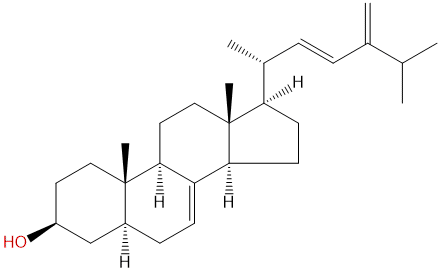
Ergosta-7,22,24 (28) - terin-3 β - ol (hereinafter referred to as "ergosterol") is an important natural sterol compound widely present in various fungi and plants. In recent years, with the deepening of pharmacological research on natural products, ergotrinol has gradually become a research hotspot due to its unique chemical structure and diverse biological activities, especially its potential in the field of anti-tumor. As one of the malignant tumors with high incidence rate and mortality in the world, colon cancer treatment still faces many challenges. Ergotrinol exhibits significant inhibitory effects on colon cancer cells by regulating multiple key molecular targets, demonstrating promising pharmacological prospects.
This article will systematically review the chemical structure and physicochemical properties, plant sources and extraction methods, pharmacological activity and mechanism of action of ergotrinol, with a focus on exploring its molecular targets and drug evaluation in the treatment of colon cancer, and looking forward to its clinical application potential, providing theoretical basis and reference for subsequent research and development.
Chemical structure and physicochemical properties
The chemical name of ergotrinol is Ergosta-7,22,24 (28) - terin-3 β - ol, with a molecular formula of C28H44O and a molecular weight of 396.6590. Its structural core is the steroid skeleton, containing three double bonds (located at positions 7, 22, and 24 (28)), and the hydroxyl group at position 3 is in the β - configuration, giving the molecule strong stereoselectivity. The LogP value of this compound is as high as 7.5844, indicating its high hydrophobicity, and the extremely low polar surface area (TPSA=20.23 Å ²) further confirms its lipid solubility characteristics.
In terms of physicochemical properties, ergotrinol has extremely low water solubility (0.0002 mg/mL) and is difficult to dissolve in aqueous media, indicating the need for appropriate solvents or carrier systems in pharmaceutical formulations to improve its bioavailability. Its high lipid solubility endows it with excellent cell membrane penetration ability, and it is predicted to effectively cross the blood-brain barrier, with potential central nervous system activity. It is worth noting that the compound does not exhibit hERG channel inhibitory activity, indicating a low risk of cardiac toxicity; At the same time, the Ames test result was 0, indicating no significant genotoxicity.
Plant sources and extraction methods
Ergotrinol mainly comes from fungal organisms, especially Claviceps spp. and certain wood decaying fungi. In addition, some sterols in higher plants also contain this compound or its homologs. It has a wide natural distribution and relatively abundant content, laying the foundation for its industrial extraction and medicinal development.
Traditional extraction methods often use solvent extraction combined with chromatographic separation technology. Common solvents include organic solvents such as ethanol, methanol, and ethyl acetate to improve extraction efficiency and purity. In recent years, emerging technologies such as ultrasound assisted extraction, microwave-assisted extraction, and supercritical CO2 extraction have been applied to the extraction of ergotrinol, significantly improving yield and purity while reducing solvent usage and extraction time.
During the purification process, silica gel column chromatography, reverse phase high performance liquid chromatography (RP-HPLC), and preparative liquid chromatography are mainstream methods that can effectively separate and obtain high-purity ergotrinol. The identification techniques mainly use mass spectrometry (MS), nuclear magnetic resonance (NMR), and infrared spectroscopy (IR) to ensure the accuracy of the structure.
Pharmacological activity research
Ergotrinol has shown significant pharmacological potential in various biological activities, especially in breakthroughs in anti-tumor, anti-inflammatory, and neuroprotective research.
Antitumor activity
Numerous in vitro cell experiments and animal model studies have shown that ergotrinol has a significant inhibitory effect on colon cancer cells. It significantly reduces tumor growth rate by inducing cell apoptosis, blocking cell cycle, inhibiting tumor cell proliferation and migration. Related studies have shown that ergotrinol can regulate multiple signaling pathways, inhibit oncogenes in the tumor microenvironment, enhance the sensitivity of chemotherapy drugs, and reduce drug resistance.
anti-inflammatory effect
Ergotrinol has potential anti-inflammatory effects by downregulating pro-inflammatory cytokine TNF - α and regulating the activity of lipoxygenase ALOX5, thereby reducing inflammatory responses. Its application value in chronic inflammation related diseases is gradually being recognized, especially in the regulation of the inflammatory microenvironment in colon cancer.
Neuroprotection and other activities
Given its high blood-brain barrier penetration, ergotrinol exhibits neuroprotective effects in neurodegenerative disease models, possibly by modulating the AMPK and GSK3 β signaling pathways to alleviate neuronal damage. In addition, its impact on immune regulation and metabolic balance also provides new ideas for pharmacological research in multiple fields.
Mechanism of action and molecular targets
The anti colon cancer mechanism of ergotrinol is complex, involving the regulation of multiple molecular targets and signaling pathways. The main targets include:
-
AMPK (PRKAA1)As a key regulatory factor of cellular energy metabolism, AMPK activation promotes cellular metabolic homeostasis and inhibits tumor cell proliferation. Ergotrinol can activate AMPK, induce energy stress, and promote cancer cell apoptosis.
-
BCL2 (BCL2)The anti apoptotic protein BCL2 plays an important role in the survival of tumor cells. Ergotrinol promotes mitochondrial mediated apoptosis by downregulating BCL2 expression.
-
STAT3 (STAT3)The STAT3 signaling pathway plays a central role in tumor cell proliferation, immune escape, and drug resistance. Ergotrinol inhibits the phosphorylation of STAT3, blocks its transcriptional activity, and suppresses tumor growth.
-
ABCB1 (ABCB1)As a multidrug resistance protein, ABCB1 mediates drug efflux, leading to chemotherapy resistance. Ergotrinol can inhibit ABCB1 function, reverse drug resistance, and improve chemotherapy efficacy.
-
ALOX5 (ALOX5)Lipoxygenase 5 participates in the generation of inflammatory mediators and promotes the inflammatory state of the tumor microenvironment. Ergotrinol inhibits ALOX5 activity, reduces inflammation, and suppresses tumor progression.
-
LCK (LCK)LCK is a key enzyme in T cell receptor signaling transduction, involved in immune regulation. Ergotrinol enhances anti-tumor immune response by regulating LCK activity.
-
TOP1 (TOP1)Topoisomerase I is involved in DNA replication and transcription, and inhibiting TOP1 activity can block tumor cell proliferation. Ergotrinol has a certain inhibitory effect on TOP1.
-
MAPK1 (MAPK1)The MAPK signaling pathway regulates cell proliferation and apoptosis. Ergotrinol affects the fate of tumor cells by regulating MAPK1 activity.
-
TNF (TNF)Tumor necrosis factor is involved in inflammation and cell apoptosis. Ergotrinol regulates TNF expression and regulates the tumor microenvironment.
-
GSK3B (GSK3B)Glycogen synthase kinase 3 β regulates cell cycle and apoptosis. Ergotrinol promotes tumor cell apoptosis by regulating GSK3B.
In summary, ergotrinol exhibits strong potential in combating colon cancer through multi-target and multi pathway synergistic effects, providing a theoretical basis for its development as a novel anti-tumor drug.
Evaluation of drug properties and pharmacokinetics
The pharmacological evaluation of ergotrinol shows that it has certain advantages and challenges. High lipid solubility (LogP=7.58) makes it easy to penetrate cell membranes and the blood-brain barrier, with good tissue distribution potential, but it also brings poor water solubility, limiting its oral bioavailability. Low TPSA values are beneficial for the binding of intracellular targets.
In toxicology assessment, ergotrinol does not inhibit hERG channels, reducing the risk of cardiac toxicity, and the Ames test is negative, indicating no significant genetic toxicity and high safety. The high permeability of the blood-brain barrier suggests its potential application in central nervous system diseases.
In terms of pharmacokinetics, although there is limited specific in vivo kinetic data, its high lipid solubility may lead to significant first pass effects in the liver, and drug formulation optimization (such as nanocarriers, liposome encapsulation, etc.) is needed to improve in vivo stability and bioavailability. In addition, the metabolic pathway may involve the liver cytochrome P450 enzyme system, and further research is needed on its metabolites and drug interactions.
Clinical application prospects and prospects
As a natural sterol compound with multi-target effects, ergotrinol has shown broad application prospects in the field of colon cancer treatment. It inhibits tumor progression by regulating tumor cell metabolism, apoptosis, and immune microenvironment, and has good safety, providing a solid foundation for the development of new anti-tumor drugs.
Future research should focus on the following aspects:
-
Optimization of drug formulations To address the issue of poor water solubility, new drug delivery systems such as nanocarriers, liposomes, and solid dispersions have been developed to improve their in vivo stability and bioavailability.
-
In depth mechanism research Systematically analyze its functional network through multiple omics technologies (genomics, proteomics, metabolomics) to reveal more potential targets and signaling pathways.
-
Pharmacokinetic and Toxicological Studies Improve pharmacokinetic data in vivo, evaluate long-term safety and potential toxicity, and guide clinical dose design.
-
Preclinical and clinical trials Conduct animal model validation and early clinical trials to evaluate its efficacy and safety, and promote its clinical translation.
-
Combination therapy strategy Exploring the combined use of existing chemotherapy drugs and immune checkpoint inhibitors to overcome drug resistance and improve treatment efficacy.
In addition, given its blood-brain barrier penetration ability, the potential application of ergotrinol in neurological diseases also deserves further exploration.
Conclusion
As a natural sterol compound, 7,22,24 (28) - ergotrine-3 β - ol exhibits significant pharmacological activity and good safety in the treatment of colon cancer and related diseases due to its unique chemical structure and multi-target regulatory ability. Although there are certain challenges in terms of poor water solubility and drug efficacy, it is expected to overcome these bottlenecks and promote its clinical application through modern pharmaceutical formulation technology and in-depth mechanism research.
In the future, with the development of natural product pharmacology and molecular targeted therapy, ergotrinol is expected to become an emerging candidate drug for the treatment of colon cancer and other complex diseases, bringing new treatment options and hope to patients. Continuous basic and clinical research will provide solid support for its development, promoting innovative applications of natural products in modern medicine.