


Product name: Dephnoretin
Synonym name: Thymelol
Catalogue No.: BP0484
Cas No.: 2034-69-7
Formula: C19H12O7
Mol Weight: 352.298
Botanical Source: Wikstroemia indica (Linn.) C. A. Mey
Physical Description:
Type of Compound: Coumarins
Purity: 95%~99%
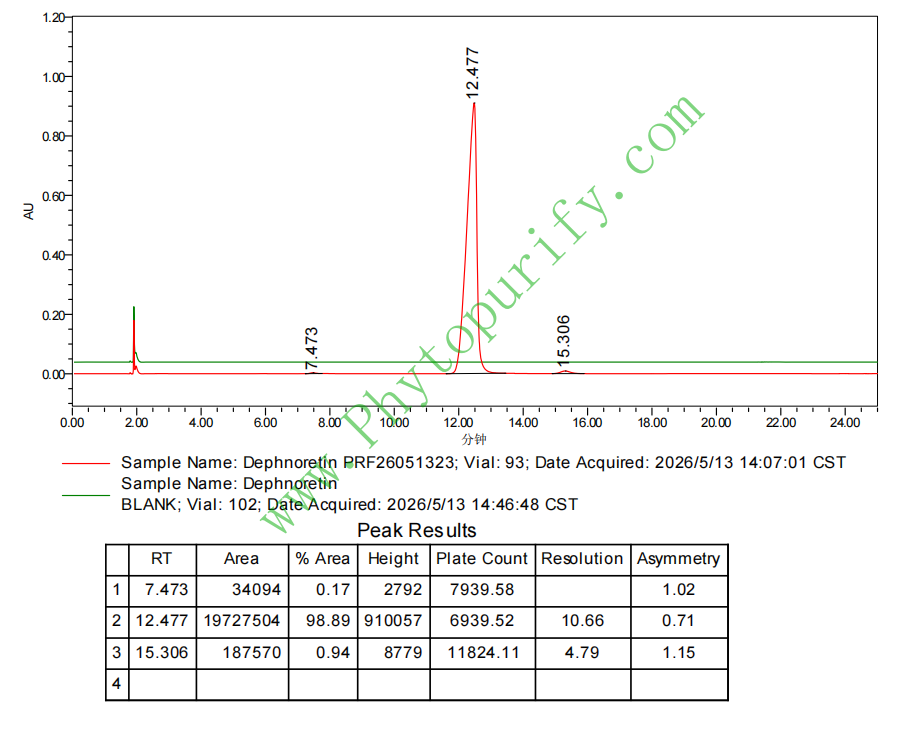
Analysis Method: HPLC-DAD or/and HPLC-ELSD
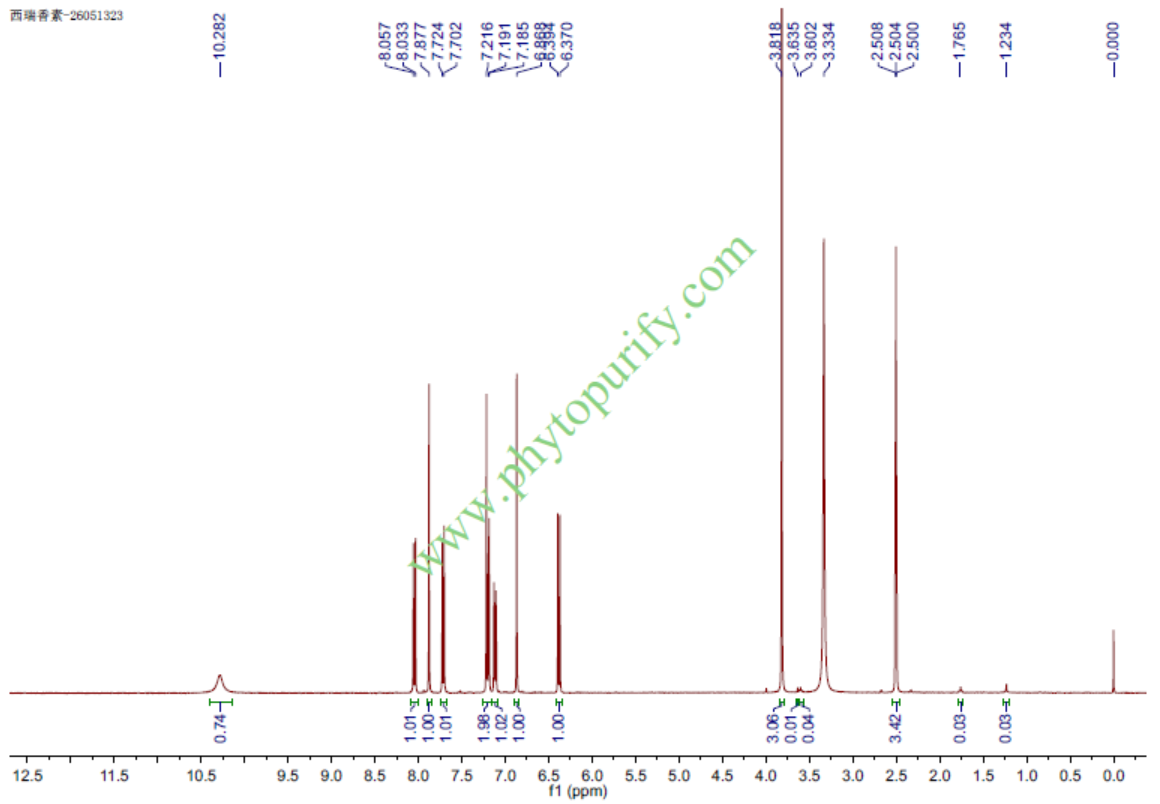
Identification Method: Mass, NMR
Packing: Brown vial or HDPE plastic bottle
Storage: Store in a well closed container, protected from air and light. Put into refrigerate or freeze for long term storage.
Whenever possible, you should prepare and use solutions on the same day. However, if you need to make up stock solutions in advance, we recommend that you store the solution as aliquots in tightly sealed vials at -20℃. Generally, these will be useable for up to two weeks.
The product could be supplied from milligrams to grams
Inquire for bulk scale.
Description:
Daphnoretin has strong antiviral activity, mainly on the later phase of the replication cycle. Daphnoretin has anticancer effects on leukemia, osteosarcoma and uterine cervix cancer cells, might through promoting apoptosis in a mitochondria-mediated way; it causes death of HOS cells by blocking cells successively in G2/M phases and activating the caspase-3 pathway.
References:
Oncol Lett. 2014 Sep;8(3):1139-1142.
Effect of daphnoretin on the proliferation and apoptosis of A549 lung cancer cells in vitro.
Daphnoretin is an active constituent of Wikstroemia indica C.A. Mey., which is widely distributed in the northwest and southwest regions of China. Previous studies have shown that Daphnoretinhas anticancer effects on leukemia, osteosarcoma and uterine cervix cancer cells. However, the effect of Daphnoretin on human lung cancer cells has yet to be elucidated.
METHODS AND RESULTS:
In the present study, Daphnoretin was observed to inhibit A549 lung cancer cell proliferation in a concentration- and time-dependent manner. Fluorescent microscopy and flow cytometric analysis showed that Daphnoretin induced A549 cell apoptosis in a concentration-dependent manner. Western blot analysis also revealed that Daphnoretin induced apoptosis through the regulation of the B-cell lymphoma-2 gene family in A549 cells.
CONCLUSIONS:
These findings indicate that Daphnoretin may have potential as a therapeutic agent for the management of lung cancer.
Molecules. 2012 Jan 9;17(1):598-612.
Daphnoretin induces cell cycle arrest and apoptosis in human osteosarcoma (HOS) cells.
In this study antiproliferation, cell cycle arrest and apoptosis induced by Daphnoretin in human osteosarcoma (HOS) cells were investigated.
METHODS AND RESULTS:
Antiproliferative activity was measured with the 3-(4,5-dimethylthiazol-2-yl)-2,5-diphenyltetrazolium bromide (MTT) assay. The IC(50) value of Daphnoretin was 3.89 μM after 72 h treatment. Induction of apoptosis was evidenced by apoptotic body appearance and Annexin V-FITC/PI apoptosis detection kit. Flow cytometric analysis indicated Daphnoretin arrested the cell cycle in the G2/M phase. Western-blot assay showed that the G2/M phase arrest was accompanied by down-regulation of cdc2, cyclin A and cyclin B1. Moreover, Daphnoretin inhibited Bcl-2 expression and induced Bax expression to desintegrate the outer mitochondrial membrane and causing cytochrome c release. Mitochondrial cytochrome c release was associated with the activation of caspase-9 and caspase-3 cascade.
CONCLUSIONS:
Our results demonstrated that Daphnoretin caused death of HOS cells by blocking cells successively in G2/M phases and activating the caspase-3 pathway.
Phytother Res. 2010 May;24(5):657-61.
Antiviral activity of daphnoretin isolated from Wikstroemia indica.
METHODS AND RESULTS:
The ethanol extract of Wikstroemia indica was fractionated with organic solvents of different polarities, and various fractions were screened for their antiviral activity against respiratory syncytial virus (RSV) using a cytopathic effect (CPE) reduction assay. The ethyl acetate fraction was most active against RSV with 50% inhibition concentration (IC(50)) value < 3.9 microg/mL and a selectivity index (SI) > 64.1. Further isolation and purification of the fraction led to a purified compound, Daphnoretin. Daphnoretin was tested for its anti-RSV activity using a plaque reduction assay and found active against RSV, with an IC(50 )value of 5.87 microg/mL and SI value of 28.17.
CONCLUSIONS:
The mode of antiviral action study revealed that Daphnoretin could slightly inhibit the early events of the viral infection but its effect was mainly on the later phase of the replication cycle.
HPLC of Dephnoretin
HNMR of Dephnoretin
Storage conditions:Short-term storage at 2~8℃, long-term storage at -20 ~ -80℃
Dephnoretin, CAS number 2034-69-7, is an important natural coumarin compound that has attracted much attention due to its unique chemical structure and diverse biological activities. As a derivative of coumarin, Xirui Xiangsu has shown extensive pharmacological potential in traditional Chinese medicine and modern natural product pharmacology research, especially in antiviral, anti-tumor, and metabolic disease regulation. In recent years, with the development of molecular biology and medicinal chemistry technology, the mechanism of action of Sirtuin and its interactions with various disease-related molecular targets have gradually become clear, laying a solid foundation for its development as a new type of drug. This article provides a systematic review of the chemical structure, plant origin, pharmacological activity, mechanism of action, pharmacological evaluation, and clinical application prospects of Xirui Xiangsu, aiming to provide comprehensive and in-depth references for researchers in the field of natural product pharmacology.
Xiruixiangsu belongs to the coumarin class of compounds, with a molecular formula of C20H16O6 and a molecular weight of 352.2980. Its structural characteristics are the substitution of 7-hydroxyl, 6-methoxy, and 3-oxo-2H-chromen-7-yl oxygen groups, forming a composite structure of aromatic ether and hydroxycoumarin. This structure endows Sirtuin with strong biological activity and good drug compatibility.
In terms of physical and chemical properties, the LogP value of Xirui Xiangsu is about 2.96, indicating that it has moderate lipid solubility and is conducive to cell membrane penetration. The polarization surface area (TPSA) is 99.11 Å ², indicating that its polarity is moderate and conducive to binding with biomolecules. Low water solubility (0.0004 mg/mL) suggests limited solubility in aqueous phase, which may affect bioavailability. The high penetration ability of the blood-brain barrier indicates its potential application in central nervous system diseases. The negative result of hERG channel inhibition experiment indicates a low risk of cardiac toxicity. The Ames mutagenicity test score is 0.9, indicating a low risk of genotoxicity and good safety.
Xirui Xiangsu mainly exists in various plants, especially in certain coumarin rich traditional Chinese medicinal materials and aromatic plants. Common source plants include Daphne spp. and certain Umbelliferae plants. The content of resveratrol in plants varies depending on the species, geographical environment, and harvesting time.
In terms of extraction methods, traditional organic solvent extraction and separation techniques are used. Common extraction solvents include ethanol, methanol, and ethyl acetate, which can be combined with ultrasound assisted extraction or reflux extraction to improve extraction efficiency. The extraction solution was purified by liquid-liquid distribution, column chromatography (silica gel, C18 reverse phase column), and high performance liquid chromatography (HPLC) to obtain high-purity naringenin. In addition, modern green extraction technologies such as supercritical CO2 extraction and microwave-assisted extraction are gradually being applied to the extraction of Sirtuin, balancing high efficiency and environmental protection.
A large number of in vitro and in vivo experiments have shown that Xirui Xiangsu has various significant pharmacological activities, covering fields such as antiviral, anti-tumor, and metabolic regulation.
Antiviral activity
Xiruixiangsu exhibits inhibitory effects on various viruses, especially on hepatitis B virus (HBV) and herpes virus infections. It exhibits good antiviral potential by regulating host immune response and virus replication related signaling pathways, reducing viral load and virus related protein expression.
Antitumor activity
In many tumor models such as breast cancer and lung cancer, daphnetin has shown the ability to inhibit tumor cell proliferation, induce apoptosis and inhibit tumor metastasis. Its function involves regulating apoptosis related proteins (such as BCL2), signal transduction molecules (such as STAT3, MAPK1), and multidrug resistance related proteins (such as ABCB1, ABCG2), which have a regulatory effect on the tumor microenvironment and tumor cell resistance.
Metabolic regulation effect
Seretin shows potential in the treatment of diabetes and metabolic syndrome. By activating the AMPK signaling pathway, regulating glucose transporter 2 (SGLT2), and glucose metabolism enzymes (GCK), it can help improve insulin sensitivity and blood glucose control. In addition, it also has a positive impact on lipid metabolism and oxidative stress regulation.
Other pharmacological effects
Xiruixiangsu also exhibits anti-inflammatory, antioxidant, and neuroprotective effects, which may be related to its regulation of inflammatory and oxidative stress-related factors such as NFKB and NFE2L2. These effects provide a theoretical basis for its application in chronic inflammatory diseases and neurodegenerative diseases.
The multi-target mechanism of action of Xirui Xiangsu is the basis for its broad pharmacological activity. Through molecular docking, gene expression analysis, and proteomic research, it has been determined that its main targets cover multiple key proteins in signaling pathways.
AMPK(PRKAA1)
As a core regulatory factor of energy metabolism, the activation of AMPK is an important mechanism for the regulation of metabolism and anti-tumor effects of Sirtuin. Xiruixiang Su promotes AMPK phosphorylation, enhances cellular energy metabolism, inhibits tumor cell proliferation and metabolic adaptation.
BCL2 family proteins
Xiruixiang Su regulates BCL2 expression, promotes tumor cell apoptosis, reverses anti apoptotic signals, and enhances chemotherapy drug sensitivity.
STAT3 signaling pathway
STAT3, as a key factor in tumor cell proliferation and immune escape, is inhibited by sirtuin, blocking the growth signal of tumor cells.
SGLT2 and GCK
In the diabetes model, daphnetin regulates SGLT2 mediated glucose reabsorption and GCK glucose metabolic activity to improve glucose metabolism.
NFKB1, TNF, IL6, and NLRP3
Xiruixiangsu exerts anti-inflammatory effects by inhibiting the NFKB signaling pathway, reducing the expression of inflammatory factors TNF and IL6, and inhibiting the activation of NLRP3 inflammasome.
ABCB1、ABCG2、ABCA1
As a multidrug resistance related transporter protein, Sirtuin regulates these targets and helps reverse drug resistance in tumor cells.
TLR3, TLR4, and IRF3
In antiviral immunity, Sirtuin enhances the body's antiviral response by regulating the Toll like receptor signaling pathway.
In summary, Xirui Xiangsu achieves a wide range of pharmacological effects through multi-target and multi pathway synergistic effects, reflecting the advantages of natural product multi-target drugs.
The pharmacological evaluation of Xiruixiangsu shows that it has good potential for drug development. The molecular weight of 352.3 conforms to Lipinski's rule, and the LogP is moderate, which is beneficial for cell membrane permeation and in vivo distribution. The high blood-brain barrier penetration ability gives it an advantage in the treatment of central nervous system diseases.
Low water solubility may limit its oral bioavailability, and it is necessary to improve its solubility and absorption rate through formulation modifications such as nanocarriers and solid dispersions. The negative inhibition of hERG channel indicates a low risk of cardiac toxicity, and the Ames test results support its genetic safety.
Pharmacokinetic studies have shown that naringenin has good stability and distribution characteristics in vivo, but the metabolic pathways and clearance mechanisms still need to be further studied. Preliminary data suggests that it may be metabolized by the liver CYP450 enzyme system, which poses a potential risk of drug interactions and requires further systematic evaluation.
Based on its multi-target and multifunctional pharmacological activity, Xirui Xiangsu has shown broad clinical application prospects in the treatment of various diseases.
metabolic diseases
By regulating AMPK and glucose metabolism related targets, daphnetin is expected to become a new therapeutic drug for diabetes and metabolic syndrome, especially suitable for combining existing treatment schemes to improve metabolic disorders.
tumor therapy
Its anti-tumor activity and reversing drug resistance in breast cancer, lung cancer and other solid tumors provide a new idea for the comprehensive treatment of tumors. In the future, targeted drugs and immunotherapy can be combined to enhance treatment efficacy.
antiviral therapy
Xiruixiangsu has the potential to develop new antiviral drugs for hepatitis B and herpes virus infections by regulating immune and viral replication mechanisms, especially in the prevention and treatment of drug-resistant virus strains.
Inflammation and neuroprotection
Its anti-inflammatory and neuroprotective effects provide possibilities for the treatment of chronic inflammatory and neurodegenerative diseases, and it is worth conducting relevant preclinical and clinical studies.
Future research should focus on optimizing the dosage form, improving pharmacokinetics, conducting toxicological system evaluations, and designing clinical trials of Xirui Xiang Su, in order to promote its transition from laboratory to clinical application.
Xiruixiangsu, as a natural coumarin compound with multiple biological activities, has shown broad application prospects in the fields of antiviral, anti-tumor, and metabolic disease treatment due to its unique chemical structure and multi-target mechanism of action. Its good pharmacokinetic parameters and safety evaluation lay the foundation for further drug development. In the future, through in-depth mechanism research, pharmacokinetic optimization, and clinical validation, Xiruixiangsu is expected to become an important representative of natural product drug development, contributing new therapeutic methods to human health. The field of natural product pharmacology should continue to pay attention to the research progress of Xiruixiangsu and promote its clinical translation.
