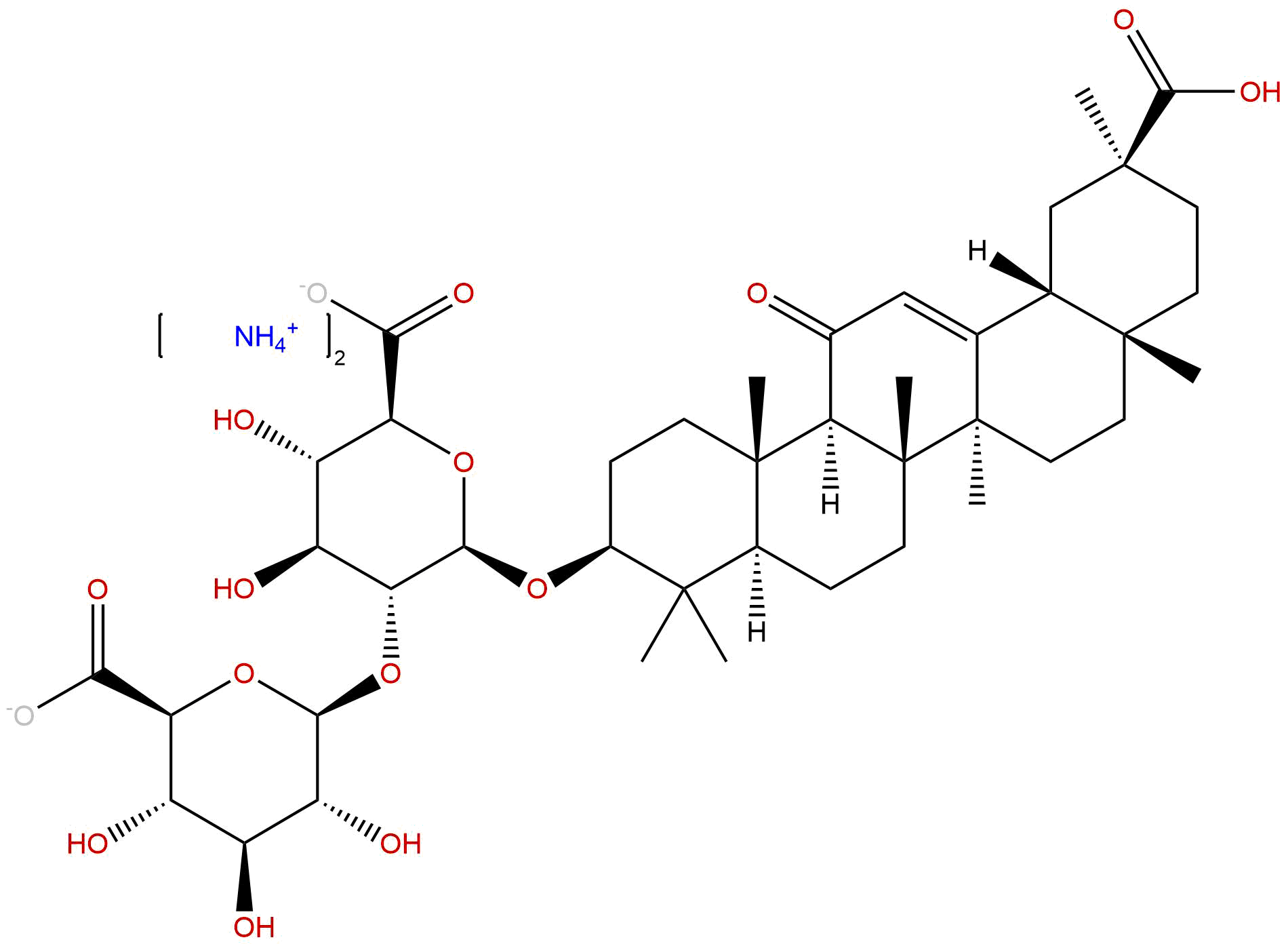


Product name: Diammonium glycyrrhizinate
Synonym name:
Catalogue No.: SBP03872
Cas No.: 79165-06-3
Formula: C42H68N2O16
Mol Weight: 857.004
Botanical Source:
Physical Description:
Type of Compound: Triterpenoids
Purity: 95%~99%
Analysis Method: HPLC-DAD or/and HPLC-ELSD
Identification Method: Mass, NMR
Packing: Brown vial or HDPE plastic bottle
Storage: Store in a well closed container, protected from air and light. Put into refrigerate or freeze for long term storage.
Whenever possible, you should prepare and use solutions on the same day. However, if you need to make up stock solutions in advance, we recommend that you store the solution as aliquots in tightly sealed vials at -20℃. Generally, these will be useable for up to two weeks.
The product could be supplied from milligrams to grams
Inquire for bulk scale.
For Reference Standard and R&D, Not for Human Use Directly.
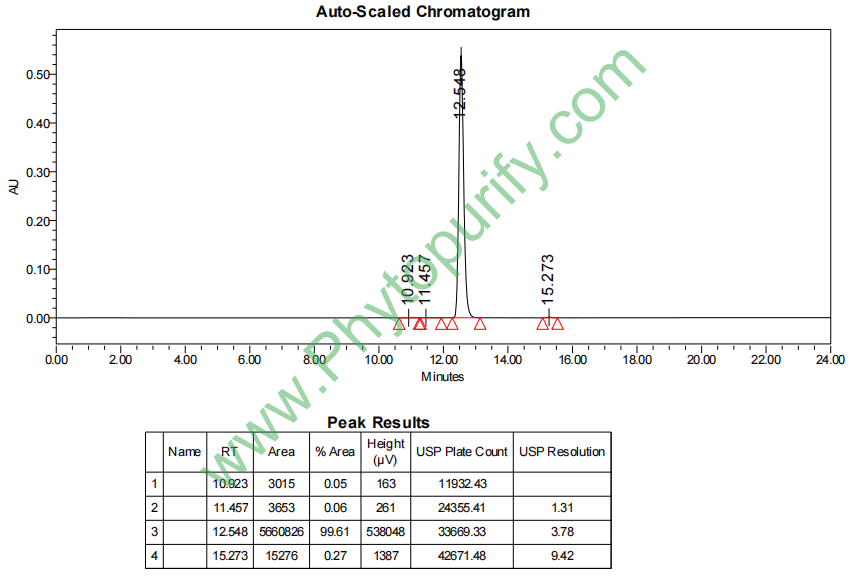
HPLC of Diammonium glycyrrhizinate
Storage conditions:Short-term storage at 2~8℃, long-term storage at -20 ~ -80℃
267.0400
2.3505
-.6100
.1297
.5179
.4612
Low
84.8732
6.4095
No
No
Yes
No
Yes
No
0.0
Yes
No
No
No
As the largest metabolic and detoxifying organ in the human body, the health status of the liver is directly related to the body's homeostasis. However, various factors such as viruses, alcohol, drugs, and metabolic abnormalities can all cause liver damage, leading to a series of serious diseases such as hepatitis, liver fibrosis, cirrhosis, and even liver cancer. The burden of liver disease is becoming increasingly heavy globally, and the development of efficient and safe hepatoprotective drugs is an important direction of pharmacological research. In this context, natural products derived from traditional medicine have attracted much attention due to their multi-target and low toxicity characteristics. Diamonium glycyrrhizinate (DG), as an active ingredient extracted and purified from traditional Chinese medicine licorice, has become a star molecule in the field of modern liver disease treatment due to its precise anti-inflammatory, antioxidant, and membrane protective pharmacological effects. This article aims to systematically review the chemical properties, plant sources, pharmacological activities, molecular mechanisms, medicinal properties, and clinical application prospects of diammonium glycyrrhizinate, in order to provide comprehensive academic references for the in-depth research and development of this compound.
Glycyrrhetinic acid diammonium (CAS number: 79165-06-3) is the diammonium salt form of glycyrrhizic acid. Its parent nucleus structure is composed of pentacyclic triterpenoid saponins, which are linked by glycosidic bonds between hydrophobic glycyrrhetinic acid glycosides and hydrophilic two molecules of glucuronic acid. After the formation of ammonium salts, their water solubility is significantly improved, making them more suitable for formulation development and clinical applications.
Its molecular formula is C42H68N2O16 and its molecular weight is 822.9420. The calculated lipid water partition coefficient (LogP) is 2.3505, indicating that the molecule has a certain degree of lipophilicity. However, due to its amphiphilic nature (with one end being a hydrophobic glycoside and the other end being a hydrophilic sugar chain and ammonium salt), it exhibits moderate polarity overall. The topologically polar surface area (TPSA) is as high as 267.0400 Å ², mainly attributed to the presence of a large number of hydroxyl and carboxyl groups (in the form of ammonium salts) in the molecule, which are hydrogen bond donors and acceptors, determining its strong hydration ability. The water solubility measured in the experiment is about 0.1297 mg/mL, which is not extremely high but can meet the requirements of the formulation. In the prediction of absorption, distribution, metabolism, and excretion (ADME), the ability of diammonium glycyrrhizinate to cross the blood-brain barrier is evaluated as "low", which is consistent with its higher molecular weight and polar surface area, indicating a lower risk of central nervous system side effects. In addition, key safety parameters of the drug indicate that it has no significant inhibitory effect on hERG potassium channels (hERG inhibition: No), and the Ames test result is 0.0, indicating that it has no mutagenic risk and has good cardiac and genetic toxicity safety.
The direct source of diammonium glycyrrhizinate is the traditional Chinese medicine licorice, mainly derived from the leguminous plant licorice(Glycyrrhiza uralensis Fisch.)、 Swelling fruit licorice(Glycyrrhiza inflata Bat. or licorice(Glycyrrhiza glabra L. Dry roots and rhizomes. Licorice, as a traditional Chinese medicine, has been used for over two thousand years. Its effects of clearing heat and detoxifying, removing phlegm and cough, relieving urgency and pain, and harmonizing various medicines are recorded in classics such as the Shennong Bencao Jing.
In modern industry, the extraction and purification of glycyrrhetinic acid and its salts mainly use water extraction combined with column chromatography technology. The typical process is as follows: after crushing licorice slices, heat and extract them with water or dilute ammonia water, and transfer them from plant tissues to the solution using the solubility of glycyrrhetinic acid in water. After filtering and concentrating the extract, adjust the pH to acidity with sulfuric acid or hydrochloric acid to precipitate glycyrrhetinic acid (known as "crude glycyrrhetinic acid"). The crude product can be further dissolved in an appropriate solvent (such as ethanol water mixture), neutralized with ammonia water to form a salt, and diammonium glycyrrhizinate can be obtained. In order to obtain high-purity products (such as pharmaceutical grade), it is often necessary to use techniques such as macroporous adsorption resin, silica gel column chromatography, or preparative high-performance liquid chromatography for refining. In recent years, green and efficient technologies such as ultrasound assisted extraction, microwave extraction, and supercritical fluid extraction have been continuously explored to improve extraction efficiency, reduce solvent consumption, and protect active ingredients.
Numerous in vitro and in vivo pharmacological studies have confirmed that diammonium glycyrrhizinate has a wide range of biological activities, with its core role focused on liver protection.
The hepatoprotective effect of diammonium glycyrrhizinate is not achieved through a single pathway, but rather through the synergistic action of multiple targets and pathways. The core of its molecular network involves antioxidant stress and anti-inflammatory signaling pathways.
Based on its physical and chemical properties and preliminary safety data, diammonium glycyrrhizinate exhibits good potential for pharmaceutical development. Its moderate LogP and improved water solubility are beneficial for oral absorption and formulation development. The absence of hERG inhibition and Ames mutagenicity provides important guarantees for its clinical safety.
Pharmacokinetic studies have shown that diammonium glycyrrhizinate is absorbed in the upper small intestine after oral administration, but it is a large molecule polar compound with low absolute bioavailability. After absorption, it is mainly distributed in the liver, followed by tissues such as the lungs and kidneys. It is not easily able to pass through the blood-brain barrier and placental barrier in the body. Glycyrrhetinic acid diammonium itself is not a directly active form. It hydrolyzes one molecule of glucuronic acid under the action of β - glucuronidase secreted by gut microbiota, producing monoglucuronic acid glycyrrhetinic acid, which may further hydrolyze into more active glycyrrhetinic acid. Glycyrrhetinic acid binds with glucuronic acid in the liver and is mainly excreted through bile, forming hepatic intestinal circulation. This is also one of the reasons for its long-lasting effect, but it may also lead to accumulation. Prototype drugs and metabolites can also be excreted through the kidneys. During clinical use, attention should be paid to the side effects of "pseudo aldosteronism". It is recommended to monitor blood pressure and potassium levels to avoid long-term high-dose use.
At present, salts of diammonium glycyrrhizinate (such as diammonium glycyrrhizinate enteric coated capsules and injections) have been widely used as prescription drugs in clinical practice in multiple countries including China. They are mainly used to treat chronic viral hepatitis, drug-induced liver injury, alcoholic liver disease, and autoimmune liver disease. Their effects in improving liver function indicators and reducing liver tissue inflammation have been widely recognized.
Looking ahead to the future, there is still vast space and challenges in the research and development of diammonium glycyrrhizinate
1. Development of new formulations To address the issue of low oral bioavailability, new drug delivery systems such as nanoparticles, liposomes, microemulsions, and solid dispersions can be developed to improve their solubility, stability, and targeting, enhance therapeutic efficacy, and reduce systemic side effects.
2. Combination therapy strategy Exploring the combination therapy of DG with other hepatoprotective drugs (such as silymarin, bicyclic alcohol), antiviral drugs, or anti fibrotic drugs, through multi mechanism synergy, may produce better therapeutic effects and potentially reduce their respective dosages and side effects.
3. Indications expansion Based on its powerful anti-inflammatory and antioxidant mechanisms, the application value of DG in non-alcoholic fatty liver disease (NAFLD)/non-alcoholic fatty liver disease (NASH), a globally high incidence metabolic liver disease, urgently needs to be further verified. In addition, its potential in extrahepatic diseases such as pulmonary fibrosis, skin inflammation, and intestinal inflammation is also worth exploring.
4. Precision mechanism mining Using modern technologies such as proteomics, metabolomics, and single-cell sequencing, further map the global molecular network of DG in specific liver disease models, discover new targets and biomarkers, and lay the foundation for its precision medical applications.
5. Structural modification and optimization By chemically modifying glycyrrhizin glycosides or glycosides, the aim is to obtain derivatives or analogues with stronger activity, lower side effects (especially steroid like effects), and better pharmacokinetic properties.
Glycyrrhetinic acid diammonium is a modern liver protective star molecule derived from traditional Chinese medicine licorice, and is a successful example of the combination of Chinese and Western medicine in the treasure trove of traditional Chinese medicine. It has constructed a three-dimensional liver protection network with its multi-target and multi pathway characteristics - by activating the NRF2 antioxidant pathway, inhibiting the NF - κ B inflammatory pathway, regulating metabolic enzymes and membrane stability. Despite challenges such as bioavailability and aldosterone like side effects, its clear efficacy and good safety foundation make it important in the field of liver disease treatment. With the innovation of formulation technology, in-depth analysis of the mechanism of action, and continuous expansion of clinical applications, diammonium glycyrrhizinate will play a more important and precise role in the prevention and treatment of liver diseases in the future, and also provide valuable paradigm references for the modernization research of other natural products.
