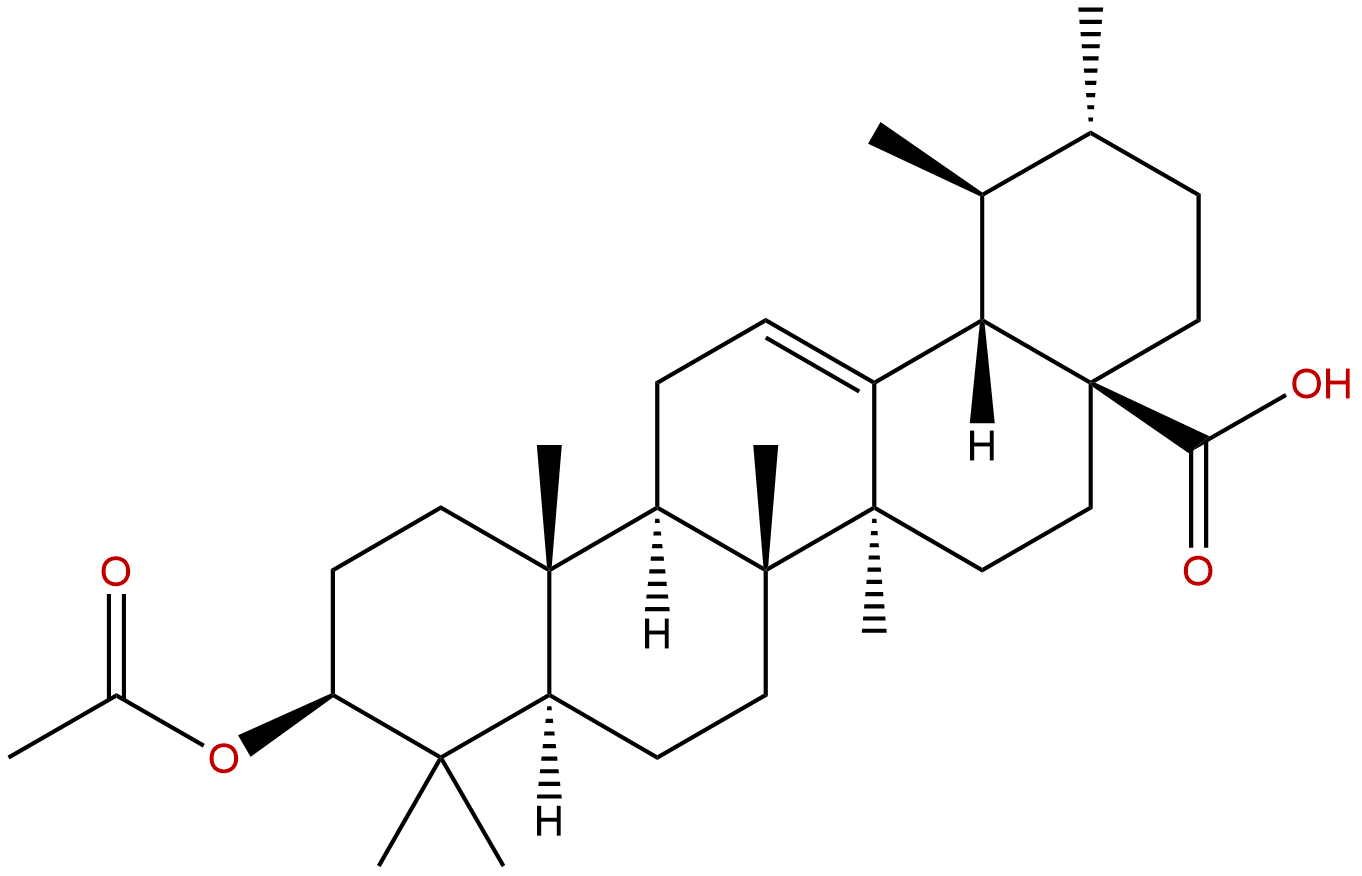


Product name: 3-acetylursolic acid
Synonym name:
Catalogue No.: BP3024
Cas No.: 7372-30-7
Formula: C32H50O4
Mol Weight: 498.748
Botanical Source:
Physical Description: Powder
Type of Compound: Triterpenoids
Purity: 95%~99%
Analysis Method: HPLC-DAD or/and HPLC-ELSD
Identification Method: Mass, NMR
Packing: Brown vial or HDPE plastic bottle
The product could be supplied from milligrams to grams. Inquire for bulk scale.
We provide solution to improve the water-solubility of compounds, thereby facilitating the variety of activity tests and clinic uses.
For Reference Standard and R&D, Not for Human Use Directly.
Description:
Acetylursolic acid shows significant cytotoxic activities, and shows suppression of the SOS-inducing activity of mutagenic heterocyclic amine, Trp-P-1. 3β-Acetylursolic acid can reduce parasitaemia against Plasmodium berghei.
References:
Phytochemistry. 2005 Feb;66(4):495-501.
Cytotoxic triterpenes from the aerial roots of Ficus microcarpa.
METHODS AND RESULTS:
Six triterpenes, 3beta-acetoxy-12,19-dioxo-13(18)-oleanene (1), 3beta-acetoxy-19(29)-taraxasten-20alpha-ol (2), 3beta-acetoxy-21alpha,22alpha-epoxytaraxastan-20alpha-ol (3), 3,22-dioxo-20-taraxastene (4), 3beta-acetoxy-11alpha,12alpha-epoxy-16-oxo-14-taraxerene (5), 3beta-acetoxy-25-methoxylanosta-8,23-diene (6) along with nine known triterpenes, 3beta-acetoxy-11alpha,12alpha-epoxy-14-taraxerene (7), 3beta-acetoxy-25-hydroxylanosta-8,23-diene (8), oleanonic acid (9), acetylbetulinic acid (10), betulonic acid (11), Acetylursolic acid (12), ursonic acid (13), ursolic acid (14), and 3-oxofriedelan-28-oic acid (15) were isolated from the aerial roots of Ficus microcarpa, and their structures elucidated by spectroscopic methods. The in vitro cytotoxic efficacy of these triterpenes was investigated using three human cancer cell lines, namely, HONE-1 nasopharyngeal carcinoma, KB oral epidermoid carcinoma, and HT29 colorectal carcinoma cells.
CONCLUSIONS:
Compound 8 and pentacyclic triterpenes 9-15 possessing a carboxylic acid functionality at C-28 showed significant cytotoxic activities against the aforementioned cell lines and gave IC50 values in the range 4.0-9.4 microM.
J Agric Food Chem. 2005 Mar 23;53(6):2312-5.
Suppression of the SOS-inducing activity of mutagenic heterocyclic amine, Trp-P-1, by triterpenoid from Uncaria sinensis in the Salmonella typhimurium TA1535/pSK1002 Umu test.
METHODS AND RESULTS:
The methanol extract from Uncaria sinensis showed a suppressive effect on umu gene expression of the SOS response in Salmonella typhimurium TA1535/pSK1002 against the mutagen 3-amino-1,4-dimethyl-5H-pyrido[4,3b]indole (Trp-P-1), which requires liver metabolizing enzymes. The methanol extract from U. sinensis was re-extracted with hexane, CH2Cl2, BuOH, and water, respectively. CH2Cl2 extract showed a suppressive effect. A suppressive compound 1 in CH2Cl2 extract was isolated by SiO2 column chromatography. Compound 1 was identified as ursolic acid by IR, electron ionization EI-MS, and NMR spectroscopy. Suppressive effects of ursolic acid (1) and its derivatives, methyl ursolate (1M), Acetylursolic acid (1A), and methyl acetylursolate (1MA), were determined in the umu test.
CONCLUSIONS:
These compounds suppressed 61.3, 37.7, 71.5, and 37.8% of the Trp-P-1-induced SOS response at a concentration of 0.4 micromol/mL, respectively. The ID50 values of compounds 1 and 1A were 0.17 and 0.20 micromol/mL. In addition, these compounds were assayed with the activated Trp-P-1. Suppressive effects on activated Trp-P-1 were decreased as compared with those of Trp-P-1.
Molecules. 2013 Oct 8;18(10):12313-23.
Anti-plasmodial activity of some Zulu medicinal plants and of some triterpenes isolated from them.
Mimusops caffra E. Mey. ex A.DC and Mimusops obtusifolia Lam (both members of the Sapotaceae family), and Hypoxis colchicifolia Bak (family Hypoxidaceae) are used by traditional healers in Zululand to manage malaria.
METHODS AND RESULTS:
Anti-plasmodial investigation of the crude extracts and some triterpenes isolated from the plants showed activity against a chloroquine sensitive (CQS) strain of Plasmodium falciparum (D10). Among the crude extracts the leaves of M. caffra exhibited the highest activity, with an IC₅₀ of 2.14 μg/mL. The pentacyclic tritepenoid ursolic acid (1), isolated from the leaves of M. caffra was the most active compound (IC₅₀ 6.8 μg/mL) as compared to taraxerol (2) and sawamilletin (3) isolated from the stem bark of M. obtusifolia (IC₅₀ > 100). Chemical modification of the ursolic acid (1) to 3β-Acetylursolic acid (4) greatly enhanced its anti-plasmodial activity. Compound 4 reduced parasitaemia against Plasmodium berghei by 94.01% in in vivo studies in mice.
CONCLUSIONS:
The cytotoxicity of 3β-Acetylursolic acid (IC₅₀) to two human cell lines (HEK293 and HepG2) was 366.00 μg/mL and 566.09 μg/mL, respectively. The results validate the use of these plants in folk medicine.
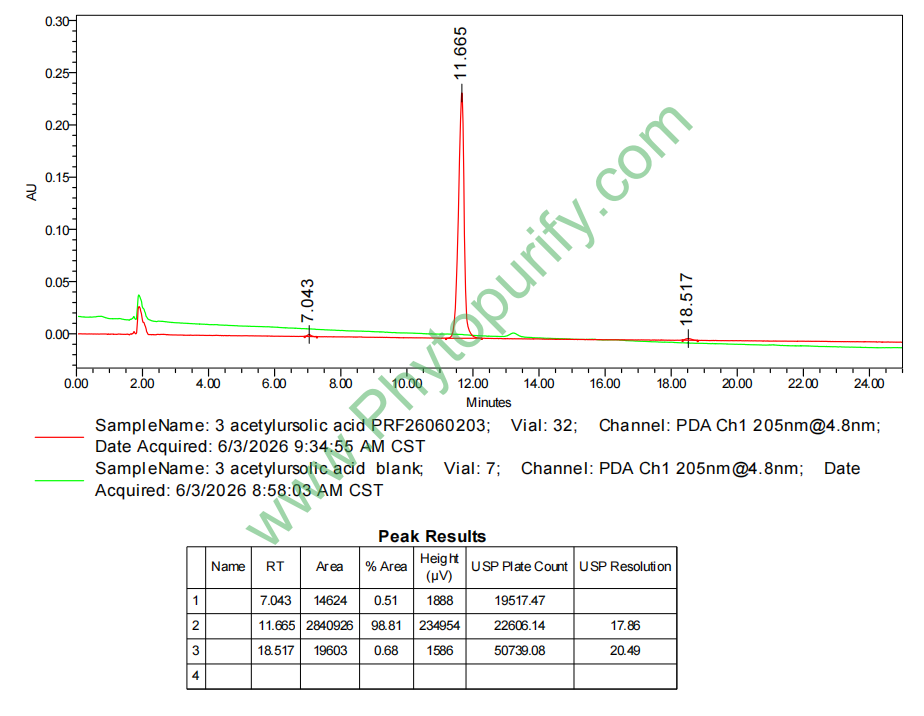
HPLC of 3-acetylursolic acid
Storage conditions:Short-term storage at 2~8℃, long-term storage at -20 ~ -80℃
63.6000
7.0530
5.3464
.0008
6.1731
2.9709
Low
93.1304
4.7563
No
No
Yes
No
No
No
0.0
No
No
No
No
Nonalcoholic fatty liver disease (NAFLD) and its progressive form, nonalcoholic steatohepatitis (NASH), have become the most common chronic liver disease worldwide, closely related to the prevalence of obesity, type 2 diabetes and metabolic syndrome. Its pathological process involves excessive accumulation of liver lipids, insulin resistance, oxidative stress, and chronic inflammation, ultimately leading to liver fibrosis, cirrhosis, and even hepatocellular carcinoma. At present, there are no approved specific drugs for the treatment of NASH worldwide, and clinical treatment mainly relies on lifestyle interventions and comorbidity management, resulting in a huge unmet clinical demand. Therefore, searching for lead compounds with multi-target and multi pathway regulatory effects from natural products has become an important strategy for new drug development.
Triterpenoids are a large class of secondary metabolites widely present in plants, with rich and diverse biological activities. Ursolic acid (UA), as one of them, has attracted much attention for its significant anti-inflammatory, antioxidant, anti-tumor, and lipid metabolism regulating activities. 3-O-Acetylursolic acid (3-AUA, CAS number: 7372-30-7) is an acetylated derivative of ursolic acid. Studies have shown that acetylation modification may alter the lipid solubility and bioavailability of parent compounds, thereby affecting their pharmacological activity spectrum and strength. In recent years, 3-AUA has shown unique potential in improving metabolic disorders, especially in targeting NAFLD/NASH. This article aims to systematically review the chemical properties, plant sources, pharmacological activities against NAFLD, mechanisms of action, drug evaluation, and clinical application prospects of 3-AUA, in order to provide comprehensive scientific references for the in-depth research and development of this natural product.
3-O-Acetylursolic acid is a pentacyclic triterpenoid compound with the molecular formula C ∝₂ H ₅₀ O ₄ and a molecular weight of 498.7480. Its chemical structure is based on ursolic acid as the basic skeleton, which introduces an acetyl group (- OCOCH3) on the C-3 hydroxyl group of the Ursane type tetracyclic triterpenoid mother nucleus (composed of six isoprene units). This structural modification is a key feature that distinguishes it from ursolic acid (C ∝₀ H ₄₈ O ∝).
Acetylation significantly alters the physicochemical properties of compounds. Firstly, its lipid water partition coefficient (LogP) is as high as 7.0530, indicating that 3-AUA has extremely strong lipophilicity, which is much higher than that of ursolic acid (LogP of about 6.3). A high LogP value means that the compound is more likely to penetrate the cell membrane, but it may also lead to poor water solubility. The calculated or measured water solubility data is extremely low (about 0.0008 mg/mL), which poses a major challenge for its formulation development and in vivo delivery. Its topological polar surface area (TPSA) is 63.6000 Å ², reflecting the size of the polar regions (mainly carboxyl and ester oxygen atoms) in the molecule. Combining high LogP and low TPSA, it is predicted that its ability to cross the blood-brain barrier is relatively low, which to some extent limits its potential application in central nervous system related diseases, but may also reduce the risk of central side effects.
In the preliminary screening of drug properties, 3-AUA showed certain advantages. Its molecular weight is less than 500, meeting the basic requirements of the five rules for generic drugs. The key safety warning indicators indicate that it does not inhibit hERG potassium ion channels (hERG inhibition: No), suggesting a low potential risk of arrhythmia. In addition, the Ames test result was 0.0, which preliminarily indicates that there is no mutagenicity under this testing system, providing important early safety support for its further development. However, its extremely low solubility and high lipophilicity suggest that oral absorption may be limited and prone to accumulation in adipose tissue, which are key issues that need to be addressed in subsequent pharmacokinetic studies and formulation studies.
3-O-Acetylursolic acid is not widely present, but rather exists as a byproduct or transformation product of ursolic acid in various plants. Common plant sources include:
1. Lamiaceae plants Like rosemary(Rosmarinus officinalis)Sage(Salvia spp.), These plants are rich in ursolic acid and its derivatives.
2. Oleaceae plants: Ligustrum genus(Ligustrum The fruit or leaves of a plant.
3. Rosaceae plants Like loquat(Eriobotrya japonica)The leaves.
4. Other sources There have also been reports of isolation in some traditional medicinal plants such as Plantago asiatica and Prunella vulgaris.
The extraction and separation of 3-AUA from plant materials usually follow the conventional process of natural product chemistry, but optimization is needed based on the characteristics of its triterpenoid compounds:
1. Extract Due to its strong lipophilicity, 3-AUA is often extracted using organic solvents. Classic methods include cold soaking, reflux, or ultrasound assisted extraction using methanol, ethanol, or acetone. In recent years, green extraction techniques such as supercritical CO ₂ fluid extraction have been applied due to their high selectivity and no solvent residue, making them particularly suitable for extracting such highly lipophilic compounds.
2. Enrichment and Separation After vacuum concentration, the crude extract is often subjected to gradient extraction using solvents such as petroleum ether, ethyl acetate, and n-butanol. 3-AUA is mainly enriched in the moderately polar ethyl acetate fraction. Further purification mainly relies on column chromatography technology. Positive phase silica gel column chromatography is preferred, and the eluent is usually a petroleum ether ethyl acetate or chloroform methanol gradient system. High performance liquid chromatography (HPLC), especially preparative HPLC, is the final key step in obtaining high-purity 3-AUA monomers, often using a reverse phase C18 column with methanol water or acetonitrile water as the mobile phase.
3. appraisal The separated compounds were subjected to structural identification using spectroscopic methods, including mass spectrometry (MS) to determine molecular weight, nuclear magnetic resonance hydrogen (¹ H NMR) and carbon (¹ ³ C NMR) to confirm the connection positions of functional groups such as carbon hydrogen skeleton and acetyl group, and compared with literature data.
It is worth noting that 3-AUA can also be prepared by chemical semi synthetic methods, using ursolic acid from a wider range of sources as raw material, reacting with acetyl chloride or acetic anhydride under alkaline conditions to selectively acetylate the C-3 hydroxyl group. This provides a feasible approach for obtaining sufficient samples for further research.
Although the pharmacological activity research of 3-AUA is not as extensive as that of ursolic acid, existing evidence shows that it exhibits significant effects in multiple disease models, especially in the field of metabolic diseases.
1. Lipid regulation and anti non-alcoholic fatty liver activity This is currently the most promising pharmacological effect of 3-AUA. In high-fat diet (HFD) - induced NAFLD/NASH mouse or rat models, 3-AUA intervention can significantly reduce liver weight and liver index, alleviate hepatic steatosis, ballooning, and inflammatory infiltration. Serological testing shows that it can effectively reduce the levels of total cholesterol (TC), triglycerides (TG), low-density lipoprotein cholesterol (LDL-C) in the serum of model animals, and increase high-density lipoprotein cholesterol (HDL-C). More importantly, it can significantly reduce serum transaminase (ALT, AST) levels, indicating its protective effect against liver injury. Histopathology, such as Oil Red O staining and H&E staining, intuitively confirmed its effect in reducing hepatic lipid deposition.
2. Anti inflammatory and antioxidant activity Inflammation and oxidative stress are the core driving forces behind the progression of NAFLD to NASH. 3-AUA exhibits anti-inflammatory effects in various acute and chronic inflammation models, such as carrageenan induced mouse foot swelling and lipopolysaccharide stimulated macrophage models, and can inhibit the production of pro-inflammatory factors such as tumor necrosis factor - α (TNF - α), interleukin-6 (IL-6), and interleukin-1 β (IL-1 β). At the same time, it can enhance the antioxidant defense system in the liver and cells, increase the activity of superoxide dismutase (SOD) and glutathione peroxidase (GSH Px), reduce the level of lipid peroxidation products such as malondialdehyde (MDA), and thus alleviate oxidative stress damage.
3. Antitumor activity Similar to many triterpenoids, 3-AUA has shown inhibitory effects on proliferation and pro apoptotic effects on a variety of tumor cell lines (such as liver cancer, breast cancer, lung cancer, colon cancer cells). The mechanism may involve inducing cell cycle arrest (such as G0/G1 phase), activating the caspase cascade, regulating the Bcl-2/Bax protein ratio, and inhibiting signaling pathways such as nuclear factor kappa B (NF - κ B).
4. Other activities Preliminary studies also suggest that 3-AUA may have antibacterial, antiviral (such as anti HIV), and neuroprotective activities, but these studies are still in the early stages and need to be further explored.
The improvement of NAFLD/NASH by 3-AUA is not achieved through a single target, but through the synergistic regulation of liver lipid metabolism, inflammation, and oxidative stress through multiple targets and pathways, forming a networked mechanism of action.
1. Regulating lipid synthesis and uptake:
* Inhibit SREBF1/SREBP-1c Sterol regulated element binding protein 1c (SREBP-1c) is a key transcription factor that controls the synthesis of fatty acids and triglycerides. 3-AUA can downregulate the expression of SREBP-1c and its downstream target genes, such as FASN(Fatty acid synthase) and ACC1 Acetyl CoA carboxylase 1 is used to inhibit liver function from the source de novo Lipid synthesis.
* Affects PNPLA3 The I148M mutation of Parkinson's disease protein 3 (PNPLA3, also known as adiponutrin) is an important genetic risk factor for NAFLD/NASH. Research has shown that 3-AUA may regulate the hydrolysis of triglycerides and lipid droplet remodeling, reducing lipid storage, by affecting the activity or expression of PNPLA3.
* Adjust MTTP Mitochondrial triglyceride transfer protein (MTTP) is essential for the assembly and secretion of very low-density lipoprotein (VLDL) in the liver. 3-AUA may promote the output of triglycerides synthesized in the liver in the form of VLDL by regulating MTTP activity, thereby reducing lipid accumulation in the liver.
2. Promote β - oxidation of fatty acids:
* Activate PPARA Peroxisome proliferator activated receptor alpha (PPAR alpha) is the main regulator of fatty acid oxidation. 3-AUA can activate PPAR α, thereby upregulating its target gene CPT1A Expression of carnitine palmitoyltransferase 1A. CPT1A is the rate limiting enzyme for long-chain fatty acids entering mitochondria for β - oxidation. Increased expression of CPT1A indicates an enhanced ability of the liver to break down and utilize fatty acids, which helps to clear excess lipids.
3. Anti inflammatory and antioxidant pathways:
* Inhibition of NF - κ B pathway NF - κ B is the core transcription factor of inflammatory response. 3-AUA can inhibit the activation of I κ B kinase (IKK), prevent I κ B degradation and NF - κ B nuclear translocation, thereby downregulating the transcription of inflammatory factors such as TNF - α and IL-6.
* Activate Nrf2 pathway Nuclear factor E2 related factor 2 (Nrf2) is the central regulator of cellular antioxidant response. Research has shown that 3-AUA can promote the transfer of Nrf2 from the cytoplasm to the nucleus, activate a series of downstream antioxidant enzymes and phase II detoxifying enzymes (such as heme oxygenase-1, HO-1; The expression of quinone oxidoreductase 1 (NQO1) enhances the antioxidant defense ability of cells.
* Regulating inflammasomes Research suggests that 3-AUA may alleviate liver inflammation damage by inhibiting the assembly and activation of NLRP3 inflammasomes, reducing the maturation and release of IL-1 β and IL-18.
In summary, 3-AUA reduces lipid synthesis by inhibiting the SREBP-1c/FASN/ACC1 axis, which may regulate PNPLA3 and MTTP to affect lipid storage and output. It also promotes fatty acid oxidation by activating the PPAR α/CPT1A axis, and corrects liver lipid metabolism disorders through a multi pronged approach. At the same time, it inhibits pathways such as NF - κ B and activates Nrf2 to combat accompanying inflammation and oxidative stress, preventing the pathological progression of NAFLD from multiple aspects.
Although 3-AUA has shown good pharmacological activity in preclinical models, its pharmacological properties, especially pharmacokinetic properties, are the main challenges facing its conversion to drugs.
1. Absorption, distribution, metabolism, and excretion (ADME):
* absorb The extremely high lipophilicity and low water solubility severely limit its oral bioavailability. Unoptimized 3-AUA has poor solubility and dissolution in the gastrointestinal tract, with slow and incomplete absorption. Studies have shown that its oral bioavailability may be low.
* distribution A high LogP value indicates that it is easy to penetrate cell membranes and widely distributed in the body, especially in organs rich in lipids such as adipose tissue and liver. The prediction of low blood-brain barrier permeability is consistent with its targeted distribution in the liver, which may be a favorable factor for the treatment of liver disease.
* Metabolism As a triterpenoid compound, 3-AUA mainly undergoes phase I and phase II metabolism in vivo. Phase I metabolism may involve reactions such as hydroxylation and deacetylation (possibly converted to ursolic acid) catalyzed by cytochrome P450 enzyme systems (such as CYP3A4). Phase II metabolism mainly involves glucuronic acid binding or sulfation, producing more polar metabolites that are easier to excrete.
* excretion Metabolites are mainly excreted from the body through bile and urine. The proportion of prototype drugs excreted through the kidneys may be very low.
2. Optimization strategy for drug properties:
In order to overcome the inherent physicochemical defects of 3-AUA and improve its bioavailability and efficacy, various formulation strategies have been widely studied
* Nano delivery system This is one of the most promising strategies. Including liposomes, nanoemulsions, solid lipid nanoparticles, polymer nanoparticles, etc. These nanocarriers can encapsulate or embed 3-AUA, significantly increasing its apparent solubility in aqueous media, protecting it from premature degradation, and enhancing oral bioavailability and liver targeting by enhancing intestinal lymphatic absorption or passive targeting (such as hepatic reticuloendothelial system uptake).
* Cyclodextrin inclusion complex By utilizing the cavity structure of cyclodextrin to form inclusion complexes with 3-AUA, its water solubility and dissolution rate can be effectively improved.
* Prodrug strategy By chemically modifying the carboxyl or remaining hydroxyl groups of 3-AUA, better water-soluble prodrugs (such as phosphate esters, amino acid esters, etc.) can be prepared and released in vivo through enzymatic interpretation.
* Crystal Engineering By preparing eutectic or amorphous forms and changing their solid-state properties, solubility and dissolution rate can be improved.
3. Preliminary evaluation of safety Based on limited existing data, 3-AUA did not exhibit significant acute toxicity to experimental animals within the effective dose range. HERG inhibition negative and Ames test negative are important early safety signals for it. However, comprehensive preclinical safety evaluation, including long-term toxicity, reproductive toxicity, genetic toxicity supplementary tests, etc., is still a necessary step before entering clinical research.
3-AUA, as a natural triterpenoid derivative with multi-target anti NAFLD/NASH activity, has both clinical application prospects and challenges.
prospect:
1. As a potential drug or lead compound for treating NAFLD/NASH In response to the current situation of no specific drugs for NAFLD/NASH, 3-AUA synergistically regulates multiple pathological processes such as lipid synthesis, oxidation, inflammation, and oxidative stress, which is in line with the modern concept of multi-target therapy for complex metabolic diseases. Its natural product identity is also easily accepted by the market.
2. Components of combination therapy In the future, 3-AUA may be combined with existing or developing drugs with other mechanisms of action, such as farnesol X receptor agonists, glucagon like peptide-1 receptor agonists, etc., to produce synergistic effects, improve efficacy, and reduce their respective dosages and side effects.
3. Application of functional foods or health products If its safety is fully confirmed, standardized extracts from plants rich in 3-AUA may be developed as health products to assist in regulating blood lipids and protecting the liver.
Challenges and Prospects:
1. Breakthrough in the bottleneck of drug development As mentioned earlier, extremely low solubility and bioavailability are the primary obstacles. The future research focus should be on developing efficient, stable, and industrializable new delivery systems (such as liver targeted nanomaterials), and verifying their improvement effects through systematic pharmacokinetic studies.
2. In depth explanation of the mechanism of action Although multiple related targets have been identified, the direct interactions between 3-AUA and these targets (such as PNPLA3), precise binding sites, and global regulatory maps of downstream signaling networks still require more detailed analysis using techniques such as chemical biology, proteomics, and computational simulations.
3. Systematization and standardization of preclinical research It is necessary to systematically evaluate the long-term efficacy and safety of NASH in animal models of different species that are closer to human NASH pathology, such as STAM mice, CDAHFD feed models, humanized mouse models, etc., in order to provide a solid basis for clinical trial design.
4. Structural optimization and development of analogues Using 3-AUA as the lead compound, a systematic structure-activity relationship study was conducted, and its structure was modified through semi synthetic or total synthetic methods (such as introducing polar groups to improve solubility, or modifying other sites to enhance activity or selectivity), which is expected to obtain derivatives with better drug properties.
5. Explore a wider range of indications Based on its anti-inflammatory, antioxidant, and anti-tumor activity basis, its therapeutic potential in other inflammatory diseases, fibrotic diseases, or specific types of cancer can be explored.
3-O-Acetylursolic acid, as a natural derivative of ursolic acid, has shown potential in improving lipid metabolism, anti-inflammatory, antioxidant and other aspects with its unique acetyl modification, which is superior or different from the parent compound. Especially in the prevention and treatment of non-alcoholic fatty liver disease, which is a global health challenge, it provides a new candidate molecule. It exerts multidimensional and networked pharmacological effects by regulating multiple key targets and pathways such as SREBF1, FASN, PPARA, CPT1A, NF - κ B, Nrf2, etc., which is in line with the complex pathogenesis of NAFLD/NASH. However, its inherent extremely low water solubility and potentially poor pharmacokinetic properties are the main barriers between laboratory research and clinical applications. Future research should be conducted in a dual track approach: on the one hand, modern pharmaceutical and medicinal chemistry methods should be utilized to overcome the delivery challenges and enhance bioavailability; On the other hand, continue to deepen its molecular mechanism research and carry out systematic and standardized preclinical safety and efficacy evaluations. Only in this way can this promising natural molecule be truly transformed into therapeutic drugs that benefit a wide range of patients, adding new weapons to the treatment of metabolic liver disease.
