


Synonym name: Pterixin
Catalogue No.: BP1492
Cas No.: 13161-75-6
Formula: C21H22O7
Mol Weight: 386.4
Botanical Source: Pteryxia terebinthina, Ammi ursina, Musineon diviricatum and Seseli libanotis
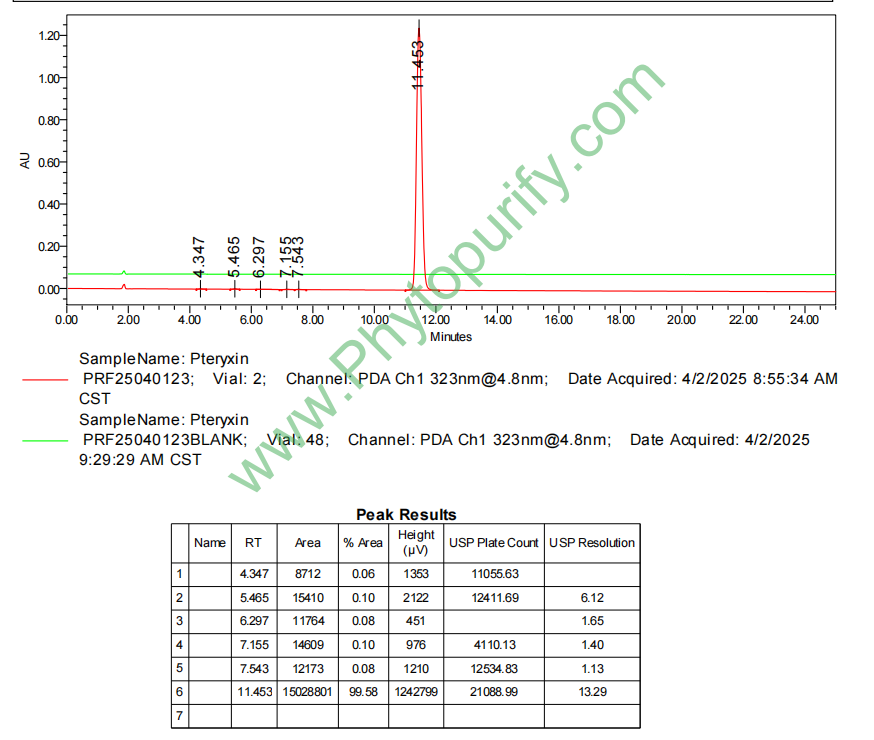
Purity: 95%~99%
Analysis Method: HPLC-DAD or/and HPLC-ELSD
Identification Method: Mass, NMR
Packing: Brown vial or HDPE plastic bottle
Can be supplied from milligrams to grams. Inquire for bulk scale.
For Reference Standard and R&D, Not for Human Use Directly.
HPLC of Pteryxin
Storage conditions:Short-term storage at 2~8℃, long-term storage at -20 ~ -80℃
92.0400
3.1714
3.1712
.0166
3.0994
6.4712
High
84.1268
3.7197
Yes
Yes
No
No
No
Yes
0.0
Yes
Yes
Yes
Yes
Inflammation and oxidative stress are the common pathological basis of many chronic diseases, such as rheumatoid arthritis, osteoporosis, diabetes and its complications, neurodegenerative diseases, etc. These complex diseases often involve abnormal activation of multiple signaling pathways, including pro-inflammatory pathways such as nuclear factor kappa B (NF - κ B), mitogen activated protein kinase (MAPK), NOD like receptor heat protein domain associated protein 3 (NLRP3) inflammasome, as well as dysregulation of antioxidant pathways such as nuclear factor E2 related factor 2 (Nrf2). Therefore, developing multi-target drugs that can simultaneously act on multiple key targets and restore immune and redox homeostasis has become an important strategy for modern drug development. In this context, natural products derived from traditional medicinal plants have attracted much attention due to their structural diversity and pleiotropy.
Pteryxin, also known as (+) - Pteryxin, is a naturally occurring coumarin compound with significant biological activity. Early research focused on its plant chemical taxonomic significance, but in recent years, its extensive pharmacological activities have gradually been revealed. Research has shown that North American apigenin is an orally effective multi-target regulator that can simultaneously target NF - κ B, MAPK, NLRP3 inflammasome, and Nrf2/ARE pathway, exhibiting strong anti-inflammatory, antioxidant, and osteoclastogenetic effects. Of particular note, it has also been identified as a butyrylcholinesterase (BChE) inhibitor, providing a new perspective for its application in neurodegenerative diseases such as Alzheimer's disease. This article aims to systematically review the chemical properties, plant sources, pharmacological activities, mechanisms of action, and pharmacological properties of North American apigenin, and to explore its clinical application prospects as a multi-target therapeutic drug.
The molecular formula of North American apigenin (CAS number: 13161-75-6) is C21H22O7, with a molecular weight of 386.40 g/mol. Its core structure is 7-hydroxycoumarin (umbelliferone), which belongs to the linear furan coumarin class of compounds. Specifically, its structural feature is the combination of an isopentenyl side chain and a dihydropyran ring at position 6 of the coumarin parent nucleus, forming a unique dihydropyran coumarin skeleton. This structure contains multiple oxygen-containing functional groups, including a lactone ring, a pyran ether bond, and free phenolic hydroxyl groups, which have a decisive impact on its biological activity and physicochemical properties.
According to the pharmacological parameters calculated based on its chemical structure, the lipid water partition coefficient (LogP) of North American apigenin is 3.17, indicating its moderate lipophilicity and favorable transmembrane absorption. The topological polar surface area (TPSA) is 92.04 Å ², which is relatively low and consistent with its good membrane permeability prediction. Its water solubility is poor, about 0.0166 mg/mL, which may need to be considered in formulation development. Pharmacokinetic predictions show that North American apigenin has a high blood-brain barrier permeability, which is consistent with its potential to exert BChE inhibitory activity in the central nervous system and regulate neuroinflammation. In addition, preliminary toxicity predictions indicate that it has no inhibitory activity on hERG potassium channels (hERG inhibition: No), and the Ames test result is negative (0.0), suggesting that it may have low risks of cardiac and genetic toxicity, providing a favorable preliminary safety signal for subsequent development.
North American apigenin is mainly found in Apiaceae plants and is one of the characteristic chemical components of various medicinal plants in this family. Its name "Pteryxin" comes from its early discovery of plant sources, such as the North American parsley genus(Pteryxia)Plants. In addition, it is also distributed in many traditional medicinal plants, such as the genus Peucedanum(Peucedanum)Ferula genus(Ferula), Artemisia genus(Seseli)And windproof genus(Saposhnikovia)Waiting for species. These plants are often used in traditional medical systems in Asia, Europe, and North America to treat inflammation related diseases such as fever, pain, rheumatism, and respiratory infections, which indirectly confirms the anti-inflammatory activity of North American apigenin from the perspective of ethnopharmacology.
Organic solvent extraction is commonly used to extract North American apigenin from plant materials. The common process includes crushing dried plant roots, stems, or fruits, and then extracting them by cold soaking or hot reflux using polar solvents such as methanol, ethanol, or acetone. After vacuum concentration, the crude extract is separated and purified using methods such as silica gel column chromatography, preparative thin layer chromatography, or high-performance liquid chromatography (HPLC). As North American apigenin belongs to the coumarin class, it usually exhibits blue or blue-green fluorescence under ultraviolet light (such as 365 nm), which provides convenience for tracking its separation process. In recent years, green extraction techniques such as ultrasound assisted extraction and microwave-assisted extraction have also been applied to improve extraction efficiency and shorten extraction time. The extraction rate is influenced by various factors such as plant species, parts, origin, harvesting season, and extraction process.
Numerous in vitro and in vivo pharmacological studies have confirmed that North American apigenin has multiple biological activities, with its core being anti-inflammatory, antioxidant, and bone protective effects.
anti-inflammatory activity North American apigenin has shown strong inhibitory effects in various inflammatory models. In the lipopolysaccharide (LPS) - induced macrophage (such as RAW 264.7 cells) inflammation model, it can dose dependently inhibit the production of key inflammatory mediators such as nitric oxide (NO), prostaglandin E2 (PGE2), tumor necrosis factor - α (TNF - α), interleukin-6 (IL-6), and IL-1 β. In animal models, such as carrageenan induced paw edema in mice, xylene induced ear swelling in mice, and dextran sulfate sodium (DSS) - induced colitis in mice, oral administration of North American celery can significantly reduce tissue edema, inflammatory cell infiltration, and tissue damage.
antioxidant activity North American apigenin can directly scavenge free radicals such as DPPH free radicals and ABTS free radical cations, and exhibits iron ion reduction ability. More importantly, it can enhance the cell's resistance to oxidative stress by activating the Nrf2 antioxidant pathway, upregulating the expression of phase II detoxifying enzymes and antioxidant enzymes such as heme oxygenase-1 (HO-1) and quinone oxidoreductase 1 (NQO1). In the cellular oxidative damage model induced by hydrogen peroxide or tert butyl hydroperoxide, North American apigenin exhibits significant cell protective effects.
Inhibition of osteoclastogenesis and anti osteoporosis activity Overactivation of osteoclasts is a key factor in bone resorption diseases such as osteoporosis. Research has found that North American apigenin can effectively inhibit osteoclast differentiation and bone resorption induced by receptor activator of nuclear factor kappa B ligand (RANKL). In a postmenopausal osteoporosis mouse model induced by ovariectomy (OVX), North American apigenin treatment significantly increased bone density and improved bone microstructure, and its effect was closely related to the inhibition of osteoclast activity.
Neuroprotection and cholinesterase inhibition activity The inhibitory activity of North American apigenin on BChE (IC50=12.96 μ g/mL) is much higher than that on acetylcholinesterase (AChE), and this selective inhibitory property is of great significance because BChE plays a more prominent role in the late stage of Alzheimer's disease. In addition, its anti-inflammatory and antioxidant effects help alleviate neuroinflammation and oxidative damage, providing potential therapeutic strategies for neurodegenerative diseases at the multi-target level.
Other potential activities Based on its multi target characteristics, apigenin also shows research potential in the fields of diabetes (improving insulin resistance, protecting pancreatic beta cells), cardiovascular disease (anti atherosclerosis), etc. Its anti allergic activity may be achieved by regulating relevant targets such as ALOX5, IL-4, IL-13, etc.
The multiple pharmacological activities of North American apigenin stem from its synergistic regulation of multiple key signaling pathways within cells, and its mechanism of action network is shown in the following figure:
(Here is a textual description of the mechanism diagram: North American apigenin blocks NF - κ B nuclear translocation by inhibiting IKK/I κ B α phosphorylation.); Blocking the MAPK pathway by inhibiting the phosphorylation of ERK, JNK, and p38; Inhibiting inflammasome activation by suppressing the expression of NLRP3, ASC, Caspase-1, and IL-1 β maturation; Blocking osteoclast differentiation by reducing ROS generation, inhibiting calcium oscillations, and NFATc1 nuclear translocation; By promoting Nrf2 nuclear translocation and upregulating the expression of HO-1 and NQO1, antioxidant defense is enhanced; Reduce cholinergic neurotransmitter hydrolysis by inhibiting BChE activity. )
The specific molecular mechanism is explained as follows:
Inhibition of NF - κ B and MAPK pro-inflammatory pathways NF - κ B and MAPK are core pathways that regulate the expression of inflammatory mediator genes. North American apigenin can inhibit LPS induced degradation of I κ B α protein and phosphorylation and nuclear translocation of p65 subunit, thereby blocking the transcriptional activity of NF - κ B. Meanwhile, it can inhibit the phosphorylation activation of MAPK family members ERK, JNK, and p38. By inhibiting these two upstream pathways, North American apigenin reduces the transcriptional expression of inflammatory mediators such as TNF - α, IL-6, IL-1 β, COX-2, and iNOS from the source.
Inhibition of NLRP3 inflammasome activation NLRP3 inflammasome is a key platform mediating the mature release of IL-1 β and IL-18. North American apigenin not only inhibits the protein expression of NLRP3, apoptosis related spotted protein (ASC), and caspase-1, but also suppresses the activation of Caspase-1 and the maturation of IL-1 β. The mechanism may be related to common triggering factors for NLRP3 activation, such as reducing reactive oxygen species (ROS) generation and inhibiting potassium ion efflux.
Activate Nrf2/ARE antioxidant pathway In the resting state, Nrf2 is bound to the cytoplasm by its negative regulatory protein Keap1 and undergoes ubiquitination degradation. North American apigenin may act by modifying cysteine residues on Keap1 or through its metabolites, promoting the dissociation and transfer of Nrf2 from Keap1 to the nucleus. In the nucleus, Nrf2 binds to antioxidant response elements (ARE), initiating the expression of a series of cell protective genes such as HO-1, NQO1, and glutamate cysteine ligase catalytic subunit (GCLC), thereby enhancing the cell's antioxidant and detoxification capabilities.
Inhibition of osteoclastogenesis by Ca2+- calcium regulated neurophosphatase NFATc1 pathway RANKL induced osteoclast differentiation depends on the burst of ROS and subsequent calcium oscillations. North American apigenin reduces ROS generation through its antioxidant effect, thereby inhibiting the sustained increase in intracellular calcium ion concentration induced by RANKL. The weakening of calcium signaling leads to a decrease in the activity of calcineurin, thereby inhibiting the dephosphorylation, nuclear translocation, and transcriptional activity of its downstream key transcription factor NFATc1. NFATc1 is the main regulator of osteoclast differentiation, and its inhibition ultimately leads to downregulation of osteoclast specific genes (such as TRAP, CTSK, MMP-9) expression and inhibition of osteoclast generation.
Inhibition of cholinesterase As a selective inhibitor of BChE, North American apigenin can reversibly bind to the active site of BChE, slowing down the breakdown of cholinergic neurotransmitters such as acetylcholine, which may improve cholinergic neurotransmission defects in Alzheimer's disease patients.
Although North American apigenin has shown great potential in preclinical studies, its successful conversion into a drug depends on systematic drug efficacy evaluation and pharmacokinetic studies.
Absorption, distribution, metabolism, excretion (ADME):
- absorb Moderate LogP value (3.17) and lower TPSA indicate good oral bioavailability potential. Its coumarin and lactone structures may be absorbed by the intestine through passive diffusion.
- distribution The predicted high blood-brain barrier permeability is a significant advantage for its use in central nervous system diseases such as Alzheimer's disease and neuroinflammation. Its lipophilicity also facilitates its distribution in adipose rich tissues.
- Metabolism Coumarin compounds are mainly metabolized in the liver. North American apigenin may undergo phase I metabolism (such as oxidation and hydrolysis by cytochrome P450 enzymes) and phase II metabolism (such as glucuronidation and sulfation). Its furan ring and phenolic hydroxyl group are potential metabolic sites. Clarifying its main metabolites and metabolic enzymes is crucial for evaluating drug interactions and individual differences.
- excretion Metabolites may be mainly excreted from the body through the kidneys (urine) or bile (feces).
Formulation Challenge The poor water solubility of North American apigenin is the main challenge in its formulation development. It may be necessary to use solubilization techniques such as nanocrystals, solid dispersions, liposomes, cyclodextrin inclusion complexes, or develop soluble prodrugs to improve their solubility and oral absorption efficiency.
Preliminary Safety Assessment Based on computational predictions, North American apigenin has no risk of hERG inhibition and Ames mutagenicity, which is a positive early signal. However, a comprehensive safety evaluation is still needed, including preclinical toxicology studies of GLP standards such as acute toxicity, chronic toxicity, and reproductive toxicity. Some coumarin compounds have photosensitivity, and it is also necessary to investigate whether North American apigenin possesses this characteristic.
Pharmacokinetic research needs At present, there is insufficient research data on the pharmacokinetics of the North American apigenin system. In the future, it is necessary to establish sensitive and accurate analytical methods (such as LC-MS/MS) to study in detail their absolute bioavailability, half-life (t1/2), peak time (Tmax), peak concentration (Cmax), area under the drug time curve (AUC), and tissue distribution characteristics in animal models (rats, mice), providing a basis for the design of drug administration regimens.
North American apigenin, as a natural small molecule with multiple targets and effects, has shown broad application prospects in the prevention and treatment of various chronic diseases.
Future research directions should focus on:
- In depth mechanism research Using chemical biology methods (such as molecular probes) to search for their direct target proteins.
- structural optimization Based on its pharmacophore, structural modifications are made to enhance its activity, water solubility, and metabolic stability, while reducing potential toxicity.
- Preclinical development Complete the pharmacodynamic (validated in animal models closer to human diseases), pharmacokinetic, and toxicological research packages for the system.
- Exploration of combination therapy Explore the combination use of North American apigenin with existing standard therapeutic drugs such as bisphosphonates, methotrexate, cholinesterase inhibitors, etc., in order to generate synergistic effects and reduce their respective dosages and side effects.
North American apigenin is a highly valuable natural lead compound discovered from traditional medicinal plants. Its unique chemical structure endows it with powerful multi-target regulation ability, which can synergistically act on multiple key targets closely related to inflammation, oxidative stress, bone metabolism, and neurological function, such as NF - κ B, MAPK, NLRP3, Nrf2, NFATc1, and BChE. A large amount of preclinical research evidence supports its significant therapeutic potential in inflammatory diseases, osteoporosis, Alzheimer's disease, and other fields. Despite facing challenges in drug formulation, such as water solubility, its excellent blood-brain barrier permeability, initially predicted low toxicity, and orally effective properties have laid a solid foundation for its further development. In the future, through in-depth mechanism analysis, rational structural optimization, and systematic preclinical evaluation, North American apigenin is expected to be successfully transformed from a plant chemical molecule with a long history of application into a modern multi-target innovative drug for treating various complex chronic diseases, fully reflecting the sustained vitality and important value of natural products in drug development.
