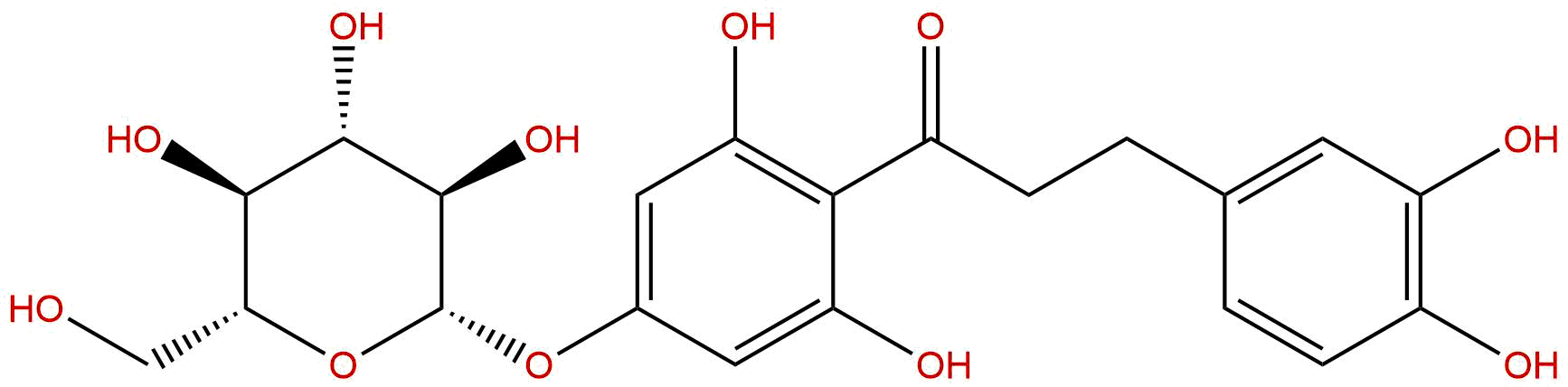


Product name: Sieboldin
Synonym name: 3-Hydroxyphloretin 4'-β-D-glucoside
Catalogue No.: BP4682
Cas No.: 18777-73-6
Formula: C21H24O11
Mol Weight: 452.412
Botanical Source:
Type of Compound: Chalcones
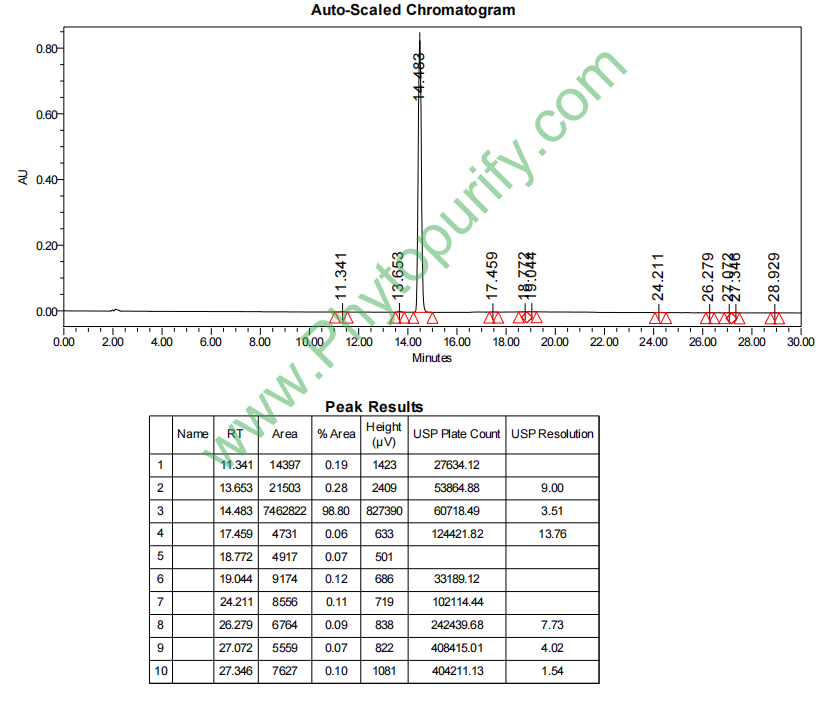
Purity: 95%~99%
Analysis Method: HPLC-DAD or/and HPLC-ELSD
Identification Method: Mass, NMR
Packing: Brown vial or HDPE plastic bottle
Storage: Store in a well closed container, protected from air and light. Put into refrigerate or freeze for long term storage.
Whenever possible, you should prepare and use solutions on the same day. However, if you need to make up stock solutions in advance, we recommend that you store the solution as aliquots in tightly sealed vials at -20℃. Generally, these will be useable for up to two weeks.
The product could be supplied from milligrams to grams
Inquire for bulk scale.
For Reference Standard and R&D, Not for Human Use Directly.
HPLC of Sieboldin
Storage conditions:Short-term storage at 2~8℃, long-term storage at -20 ~ -80℃
3-Hydroxytrefoil glycoside (Sieboldin, CAS number: 18777-73-6) is a naturally occurring dihydrochalcone compound that has received widespread attention due to its unique biological activity and potential medicinal value. As a natural product, 3-hydroxy trefoil glycoside not only shows significant anti diabetes activity, but also has multiple pharmacological effects such as free radical scavenging and cytotoxicity. In recent years, with the increasing incidence rate of diabetes and its complications, the research on advanced glycation end products (AGEs) and their related pathological mechanisms has become increasingly in-depth. 3-hydroxytrefoil glycoside has become a research hotspot because of its ability to inhibit the generation of AGEs. In addition, the compound also showed the ability to capture methylglyoxal (MGO), suggesting its potential application in alleviating diabetes related oxidative stress and protein carbonization damage.
This article provides a systematic review of the chemical structure and physicochemical properties, plant sources, and extraction methods of 3-hydroxytrefoil glycoside. It details its pharmacological activity and mechanism of action, evaluates its pharmacokinetic characteristics based on pharmacological parameters, and finally explores its clinical application prospects and future research directions. The aim is to provide theoretical basis and research references for the drug development of this natural product.
3-hydroxytrefoil glycoside belongs to dihydrochalcone compounds, with a molecular formula of C21H2O11 and a molecular weight of 452.4120. The core of its structure is a dihydrochalcone skeleton, and the introduction of a 3-hydroxyl group endows it with strong polarity and biological activity. In terms of physical and chemical properties, the LogP value of 3-hydroxytrefoil glycoside is 0.0815, indicating its strong hydrophilicity and water solubility of 4.0859, indicating its good solubility in aqueous phase. The extremely high topological polar surface area (TPSA) of 197.37 Å ² suggests that its molecular polarity is high, which may limit its passive diffusion ability through the cell membrane. The blood-brain barrier has low penetration, which is consistent with its characteristics of high polarity and molecular weight.
In addition, 3-hydroxytrefoil glycoside does not exhibit hERG channel inhibitory activity, and the Ames test result is 0.0, indicating that it has no significant genetic toxicity risk, which provides preliminary assurance for its safety. The structural characteristics and physicochemical properties of this compound lay the foundation for its pharmacological activity and drug formation.
3-hydroxytrefoil glycoside is mainly found in the Rosaceae plant Malus spp., especially in some Malus fruits and leaves where it is abundant. The diversity of its natural sources provides multiple possibilities for the acquisition of this compound. Both traditional Chinese medicinal herbs and wild crabapple fruits can be used as raw materials.
The extraction method usually uses organic solvent extraction combined with column chromatography separation technology. The specific steps include: crushing the dried crabapple fruit or leaves, reflux extraction with ethanol or methanol, concentration, liquid-liquid separation to remove impurities, purification by silica gel column or C18 reverse phase column chromatography, and finally qualitative and quantitative analysis by high performance liquid chromatography (HPLC). In recent years, green extraction techniques such as ultrasound assisted extraction and microwave-assisted extraction have also been applied to improve extraction efficiency and purity.
In addition, the exploration of synthetic biology and chemical synthesis routes has gradually begun to address the structural complexity of 3-hydroxytrefoil glycoside, providing new ideas for its large-scale production.
3-hydroxy trefoil glycoside shows significant potential in the field of anti diabetes. One of its main mechanisms of action is to inhibit the generation of advanced glycation end products (AGEs). AGEs are the key pathogenic factor in diabetes and its complications, which can cause oxidative stress, inflammatory reaction and tissue damage. 3-hydroxytrefoil glycoside reduces glycosylation related cell damage by inhibiting the reaction between bovine serum albumin (BSA) and sugars to generate AGEs.
In addition, the compound has regulatory effects on a variety of diabetes related targets, including activating AMPK (5 'AMP activated protein kinase), promoting the balance of glucose metabolism and lipid metabolism; Regulating the function of SGLT2 (sodium glucose cotransporter 2) and affecting renal glucose reabsorption; Activate GCK (glucokinase) and PPARG (peroxisome proliferator activated receptor gamma) to improve insulin sensitivity and lipid metabolism; Participate in the regulation of insulin signaling pathways such as AKT1, IRS1, PIK3R1, and INSR, enhance insulin signaling transduction, and promote glucose uptake and utilization.
3-hydroxytrefoil glycoside exhibits free radical scavenging ability in various cancer cell lines, significantly reducing reactive oxygen species (ROS) levels and alleviating cell damage caused by oxidative stress. Its antioxidant activity not only helps to protect cells from oxidative damage, but may also enhance their ability to resist stress by regulating the intracellular antioxidant enzyme system.
In various cancer cell lines, 3-hydroxytrefoil exhibits certain cytotoxicity, which can inhibit tumor cell proliferation and induce apoptosis. Its mechanism of action may involve regulating cell cycle related proteins, activating apoptotic signaling pathways, and inhibiting tumor related transcription factors. This characteristic provides a theoretical basis for its development as a potential anti-tumor drug.
3-hydroxy trefoil glycoside can effectively capture methyl glyoxal (MGO), the key intermediate product in the glycosylation process, reduce its nonenzymatic glycosylation reaction with protein, and alleviate diabetes related protein carbonization damage. This function is of great significance in preventing complications of diabetes, such as diabetes nephropathy and retinopathy.
The multi-target mechanism of action of 3-hydroxytrefoil glycoside is the basis for its significant pharmacological activity. Its main targets and mechanisms include:
The above multi target and multi mechanism synergistic effect makes 3-hydroxytrefoil glycoside show a wide application potential in the prevention and treatment of diabetes and related complications.
Based on the physicochemical properties and preliminary in vitro safety evaluation of 3-hydroxytrefoil glycoside, its pharmacological properties show certain advantages. Although the molecular weight of 452.4120 is slightly higher than the ideal range recommended by Lipinski's rule, its low LogP value (0.0815) and high water solubility (4.0859) are beneficial for in vivo absorption and distribution. A higher TPSA (197.37 Å ²) may limit its oral bioavailability and cell membrane penetration ability, but this also reduces its blood-brain barrier penetration and lowers the risk of central nervous system side effects.
The negative hERG channel inhibition test and no genotoxicity results in Ames test indicate its good safety. Further pharmacokinetic and toxicological studies are needed in the future to clarify its absorption, distribution, metabolism, and excretion (ADME) characteristics.
The existing pharmacokinetic data is relatively limited, but due to its strong polarity, it is expected that oral absorption may be limited. Therefore, it is necessary to consider improving drug formulations (such as nanocarriers, liposomes) or structural modifications to enhance bioavailability. In addition, research on metabolic stability and in vivo half-life will provide important basis for dose design and clinical application.
3-hydroxytrefoil glycoside, as a multifunctional natural product, has broad clinical application potential. Its multi-target regulatory role in the field of anti diabetes, especially the inhibition of AGEs production and the capture of MGO, provides a new strategy for the prevention and treatment of diabetes and its chronic complications. Combined with its free radical scavenging and cytoprotective effects, 3-hydroxytrefoil glycoside is expected to become an important adjuvant in the comprehensive management of diabetes.
In addition, its cytotoxicity and anticancer potential provide new ideas for the development of anti-tumor drugs. In the future, through structural optimization and drug carrier technology, its in vivo stability and targeting can be improved, and its clinical indications can be expanded.
However, current research mainly focuses on in vitro and animal models, lacking systematic preclinical and clinical trial data. In the future, it is necessary to strengthen in-depth research on its pharmacokinetics, toxicology, and pharmacodynamics, clarify the safe dose and effective dose range, and conduct clinical trials to verify its efficacy and safety.
At the same time, based on the design and synthesis of chemical derivatives of 3-hydroxytrefoil glycoside, combined with modern drug design concepts, it is expected to develop more potent candidate drugs and promote their clinical translation.
As a natural dihydrochalcone with significant anti diabetes and antioxidant activities, 3-hydroxy trefoil glycoside shows broad medicinal value by virtue of its multi target, multi mechanism pharmacological properties. Its inhibition of AGEs formation, MGO capture and regulation of key diabetes related signaling pathways provide a new molecular basis and treatment strategy for the prevention and treatment of diabetes and its complications.
Although research on its pharmacological properties and clinical applications is still in its early stages, its good safety and multiple pharmacological effects have laid a solid foundation for subsequent drug development. In the future, it is necessary to combine modern drug research and development technology to carry out systematic pharmacokinetic, toxicological, and clinical studies, promote the transition of 3-hydroxytrefoil glycoside from laboratory to clinical application, and benefit the vast number of patients.
In summary, 3-hydroxytrefoil glycoside, as a model for pharmacological research on natural products, has important scientific value and application prospects, and is worthy of continuous and in-depth exploration and development.
