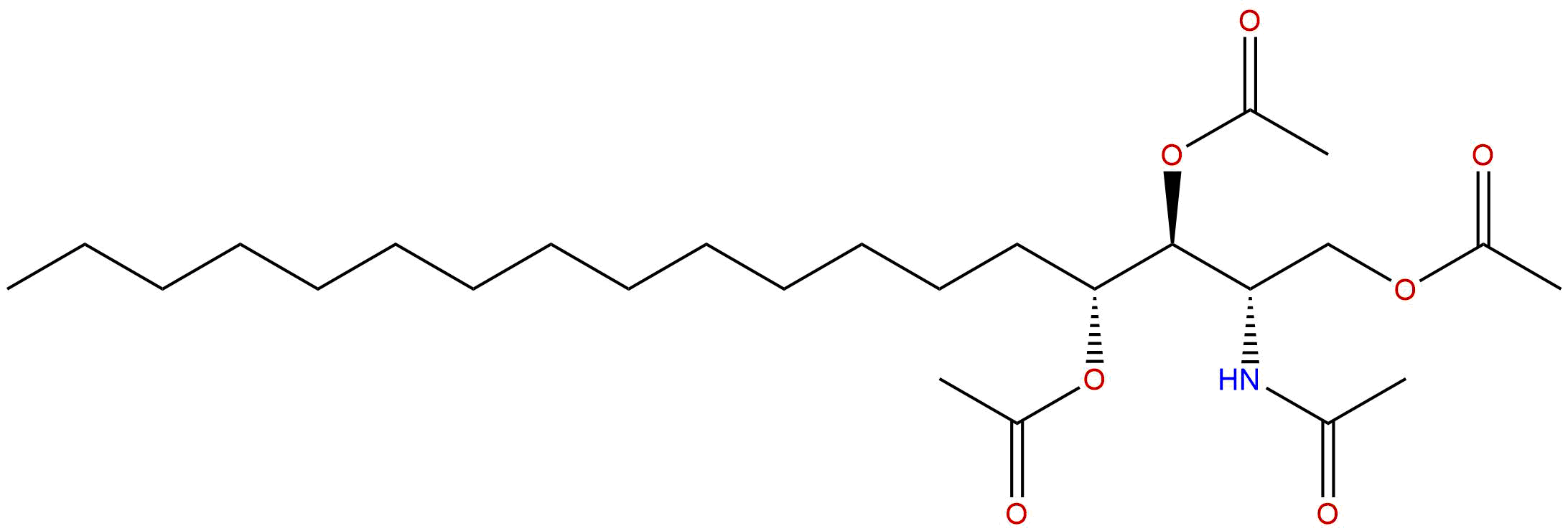


Product name: Tetraacetylphytosphingosine
Synonym name: Tetraacetylphytospingosine;Phytosphingosine tetraacetate; Tetraacetyl-4-hydroxysphinganine
Catalogue No.: BP2294
Cas No.: 13018-48-9
Formula: C26H47NO7
Mol Weight: 485.662
Botanical Source:
Type of Compound: Alkaloids
Purity: 95%~99%
Analysis Method: HPLC-DAD or/and HPLC-ELSD
Identification Method: Mass, NMR
Packing: Brown vial or HDPE plastic bottle
Storage: Store in a well closed container, protected from air and light. Put into refrigerate or freeze for long term storage.
Whenever possible, you should prepare and use solutions on the same day. However, if you need to make up stock solutions in advance, we recommend that you store the solution as aliquots in tightly sealed vials at -20℃. Generally, these will be useable for up to two weeks.
The product could be supplied from milligrams to grams
Inquire for bulk scale.
Tetraacetylphytosphingosine is a fatty acid that belongs to the group of polyunsaturated fatty acids. It has been shown to have anti-cancer activity in skin cells and can be used for the treatment of acne. Tetraacetylphytosphingosine is not active in the presence of amines, but it is activated by an enzyme in wheat germ called tyrosinase. This compound inhibits tyrosinase activity, which leads to reduced production of melanin. Tetraacetylphytosphingosine also reduces skin inflammation and can be used as a moisturizer. It also has an inhibitory effect on the growth of some bacteria, such as Mycobacterium tuberculosis and Mycobacterium avium complex, through its ability to bind with lipids on their cell surface.
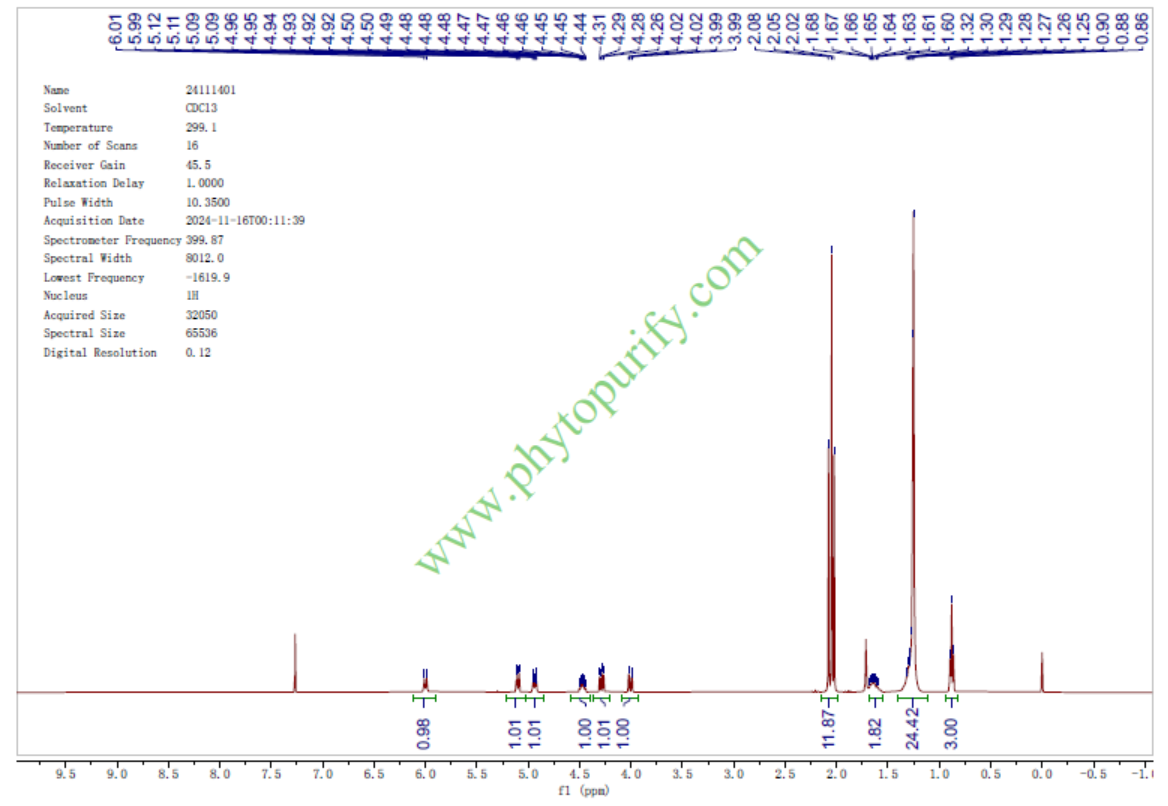
HNMR of Tetraacetylphytosphingosine
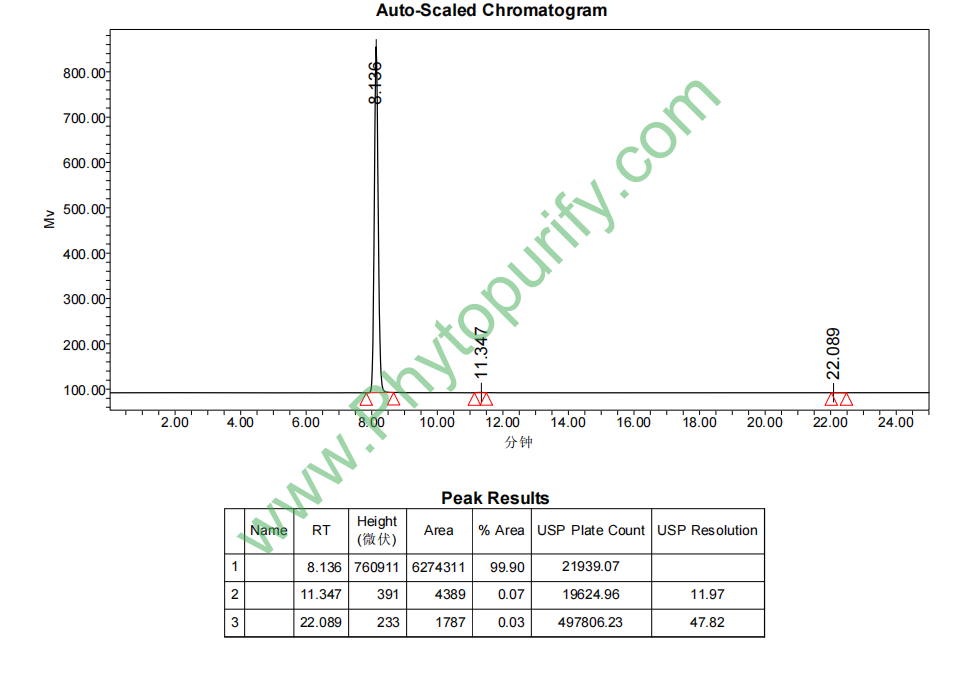
HPLC of Tetraacetylphytosphingosine
Storage conditions:Short-term storage at 2~8℃, long-term storage at -20 ~ -80℃
108.0000
4.5410
4.5404
.0197
.5842
.9792
Low
89.3317
3.5736
Yes
No
No
No
No
No
0.0
No
No
Yes
Yes
Sphingolipids are a class of structural and functional lipid molecules widely present in eukaryotic cell membranes. For a long time, they have been regarded as structural skeleton components of cell membranes. However, nearly thirty years of research have completely changed this understanding, revealing that sphingolipids and their metabolites are signaling molecules involved in regulating various key life activities such as cell proliferation, differentiation, aging, apoptosis, migration, and inflammatory responses. Among numerous sphingolipid metabolites, phytosphingosine (PHS) and its derivatives have attracted much attention due to their unique biological functions and potential therapeutic value. Plant sphingosine was initially discovered in plants and yeast, and is an important intermediate in the sphingolipid metabolism pathway. It is structurally similar to sphingosine in mammals, but has an additional hydroxyl group at the C4 position.
Tetraacetylphytosphingosine (TAPS), with CAS number 13018-48-9, is a derivative formed by acetylation modification of all four hydroxyl groups (including C1, C3, C4 hydroxyl groups and C2 amino group) of phytosphingosine. This chemical modification significantly alters the physicochemical properties and biological activity of the parent molecule. As a metabolite of sphingolipids, TAPS exhibits unique dual regulatory properties in the field of natural product pharmacology: on the one hand, it exerts significant anti angiogenic effects by inhibiting the activation of mitogen activated protein kinase (MAPK) and increasing intracellular calcium ion concentration; On the other hand, it can induce apoptosis in human immortalized keratinocytes (HaCaT cells). These findings closely link TAPS with a variety of pathological processes, especially those involving abnormal angiogenesis and cell proliferation, such as tumor, atherosclerosis, psoriasis and inflammatory bowel disease.
This article aims to provide a comprehensive professional review of tetraacetyl phytosphingosine, systematically elaborating on its chemical structure and physicochemical properties, plant sources and extraction methods, pharmacological activity research, mechanism of action and molecular targets, pharmacological evaluation and pharmacokinetic characteristics, and looking forward to its application prospects and challenges in clinical transformation, in order to provide reference for the in-depth research and development of this natural product.
The chemical essence of tetraacetyl phytosphingosine is the fully acetylated derivative of phytosphingosine. Plant sphingosine (2S, 3S, 4R) -2-aminooctadecane-1,3,4-triol) itself is a long-chain base containing 18 carbon atoms, characterized by an amino group at the C2 position and a hydroxyl group at the C1, C3, and C4 positions. TAPS converts all four active groups (one amino group and three hydroxyl groups) into acetyl derivatives through acetylation reaction, generating N-acetyl and three O-acetyl groups. Therefore, the chemical name of TAPS is N-acetyl-1,3,4-tri-O-acetyl phytosphingosine, and its molecular formula is C26H47NO7.
The molecular weight of this compound is 485.66 Da, which is a medium sized lipophilic molecule. Its oil-water partition coefficient (LogP) is 4.541, indicating that it has high lipophilicity, which is consistent with its long fatty chain and hydrophobic properties of acetyl groups. A high LogP value indicates poor solubility of TAPS in aqueous environments, with a calculated water solubility of only 0.0197 mg/mL. This poses challenges for its absorption, distribution, and formulation development in living organisms. The polar surface area (TPSA) is 108.00 Å ², which is slightly higher than the recommended standard of less than 140 Å ² in traditional oral medication "rules", but still within an acceptable range, indicating its potential for membrane permeability, but may depend on specific transport mechanisms or formulation techniques.
From the perspective of structure-activity relationship (SAR), acetylation modification is crucial for the biological function of TAPS. The parent molecule plant sphingosine itself has strong cytotoxicity and pro apoptotic activity, but after acetylation, its toxicity is significantly reduced, while obtaining new and more refined regulatory functions, such as anti angiogenesis. The introduction of acetyl groups not only changes the charge distribution and hydrogen bond donor/acceptor ability of the molecule, but may also affect its binding mode with specific protein targets. For example, the ability of TAPS to inhibit MAPK activation may be related to specific conformations or hydrophobic interactions mediated by its acetyl group. In addition, acetylation enhances the metabolic stability of the molecule, allowing it to exert its effects more persistently in the body.
Although tetraacetyl phytosphingosine does not exist in high concentrations in nature, it is an important modified product in the phytosphingosine metabolic pathway. Plant sphingosine is widely present in the plant kingdom, especially abundant in grains such as wheat and corn, soybeans, yeast, and certain fungi. In plants, phytosphingolipids mainly exist in glycosylated forms (such as phytosphingosine glucoside) or as skeletal components of complex sphingolipids (such as glycosylated ceramides). TAPS is usually obtained by acetylating naturally extracted plant sphingolipids through chemical or enzymatic methods, rather than directly isolating them in large quantities from plants.
The classic process for extracting TAPS or its precursor plant sphingosine typically includes the following key steps:
In recent years, with the promotion of green chemistry concepts, enzymatic synthesis of TAPS has also received attention. Using immobilized lipase or acyltransferase, the acetylation of plant sphingosine can be efficiently and selectively catalyzed in a water organic solvent two-phase system, avoiding the use of toxic pyridine and acetic anhydride. In addition, supercritical fluid extraction (SFE) technology has also been explored for more efficient and environmentally friendly extraction of sphingolipids from natural raw materials.
The pharmacological activity research of tetraacetyl phytosphingosine mainly focuses on its regulatory effects on angiogenesis and cell apoptosis, which have derived potential therapeutic value for various diseases.
1. Anti angiogenic activity
Angiogenesis is the process of forming new blood vessels from existing vascular networks and plays a key role in tumor growth, metastasis, atherosclerotic plaque progression, retinopathy, chronic inflammation and other diseases. TAPS has been proven to be an effective angiogenesis inhibitor. In vitro studies have shown that TAPS can significantly inhibit the proliferation, migration, and luminal formation of human umbilical vein endothelial cells (HUVECs) induced by vascular endothelial growth factor (VEGF) or basic fibroblast growth factor (bFGF). Its mechanism of action involves interference with intracellular signaling pathways. Specifically, TAPS can inhibit the phosphorylation activation of MAPK (especially ERK1/2 and p38) induced by VEGF stimulation. The MAPK pathway is one of the core pathways regulating endothelial cell proliferation and migration. In addition, TAPS can also block the increase in intracellular calcium ion concentration ([Ca ² ⁺] i) induced by VEGF. The dynamic changes in the concentration of calcium ions, as a second messenger, are crucial for endothelial cell activation, nitric oxide (NO) synthesis, and cytoskeleton rearrangement. TAPS effectively blocks the cascade of angiogenesis by inhibiting MAPK activation and calcium ion signaling. In vivo experiments, such as chicken embryo chorioallantoic membrane (CAM) model and mouse Matrigel plug experiment, further confirmed the anti angiogenic effect of TAPS in vivo, manifested by a significant decrease in neovascularization density and hemoglobin content.
2. Inducing cell apoptosis activity
In addition to its anti angiogenic effect, TAPS has also been found to have the ability to induce apoptosis in specific types of cells. Research has shown that TAPS can induce apoptosis in HaCaT cells (an immortalized human keratinocyte cell line) in a dose-dependent and time-dependent manner. HaCaT cells are a commonly used model for studying skin barrier function and skin diseases such as psoriasis. HaCaT cells treated with TAPS exhibit typical apoptotic morphological features, such as cell shrinkage, chromatin condensation, and DNA fragmentation. Flow cytometry analysis showed that TAPS treatment led to cell cycle arrest in the G0/G1 phase and increased the proportion of apoptosis peaks in the sub diploid (Sub-G1) phase. Further molecular mechanism studies have shown that TAPS induced apoptosis is related to the activation of the mitochondrial pathway, involving changes in the expression of Bcl-2 family proteins (such as upregulation of pro apoptotic protein Bax and downregulation of anti apoptotic protein Bcl-2), leading to loss of mitochondrial membrane potential, release of cytochrome c, and activation of Caspase-9 and Caspase-3, ultimately executing the apoptotic program. This selective induction of apoptosis in overexpressing keratinocytes provides a theoretical basis for the application of TAPS in proliferative skin diseases such as psoriasis.
3. Anti inflammatory and immune regulatory activity
Based on the regulation of TAPS on MAPK and calcium signals, and its association with a variety of inflammatory diseases (such as atherosclerosis, inflammatory bowel disease, multiple sclerosis), its anti-inflammatory and immunomodulatory activities have also received attention. The MAPK pathway is the core driver of inflammatory response, regulating the production of various pro-inflammatory cytokines such as TNF - α, IL-6, IL-1 β. By inhibiting MAPK activation, TAPS may exert a broad-spectrum anti-inflammatory effect. In addition, the regulation of intracellular calcium signaling by TAPS may also affect the activation and function of immune cells, such as T cell receptor signaling and degranulation of mast cells. Although the current systematic research on the anti-inflammatory activity of TAPS is not as in-depth as its anti angiogenesis research, its target network (such as AMPK, TLR4, STAT3, etc.) strongly suggests its potential anti-inflammatory and immune regulatory abilities. For example, the activation of AMPK is typically associated with anti-inflammatory and metabolic homeostasis, while TLR4 is a key receptor for innate immunity.
The pharmacological effects of tetraacetyl phytosphingosine are the result of multi-target and multi pathway synergistic effects. Based on existing research, its core mechanism of action can be summarized as follows:
1. Inhibit the MAPK signaling pathway
The MAPK family includes three main branches: ERK, JNK, and p38. TAPS has been shown to inhibit the phosphorylation of ERK1/2 and p38 induced by stimuli such as VEGF. The ERK pathway mainly regulates cell proliferation and differentiation, while the p38 pathway is closely related to stress response, inflammation, and cell migration. TAPS may block the cascade amplification of signals by directly or indirectly acting on upstream kinases (such as Raf, MEK) or phosphatases in the MAPK pathway. This mechanism is the core of its anti angiogenic activity.
2. Regulating intracellular calcium ion homeostasis
TAPS can inhibit the increase in intracellular calcium ion concentration induced by agonists. This may be achieved by affecting calcium ion channels on the cell membrane (such as transient receptor potential channel TRPV1, which is associated with psoriasis) or IP3 receptors on the endoplasmic reticulum (such as RYR2, which is associated with tumor angiogenesis). The inhibition of calcium ion signals directly affects the activity of downstream calmodulin dependent kinases (CaMK) and calmodulin phosphatases (Calcinurin), thereby regulating cytoskeleton reorganization, NO synthesis, and gene transcription.
3. Regulating apoptosis related proteins
The mechanism by which TAPS induces apoptosis in HaCaT cells involves the mitochondrial pathway. It regulates the balance of Bcl-2 family proteins (upregulating Bax, downregulating Bcl-2 and MCL1), increases mitochondrial outer membrane permeability, leads to cytochrome c release, and activates the Caspase cascade reaction. In addition, TAPS may also synergistically induce apoptosis by affecting death receptor pathways (such as TNF receptors) or endoplasmic reticulum stress pathways. The MCL1 and BCL2 in its target list directly support this mechanism.
4. Activate the AMPK signaling pathway
AMPK (AMP activated protein kinase) is a key sensor for cellular energy metabolism. The target list shows that AMPK (PRKAA1) is the common target of TAPS in many diseases (atherosclerosis, inflammatory bowel disease, psoriasis). The activation of AMPK typically has anti-inflammatory, anti proliferative, and metabolic health promoting effects. TAPS may activate AMPK by increasing the intracellular AMP/ATP ratio or directly acting on upstream kinases of AMPK, such as LKB1. The activation of AMPK can inhibit the mTOR pathway, thereby inhibiting cell growth and proliferation, and may improve vascular function through phosphorylation of eNOS, which is related to the anti atherosclerosis effect.
5. Intervention in lipid metabolism and inflammatory pathways
In the context of atherosclerosis, the targets of TAPS include LOX-1 (lectin like oxidized low-density lipoprotein receptor-1), ABCA1 (ATP binding cassette transporter A1) and EHMT2. LOX-1 is the main receptor for endothelial cells to uptake oxidized low-density lipoprotein (ox LDL), and its activation can cause endothelial dysfunction and inflammation. TAPS may alleviate the damage of ox LDL by inhibiting the expression or function of LOX-1. ABCA1 participates in cholesterol reverse transport, and its upregulation helps to clear excess cholesterol from the blood vessel wall. EHMT2 is a histone methyltransferase involved in epigenetic regulation. The regulation of TAPS on these targets suggests that it has potential in improving lipid metabolism and inhibiting atherosclerosis inflammation.
6. Regulating immune and inflammatory transcription factors
The target network of TAPS also includes NFKB1 (NF - κ B p50 subunit), STAT3, and RORC (retinoic acid associated orphan receptor gamma). NF - κ B and STAT3 are key pro-inflammatory transcription factors that regulate the expression of a large number of inflammation and immune related genes. RORC is a key transcription factor for Th17 cell differentiation and plays a central role in autoimmune diseases such as psoriasis and multiple sclerosis. TAPS may exert anti-inflammatory and immunomodulatory effects by inhibiting the activity or nuclear translocation of these transcription factors.
To evaluate whether a natural product can become a candidate drug, it is necessary to comprehensively consider its drug like and pharmacokinetic (ADME) properties. The performance of tetraacetyl phytosphingosine in this regard presents both opportunities and challenges.
1. Evaluation of drug properties
According to Lipinski's "Rule of Five", the molecular weight of TAPS (485.66 Da) is slightly higher than the threshold of 500 Da, and the LogP value (4.541) is also slightly higher than the threshold of 5, indicating that it may have poor oral bioavailability. Its TPSA (108.00 Å ²) and the number of hydrogen bond donors/acceptors (compliant with regulations) are favorable factors. Overall, TAPS is a molecule on the "edge of the rules", and its oral absorption may be limited, but it is not absolutely impossible and needs to be improved through formulation methods.
2. Pharmacokinetic characteristics (prediction and inference)
3. Safety evaluation
Based on the unique pharmacological activity and multi-target mechanism of action of tetraacetylphytosphingosine, its clinical application prospects in the following disease fields are worthy of further exploration:
1. Tumor treatment and anti angiogenic therapy
The most clear application prospect of TAPS lies in its anti angiogenic activity. The growth and metastasis of tumors are highly dependent on neovascularization. As a novel angiogenesis inhibitor, TAPS can be used alone or in combination with chemotherapy, radiotherapy, and other targeted drugs (such as VEGF inhibitors) to enhance anti-tumor efficacy and overcome drug resistance. Its unique mechanism (simultaneous inhibition of MAPK and calcium signaling) may provide a complementary or alternative approach to existing anti angiogenic therapies. Especially for certain tumor types that are insensitive to VEGF inhibitors, TAPS may have advantages.
2. Hypertrophic skin diseases such as psoriasis
TAPS can induce apoptosis of keratinocytes (HaCaT), and its targets include key molecules in the pathogenesis of psoriasis (such as STAT3, RORC, AMPK). This makes it a promising candidate drug for treating psoriasis. Compared with commonly used glucocorticoids or vitamin D3 derivatives, TAPS may provide a new mechanism of action, particularly suitable for patients who are unresponsive to traditional treatments or develop resistance. Topical preparations (such as ointments and creams) are the most direct form of development, which can maximize local efficacy while reducing systemic side effects.
3. Atherosclerosis and cardiovascular disease
TAPS is expected to be used to prevent atherosclerosis by inhibiting LOX-1, activating AMPK, regulating cholesterol transport (ABCA1) and anti-inflammatory mechanisms. It can inhibit the activation of vascular endothelial cells and the formation of foam cells, stabilize atherosclerotic plaque, and thus prevent cardiovascular events such as myocardial infarction and stroke. However, the main challenge in developing its cardiovascular indications is how to achieve effective oral absorption and targeted delivery to the vascular wall.
4. Inflammatory bowel disease and autoimmune diseases
The inhibitory effect of TAPS on inflammatory signaling pathways such as MAPK, NF - κ B, STAT3, and TLR4 makes it potential for the treatment of inflammatory bowel diseases (such as Crohn's disease, ulcerative colitis) and autoimmune diseases such as multiple sclerosis. TAPS may locally inhibit intestinal inflammation through oral or rectal administration (for IBD). For multiple sclerosis, due to its low BBB permeability, it may be necessary to develop special brain targeted delivery systems (such as nanoparticles, liposomes) or utilize their properties as prodrugs to produce active ingredients that can enter the central nervous system after metabolism in vivo.
Future prospects and challenges:
Tetraacetyl phytosphingosine, as a unique molecule derived from natural sphingolipid metabolism, has achieved a magnificent transformation from a cytotoxic molecule to a multifunctional signaling regulator through its acetylation modification. It combines anti angiogenesis, induction of specific cell apoptosis, anti-inflammatory and potential immune regulatory activities. Its mechanism of action involves multiple key signaling pathways and targets such as MAPK, calcium signaling, AMPK, Bcl-2 family, NF - κ B, STAT3, etc., exhibiting complex pharmacological characteristics of multi-target and networked regulation. This characteristic makes it show attractive therapeutic potential in many major disease fields such as tumor, psoriasis, atherosclerosis and autoimmune diseases.
However, the path from laboratory discovery to clinical application remains challenging. The pharmacokinetic challenges posed by its inherent physicochemical properties (high lipophilicity, low water solubility) are the primary obstacles. Future research should focus on the development of innovative formulation technologies, in-depth metabolic and pharmacokinetic characterization, precise validation of key targets, and systematic in vivo efficacy and safety evaluation. With the gradual tackling of these issues, tetraacetyl phytosphingosine and its derivatives are expected to become a new class of therapeutic drugs with unique value, contributing to the cause of human health. The in-depth study of these "edge" natural products also provides valuable examples for us to understand the complexity of the sphingolipid signaling network and develop innovative drugs based on natural products.
