Introduction/Overview
Tannic acid and its derivatives are a class of natural polyphenolic compounds widely present in various fruits, nuts, and medicinal plants, which have attracted much attention due to their significant biological activities such as antioxidant, anti-inflammatory, and anti-tumor. 3-O-Methylellagic acid (CAS: 51768-38-8), as one of the important methylated derivatives of ellagic acid, not only retains some of the active characteristics of the parent compound, but also exhibits a unique pharmacological spectrum due to its specific structural modifications. This compound was initially isolated from the skin of the South American fruit Myrciaria cauliflora, and subsequent studies have also found its presence in various other plants. Modern pharmacological studies have shown that 3-methylellagic acid has clear activities in anti-inflammatory, antibacterial and glucose metabolism regulation, such as its inhibitory activity against Staphylococcus aureus (MIC=32 μ g/mL) and its inhibitory effect on glucose transport, suggesting that it has potential application value in the field of infectious diseases and metabolic diseases. Of particular note is that its anti-inflammatory effect involves the regulation of multiple key inflammatory targets such as interleukin-6 (IL-6), signal transduction and transcription activator 3 (STAT3), tumor necrosis factor (TNF), etc., and the mechanisms are relatively diverse. This article aims to systematically review the chemical properties, plant sources, pharmacological activities, mechanisms of action, and potential medicinal properties of 3-methyltannic acid, in order to provide comprehensive scientific references for the in-depth research and development of this natural product.
Chemical structure and physicochemical properties
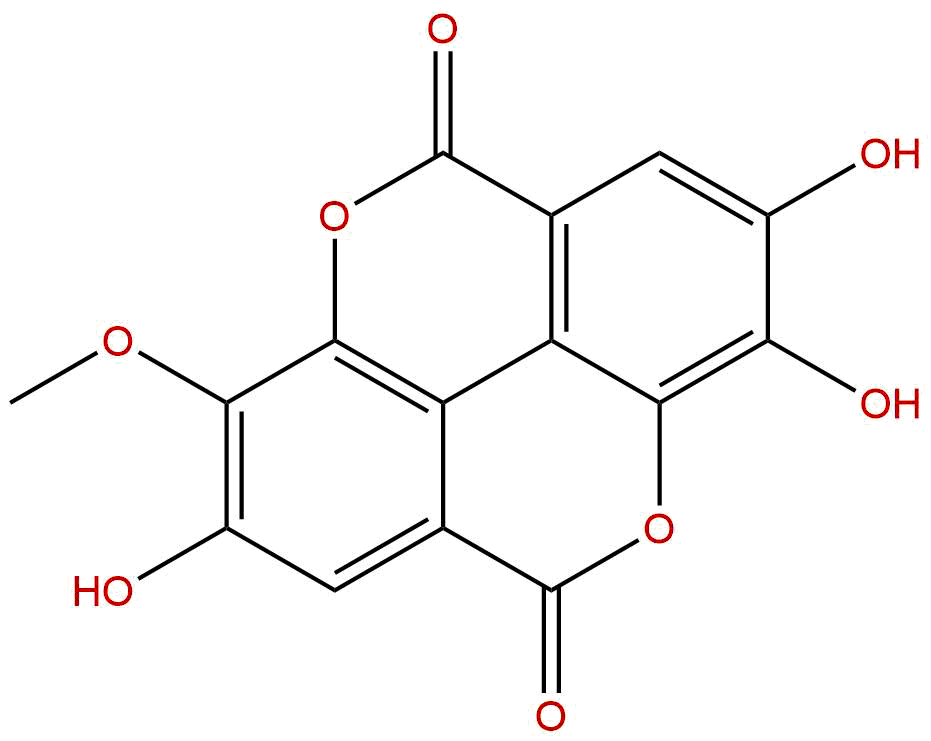
The chemical name of 3-methyltannic acid is 3-O-methyltannic acid, with a molecular formula of C16H10O8 and a molecular weight of 316.2210. Its core structure consists of two fused hexagonal lactone rings (i.e. benzofuranone structure) connected by a central hexagonal ring, forming a highly conjugated planar aromatic system. Compared with ellagic acid, its structural feature is that one of the phenolic hydroxyl groups (usually at position 3) undergoes methylation, forming a methoxy group (- OCH3). Although this structural modification is small, it significantly changes its physicochemical properties and biological activity.
In terms of physicochemical properties, the lipophilic water partition coefficient (LogP) of the compound is 1.6437, indicating that it has a certain degree of lipophilicity, but not highly hydrophobic. Its topological polar surface area (TPSA) is as high as 130.3400 Å ², mainly attributed to the presence of multiple carbonyl and hydroxyl/methoxy groups in the molecule, which are potential hydrogen bond donors and acceptors, resulting in strong molecular polarity. The calculated water solubility value is relatively low, about 0.0037 mg/mL, indicating poor solubility in water, which may be a limiting factor for its oral bioavailability. In the preliminary screening of drug safety, the Ames test value was 0.9, indicating no significant mutagenic risk in this testing system; Meanwhile, it has no inhibitory effect on hERG potassium channels, suggesting a lower risk of causing prolonged QT interval in the heart. In addition, its ability to cross the blood-brain barrier is predicted to be "low", which means it may not easily enter the central nervous system. For drugs that mainly act on the peripheral system, this may reduce central side effects, but also limit its therapeutic potential for central nervous system diseases.
Plant sources and extraction methods
3-methyltannic acid, as a plant secondary metabolite, mainly exists in the fruits, bark, and leaves of various plants. Its most famous source is Myrciaria cauliflora, commonly known as tree grape, which is a plant of the Rosaceae family native to South America. Its deep purple skin is rich in various tannic acid derivatives, including 3-methyltannic acid. In addition, the compound has also been found in other plant genera such as Eucalyptus, Punica granatum, Castanea, as well as some traditional medicinal plants such as Terminalia.
The extraction of 3-methyltannic acid from plant materials often uses universal extraction techniques for polyphenolic compounds. Classic methods include organic solvent extraction, commonly using methanol, ethanol, acetone, or their mixed solvents with water for leaching or reflux extraction. In order to improve extraction efficiency and selectivity, modern extraction techniques have been widely applied:
1. Ultrasound assisted extraction Utilizing the cavitation effect generated by ultrasound to destroy plant cell walls, accelerate solvent penetration and compound dissolution, has the advantages of short time, high efficiency, and low temperature.
2. Microwave assisted extraction Microwaves can directly act on polar molecules, causing a rapid increase in intracellular temperature and pressure, leading to cell rupture and rapid release of target components.
3. Supercritical fluid extraction Supercritical CO2 is usually used to change its solubility by adjusting pressure and temperature. This method is environmentally friendly and has high extraction purity, but the equipment cost is high, and often requires the addition of entrainers (such as ethanol) to improve the extraction rate of polar compounds.
After obtaining the crude extract, further separation and purification are required to obtain high-purity 3-methyltannic acid. The conventional purification steps include: preliminary enrichment using macroporous adsorption resins (such as AB-8, D101); Subsequently, silica gel column chromatography, polyamide column chromatography or Sephadex LH-20 column chromatography were used for subdivision; The final purification of monomeric compounds often relies on preparative high-performance liquid chromatography, achieved by optimizing the mobile phase (commonly methanol water or acetonitrile water systems, and adding a small amount of formic acid or acetic acid to adjust pH) and elution procedures. Structural identification involves the comprehensive use of techniques such as ultraviolet spectroscopy (UV), infrared spectroscopy (IR), mass spectrometry (MS), and nuclear magnetic resonance spectroscopy (NMR, especially 1H-NMR and 13C-NMR).
Pharmacological activity research
A large number of in vitro and in vivo pharmacological experiments have confirmed that 3-methyltannic acid has various biological activities, among which its anti-inflammatory, antibacterial, and effects on sugar metabolism are the most prominent.
- anti-inflammatory activity This is one of the most extensively studied activities of 3-methyltannic acid. In various inflammatory cell models (such as lipopolysaccharide induced macrophage RAW264.7) and animal models (such as carrageenan induced rat paw swelling and xylene induced mouse ear swelling), this compound has shown significant anti-inflammatory effects. It can effectively inhibit the production and release of inflammatory mediators, including nitric oxide (NO), prostaglandin E2 (PGE2), and various pro-inflammatory cytokines.
- Antibacterial activity 3-methyltannic acid has inhibitory effects on various bacteria. Research has shown that its minimum inhibitory concentration (MIC) against the standard strain ATCC 25923 of Staphylococcus aureus is 32 μ g/mL, indicating its moderate antibacterial potential. Its antibacterial mechanism may involve disrupting the integrity of bacterial cell membranes, inhibiting bacterial biofilm formation, or interfering with bacterial metabolic enzyme systems. In addition to Gram positive bacteria, it also has a certain inhibitory effect on some fungi and Gram negative bacteria, but the activity may vary depending on the strain.
- Inhibition of glucose transport Research has found that 3-methyltannic acid can inhibit cellular uptake of glucose. This activity suggests that it may intervene in cellular energy metabolism by affecting the function or expression of glucose transporters such as GLUT4. In pathological conditions, this effect may have a dual significance in inhibiting the proliferation of certain tumor cells (dependent on high glycolysis) or improving insulin resistance related metabolic disorders, but its specific effects are highly dependent on physiological or pathological backgrounds and require more detailed research to elucidate.
- Other activities Based on its polyphenol structure and antioxidant potential, 3-methyltannic acid also exhibits the ability to scavenge free radicals and resist oxidation. In addition, some preliminary studies suggest that it may have anti-tumor, anti fibrotic, neuroprotective and other activities, but these effects still require more evidence to support.
Mechanism of action and molecular targets
The pharmacological effects of 3-methyltannic acid, especially its core anti-inflammatory activity, are achieved by acting on key molecules in multiple inflammatory signaling pathways. The potential molecular targets revealed by existing research mainly include:
- Nuclear factor kappa B signaling pathway This is one of the core mechanisms of its anti-inflammatory effect. 3-methyltannic acid can inhibit the activity of IKBKB (I κ B kinase β), thereby preventing the phosphorylation and degradation of inhibitory protein I κ B, preventing the activation and translocation of transcription factor NF - κ B (its key subunit is RELA/p65) into the nucleus, and subsequently downregulating the expression of a series of NF - κ B-dependent pro-inflammatory genes (such as TNF - α, IL-6, NOS2).
- JAK/STAT signaling pathway This compound can inhibit the expression of key inflammatory cytokine IL-6 and its downstream signal transduction. After binding to its receptor, IL-6 activates JAK kinase, which in turn phosphorylates and activates transcription factor STAT3. 3-methyltannic acid can interfere with this process, inhibit STAT3 phosphorylation and nuclear translocation, and block its mediated inflammation and cell proliferation signals.
- Inflammatory bodies and cell pyroptosis CASP1 (cysteine protease-1) is a key executor of inflammasome activation, responsible for cleaving the precursors of IL-1 β and IL-18 into mature forms and triggering cell pyroptosis. Research has shown that 3-methyltannic acid may alleviate excessive inflammatory responses driven by inflammasomes by inhibiting the activation of CASP1.
- Inflammatory mediator synthase This compound can inhibit the activity or expression of inducible nitric oxide synthase (NOS2) and cyclooxygenase-1 (PTGS1/COX-1), thereby reducing the excessive production of inflammatory mediators NO and PGE2.
- Ion channels and receptors The study also found that 3-methyltannic acid may have a regulatory effect on transient receptor potential vanillic acid subtype 1 (TRPV1) and transient receptor potential anchor protein subtype 1 (TRPA1). These two channels are important receptors for pain and neurogenic inflammation, and their inhibition may contribute to the anti-inflammatory and analgesic effects of this compound.
- Pro-inflammatory cytokines Directly or indirectly inhibiting the production of core pro-inflammatory factors such as TNF - α is a direct manifestation of its anti-inflammatory effect.
In summary, 3-methyltannic acid does not act on a single target, but synergistically exerts anti-inflammatory effects through a multi-target, multi pathway network, which is consistent with the characteristics of many natural product mechanisms and may also help reduce drug resistance or side effects caused by single target inhibition.
Evaluation of drug properties and pharmacokinetics
Although 3-methyltannic acid exhibits encouraging pharmacological activity, its development into a drug still requires systematic pharmacological evaluation.
- Absorption, distribution, metabolism, excretion Currently, research on the pharmacokinetics of 3-methyltannic acid system is relatively limited. Based on its physicochemical properties (moderate LogP, high TPSA, low water solubility), it is predicted that its oral absorption may face challenges and its bioavailability may not be high. Its distribution in the body may be limited by its strong plasma protein binding rate and poor transmembrane ability (including low blood-brain barrier penetration). As polyphenolic compounds, they are likely to undergo extensive phase II metabolism in the body, such as glucuronidation and sulfation, forming more water-soluble complexes, which are then excreted through bile or urine. The gut microbiota may also modify its structure (such as hydrolysis, ring opening, etc.).
- Advantages and challenges of pharmaceutical properties:
- Advantage Clear structure, sourced from natural food, with a good foundation of safety; Preliminary safety screening (Ames test negative, no hERG inhibition) showed low potential risk; The multi-target mechanism of action may bring synergistic therapeutic effects.
- challenge:
- Solubility and permeability Low water solubility and high polarity may lead to poor oral absorption and low bioavailability, which are the primary obstacles to its drug development.
- Metabolic stability Phenolic hydroxyl groups are easily metabolized, which may result in a shorter half-life in the body.
- Formulation development To improve its bioavailability, advanced drug delivery technologies such as nanocrystals, liposomes, solid dispersions, cyclodextrin inclusion complexes, etc. may be needed to enhance its solubility and permeability.
- In vivo efficacy verification Most of the activity data comes from in vitro studies, and there is an urgent need to validate its in vivo effectiveness and dose-response relationship in more complex animal models of diseases.
Clinical application prospects and prospects
Based on existing pharmacological activities, 3-methyltannic acid has potential clinical application prospects in the following fields:
- Inflammatory related diseases This is its most direct application direction. It can be used to treat or assist in the treatment of chronic low-grade inflammation related diseases, such as arthritis, colitis, dermatitis, atherosclerosis, etc. Its multi-target anti-inflammatory properties may have better overall regulatory effects than single target anti-inflammatory drugs.
- infectious diseases Especially for skin and soft tissue infections caused by Gram positive bacteria such as Staphylococcus aureus, which are becoming increasingly resistant, it can be used as a candidate ingredient for local antibacterial agents or combined with existing antibiotics to enhance efficacy and reduce resistance.
- Metabolic diseases Its inhibitory effect on glucose transport may be valuable in specific contexts, such as inhibiting tumor cell glycolysis, but its impact on systemic glucose homeostasis needs to be carefully evaluated. What is more worth exploring is its potential to improve insulin resistance through anti-inflammatory effect, and provide new ideas for the prevention and treatment of type 2 diabetes and its complications.
- Functional food and cosmetic additives Due to its antioxidant and anti-inflammatory properties, it can be used as an ingredient in advanced functional foods or in the development of cosmetics and skincare products with anti allergic, soothing, and repairing effects.
Future research should focus on:
* In depth mechanism research Using techniques such as molecular docking, surface plasmon resonance, and gene knockout/knockdown, accurately verify its direct interaction with the aforementioned targets and elucidate its network pharmacology mechanism.
* Systematic pharmacokinetic study Conduct a comprehensive study on ADME in animals to determine its absolute bioavailability, tissue distribution, major metabolites, and excretion pathways.
* Pharmaceutical research Vigorously developing new drug delivery systems, breaking through their solubility and permeability bottlenecks, and improving their in vivo exposure and efficacy.
* Preclinical and clinical research Evaluate its therapeutic efficacy and safety on reliable animal models of diseases, and gradually advance to the clinical research stage.
Conclusion
3-methyltannic acid, as a natural derivative of tannic acid, has shown great potential for drug development due to its clear anti-inflammatory, antibacterial, and sugar metabolism regulating pharmacological activities, as well as its mechanism of action on multiple key signaling pathways such as IL-6/STAT3, NF - κ B, and CASP1. Although it faces challenges such as poor solubility and potential low bioavailability in drug development, modern drug chemical modification strategies (such as prodrug preparation) and advanced drug delivery technologies provide possibilities to address these issues. In the future, through interdisciplinary in-depth research, chemistry, pharmacology, pharmacy, and clinical medicine will be closely integrated, and this interesting natural molecule is expected to be transformed into innovative drugs or functional products with practical application value, providing new choices for the treatment of inflammation, infections, and metabolic related diseases.