


Synonym name: Nevadensin; Ethoxychelerythrine; 152743-19-6
Catalogue No.: BP0906
Cas No.: 10176-66-6
Formula: C18H16O7
Mol Weight: 344.319
Botanical Source:
Purity: 95%~99%
Analysis Method: HPLC-DAD or/and HPLC-ELSD
Identification Method: Mass, NMR
Packing: Brown vial or HDPE plastic bottle
Can be supplied from milligrams to grams.
For Reference Standard and R&D, Not for Human Use Directly.
Inquire for bulk scale.
Description:
Nevadensin is an important herb-based constituent inhibiting estragole bioactivation. Nevadensin protects against a methyleugenol-induced marker of hepatocarcinogenicity in male F344 rat. It also exhibits inhibition activity against Mycobacterium tuberculosis, with equal MIC value of 200 microg/mL.
References:
Food Chem Toxicol. 2014 Dec;74:28-34.
The natural basil flavonoid nevadensin protects against a methyleugenol-induced marker of hepatocarcinogenicity in male F344 rat.
The alkenylbenzene methyleugenol occurs naturally in a variety of spices and herbs, including basil, and their essential oils. At high dose levels methyleugenol induces hepatocarcinogenicity in rodents following bioactivation to 1'-sulfooxymethyleugenol which forms DNA adducts.
METHODS AND RESULTS:
This study investigated whether the inhibitory effect of the basil flavonoid Nevadensin on sulfotransferase (SULT)-mediated bioactivation of methyleugenol observed in vitro would also be reflected in a reduction of DNA adduct formation and a reduction in an early marker for liver carcinogenesis in an 8-week rat study. Co-exposure to methyleugenol and Nevadensin orally resulted in a significant inhibition of liver methyleugenol DNA adduct formation and in inhibition of hepatocellular altered foci induction, representing indicators for initiation of neoplasia.
CONCLUSIONS:
These results suggest that tumor formation could be lower in rodent bioassays when methyleugenol would be dosed in a matrix containing SULT inhibitors such as Nevadensin compared to experiments using the pure methyleugenol.
Arch Pharm Res. 2003 Oct;26(10):816-20.
Antimycobacterial and antioxidant flavones from Limnophila geoffrayi.
The chloroform extract of the aerial part of Limnophila geoffrayi showed antimycobacterial and antioxidant activities.
METHODS AND RESULTS:
Bioassay-guided fractionation has led to the isolation of the flavones Nevadensin (5,7-dihydroxy-6,8,4'-trimethoxyflavone, 1) and isothymusin (6,7-dimethoxy-5,8,4'-trihydroxyflavone, 2). Both compounds 1 and 2 exhibited inhibition activity against Mycobacterium tuberculosis, with equal MIC value of 200 microg/mL. Only compound 2 exhibited antioxidant activity against the radical scavenging ability of DPPH, with the IC50 value of 7.7 microg/mL.
CONCLUSIONS:
The crude hexane, chloroform and methanol extracts as well as the pure compounds 1 and 2 did not exhibit mutagenic activity in the Bacillus subtilis recassay.
Toxicol Appl Pharmacol. 2010 Jun 1;245(2):179-90.
Identification of nevadensin as an important herb-based constituent inhibiting estragole bioactivation and physiology-based biokinetic modeling of its possible in vivo effect.
Estragole is a natural constituent of several herbs and spices including sweet basil. In rodent bioassays, estragole induces hepatomas, an effect ascribed to estragole bioactivation to 1'-sulfooxyestragole resulting in DNA adduct formation.
METHODS AND RESULTS:
The present paper identifies Nevadensin as a basil constituent able to inhibit DNA adduct formation in rat hepatocytes exposed to the proximate carcinogen 1'-hydroxyestragole and Nevadensin. This inhibition occurs at the level of sulfotransferase (SULT)-mediated bioactivation of 1'-hydroxyestragole. The Ki for SULT inhibition by Nevadensin was 4 nM in male rat and human liver fractions. Furthermore, Nevadensin up to 20 microM did not inhibit 1'-hydroxyestragole detoxification by glucuronidation and oxidation. The inhibition of SULT by Nevadensin was incorporated into the recently developed physiologically based biokinetic (PBBK) rat and human models for estragole bioactivation and detoxification. The results predict that co-administration of estragole at a level inducing hepatic tumors in vivo (50mg/kg bw) with Nevadensin at a molar ratio of 0.06, representing the ratio of their occurrence in basil, results in almost 100% inhibition of the ultimate carcinogen 1'-sulfooxyestragole when assuming 100% uptake of Nevadensin. Assuming 1% uptake, inhibition would still amount to more than 83%. Altogether these data point at a Nevadensin-mediated inhibition of the formation of the ultimate carcinogenic metabolite of estragole, without reducing the capacity to detoxify 1'-hydroxyestragole via glucuronidation or oxidation.
CONCLUSIONS:
These data also point at a potential reduction of the cancer risk when estragole exposure occurs within a food matrix containing SULT inhibitors compared to what is observed upon exposure to pure estragole.
HPLC of Lysionotin
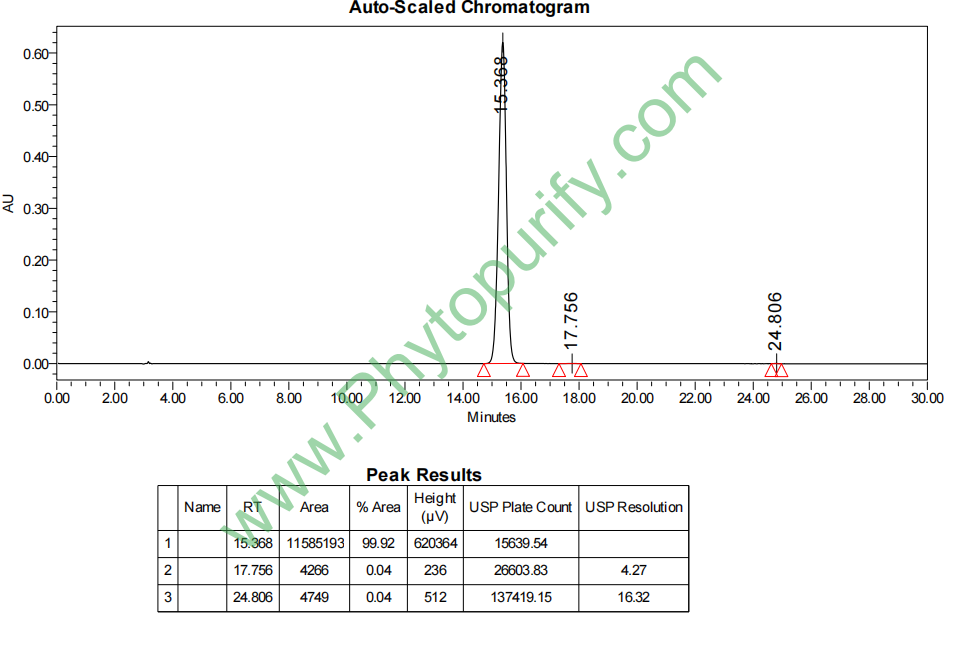
Storage conditions:Short-term storage at 2~8℃, long-term storage at -20 ~ -80℃
Lysionotin (CAS No. 10176-66-6) is a natural product of trimethoxyflavones with unique structural characteristics. Because of the special arrangement of its polyhydroxy and methoxy substituents, Lysionotin (CAS No. 10176-66-6) shows rich biological activity, especially in the field of anti tuberculosis, it shows potential pharmaceutical value. As a plant metabolite, chlorophytum comosum not only plays an important role in plant defense mechanism, but also its potential application in drug research and development is increasingly concerned. In recent years, with the intensification of drug resistance in tuberculosis, finding new anti tuberculosis drugs has become an urgent task in the field of global public health. Chlorophytum comosum has become one of the hot spots in natural product pharmacology because of its role in key targets of Mycobacterium tuberculosis.
This paper will systematically review the chemical structure and physical and chemical properties, plant sources and extraction methods, pharmacological activities and mechanisms, pharmaceutical evaluation and pharmacokinetic characteristics of chlorophytum comosum, and discuss its clinical application prospects and future development direction, with a view to providing comprehensive reference materials for scientific research workers and authors in related fields.
Chlorophytum comosum belongs to flavonoids, specifically trimethoxyflavone, with molecular formula of C18H16O7 and molecular weight of 344.3190. Its structural feature is that methoxy groups are substituted at positions 6, 8, and 4 'of the flavonoid skeleton, while hydroxyl groups are substituted at positions 5 and 7', forming a unique arrangement of functional groups. This structure combines the hydrophobicity of methoxyflavones with the hydrophilicity of hydroxyflavones, giving it a good basis for biological activity.
In terms of physical and chemical properties, the LogP value of chlorophytum comosum is 2.4315, indicating that it has moderate fat solubility and is conducive to the penetration of cell membrane. The polar surface area (TPSA) is 98.36 Å ², indicating that it has a certain polarity that facilitates binding to biological targets. Low water solubility (about 0.0108 mg/mL) suggests limited solubility in aqueous phase, which may affect its bioavailability. The low permeability of the blood-brain barrier indicates limited distribution in the central nervous system. The hERG channel inhibition experiment showed a negative result, indicating a low risk of cardiac toxicity. The Ames test value is 1.2, indicating a low risk of genotoxicity.
The molecular structure of chlorophytum comosum is shown in the following figure (the structural formula diagram should be inserted here). The distribution of its polyhydroxy and methoxy groups provides a variety of binding sites for its biological activity, especially in the interaction with protein targets, it shows a high affinity.
Chlorophytum comosum mainly exists in Lysionotus, especially in the leaves and stems of Lysionotus chlorophytum comosum and other species. This type of plant is widely distributed in temperate and subtropical regions of Asia and has traditionally been used as a traditional Chinese herbal medicine. It has the effects of clearing heat, detoxifying, reducing inflammation, and relieving pain.
The common methods of extracting chlorophytum comosum include solvent extraction, ultrasonic assisted extraction and column chromatography. Ethanol or methanol are generally used as extraction solvents, combined with ultrasound assisted technology to improve extraction efficiency. The extraction process is usually as follows:
In recent years, green extraction technologies such as supercritical CO2 extraction and microwave assisted extraction have also been tried to be applied to the extraction of chlorophytum comosum to improve efficiency and reduce environmental pollution.
The pharmacological activities of chlorophytum comosum mainly focus on its anti tuberculosis effect and related antibacterial and anti-inflammatory activities. Several in vitro and in vivo experiments showed that chlorophytum comosum had a significant inhibitory effect on Mycobacterium tuberculosis, especially in drug-resistant strains.
Chlorophytum comosum interferes with the physiological function of Mycobacterium tuberculosis through a multi-target mechanism. It has inhibitory effects on key targets such as INHA (pyruvate dehydrogenase inhibitory protein), KATG (catalase), EMBR (cell wall synthase), RPOB (RNA polymerase beta subunit), and PNC1 (penicillin binding protein), blocking bacterial energy metabolism, cell wall synthesis, and gene transcription processes, ultimately leading to bacterial death or growth restriction.
In addition to anti tuberculosis, chlorophytum comosum also showed some antioxidant and anti-inflammatory activities. Its hydroxyl group can effectively eliminate free radicals and alleviate oxidative stress damage. In the inflammatory model, chlorophytum comosum reduces the tissue inflammatory response by inhibiting the expression of inflammatory factors such as TNF - α and IL-6. In addition, some studies suggest that it also has potential effects on liver protection and neuroprotection, but the relevant mechanisms still need to be further explored.
The mechanism of action of chlorophytum comosum involves multiple biological pathways, which mainly inhibits its biosynthesis and metabolism by combining with key enzymes and proteins of Mycobacterium tuberculosis.
Molecular docking and dynamics simulation showed that the methoxy and hydroxyl groups of chlorophytum comosum formed stable binding with the active site of the target protein through hydrogen bonding and hydrophobic interaction, and enhanced its inhibitory activity. In addition, the structural characteristics of chlorophytum comosum enable it to cross the bacterial cell wall and reach the target site.
The pharmaceutical property parameters of chlorophytum comosum show that it has certain development potential:
In terms of pharmacokinetics, existing research is relatively limited. The preliminary in vivo experiment showed that the absorption of chlorophytum comosum after oral administration was slow, the plasma half-life was moderate, and it was mainly metabolized by the liver, and the metabolites were not yet completely clear. Due to its low water solubility and limited bioavailability, it is necessary to improve its in vivo stability and absorption efficiency through technologies such as nanocarriers, liposomes, or solid dispersions in the future.
As a multi target anti tuberculosis natural product, chlorophytum comosum has good pharmacological activity and safety, showing the potential to become a new anti tuberculosis drug. Its multi target mechanism of action helps to overcome the defect that single target drugs are prone to drug resistance, and provides new ideas for the treatment of tuberculosis.
The key to future clinical applications lies in:
In addition, the potential application of chlorophytum comosum in anti inflammation, anti-oxidation and other aspects is also worth exploring, which may play an auxiliary role in a variety of chronic diseases.
Chlorophytum comosum, as a kind of natural product with unique structure and trimethoxy flavonoids, has become an important object of natural product pharmacology research because of its remarkable anti tuberculosis activity and good pharmaceutical parameters. Its multi-target mechanism of action provides a new direction for the development of anti tuberculosis drugs. Although the research on its pharmacokinetics and clinical application is still in its infancy, with the development of extraction and purification technology and drug delivery system, chlorophytum comosum is expected to become a new candidate drug for anti tuberculosis treatment in the future.
Future research should focus on in-depth analysis of its mechanism of action, optimization of drug dosage forms and systematic preclinical and clinical research, with a view to promoting the clinical application of chlorophytum comosum from the laboratory, benefiting tuberculosis patients, and expanding its application potential in other disease fields.
