Introduction/Overview
Natural products, as an important source of drug discovery and development, play an irreplaceable role in the history of human disease prevention and treatment. Cycloterpenoids are a class of structurally diverse and biologically active secondary metabolites found in natural products, widely distributed in plants such as Gentianaceae, Rubiaceae, and Lamiaceae. Among them, Gentiopicroside, as a characteristic bitter component and main active substance of Gentianaceae plants, has been widely studied for its pharmacological effects such as anti-inflammatory, hepatoprotective, analgesic, and anti-tumor effects. 6 '- O - β - D-glucosylgentiopicroside (CAS: 115713-06-9) is a glycosylated derivative of gentiopicroside, in which a glucose unit is further attached to the 6' hydroxyl group of the glucose group. This glycosylation modification not only changes its physicochemical properties, but may also significantly affect its biological activity, metabolic stability, and in vivo distribution. In recent years, with the advancement of separation and identification techniques and the development of natural product glycobiology, these glycosylated cyclohexene ether terpenoid glycosides have received increasing attention. This article aims to systematically review the chemical structure, plant origin, pharmacological activity, mechanism of action, and pharmacological potential of 6 '- O - β - D-glucosylgentiopicroside, in order to provide comprehensive scientific references for the in-depth research and development of this compound.
Chemical structure and physicochemical properties
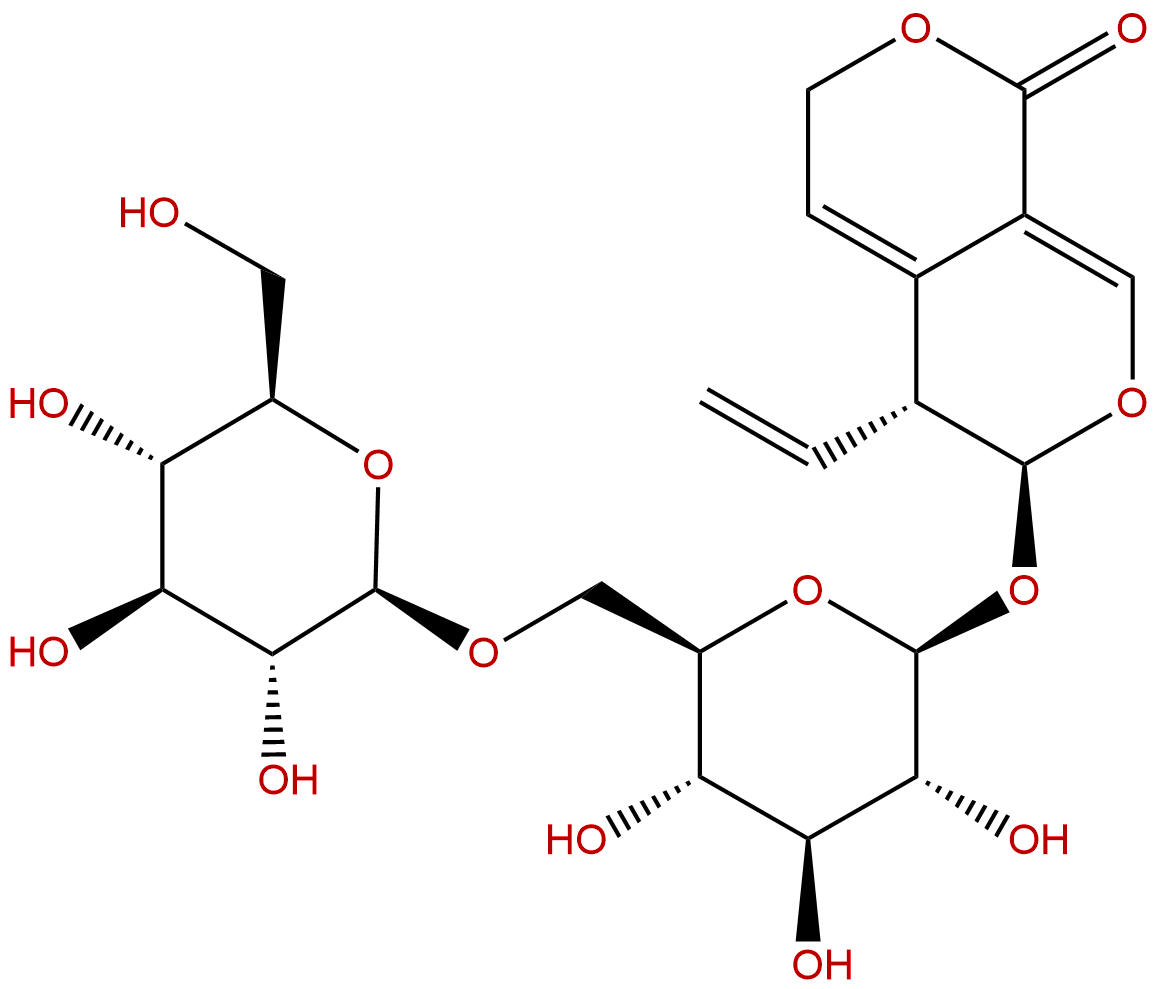
The chemical name of 6 '- O - β - D-glucosylgentiopicroside is (1S, 4aS, 7S, 7aS) -1- [(β - D-Glucopyranosyloxy) methyl] -1,4a, 5,6,7,7a-hexahydro-7-hydroxy-cyclopenta [c] pyran-4-carbonyl acid 6' - O - β - D-Glucopyranoside. Its molecular formula is C23H34O15 and its molecular weight is 518.4680.
Structurally, the compound has a cyclohexene ether terpene glycoside as its parent nucleus, with its C-1 position connected to a β - D-glucose group (internal sugar group) through an oxygen atom. The 6 '- hydroxyl group of the internal sugar group is further linked to another β - D-glucose group (external sugar group) through a glycosidic bond, forming a disaccharide chain. This structure makes it the O-diglucoside of gentiopicroside. The introduction of sugar groups significantly enhances the hydrophilicity of the molecule.
The key physicochemical property parameters are as follows:
* Lipid water partition coefficient (LogP)The calculated value is about -1.8615, indicating that the compound has strong hydrophilicity and is not easily able to penetrate the lipid bilayer, which poses a challenge to its oral absorption and cell membrane permeability.
* Topological Polarity Surface Area (TPSA)Up to 214.0600 Å ², mainly attributed to multiple hydroxyl and ether oxygen atoms in the molecule, further confirming its high hydrophilicity and potential as a substrate for interacting with transporters such as glucose transporters.
* Water solubility The predicted value is as high as 45.2817 mg/L, indicating that it has good solubility in aqueous media, which is beneficial for the preparation of water-soluble formulations.
* Blood-brain barrier permeability Predicted as' low ', which is consistent with high TPSA and negative LogP values, indicating that it is difficult for it to freely diffuse into the central nervous system, but may also avoid potential neurotoxicity.
* HERG inhibition risk A prediction of 'no' indicates that the compound may not inhibit rapid delayed rectifier potassium channels in the heart at conventional concentrations, and the risk of cardiac toxicity is low.
* Genotoxicity (Ames test)The predicted value is 0.3, and it is generally believed that a value less than 1.0 indicates no mutagenic tendency, indicating a low risk of genetic toxicity.
These physicochemical properties provide a fundamental framework for subsequent pharmacological activity research and drug evaluation.
Plant sources and extraction methods
6 '- O - β - D-glucosylgentiopicroside mainly comes from Gentianaceae plants, especially Gentianaceae genus(Gentiana)And the genus Swertia(Swertia)Plants. Common sources include:
1. Large Leaf Gentian(Gentiana macrophylla Pall.: As a traditional Chinese medicine, it is used to dispel rheumatism, clear dampness and heat, and relieve rheumatism and pain. This compound is another important iridoid glycoside component in Gentiana macrophylla, besides gentiopicroside and swertiamarin.
2. Thick stemmed Gentiana macrophylla(Gentiana crassicaulis Duthie ex Burk Gentiana Fried Dough Twists(Gentiana straminea Maxim.: It is also the original plant of the traditional Chinese medicine Gentiana macrophylla and contains this ingredient.
3. Western Sichuan Swertia(Swertia mussotii Franch. and other plants of the Swertia genus: commonly used in Tibetan medicine to treat hepatitis and cholecystitis, and also a potential source of this compound.
Extraction and Separation Methods Usually following the conventional process of natural product chemistry:
1. Extract Alcohol solvents (such as methanol, ethanol) or alcohol water mixed solvents with different ratios are often used for reflux extraction or ultrasound assisted extraction of dried plant roots or whole plants. Water extraction can also be obtained, but with more impurities.
2. Enrichment and preliminary separation After the extraction solution is concentrated under reduced pressure, the resulting extract is often subjected to liquid-liquid distribution extraction using organic solvents such as petroleum ether, ethyl acetate, and n-butanol in sequence. Due to its strong hydrophilicity, the compound is mainly enriched in the n-butanol extraction site and water site.
3. Fine separation The n-butanol fraction is further purified using various chromatographic techniques, including:
* Column chromatography Silica gel, reverse phase silica gel (such as ODS-C18), macroporous adsorption resin (such as D101, AB-8), or polyamide are commonly used as stationary phases for gradient elution using chloroform methanol water or methanol water systems in different ratios.
* High performance liquid chromatography Prepa HPLC is the final key step in obtaining high-purity monomers, typically using a reverse phase C18 chromatography column with methanol water or acetonitrile water as the mobile phase.
4. appraisal The structural identification of compounds mainly relies on modern spectroscopic techniques, including nuclear magnetic resonance (NMR, especially 1H-NMR, 13C-NMR, HSQC, HMBC, etc.), mass spectrometry (MS, such as ESI-MS, HR-ESI-MS), and optical rotation determination, which are confirmed by comparing with literature data or standard samples.
Pharmacological activity research
Existing studies have shown that 6 '- O - β - D-glucosylgentiopicroside inherits some of the biological activities of parent nucleus gentiopicroside and exhibits unique or stronger effects in certain aspects.
-
Anti inflammatory and immune regulatory activity This is one of the most extensively studied activities of the compound. In the RAW 264.7 macrophage inflammation model induced by lipopolysaccharide (LPS), it can dose dependently inhibit the production of key inflammatory mediators such as nitric oxide (NO), prostaglandin E2 (PGE2), tumor necrosis factor - α (TNF - α), and interleukin-6 (IL-6). Its anti-inflammatory strength is comparable or superior to gentiopicroside in some studies. In addition, it can also inhibit the protein expression of inflammation related enzymes such as inducible nitric oxide synthase (iNOS) and cyclooxygenase-2 (COX-2). In in vivo experiments, it also showed good inhibitory effects on acute inflammation models such as ear swelling and paw swelling in mice.
-
Liver protective activity Regarding chemical liver injury, studies have shown that this compound has a protective effect on liver cell damage induced by carbon tetrachloride (CCl4), acetaminophen (APAP), or D-galactosamine. The mechanism may be related to reducing oxidative stress, inhibiting inflammatory response, and maintaining the stability of liver cell membrane. In relevant models, it can reduce the levels of alanine aminotransferase (ALT) and aspartate aminotransferase (AST) in serum and improve liver pathological damage.
-
Analgesic effect Based on the traditional use of its source plant, Gentiana macrophylla, for relieving rheumatism and pain, research has found that this compound exhibits certain analgesic effects in mouse acetic acid writhing tests and hot plate induced pain tests. Its effects may be related to central and peripheral anti-inflammatory mechanisms, rather than directly acting on opioid receptors.
-
Preliminary exploration of anti-tumor activity A few in vitro studies suggest that this compound has inhibitory effects on the proliferation of certain tumor cell lines, such as human liver cancer HepG2 cells and human lung cancer A549 cells, and can induce cell apoptosis. However, the strength and specificity of its anti-tumor activity still require extensive research verification, and its high hydrophilicity may limit its entry into tumor cells.
-
Other potential activities Based on the commonality of iridoid glycosides, this compound may also have potential activities such as antioxidant and antiviral (such as hepatitis virus), but there are few targeted research reports on this topic.
Mechanism of action and molecular targets
The pharmacological effects of 6 '- O - β - D-glucosylgentiopicroside involve multi-target and multi pathway regulation, and current research mainly focuses on its anti-inflammatory and liver protective signaling pathways.
-
Inhibition of nuclear factor kappa B (NF - κ B) signaling pathway This is the core mechanism by which it exerts anti-inflammatory effects. Under stimulation such as LPS, this compound can inhibit the phosphorylation and degradation of I κ B α, thereby preventing the nuclear translocation of NF - κ B p65 subunit. The decrease of p65 entering the nucleus leads to the inhibition of transcription of downstream inflammatory cytokine genes such as iNOS, COX-2, TNF - α, IL-6, etc.
-
Regulation of mitogen activated protein kinase (MAPK) pathway Research has shown that this compound can inhibit the phosphorylation activation of p38 MAPK, extracellular signal regulated kinase (ERK), and c-Jun N-terminal kinase (JNK) induced by LPS in RAW 264.7 cells. The MAPK pathway and NF - κ B pathway have a cross-talk and jointly regulate inflammatory responses.
-
Activation of Nrf2/ARE antioxidant pathway In liver protection research, this compound may promote the transfer of nuclear factor E2 related factor 2 (Nrf2) from the cytoplasm to the nucleus by activating it, thereby upregulating the expression of downstream antioxidant enzymes such as heme oxygenase-1 (HO-1) and quinone oxidoreductase 1 (NQO1), enhancing the cell's antioxidant defense ability, and reducing oxidative stress damage.
-
Potential interactions with glucose transporters (GLUTs)The disaccharide units in its structure suggest that it may act as a substrate or competitive inhibitor for certain glucose transporters (such as GLUT1, GLUT2), thereby affecting cellular energy metabolism and signal transduction. This may be a potential direction for its unique activity, but it remains to be verified.
-
Regulation of gut microbiota As glycoside compounds, they may be difficult to be directly absorbed by the upper gastrointestinal tract, but they may be metabolized by gut microbiota after reaching the colon. Glycoside hydrolases in the gut microbiota may hydrolyze it into gentiopicroside and glucose, or further convert it. Therefore, some of its in vivo activity may be derived from its metabolites or indirectly achieved by regulating the composition of the gut microbiota.
Evaluation of drug properties and pharmacokinetics
Although 6 '- O - β - D-glucosylgentiopicroside exhibits good biological activity, its pharmacological properties face a series of challenges, mainly due to its highly hydrophilic nature.
-
absorb The high hydrophilicity (low LogP, high TPSA) results in extremely poor passive transmembrane diffusion ability, and the expected oral bioavailability is low. It may be partially absorbed through active transporters on intestinal epithelial cells, such as sodium glucose cotransporter SGLT1 or glucose transporter GLUTs, but the efficiency remains to be studied. Non oral administration routes (such as intravenous injection) can avoid absorption issues.
-
distribution The predicted low blood-brain barrier permeability limits its application in central nervous system diseases, but may also reduce central side effects. Its hydrophilicity makes it mainly distributed in blood and extracellular fluid, with limited tissue permeability.
-
Metabolism As a glycoside compound, it may act as a substrate for gut microbiota and glycosidases (such as β - glucosidase) in the body. In the intestine and liver, the external or internal sugar groups may be gradually hydrolyzed to produce gentiopicroside and glucose. Therefore, its in vivo efficacy may be the result of the combined action of the prototype drug and its metabolites (especially gentiopicroside). It is crucial to clarify its metabolic pathways and main active forms.
-
excretion Hydrophilic compounds and their metabolites are mainly excreted through the kidneys and urine.
-
Preliminary Safety Assessment Based on computational predictions, its hERG inhibition and Ames mutagenicity risk are low, indicating that it has a good safety starting point. However, comprehensive experimental data on acute toxicity, long-term toxicity, and reproductive toxicity are currently blank.
Current status of pharmacokinetic research Currently, there are very limited reports on pharmacokinetic studies of this compound system. Limited animal experiments (such as intravenous injection or gavage in rats) suggest that the concentration of its prototype drug in plasma may be low and eliminated quickly. Developing sensitive and specific biological analysis methods (such as LC-MS/MS) to simultaneously detect the prototype drug and its main metabolites (such as gentiopicroside) is key to elucidating its in vivo processes.
Optimization strategy for drug properties To improve its bioavailability and targeting, the following strategies can be considered:
* Prodrug design Esterification, acylation and other modifications of hydroxyl groups are carried out to prepare lipophilic prodrugs, improve membrane permeability, and release active ingredients in vivo through enzymatic interpretation.
* Nano delivery system Encapsulate it in liposomes, polymer nanoparticles, or micelles to enhance its stability, promote intestinal lymphatic absorption, or achieve passive/active targeting.
* Eutectic/Eutectic Amorphous Technology Form eutectic or co amorphous materials with suitable excipients to improve their solubility and dissolution rate.
Clinical application prospects and prospects
The clinical application prospects of 6 '- O - β - D-glucosylgentiopicroside are closely related to its pharmacological activity characteristics, but also face bottlenecks in translational research.
Potential application directions:
1. Inflammatory diseases As an anti-inflammatory agent, it is expected to be developed for the treatment of chronic inflammatory diseases such as rheumatoid arthritis, enteritis, dermatitis, etc., especially when administered locally (such as intra-articular injection, topical preparations), it can avoid the weakness of poor systemic absorption.
2. liver disease As a component of hepatoprotective drugs, it can be used as an adjuvant therapy for viral hepatitis, drug-induced liver injury, alcoholic liver disease, etc. It can be considered to be used in combination with existing hepatoprotective drugs or developed into targeted formulations for the liver.
3. Analgesic adjuvant therapy Especially suitable for inflammatory pain, it can be used as a supplement or alternative to nonsteroidal anti-inflammatory drugs (NSAIDs) and may have better gastrointestinal safety.
4. Functional food/health supplement additives Given its natural origin and good safety prediction, it can be used as a raw material with anti-inflammatory and hepatoprotective functions for the development of functional foods or dietary supplements.
Future research prospects:
1. In depth mechanism exploration Using techniques such as molecular docking, surface plasmon resonance (SPR), and chemical proteomics, we aim to identify the protein targets that it directly targets. Further investigate its regulatory effects on the differentiation and function of immune cells, such as T cells and B cells.
2. Systematic pharmacokinetic study Conduct a comprehensive study on ADME, clarify its absorption, distribution, metabolism (especially intestinal microbiota metabolism), and excretion patterns in different species, and establish an "in vivo exposure pharmacological" relationship.
3. Optimization of drug properties and development of formulations Actively applying modern pharmaceutical technology, developing new delivery systems suitable for its physicochemical properties, and improving its bioavailability and targeting.
4. Expand activity spectrum research: Explore its role in metabolic diseases (such as diabetes and its complications), neurodegenerative diseases (although BBB has poor penetrability, it can indirectly affect by regulating peripheral inflammation) and other broader diseases.
5. Study on Structure Activity Relationship Synthesize a series of derivatives or analogues, study the effects of sugar group quantity, connection position, and glycoside modification on their activity and drug properties, and guide the design of more optimal candidate compounds.
Conclusion
6 '- O - β - D-glucosyl gentiopicroside, as an important glycosylated derivative of gentiopicroside, is a natural iridoid glycoside with clear anti-inflammatory and hepatoprotective pharmacological activities in medicinal plants of the Gentianaceae family. Its unique disaccharide structure endows it with highly hydrophilic physicochemical properties, which is both the basis for its specific biological activity and the main challenge for its oral drug formulation. The current research has preliminarily revealed its molecular mechanism of action by inhibiting the NF - κ B and MAPK inflammatory signaling pathways, activating the Nrf2 antioxidant pathway, and so on. However, the pharmacokinetic characteristics of its system, the exact active form in vivo, the direct molecular targets, and the formulation studies aimed at overcoming its physicochemical deficiencies are still in their infancy. In the future, through interdisciplinary integration and in-depth elucidation of its scientific connotation, while actively utilizing modern medicinal chemistry and pharmacy methods for optimization and transformation, it is expected to transform the active ingredients in this traditional medicinal plant into candidate drugs or functional products with clear clinical application value, providing a new paradigm for the modern development of natural products.