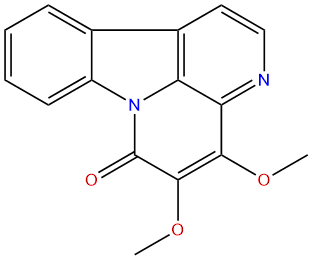


Product name: 4,5-Dimethoxycanthin-6-one
Synonym name: 4,5-Dimethoxy-β-canthin-6-one; Methylnigakinone
Catalogue No.: SBP00667
Cas No.: 18110-87-7
Formula: C16H12N2O3
Mol Weight: 280.283
Botanical Source:
Physical Description:
Type of Compound: Alkaloids
Purity: 95%~99%
Analysis Method: HPLC-DAD or/and HPLC-ELSD
Identification Method: Mass, NMR
Packing: Brown vial or HDPE plastic bottle
Storage: Store in a well closed container, protected from air and light. Put into refrigerate or freeze for long term storage.
Whenever possible, you should prepare and use solutions on the same day. However, if you need to make up stock solutions in advance, we recommend that you store the solution as aliquots in tightly sealed vials at -20℃. Generally, these will be useable for up to two weeks.
The product could be supplied from milligrams to grams
Inquire for bulk scale.
For Reference Standard and R&D, Not for Human Use Directly.
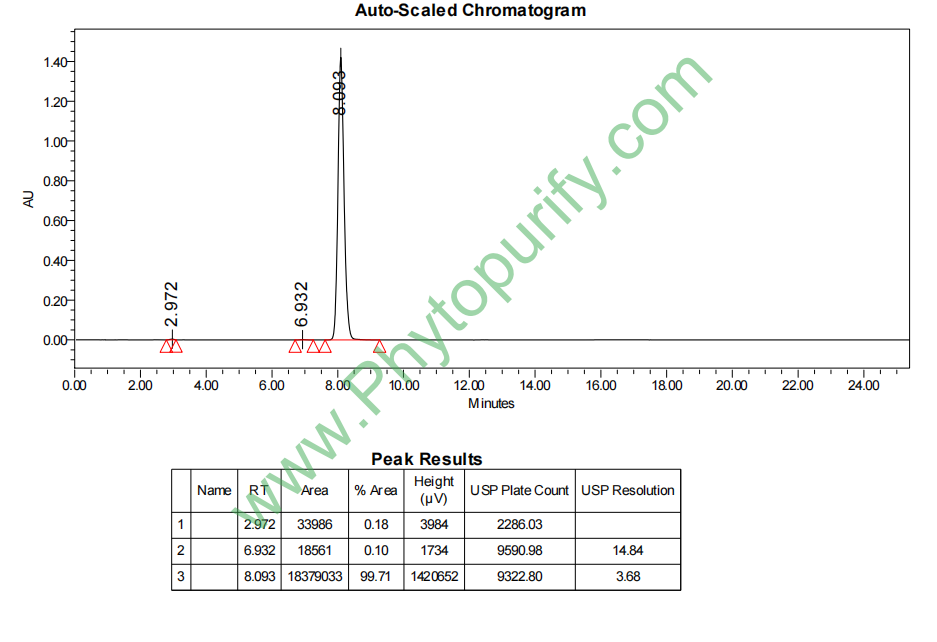
HPLC of 4,5-Dimethoxycanthin-6-one
Storage conditions:Short-term storage at 2~8℃, long-term storage at -20 ~ -80℃
52.8300
2.3729
2.3728
.0048
3.4938
26.1015
High
85.8662
2.4242
Yes
Yes
Yes
No
Yes
Yes
1.8
Yes
No
Yes
Yes
4,5-Dimethoxycanthin-6-one is a natural alkaloid with significant biological activity, belonging to the β - carboline family of compounds. This compound was first isolated from the traditional medicinal plant Picrasma quassioides, with a CAS number of 18110-87-7, a molecular formula of C16H12N2O3, and a molecular weight of 280.2830 g/mol. In the fields of natural product chemistry and drug discovery, methylpiclone alkaloids have attracted much attention due to their unique chemical structure and potential antimalarial activity.
β - carboline compounds are a class of nitrogen-containing heterocyclic compounds widely present in nature. Their core structure is formed by the fusion of indole and pyridine rings, and they have a rich spectrum of pharmacological activities, including anti-tumor, antiviral, antibacterial, anti-inflammatory, and central nervous system regulatory effects. As one of the members, methyl ketone alkaloids have introduced methoxy substitution at the 4th and 5th positions of the carboline skeleton, which may have a significant impact on their biological activity and physicochemical properties.
In recent years, with the increasingly severe problem of malaria drug resistance, searching for new lead compounds of antimalarial drugs from natural products has become an important strategy for drug development. The research on methyl ketone alkaloids is carried out in this context. According to database information, the compound exhibits potential activity against multiple malaria specific targets (such as PFCRT, PFMDR1, etc.), suggesting that it may exert anti malarial effects through a multi-target mechanism, providing new ideas for the development of novel anti malarial drugs.
The chemical structure of methyl ketone base is based on a β - carboline (9H pyridine [3,4-b] indole) skeleton, specifically 4,5-dimethoxykatin-6-one. Its SMILES representation (COc1c (OC) c2nccc3c4cccc4n (c1=O) c23) accurately describes its atomic connection sequence: a carboline parent nucleus, where the 1st position is carbonyl oxygen (forming a 6-ketone), and the 4th and 5th positions are respectively connected to methoxy groups (- OCH3). This highly planar polycyclic aromatic structure makes it easy to bind with biomolecules such as enzymes and receptors through π - π stacking, hydrophobic interactions, and other mechanisms.
Analyzing its physicochemical properties from the parameters of drug properties:
- Molecular weight (MW):280.28 g/mol, Far below 500 Da, it meets the requirements of Lipinski's five rules for the molecular weight of oral drugs.
- Lipid water partition coefficient (LogP/LogD)Approximately 2.37. This value indicates that the compound has moderate lipophilicity, which can penetrate the cell membrane without causing rapid metabolism or poor distribution due to excessive lipophilicity. This is usually beneficial for the oral absorption and transmembrane transport of compounds.
- Topological Polarity Surface Area (TPSA): 52.83 Å ². This value is relatively low, mainly due to the contributions of two methoxy groups and one carbonyl oxygen group. Lower TPSA is usually associated with better membrane permeability, which is consistent with its prediction of "high" blood-brain barrier (BBB) penetration.
- Water solubility The value is relatively low (0.0048, which may be measured in mg/mL or molar concentration, usually indicating slight solubility or insolubility), which is consistent with the moderate lipophilicity reflected by the LogP value. In the development of formulations, it may be necessary to improve their solubility through methods such as salt formation or the use of solubilizers.
- Permeability The permeability data of Caco-2 cells is 26.1015 (usually measured in 10 ⁻⁶ cm/s), which is a high value indicating its good intestinal absorption potential. The effective permeability (Peff) is 3.4938, which also supports its good permeability characteristics.
In summary, methyl ketone base exhibits good "drug like" characteristics in key physicochemical parameters such as molecular weight, lipophilicity, and polar surface area, laying a physical and chemical foundation for its further drug development.
The main plant source of methyl bitter ketone alkaloids is the bitter wood family plants bitterwood(Picrasma quassioides (D. Don) Benn.)。 Bitterwood is widely distributed in East Asia, including China, Japan, North Korea, and northern India, and has a long history in traditional Chinese medicine and folk medicine.
Kumu, as the name suggests, is known for its extremely bitter taste. Its dry stems, branches, and root bark are used as medicinal herbs in traditional Chinese medicine to clear heat, dry dampness, detoxify, and kill insects. They are commonly used to treat conditions such as damp heat diarrhea, scabies, and eczema. There are also relevant records in ancient books such as the Compendium of Materia Medica. Modern plant chemistry research has isolated and identified a large number of alkaloids from bitter wood, especially carboline alkaloids (such as bitter wood ketone alkaloids, methyl bitter wood ketone alkaloids, etc.) and bitter lignin compounds, which are considered the material basis of their pharmacological activity.
Traditionally, in areas where malaria is prevalent, bitter wood or its compound has also been used to treat symptoms such as "malaria" or "cold and heat exchange", which suggests empirically that it may contain anti malarial active ingredients. Modern pharmacological research has confirmed that the extract of bitter wood and the various alkaloids isolated from it do have anti-inflammatory, antibacterial, antiviral properties Anti malaria parasite The activity. Therefore, tracking, isolating, and identifying the antimalarial active ingredients from bitter wood is a typical drug discovery pathway based on traditional medicinal knowledge. As a representative component, the study of methyl ketone alkaloids connects traditional wisdom with modern science.
The most noteworthy pharmacological activity of methyl ketone alkaloids is their against malaria Potential. The database information indicates that the compound is associated with multiple key targets of malaria parasites, including PFCRT, PFMDR1, PFDHFR, PFATP6, and PFCYTb. The abbreviation "PF" before these targets represents Plasmodium falciparum, which is the deadliest type of malaria parasite. Below is a detailed analysis of these targets and their possible mechanisms of action:
PFCRT (chloroquine resistant transporter protein of Plasmodium falciparum)This is a transporter protein located on the food vesicle membrane of malaria parasites. The classic antimalarial drug chloroquine kills malaria parasites by accumulating in food bubbles and inhibiting the process of heme detoxification. Mutations in PFCRT can cause chloroquine to be pumped out of food bubbles, leading to drug resistance. Compounds that can inhibit the function of mutant PFCRT or bypass its action are expected to overcome chloroquine resistance. Methyl ketone alkaloids may interfere with the efflux function of this protein by interacting with it, leading to the accumulation of drugs or toxic substances in the insect body.
PFMDR1 (Plasmodium falciparum multidrug resistance protein 1)Belonging to the ABC transporter protein family, it is also associated with resistance to various antimalarial drugs such as mefloquine and haloperidol. It may affect drug efficacy by regulating the distribution of drugs between organelles. Simultaneously targeting PFCRT and PFMDR1 may produce a synergistic effect against multidrug-resistant malaria strains.
PFDHFR (Plasmodium falciparum dihydrofolate reductase)This is a key enzyme in the nucleic acid synthesis pathway of malaria parasites. The antimalarial drugs pyrimethamine and sulfadoxine pyrimethamine compound (Fansidar) exert their effects by inhibiting this enzyme and its upstream dihydropteroate synthase (DHPS). Drug resistance often originates from genetic mutations in PFDHFR. If methyl ketone alkaloids can inhibit PFDHFR, especially with inhibitory activity against mutant enzymes, it will have significant value.
PFATP6 (malignant malaria parasite sarcoplasmic/endoplasmic reticulum calcium ATPase 6)Considered as one of the main targets of artemisinin, an antimalarial drug. This enzyme is responsible for maintaining the calcium ion balance within malaria parasite cells, which is crucial for their survival. Artemisinin and its derivatives generate free radicals by alkylating targets such as PFATP6, disrupting the function of the parasite.
PFCYTb (malignant malaria parasite cytochrome b)It is the core component of the Plasmodium mitochondrial electron transport chain complex III and the target of the antimalarial drug atorvastatin. Inhibiting PFCYTb can block energy metabolism and lead to insect death.
Hypothesis of mechanism of action Methyl ketone alkaloids, as a planar aromatic molecule, may interact with the aforementioned targets in various ways
- Directly inhibit enzyme activity For enzymes such as PFDHFR and PFATP6, they may competitively bind to the active center of the enzyme, hindering their binding to substrates.
- Interference with transporter protein function For transporters such as PFCRT and PFMDR1, they may be transported as substrates or as inhibitors to block their transport function, thereby reversing or preventing drug resistance.
- Multi target synergistic effect The most likely scenario is that methylprednisolone has a certain affinity for multiple targets, interfering with the survival of malaria parasites through multiple pathways and links (such as nutrient metabolism, energy generation, ion homeostasis, and drug resistance efflux), thereby producing strong anti malarial effects and possibly delaying the development of drug resistance. This multi-target characteristic is an advantage of many natural products.
The β - carboline parent nucleus itself has the potential to embed into DNA or bind to enzyme hydrophobic pockets, and the introduction of methoxy groups may further optimize its interaction with target proteins (such as hydrogen bonding, spatial matching). However, the specific binding mode, affinity, and which target (s) are the main sites of action still need to be confirmed through molecular docking, enzyme inhibition experiments, gene knockout/overexpression studies, and other research.
Based on the provided pharmacological parameters, we can conduct a preliminary evaluation of the potential of methylbitter ketone base as a drug, and refer to the famous Lipinski's Five Rules Make a judgment based on the Rule of Five (Ro5). Ro5 is an empirical rule for evaluating the oral bioavailability of compounds, typically requiring a molecular weight<500, LogP<5, Hydrogen bond donor (HBD)<5, hydrogen bond acceptor (HBA)<10.
Lipinski Rule Compliance:
Absorption, distribution, metabolism, excretion (ADME) characteristics:
Comprehensive evaluation of drug properties Methyl bitter ketone alkaloids exhibit good pharmacological properties in terms of oral absorption and distribution, and their multi-target antimalarial mechanism is also attractive. However, it Potential genotoxicity, hepatotoxicity, and sensitization It is a major obstacle that must be seriously faced and thoroughly researched before being pushed into clinical practice. In subsequent optimization, chemists may need to eliminate or reduce these toxicities through structural modifications (such as introducing specific functional groups, changing substitution modes) while preserving their antimalarial activity as much as possible. It is a good starting point to fully comply with Ro5, but Ro5 is not a golden rule, especially for natural products, whose complex biological effects require a more comprehensive evaluation.
At present, research on methyl ketone alkaloids is still mainly in progress Natural product chemistry and preliminary pharmacology research stage A large amount of literature focuses on isolating and identifying this compound from bitter wood and other plants, and screening its in vitro anti malarial activity. Previous studies have confirmed that it has certain inhibitory activity against both drug-resistant and sensitive strains of Plasmodium falciparum in vitro, which is consistent with its multi-target prediction. However, in-depth mechanism studies (such as confirming its direct interaction with targets such as PFCRT and PFDHFR, determination of binding constants), systematic in vivo pharmacological evaluations (animal malaria models), and comprehensive preclinical safety evaluations (especially toxicity studies targeting its warning signals) are still relatively lacking or incomplete.
Future research directions and application prospects may include:
In summary, as a natural lead compound derived from traditional medicinal plants, methylprednisolone provides a promising multi-target template for addressing the challenge of malaria drug resistance. Although the toxicity challenges it currently faces cannot be ignored, it is entirely possible to transform it into a new anti malaria candidate drug with higher safety and better efficacy through rational structural optimization and in-depth biological evaluation using modern medicinal chemistry and pharmacology methods. Its research process vividly reflects the value and charm of the classic development path from traditional herbs to modern innovative drugs.
