Introduction/Overview
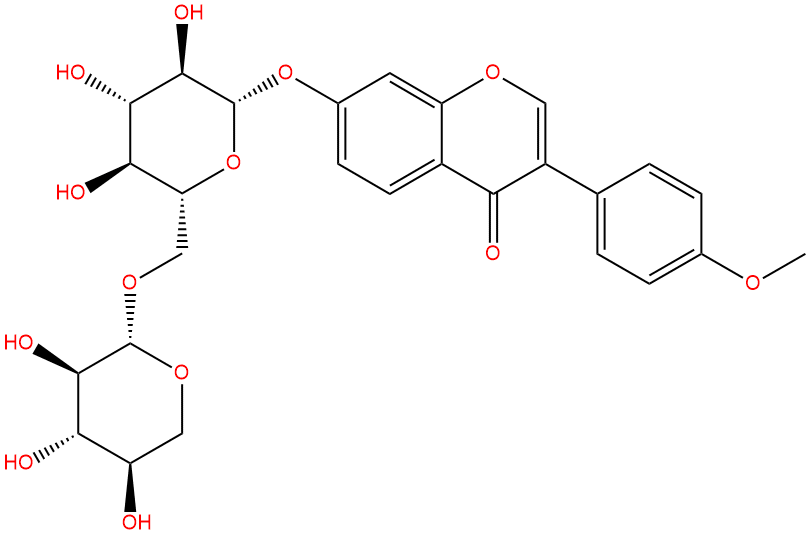
Natural products have always been an important source of innovative drug discovery, among which flavonoids have attracted much attention due to their broad biological activity and low toxicity. Kushenol O (CAS number: 102390-91-0), as a unique flavonoid glycoside compound, is a traditional Chinese medicine called Sophora flavescens(Sophora flavescens One of the many active ingredients isolated from Ait. Its chemical structure has been identified as Formononetin 7-O-xylosyl - (1->6) - glucose, which means that mangiferin is linked to a xylose - (1->6) - glucose disaccharide chain at the 7th hydroxyl group. In recent years, with the deepening of modern pharmacological research, Sophora flavescens O has shown significant anti-tumor potential. Its effects involve inducing apoptosis, inhibiting proliferation, invasion and metastasis, and its interactions with multiple key tumor related targets have been preliminarily revealed. The purpose of this article is to systematically review the chemical properties, plant sources, pharmacological activities, molecular mechanisms of action, and pharmacological potential of Sophora flavescens O, in order to provide comprehensive scientific references for the in-depth research of this compound and the development of future anti-tumor drugs.
Chemical structure and physicochemical properties
The molecular formula of Sophora flavescens O is C ₂₆ H ∝₄ O ₁₄, with a molecular weight of 562.5240. Its core skeleton is the flavonoid mother nucleus, specifically Formononetin, which is connected to a disaccharide chain through a glycosidic bond on the phenolic hydroxyl group at position 7. The disaccharide is composed of xylose and glucose connected in a (1->6) manner, forming the structure of Formononetin 7-O-xylosyl - (1->6) - glucose. This glycosylation modification significantly affects its physicochemical properties and biological activity.
From the analysis of parameters related to drug properties, the calculated LogP value is relatively low (0.1218), indicating that the compound has strong hydrophilicity, which is consistent with the presence of multiple hydroxyl and sugar groups in the molecule. The topologically polar surface area (TPSA) is as high as 197.7400 Å ², further confirming its high polarity characteristics. The predicted value of water solubility is 0.9227 mg/mL, which belongs to compounds with good solubility, which is beneficial for the development of their formulations in aqueous media. However, high polarity and large TPSA also lead to a predicted "low" blood-brain barrier (BBB) permeability, suggesting that it may not easily enter the central nervous system. This may reduce the risk of central side effects for treating peripheral tumors, but also limits its direct effect on brain tumors. In early toxicity screening, the hERG inhibition was predicted as' no ', indicating a low risk of potential arrhythmogenic cardiac toxicity. The Ames test predicted a value of 1.5 (usually considered to have mutagenic risk if>1.0, which requires experimental verification), indicating that its genetic toxicity risk needs further experimental evaluation to clarify. Overall, Sophora flavescens O exhibits a natural product characteristic of good water solubility, high polarity, limited central permeability, but low risk of cardiac toxicity.
Plant sources and extraction methods
Sophora flavescens O mainly comes from Sophora flavescens, a plant of the Sophora genus in the legume family(Sophora flavescens Dry roots of Ait. As a traditional Chinese medicine, Sophora flavescens has the effects of clearing heat and dampness, killing insects, and diuresis. Modern research has shown that it is rich in various alkaloids and flavonoids, making it a natural treasure trove of flavonoids such as Sophora flavescens O.
The extraction of Sophora flavescens O from plant materials usually follows the conventional process of natural product chemistry. Firstly, dry and crush the roots of Sophora flavescens, and extract them using appropriate solvents. Common extraction solvents include methanol, ethanol, or ethanol water mixed solutions with different ratios. Heating reflux, ultrasound assisted, or microwave-assisted extraction techniques are used to improve extraction efficiency. After vacuum concentration, the crude extract is preliminarily enriched and decolorized using macroporous adsorption resins (such as D101, AB-8, etc.) to remove impurities such as polysaccharides and proteins. Subsequently, silica gel column chromatography, reverse phase silica gel column chromatography (such as ODS-C18), dextran gel column chromatography (such as Sephadex LH-20) and other chromatographic techniques were used for systematic separation and purification. High performance liquid chromatography (HPLC), especially preparative HPLC, is the key technical means to ultimately obtain high-purity Sophora flavescens O monomer. The separation process is often tracked by comparing thin layer chromatography (TLC) spots or monitoring HPLC UV absorption peaks (isoflavones typically have characteristic absorption at 250-280 nm) to track the target components. Structural identification is accomplished through the comprehensive use of spectroscopic methods such as nuclear magnetic resonance (NMR, including ¹ H-NMR, ¹ ³ C-NMR, 2D-NMR), mass spectrometry (MS), ultraviolet spectroscopy (UV), and infrared spectroscopy (IR).
Pharmacological activity research
A large number of in vitro and partially in vivo pharmacological studies have confirmed that Sophora flavescens O has multiple anti-tumor activities, which is its most prominent pharmacological feature.
1. Antitumor activity
Matrine O exhibits growth inhibition and cytotoxicity on various human tumor cell lines. Research shows that it can significantly inhibit the proliferation of breast cancer (such as MCF-7, MDA-MB-231), liver cancer (such as HepG2, SMMC-7721), colon cancer (such as HCT-116, SW480), lung cancer (such as A549) and other cancer cells, and its effect is concentration and time dependent. In addition to directly inhibiting cell viability, oxymatrine O can effectively induce apoptosis in tumor cells, manifested by nuclear condensation, DNA fragmentation, phosphatidylserine eversion, and activation of apoptosis related proteins (such as caspase-3).
2. Anti invasive and anti metastatic activity
The invasion and metastasis of tumors are the main reasons for treatment failure. Research has found that matrine O can inhibit the migration and invasion ability of tumor cells. For example, in scratch healing experiments and Transwell invasion experiments, tumor cells treated with oxymatrine O showed a significant decrease in their ability to migrate and pass through matrix gel. This effect is closely related to its downregulation of the expression of matrix metalloproteinases (such as MMP2, MMP9), which are key factors in degrading extracellular matrix and promoting tumor cell invasion.
3. Other potential activities
In addition to its core anti-tumor effect, based on its flavonoid core structure, Sophora flavescens O may also possess activities shared by other flavonoids, such as antioxidant and anti-inflammatory properties. Mangosteen itself has been reported to have phytoestrogenic activity, which can regulate related pathways by interacting with estrogen receptor 1 (ESR1). Kushanol O, as its glycoside derivative, may release aglycones after metabolism in the body, indirectly exerting similar effects, but this requires more direct evidence to support.
Mechanism of action and molecular targets
The anti-tumor effect of Sophora flavescens O is not achieved through a single pathway, but involves multidimensional regulation of multiple key signaling pathways and molecular targets. Preliminary studies have revealed its association with the following targets:
1. Regulating apoptosis related proteins (BCL2 family and MCL1)
The mitochondrial pathway of cell apoptosis is strictly regulated by the BCL2 protein family. Research has shown that Sophora flavescens O can downregulate the expression of anti apoptotic proteins BCL2 and MCL1, while possibly upregulating the expression of pro apoptotic proteins such as BAX, leading to a decrease in mitochondrial membrane potential, release of cytochrome C, and activation of caspase cascade reaction, ultimately inducing tumor cell apoptosis.
2. Inhibit the STAT3 signaling pathway
Signal transducer and activator of transcription factor 3 (STAT3) is an important oncogenic transcription factor that is continuously activated in various tumors. Matrine O has been shown to inhibit the phosphorylation (activated form) of STAT3, block its nuclear translocation and the transcription of downstream target genes (such as Cyclin D1, Bcl-2, MMP2, etc.), thereby inhibiting cell proliferation, promoting apoptosis, and weakening invasion ability.
3. Interference with MAPK signaling pathway
The mitogen activated protein kinase (MAPK) pathway, especially the ERK (such as MAPK1/ERK2) sub pathway, plays a critical role in cell growth and survival. Matrine O may inhibit the phosphorylation and activation of ERK by affecting upstream signaling, thereby blocking cell cycle progression and suppressing proliferation.
4. Inhibit matrix metalloproteinase (MMP2)
As mentioned earlier, Sophora flavescens O can significantly reduce the mRNA and protein expression levels of MMP2. MMP2 is a key enzyme that degrades type IV collagen (the main component of the basement membrane), and its expression is regulated by various factors such as HIF-1 α and STAT3. Matrine O may indirectly downregulate MMP2 and exert anti invasive effects by inhibiting these upstream transcription factors.
5. Affects hypoxia inducible factor 1A (HIF1A)
The tumor microenvironment is often in a state of hypoxia, stabilizing the HIF-1 α protein. HIF-1 α can activate a series of genes that promote angiogenesis, metabolic reprogramming, and invasion and metastasis. Matrine O may disrupt the hypoxic adaptation of tumors by interfering with the stability or transcriptional activity of HIF-1 α.
6. Inhibition of Topoisomerase (TOP1, TOP2A)
Topoisomerase is a key enzyme in DNA replication and transcription, and is a classic chemotherapy target. Preliminary research suggests that Sophora flavescens O may have the potential to inhibit the activity of TOP1 and TOP2A, thereby causing DNA damage and preventing tumor cell division.
7. Interactions with hormone related targets (ESR1, CYP19A1)
Because of its stilbene aglycone structure, matrinol O or its metabolites may interact with ESR1 as a selective estrogen receptor modulator (SERM) and play a regulatory role in hormone dependent breast cancer. In addition, it may affect the activity of aromatase (CYP19A1), which is the rate limiting enzyme for estrogen synthesis and an important target for the treatment of breast cancer.
In summary, Sophora flavescens O forms the molecular basis for its anti-tumor activity through multi-target and multi pathway synergistic effects.
Evaluation of drug properties and pharmacokinetics
Although Sophora flavescens O has shown good anti-tumor activity in vitro, its development into a drug still requires systematic pharmacological evaluation.
1. Drug like properties and ADMET properties
According to its physicochemical parameters, Sophora flavescens O conforms to the Rule of Five, with a molecular weight slightly exceeding 500 but still within an acceptable range, and a large number of hydrogen bond donors/acceptors. Its high water solubility and low LogP are beneficial for the dissolution and absorption of oral formulations, but its high polarity may limit its passive transmembrane diffusion, leading to challenges in oral bioavailability (BA). The low permeability of the blood-brain barrier limits central application. The low risk of hERG inhibition is a positive signal. The predicted values of Ames test suggest the need for in-depth genetic toxicity experiments (such as in vitro micronucleus test, in vivo comet assay, etc.) to eliminate safety hazards.
2. Pharmacokinetic prediction and challenges
As a flavonoid glycoside compound, the pharmacokinetic behavior of Sophora flavescens O in vivo may be complex. After oral administration, its glycoside structure may be hydrolyzed by gut microbiota or brush edge enzymes (such as β - glucosidase) in intestinal mucosal epithelial cells, releasing aglycone mangiferin, which is more lipophilic and easily absorbed. Therefore, its in vivo activity may be the result of the combined action of the prototype drug and metabolites. Predict that it may undergo extensive II binding metabolism (such as glucuronidation, sulfation), leading to rapid excretion. At present, there is still a lack of detailed pharmacokinetic studies on the Sophora flavescens O system (including absorption, distribution, metabolism, and excretion parameters) in public literature, which is a key information gap for its development.
3. Formulation strategy
To improve its bioavailability, advanced formulation technologies such as nanocrystals, liposomes, polymer micelles, or phospholipid complexes may be required to enhance its membrane permeability, stability, and targeted delivery capability.
Clinical application prospects and prospects
Kushanol O, as a natural product with multi-target anti-tumor activity, has broad clinical application prospects, but also faces many challenges.
1. Prospects
* Multi targeted anti-tumor candidate drugs It acts on multiple key tumor targets such as MCL1, STAT3, MMP2, and may be effective against tumors that have developed resistance to existing single target drugs, or can be developed as a multi-target therapeutic drug.
* The potential of combination therapy The combination of Sophora flavescens O with conventional chemotherapy drugs or targeted drugs may produce synergistic effects, reduce the dosage and toxic side effects of the latter, and reverse drug resistance.
* Modernization and Value Mining of Traditional Chinese Medicine The in-depth study of Sophora flavescens O is a modern scientific interpretation of the active substance basis of traditional Chinese medicine Sophora flavescens, which helps to promote the modernization and internationalization of traditional Chinese medicine.
2. Challenges and Future Research Directions
* In depth in vivo pharmacological validation At present, research is mainly conducted in vitro, and there is an urgent need to validate its in vivo anti-tumor effect and dose-response relationship in more rigorous animal tumor models, such as transplant tumor models and PDX models.
* Systematic pharmacokinetic study It is necessary to comprehensively elucidate its ADMET characteristics in different species, clarify its bioavailability, tissue distribution, major metabolites, and excretion pathways.
* Refined mechanism of action The existing target associations are mostly preliminary or indirect evidence, and require the use of molecular docking, surface plasmon resonance (SPR), gene knockout/knockdown and other technologies to directly verify their interaction modes and binding sites with key targets such as STAT3 and MCL1.
* Comprehensive evaluation of safety Complete preclinical toxicology studies of the system, including acute toxicity, long-term toxicity, reproductive toxicity, etc., with a particular focus on identifying genetic toxicity risks.
* Structural optimization and derivative development Based on the parent nucleus structure of Sophora flavescens O, reasonable chemical modifications (such as glycosylation modification and hydroxyl derivatization) are carried out to improve its pharmacokinetic properties, enhance activity or reduce toxicity, and develop more pharmacological derivatives.
Conclusion
Kushanol O is a flavonoid glycoside compound with significant anti-tumor potential isolated from traditional Chinese medicine Sophora flavescens. It exhibits multidimensional pharmacological activity in inhibiting tumor cell proliferation, inducing apoptosis, and blocking invasion and metastasis by regulating multiple key targets such as MCL1, BCL2, STAT3, MMP2, MAPK1, and HIF1A. Despite its advantages of good water solubility and low risk of cardiac toxicity, its high polarity, potential central barrier limitations, and unclear pharmacokinetic and toxicological properties pose major challenges for its drug conversion. Future research needs to focus on in-depth in vivo efficacy validation, systematic ADMET evaluation, precise molecular mechanism elucidation, and structure based optimization and modification. With the gradual resolution of these scientific issues, Sophora flavescens O is expected to become an important lead compound for the development of novel multi-target anti-tumor drugs, providing not only new candidate strategies for tumor treatment, but also a model for the modern research of active ingredients in traditional Chinese medicine.