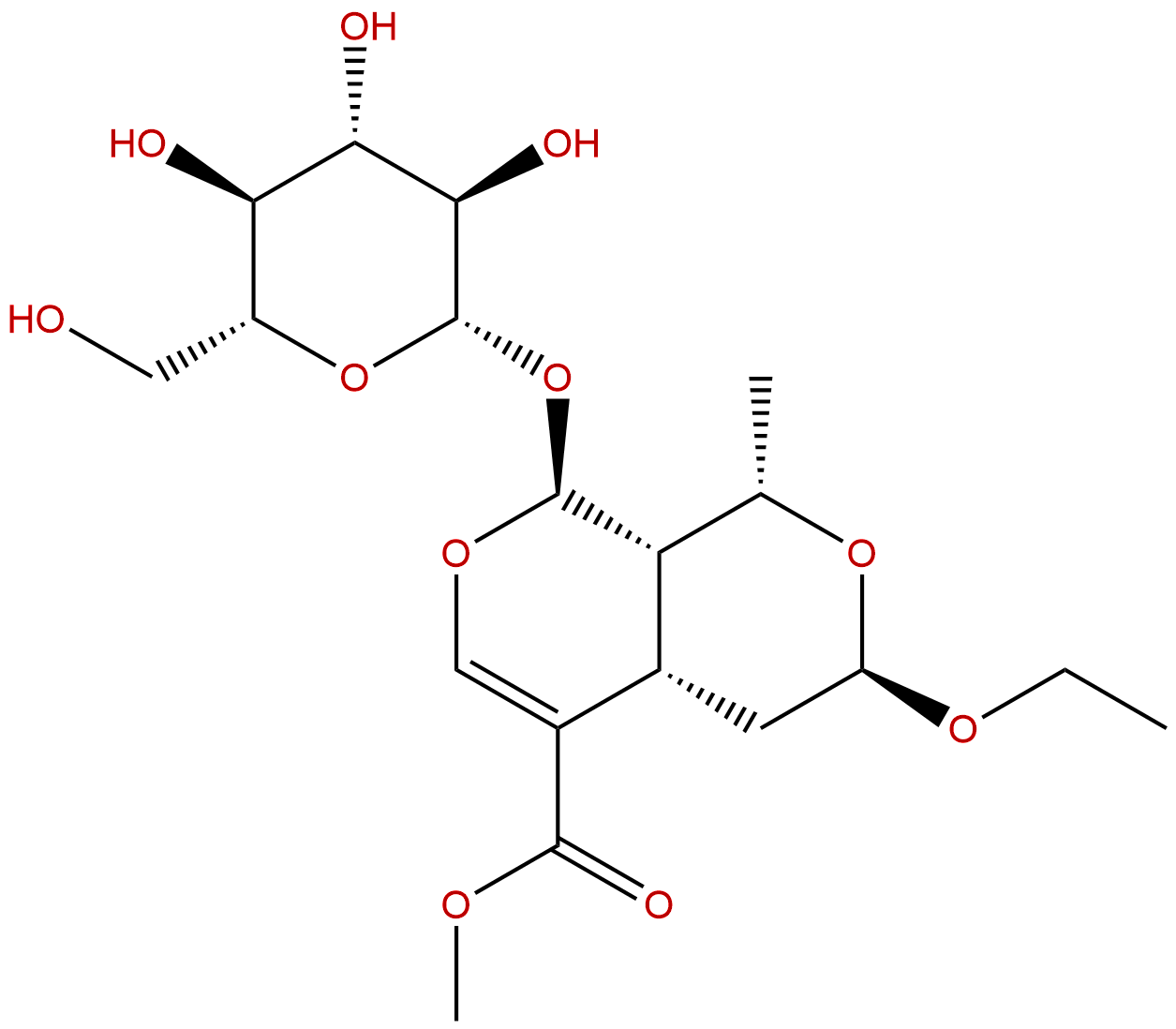


Product name: 7-O-Ethylmorroniside
Synonym name:
Catalogue No.: BP1714
Cas No.: 945721-10-8
Formula: C19H30O11
Mol Weight: 434.438
Botanical Source:
Physical Description:
Type of Compound: Iridoids
Purity: 95%~99%
Analysis Method: HPLC-DAD or/and HPLC-ELSD
Identification Method: Mass, NMR
Packing: Brown vial or HDPE plastic bottle
The product could be supplied from milligrams to grams. Inquire for bulk scale.
We provide solution to improve the water-solubility of compounds, thereby facilitating the variety of activity tests and clinic uses.
For Reference Standard and R&D, Not for Human Use Directly.
Storage conditions:Short-term storage at 2~8℃, long-term storage at -20 ~ -80℃
153.3700
-.8701
-.8701
30.3261
.5688
.7783
Low
35.8563
4.7989
Yes
No
No
No
Yes
No
0.3
Yes
No
Yes
Yes
Natural products, as an important source of drug discovery, play an irreplaceable role in the history of human disease treatment. Cycloterpenoid glycosides are a class of secondary metabolites of monoterpenes widely present in the plant kingdom, which have attracted much attention due to their diverse structures and significant biological activities such as anti-inflammatory, antioxidant, neuroprotective, liver and kidney protection. Cornus officinalis(Cornus officinalis Sieb. et Zucc. Modern pharmacological research has confirmed that the pharmacological substance basis of Cornus officinalis mainly includes iridoid glycosides, triterpenoid acids, polysaccharides, and other components. Among them, iridoid glycosides such as mononucleoside and loganin are considered its core active ingredients.
7-O-Ethylmorinoside (CAS: 945721-10-8) is a structurally modified derivative of morinoside, belonging to the class of iridoid glycosides. In recent years, with the deepening of research on the active ingredients of Cornus officinalis, 7-oxoethylmononucleoside has gradually entered the research field due to its outstanding pharmacological activity in various disease models, especially inflammatory bowel disease (such as colitis). Its function involves the regulation of multiple key signaling pathways and molecular targets, including but not limited to carboxylesterase 1 (CES1), Toll like receptor 4 (TLR4), protein kinase C alpha (PRKCA), nuclear factor E2 related factor 2 (NFE2L2), caspase 1 (CASP1), etc., indicating its potential for multi-target and multi pathway synergistic effects. This article aims to systematically review the chemical structure, plant origin, pharmacological activity, mechanism of action, pharmacological evaluation, and clinical application prospects of 7-oxoethylmononucleoside, in order to provide comprehensive scientific references for the in-depth research and development of this compound.
The chemical name of 7-oxoethylmononucleoside is (1S, 4aS, 7S, 7aS) -1- (β - D-glucopyranosyl) -7- (ethoxymethyl) -4a, 5,6,7a - tetrahydro-1H-cyclopentano [c] pyran-4-carboxylic acid methyl ester. Its molecular formula is C19H30O11 and its molecular weight is 434.4380 g/mol.
Structurally, 7-oxoethyl mononucleoside is the product of ethyl etherification of the 7-hydroxyl group of mononucleoside. Its parent nucleus is a typical iridoid glycoside structure, containing a cyclopentane pyran ring system, which is the characteristic skeleton of iridoid compounds. At the C-1 position, a β - D-glucosyl group is connected through a glycosidic bond, which is an important functional group for its biological activity, such as water solubility and recognition with certain enzymes or receptors. The ethoxymethyl group (- CH2OCH2CH3) connected at the C-7 position is a key structural modification that distinguishes it from mononucleoside (where the C-7 position is a hydroxymethyl group). The introduction of this hydrophobic group may significantly alter its lipid water partition coefficient, membrane permeability, and affinity for specific targets.
Based on its structure, the calculated physicochemical properties parameters are as follows: the lipid water partition coefficient (LogP) is -0.8701, indicating that the compound has good hydrophilicity. The topological polar surface area (TPSA) is 153.370 Å ², and the larger TPSA value is mainly attributed to the numerous oxygen atoms in the molecule (from sugar, ester, and ether bonds), which further confirms its hydrophilic properties. The predicted water solubility value is 30.3261 mg/L, which belongs to moderate to high water solubility, which is beneficial for its dissolution and absorption in aqueous media such as physiological buffer and intestinal fluid. These preliminary physicochemical properties suggest that 7-oxoethylmononucleoside may have the potential for oral administration, but its high polarity and TPSA may also affect its transmembrane transport and bioavailability.
7-Oxoethyl Monoglucoside is mainly derived from Cornus officinalis(Cornus officinalis)Dry and ripe fruit flesh. In Cornus officinalis, iridoid glycosides mainly exist in the forms of mononucleoside, loganin, and swertiamarin. 7-oxoethyl mononucleoside, as a derivative of mononucleoside, usually has a low natural content. It may be generated by enzymatic or non enzymatic ethylation of mononucleoside during plant growth, or during the processing and storage of medicinal materials. At present, there are relatively few research reports on its exact content and distribution in native plants. In more studies, 7-oxoethyl mononucleoside is obtained from high content mononucleoside through chemical semi synthesis or biotransformation methods to ensure the material supply for pharmacological research.
The conventional methods for extracting iridoid glycosides from Cornus officinalis include:
1. Solvent extraction method The most commonly used method. Usually, water, methanol, ethanol, or ethanol water mixed solvents with different ratios are used for reflux extraction or ultrasound assisted extraction. Ethanol water systems (such as 50% -70% ethanol) are widely used due to their good selectivity for iridoid glycosides, low cost, and environmental friendliness.
2. Purification and Separation The crude extract is enriched and purified by macroporous adsorption resins (such as AB-8, D101, HP-20, etc.), and eluted with a gradient of water and different concentrations of ethanol. The iridoid glycosides are usually concentrated in the 10% -30% ethanol elution site. Further refinement and separation often use preparative high-performance liquid chromatography (Prep HPLC), with high-purity methanol water or acetonitrile water as the mobile phase, to repeatedly separate and obtain single compounds including 7-oxoethyl mononucleoside.
3. Chemical synthesis/structural modification To obtain a sufficient amount of 7-oxoethyl mononucleoside, mononucleoside obtained in large quantities from Cornus officinalis is often used as the starting material. Under alkaline conditions, it undergoes Williamson ether synthesis reaction with halogenated ethane (such as iodoethane) to selectively ethylate the hydroxyl group at the C-7 position, and then the target compound is obtained by separation and purification. This method has high efficiency and is currently the main way to obtain the compound.
A large number of preclinical studies, especially pharmacological evaluations based on animal models, have revealed the extensive pharmacological activities of 7-oxoethylmononucleoside, with its core advantages focused on its powerful anti-inflammatory, antioxidant, and organ protective effects.
Anti colitis activity This is the most in-depth field of research on 7-oxoethyl mononucleoside. In experimental colitis models induced by dextran sulfate sodium (DSS) or 2,4,6-trinitrobenzenesulfonic acid (TNBS) in mice or rats, oral administration of 7-oxoethylmononucleoside can significantly improve disease activity index (DAI), alleviate colon tissue shortening, edema, and mucosal damage (ulcers, erosions, inflammatory cell infiltration). Its therapeutic effect is reflected in multiple aspects: reducing the levels of pro-inflammatory cytokines such as TNF - α, IL-1 β, IL-6; Enhance the expression of anti-inflammatory factors (such as IL-10); Inhibit myeloperoxidase (MPO) activity and reduce neutrophil infiltration; Relieve colonic epithelial barrier dysfunction.
Renal protective effect Inheriting the traditional function of "tonifying the kidney" from Cornus officinalis, 7-oxoethylmononucleoside has shown protective potential in kidney disease models. In the model of diabetes nephropathy (DN), it can reduce proteinuria, improve renal function indicators (such as blood creatinine, urea nitrogen), inhibit mesangial matrix proliferation and tubulointerstitial fibrosis. Its function is closely related to reducing renal oxidative stress, inhibiting inflammatory response, and resisting cell apoptosis.
Antioxidant activation 7-oxoethyl mononucleoside can effectively scavenge free radicals such as DPPH and ABTS, and enhance the activity of endogenous antioxidant enzymes such as superoxide dismutase (SOD), catalase (CAT), and glutathione peroxidase (GSH Px) in cell and animal models, while reducing the levels of lipid peroxidation products such as malondialdehyde (MDA). This powerful antioxidant capacity is one of the fundamental mechanisms underlying its anti-inflammatory and tissue protective effects.
Other potential activities Preliminary studies also suggest that 7-oxoethylmononucleoside may have an improving effect on liver injury (such as drug-induced liver injury) and neurological inflammation related diseases, but its specific efficacy and mechanism need further clarification.
The pharmacological effects of 7-oxoethylmononucleoside are not achieved through a single target, but through a complex multi-target network that works synergistically, especially in colitis models, where its mechanism of action network has been clearly outlined. The following are key targets and their roles related to colitis:
TLR4/NF - κ B signaling pathway This is the core mechanism of its anti-inflammatory effect. Pathogen related molecular patterns such as lipopolysaccharides (LPS) activate Toll like receptor 4 (TLR4), trigger downstream myeloid differentiation factor 88 (MyD88) dependent pathways, and ultimately activate nuclear transcription factor kappa B (NF - κ B). 7-Oxoethyl Mononucleoside can effectively inhibit the expression and activation of TLR4, block the nuclear translocation of NF - κ B p65 subunit (RELA), and thus suppress the expression of a large number of pro-inflammatory mediators such as TNF - α, IL-1 β, IL-6, iNOS, COX-2 at the transcriptional level.
Nrf2/ARE antioxidant pathway Nuclear factor E2 related factor 2 (NFE2L2) is a central regulatory factor for cellular antioxidant stress. In the resting state, Nrf2 binds to Keap1 and is degraded by ubiquitination. Oxidative stress or certain compounds can cause Nrf2 to dissociate from Keap1, enter the nucleus, bind to antioxidant response elements (ARE), and initiate transcription of phase II detoxifying enzymes and antioxidant proteins such as HO-1, NQO1, GCLC. 7-Oxoethyl Mononucleoside can activate the Nrf2 pathway, enhance cellular antioxidant defense capabilities, and counteract oxidative damage associated with inflammation.
NLRP3 inflammasome pathway The excessive activation of NLRP3 inflammasome is an important link in the occurrence and development of colitis. It consists of NLRP3, ASC, and pro-caspase-1, which upon activation leads to self cleavage activation of caspase-1 (CASP1). Activated CASP1 cleaves pro-IL-1 β and pro-IL-18, producing mature IL-1 β and IL-18, and inducing cell apoptosis. Research has shown that 7-oxoethylmononucleoside can inhibit the assembly and activation of NLRP3 inflammasomes, reduce the activity of CASP1, decrease the mature release of IL-1 β and IL-18, thereby alleviating inflammasome driven colitis.
Other important targets:
In summary, 7-oxoethylmononucleoside activates the Nrf2/ARE protective pathway by simultaneously inhibiting pro-inflammatory pathways such as TLR4/NF - κ B and NLRP3/CASP1, and synergistically regulates multiple targets related to lipid metabolism and barrier function (such as CES1, FXR, LPAR2, etc.), constructing a multidimensional and three-dimensional anti-inflammatory antioxidant tissue protective network. This provides a solid mechanistic basis for its treatment of complex inflammatory diseases such as colitis.
Based on computational predictions and preliminary experimental data, a preliminary evaluation of the pharmacological properties of 7-oxoethylmononucleoside is conducted
7-oxoethylmononucleoside shows promising development prospects, especially in the treatment of inflammatory bowel disease (IBD, including ulcerative colitis and Crohn's disease).
Potential for treating inflammatory bowel disease (IBD)The existing IBD treatment drugs (such as 5-ASA, glucocorticoids, immunosuppressants, biologics) have problems such as insufficient efficacy, significant side effects, high prices, or susceptibility to drug resistance. 7-Oxoethyl Mononucleoside is derived from traditional Chinese medicine and has unique advantages of multi-target and multi pathway synergistic effects. It can not only effectively resist inflammation and oxidation, but also regulate intestinal barrier function and lipid metabolism homeostasis. It may achieve a more comprehensive treatment for IBD, and natural product sources may bring better safety. It is expected to be developed into a new type of IBD treatment drug or as an adjuvant drug for existing therapies.
Exploration on the application of PDN in diabetes nephropathy (DN)Based on the traditional use of Cornus officinalis and the renal protective activity of 7-oxoethylmononucleoside, it has clear research value in the prevention and treatment of diabetic nephropathy. The pathogenesis of DN involves metabolic disorders, oxidative stress, inflammation, and fibrosis, and this compound exhibits regulatory effects in these links, which may provide a multi mechanism intervention strategy for DN.
Challenges faced and future research directions:
7-Oxoethyl Monoglucoside, as a derivative of iridoid glycosides derived from traditional Chinese medicine Cornus officinalis, has become a highlight in natural product pharmacology research due to its novel chemical structure (7-ethoxymethyl modification) and excellent multi-target pharmacological activity. Its strong anti-inflammatory, antioxidant, and tissue protective effects in experimental colitis and other disease models are mainly attributed to its inhibition of the TLR4/NF - κ B and NLRP3/CASP1 inflammatory pathways, activation of the Nrf2/ARE antioxidant pathway, and synergistic regulation of multiple key targets such as CES1 and FXR. Although it faces challenges in the aspect of drug formation (such as oral absorption), its clear characteristics of multi mechanism action and good preliminary safety prediction make it have significant potential in developing new therapeutic drugs for inflammatory bowel disease, diabetes nephropathy and other complex diseases. In the future, through interdisciplinary cooperation and the combination of modern research methods in medicinal chemistry, pharmacy, molecular biology, and clinical medicine, key scientific issues in the development process will be explored and solved in depth. It is expected that the active molecules of this traditional Chinese medicine will be successfully transformed into modern drugs that benefit patients, fully reflecting the value and charm of modern research on Chinese medicine.
Batch can search by a CAS number,one per line
