


Product name: Loganin
Synonym name: Meliatin; Loganoside
Catalogue No.: BP0884
Cas No.: 18524-94-2
Formula: C17H26O10
Mol Weight: 390.385
Botanical Source: Cornus officinalis Sieb.et Zucc.
Physical Description:
Type of Compound: Iridoids
Purity: 95%~99%
Analysis Method: HPLC-DAD or/and HPLC-ELSD
Identification Method: Mass, NMR
Packing: Brown vial or HDPE plastic bottle
Storage: Store in a well closed container, protected from air and light. Put into refrigerate or freeze for long term storage.
Whenever possible, you should prepare and use solutions on the same day. However, if you need to make up stock solutions in advance, we recommend that you store the solution as aliquots in tightly sealed vials at -20℃. Generally, these will be useable for up to two weeks.
The product could be supplied from milligrams to grams
Inquire for bulk scale.
Description:
Loganin is a non-competitive inhibitor of BACE1 with IC50 of 47.97 μM an also inhibits AChE and BChE with IC50 values of 3.95 μM and 33.02 μM, respectively. Loganin has neuroprotective, anti-amnesic, anti-inflammatory and anti-shock effects, it also exhibits protective effects against hepatic injury and other diabetic complications associated with abnormal metabolic states and inflammation caused by oxidative stress and advanced glycation endproduct formation. Loganin can attenuate neuroinflammatory responses through the inactivation of NF-κB by NF-κB dependent inflammatory pathways and phosphorylation of MAPK in Aβ25-35-induced PC12 cells, and can protect against hydrogen peroxide-induced apoptosis by inhibiting phosphorylation of JNK, p38, and ERK 1/2 MAPKs in SH-SY5Y cells.
References:
Neurochem Int. 2011 Mar;58(4):533-41
Loganin protects against hydrogen peroxide-induced apoptosis by inhibiting phosphorylation of JNK, p38, and ERK 1/2 MAPKs in SH-SY5Y cells.
METHODS AND RESULTS:
We investigated the mechanisms underlying the protective effects of Loganin against hydrogen peroxide (H(2)O(2))-induced neuronal toxicity in SH-SY5Y cells. The neuroprotective effect of Loganin was investigated by treating SH-SY5Y cells with H(2)O(2) and then measuring the reduction in H(2)O(2)-induced apoptosis using 3-(4,5-dimethyl thiazol-2-yl)-2,5-diphenyl tetrazolium bromide (MTT) and lactate dehydrogenase (LDH) release assays. Following H(2)O(2) exposure, Hoechst 33258 staining indicated nuclear condensation in a large proportion of SH-SY5Y cells, along with an increase in reactive oxygen species (ROS) production and an intracellular decrease in mitochondria membrane potential (MMP). Loganin was effective in attenuating all the above-stated phenotypes induced by H(2)O(2). Pretreatment with Loganin significantly increased cell viability, reduced H(2)O(2)-induced LDH release and ROS production, and effectively increased intracellular MMP. Pretreatment with Loganin also significantly decreased the nuclear condensation induced by H(2)O(2). Western blot data revealed that Loganin inhibited the H(2)O(2)-induced up-regulation of cleaved poly (ADP-ribose) polymerase (PARP) and cleaved caspase-3, increased the H(2)O(2)-induced decrease in the Bcl-2/Bax ratio, and attenuated the H(2)O(2)-induced release of cytochrome c from mitochondria to the cytosol. Furthermore, pretreatment with Loganin significantly attenuated the H(2)O(2)-induced phosphorylation of c-Jun N-terminal kinase (JNK), p38 mitogen-activated protein kinase (MAPK), and extracellular signal-regulated kinase 1/2 (ERK 1/2).
CONCLUSIONS:
These results suggest that the protective effects of Loganin against H(2)O(2)-induced apoptosis may be due to a decrease in the Bcl-2/Bax ratio expression due to the inhibition of the phosphorylation of JNK, p38, and ERK 1/2 MAPKs. Loganin's neuroprotective properties indicate that this compound may be a potential therapeutic agent for the treatment of neurodegenerative diseases.
Life Sci. 2015 Feb 15;123:78-85.
Loganin attenuates diabetic nephropathy in C57BL/6J mice with diabetes induced by streptozotocin and fed with diets containing high level of advanced glycation end products.
Diabetic nephropathy is the most common cause of end-stage renal disease in patients with diabetes. Advanced glycation end-products (AGEs) play a prominent role in the development of diabetic nephropathy. We herein evaluated the effects of Loganin on diabetic nephropathy in vivo.
METHODS AND RESULTS:
We established a diabetic nephropathy model in C57BL/6J mice with diabetes induced by streptozotocin and fed with diets containing high level of AGEs. Diabetic symptoms, renal functions, and pathohistology of pancreas and kidney were evaluated. AGE-RAGE pathway and oxidative stress parameters were determined. The model mice exhibited characteristic symptoms of diabetes including weight loss, polydipsia, polyphagia, polyuria, elevated blood glucose levels and low serum insulin levels during the experiments. However, Loganin at doses of 0.02 and 0.1g/kg effectively improved these diabetic symptoms. Loganin reduced kidney/body weight ratio, 24h urine protein levels, and serum levels of urea nitrogen and creatinine in diabetic mice to different degrees compared to positive controls. Moreover, Loganin improved the histology of pancreas and kidney, and alleviated the structural alterations in endothelial cells, mesangial cells and podocytes in renal cortex. Finally, we found that Loganin reduced AGE levels in serum and kidney and downregulated mRNA and protein expression of receptors for AGEs in kidney in diabetic mice. Loganin also reduced the levels of malondialdehyde and increased the levels of superoxide dismutase in serum and kidney.
CONCLUSIONS:
Loganin improved diabetic nephropathy in vivo associated with inhibition of AGE pathways, and could be a promising remedy for diabetic nephropathy.
Eur J Pharmacol. 2009 Oct 1;619(1-3):44-9.
Loganin improves learning and memory impairments induced by scopolamine in mice.
Loganin is an iridoid glycoside found in the Flos lonicerae, Fruit cornus, and Strychonos nux vomica.
METHODS AND RESULTS:
We investigated the effect of Loganin on learning and memory impairments induced by scopolamine (0.5mg/kg, i.p.), a muscarinic antagonist, using the Y-maze, passive avoidance, and the Morris water maze tests in mice. In the Y-maze test, Loganin (40 mg/kg, p.o.) significantly improved the scopolamine-induced memory impairment. In addition, Loganin (20 and 40 mg/kg, p.o.) significantly reversed scopolamine-induced impairments measured by the passive avoidance and the Morris water maze tests. A day after the last trial session of the Morris water maze test (probe trial session), Loganin (20 and 40 mg/kg) dose-dependently increased the latency time in the target quadrant. Furthermore, Loganin significantly inhibited acetylcholinesterase activity in the hippocampus and frontal cortex.
CONCLUSIONS:
Loganin may have anti-amnesic activity that may hold significant therapeutic value in alleviating certain memory impairments observed in Alzheimer's disease.
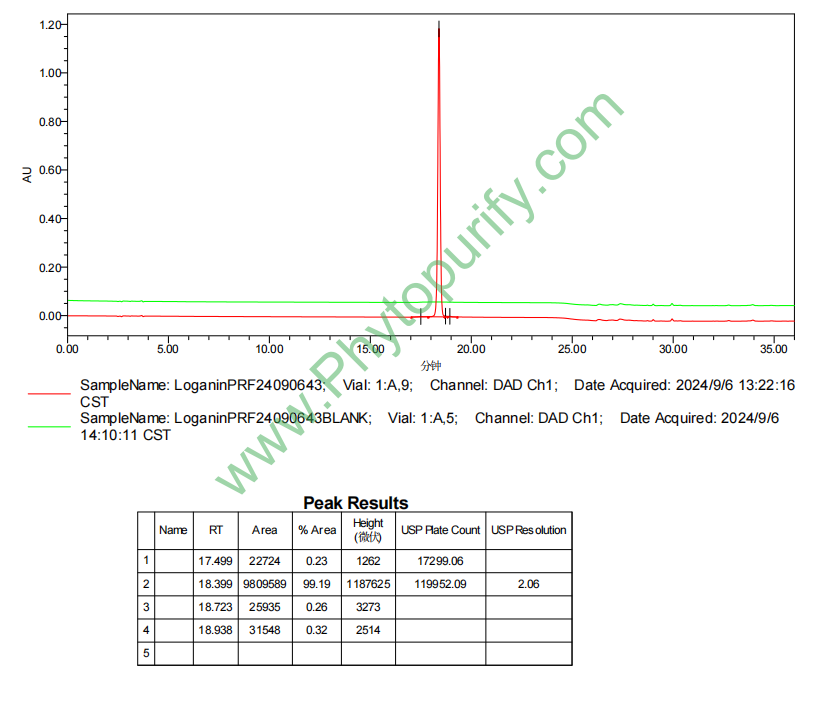
HPLC of Loganin
Storage conditions:Short-term storage at 2~8℃, long-term storage at -20 ~ -80℃
155.1400
-1.0867
-1.0867
56.7068
.5058
1.0116
Low
29.9383
4.6900
Yes
No
No
No
Yes
No
0.0
Yes
Yes
Yes
Yes
Natural products, as an important source of drug discovery, play an irreplaceable role in the long-term struggle between humans and diseases. As a class of secondary metabolites widely present in the plant kingdom, iridoid glycosides have attracted much attention due to their structural diversity and significant biological activity. Loganin (CAS number: 18524-94-2) is a typical iridoid glycoside, originally derived from plants in the family Malvaceae(Strychnos nux-vomica L. After isolation and identification, it was found to be widely present in various medicinal plants such as Cornaceae, Rubiaceae, Gentianaceae, etc.
The chemical structure of loganin is formed by the glycosidic bond between the iridoid nucleus and the glucose group, which endows it with rich pharmacological activity. In recent years, with the continuous deepening of research, the roles of loganin in anti-inflammatory, antioxidant, anti-tumor, and neuroprotective effects have gradually been revealed, especially in disease models such as acute lung injury, pulmonary fibrosis, and spinal cord injury, which have attracted widespread attention for their protective effects. Research has shown that loganin can effectively counteract lipopolysaccharide (LPS) - induced inflammation and oxidative stress damage by regulating the nuclear factor E2 related factor 2 (Nrf2)/heme oxygenase-1 (HO-1) signaling pathway, while reducing neuroinflammation caused by spinal cord injury.
This article will systematically review the research progress of loganin from the aspects of chemical structure and physicochemical properties, plant sources and extraction methods, pharmacological activity research, mechanism of action and molecular targets, drug evaluation and pharmacokinetics, clinical application prospects and prospects, in order to provide reference for the in-depth research and development of this natural product.
Maqian glycoside belongs to the class of iridoid glycosides, and its chemical structure has typical iridoid skeleton characteristics. Structurally, the parent nucleus of loganin is a cyclopentane pyran ring system, which is connected to a β - D-glucosyl group at the C-1 position to form a glycosidic structure. Its molecular formula is C ₁₇ H ₂₆ O ₁₀, and its molecular weight is 390.3850 g/mol. The substituents on the core of cyclohexene ether terpenes include the methyl group at position C-8, the hydroxyl group at position C-6, and the hydroxymethyl group at position C-7. The presence of these functional groups provides a structural basis for the chemical reactivity and biological activity of loganin.
The chemical structure of loganin contains multiple hydroxyl and glycosyl groups, which make it exhibit strong hydrophilicity. The cyclohexene ether terpene skeleton in its structure has multiple chiral centers, and its stereochemical configuration has a significant impact on its biological activity. It is worth noting that the sugar moiety of loganin not only affects its water solubility, but also has a significant impact on its metabolic conversion and bioavailability in vivo.
According to the results of computational chemistry and experimental measurements, the main physicochemical properties of loganin are as follows:
These physicochemical properties provide important reference for the drug development of loganin, and also suggest the need to pay attention to its bioavailability and targeted delivery in subsequent research.
Maqian glycoside was originally derived from the Maqian plant in the Maqian family(Strychnos nux-vomica L. It was isolated from the plant kingdom, but subsequent research found that it is widely distributed in the plant kingdom. The main known sources of plants currently include:
Cornaceae plants: Cornus officinalis(Cornus officinalis Sieb. et Zucc. is one of the most important natural sources of loganin. As a traditional Chinese medicine, Cornus officinalis has the effects of nourishing the liver and kidneys, astringency, and detoxification. Its fruit contains abundant loganin, which is the main raw material for the extraction and separation of loganin.
loganiaceous plants: Ma Qian Zi(Strychnos nux-vomica L. The seeds of) contain loganin, but also contain highly toxic alkaloids such as strychnine, so special attention should be paid to safety when extracting loganin.
Rubiaceae plants Some madder plants such as gardenia(Gardenia jasminoides Ellis also contains loganin, but the content is relatively low.
Gentianaceae plants: Gentiana genus(Gentiana)The presence of loganin has also been detected in plants.
Other plants There have also been reports of the distribution of loganin in plants such as Lonicera japonica and Oleaceae.
The content of loganin varies greatly among different plant sources, among which the content of loganin in Cornus officinalis fruit is usually higher and does not contain highly toxic components, making it the main raw material for loganin extraction and industrial production.
The extraction method of loganin is mainly based on its highly polar physicochemical properties, and commonly used extraction methods include:
1. Solvent extraction method
- Ethanol extraction method Using different concentrations of ethanol (usually 50% -80%) as the extraction solvent, crude extracts are obtained through reflux extraction or percolation extraction. This method is easy to operate and suitable for industrial production, but there are many impurities in the extract that require subsequent purification.
- Water extraction method Utilizing the good water solubility of loganin, hot water extraction is employed. This method has a low cost, but the extraction efficiency is relatively low, and it is easy to extract a large amount of water-soluble impurities.
2. Ultrasonic assisted extraction method
Ultrasonic assisted extraction utilizes the cavitation and mechanical effects of ultrasound, which can significantly improve extraction efficiency and shorten extraction time. Research has shown that under optimized conditions (ethanol concentration of 60%, solid-liquid ratio of 1:20, ultrasound time of 30 minutes), the extraction rate of loganin can reach a high level.
3. Microwave assisted extraction method
Microwave assisted extraction utilizes the penetrating and selective heating properties of microwaves to rapidly destroy cell wall structures and promote the dissolution of loganin. This method has the advantages of short extraction time and low solvent dosage.
4. Enzyme assisted extraction method
By adding enzyme preparations such as cellulase and pectinase, cellulose and pectin in plant cell walls can be degraded, improving the extraction efficiency of loganin. This method has mild conditions and is beneficial for maintaining the structural stability of loganin.
5. Purification method
- Macroporous adsorption resin method Using HPD-100, D101 and other types of macroporous adsorption resins, preliminary purification of loganin is achieved through adsorption desorption process. This method is easy to operate, the resin can be reused, and is suitable for industrial production.
- Silica gel column chromatography Using chloroform methanol water system as the mobile phase, further purify loganin by silica gel column chromatography.
- Preparation type high-performance liquid chromatography method Using a C18 reverse phase chromatography column and a methanol water or acetonitrile water system as the mobile phase, high-purity standard samples of loganin can be obtained.
The anti-inflammatory activity of loganin is one of its most prominent pharmacological effects, which has been validated in various inflammation models.
1. Protective effect on acute lung injury
Acute lung injury (ALI) is a severe clinical syndrome characterized by damage to alveolar epithelium and capillary endothelium, pulmonary edema, and infiltration of inflammatory cells. Research has shown that loganin can significantly alleviate LPS induced acute lung injury. In animal models, pretreatment with loganin can reduce the inflammatory cell count and protein content in bronchoalveolar lavage fluid, alleviate lung tissue pathological damage, and lower the levels of pro-inflammatory factors such as tumor necrosis factor - α (TNF - α), interleukin-6 (IL-6), and interleukin-1 β (IL-1 β).
2. Inhibitory effect on pulmonary fibrosis
Pulmonary fibrosis is the end-stage pathological change of various lung diseases, characterized by fibroblast proliferation and extracellular matrix deposition. Maginoside exhibits a protective effect in the bleomycin induced pulmonary fibrosis model by inhibiting epithelial mesenchymal transition (EMT) induced by transforming growth factor - β 1 (TGF - β 1), reducing collagen deposition, and improving lung function.
3. Regulation of neuroinflammation after spinal cord injury
After spinal cord injury (SCI), local inflammatory response exacerbates secondary injury. Maqian glycoside can alleviate the neuroinflammation caused by SCI, inhibit the excessive activation of microglia and astrocytes, reduce the expression of pro-inflammatory factors, and promote the recovery of neurological function.
4. Inhibitory effect on other inflammatory models
Maginoside showed significant anti-inflammatory effects in carrageenan induced foot swelling model, acetic acid induced increased intra-abdominal capillary permeability model, and xylene induced ear swelling model, indicating its broad-spectrum anti-inflammatory activity.
Oxidative stress is one of the important mechanisms underlying the occurrence and development of various diseases. Maqian glycoside exerts antioxidant effects through various pathways:
1. Directly eliminate free radicals
The hydroxyl structure in the molecule of loganin can directly scavenge 1,1-diphenyl-2-trinitrophenylhydrazine (DPPH) radicals, hydroxyl radicals, and superoxide anion radicals, exhibiting dose-dependent antioxidant activity.
2. Enhance endogenous antioxidant enzyme activity
Maqian glycoside can upregulate the activity of antioxidant enzymes such as superoxide dismutase (SOD), glutathione peroxidase (GSH Px), and catalase (CAT), while reducing the level of malondialdehyde (MDA) and enhancing the body's antioxidant defense ability.
3. Activate the Nrf2/HO-1 signaling pathway
Nrf2 is a key transcription factor that regulates the expression of antioxidant genes. Maginoside can promote the nuclear translocation of Nrf2, enhance its binding with antioxidant response elements (ARE), thereby upregulating the expression of antioxidant enzymes such as HO-1 and quinone oxidoreductase 1 (NQO1), and exert a cell protective effect.
The anti-tumor activity of loganin has received increasing attention in recent years, and it exhibits inhibitory effects in various tumor cell lines
1. Inhibit tumor cell proliferation
Loganin can inhibit the proliferation of a variety of tumor cells, such as liver cancer cells (HepG2), lung cancer cells (A549), breast cancer cells (MCF-7) and colon cancer cells (HT-29), and its IC ₀ value is usually at the micromolar level.
2. Inducing apoptosis of tumor cells
Maqian glycoside induces tumor cell apoptosis by activating the mitochondrial pathway and death receptor pathway. Research has shown that treatment with loganin can lead to a decrease in mitochondrial membrane potential, release of cytochrome c, activation of caspase-3 and caspase-9, and upregulation of Bax/Bcl-2 ratio.
3. Inhibit tumor cell migration and invasion
Maqian glycoside can inhibit the expression and activity of matrix metalloproteinases (MMPs), reduce the migration and invasion ability of tumor cells, suggesting its potential anti metastatic effect.
4. Enhance sensitivity to chemotherapy drugs
When combined with chemotherapy drugs such as cisplatin and paclitaxel, loganin can enhance the anti-tumor effect of chemotherapy drugs and reduce drug resistance, which may be related to its inhibition of the nuclear factor kappa B (NF - κ B) signaling pathway.
In addition to its protective effect in spinal cord injury, loganin also exhibits neuroprotective activity in other neurological disease models:
1. Anti Alzheimer's disease
Maqian glycoside can inhibit the aggregation and deposition of β - amyloid protein (A β), alleviate A β - induced neurotoxicity, and improve cognitive function in Alzheimer's disease model mice.
2. Anti Parkinson's disease
In the Parkinson's disease model induced by 1-methyl-4-phenyl-1,2,3,6-tetrahydropyridine (MPTP), loganin can protect dopaminergic neurons, increase striatal dopamine levels, and improve motor dysfunction.
3. Anti cerebral ischemia-reperfusion injury
Maqian glycoside can reduce the infarct area caused by cerebral ischemia-reperfusion, lower the neurological deficit score, inhibit inflammatory response and oxidative stress, and protect the integrity of the blood-brain barrier.
The Nrf2/HO-1 signaling pathway is the core mechanism by which loganin exerts anti-inflammatory and antioxidant effects. Under normal physiological conditions, Nrf2 binds to Kelch like ECH related protein 1 (Keap1) and is in an inactive state. When stimulated by oxidative stress or electrophilic agents, Nrf2 dissociates from Keap1, translocates into the nucleus, forms heterodimers with small Maf proteins, recognizes and binds to ARE, and initiates transcription of downstream antioxidant genes.
Maginoside can promote nuclear translocation of Nrf2, enhance the binding activity of Nrf2/ARE, and thereby upregulate the expression of antioxidant enzymes such as HO-1, NQO1, and glutathione S-transferase (GST). HO-1 is the rate limiting enzyme for heme degradation, and its products biliverdin, carbon monoxide, and free iron have anti-inflammatory, antioxidant, and anti apoptotic effects. By activating the Nrf2/HO-1 pathway, loganin can effectively alleviate LPS induced inflammatory response and oxidative stress damage.
Maqian glycoside exerts anti-inflammatory effects by regulating multiple inflammation related targets:
1. IL-6/STAT3 signaling pathway
Interleukin-6 (IL-6) is a multifunctional cytokine that plays a crucial role in inflammatory responses. Maqian glycoside can inhibit the production and signal transduction of IL-6, reduce the phosphorylation level of signal transduction and transcription activator 3 (STAT3), and thus suppress the inflammatory response.
2. NF - κ B signaling pathway
Nuclear factor kappa B (NF - κ B) is the core transcription factor in inflammatory response. Maqian glycoside can inhibit the activity of I κ B kinase (IKBKB), prevent the phosphorylation and degradation of I κ B α, thereby inhibiting the nuclear translocation and transcriptional activity of NF - κ B, and reducing the expression of pro-inflammatory factors such as TNF - α, IL-1 β, IL-6.
3. Caspase-1(CASP1)
Caspase-1 is a key enzyme in inflammasome activation, involved in the maturation and secretion of IL-1 β and IL-18. Maqian glycoside can inhibit the activation of Caspase-1 and alleviate the inflammatory response mediated by inflammasomes.
4. Inducible nitric oxide synthase (NOS2)
Inducible nitric oxide synthase (iNOS/NOS2) is highly expressed under inflammatory stimulation, producing excess nitric oxide (NO) and participating in inflammatory damage. Maqian glycoside can inhibit the expression and activity of NOS2, and reduce the production of NO.
5. Cyclooxygenase-1 (PTGS1/COX-1)
Cyclooxygenase is a key enzyme in prostaglandin synthesis. Maginoside can inhibit the activity of cyclooxygenase-1 (COX-1/PTGS1), reduce the synthesis of prostaglandins, and exert anti-inflammatory effects.
6. Transient receptor potential channels (TRPV1 and TRPA1)
TRPV1 and TRPA1 are ion channels involved in pain and inflammation signaling. Maqian glycoside can regulate the activity of these channels and alleviate inflammatory pain.
1. RELA(p65)
RELA is a member of the NF - κ B family, and loganin can inhibit the phosphorylation and nuclear translocation of RELA, thereby suppressing the NF - κ B signaling pathway.
2. TNF-α
Tumor necrosis factor - α (TNF - α) is a key initiating factor in inflammatory response. Maqian glycoside can inhibit the production and signal transduction of TNF - α, and alleviate inflammatory reactions.
The pharmacological activity of loganin is not the result of a single target action, but is achieved through the synergistic action of multiple targets and pathways. For example, in the LPS induced inflammation model, loganin simultaneously activates the Nrf2/HO-1 antioxidant pathway and inhibits the NF - κ B inflammatory pathway, exerting a protective effect through a "dual pronged" approach. This multi-target mode of action is in line with the characteristic of "multi-component, multi-target" action of natural products, and is also the structural basis for their broad pharmacological activity.
Based on the aforementioned physicochemical property parameters, the pharmacological properties of loganin can be evaluated from the following aspects:
1. Analysis of drug properties
According to Lipinski's "Rule of Five", the molecular weight of loganin (390.3850) is less than 500, the number of hydrogen bond donors (hydrogen atoms on hydroxyl and sugar groups) is greater than 5, the number of hydrogen bond acceptors (oxygen atoms) is greater than 10, and the LogP value (-1.0867) is less than 5. Although the number of hydrogen bond donors and acceptors exceeds the range of the "five rules", considering the specificity of natural products, loganin still has good medicinal properties.
2. Water solubility
The water solubility of loganin is good (56.7068 mg/mL), which is beneficial for the development of oral preparations and in vivo absorption.
3. blood-brain barrier permeability
The blood-brain barrier permeability of loganin is relatively low, which to some extent limits its application in central nervous system diseases. However, through nano delivery systems or structural modifications, it is expected to improve its brain distribution.
4. Safety evaluation
The hERG inhibition of loganin is negative, and the Ames test result is 0.0, indicating a low risk of cardiac and genetic toxicity. Acute toxicity studies have shown that loganin has a high LDX value and good safety.
1. Absorption
After oral administration, loganin is absorbed rapidly in the gastrointestinal tract, but its absolute bioavailability is relatively low. Research has shown that the oral bioavailability of loganin in rats is approximately 10% -20%, which may be related to its high polarity and poor intestinal permeability.
2. Distribution
Magin is widely distributed in the body, mainly in organs with abundant blood flow such as the liver, kidneys, and lungs. Due to its high polarity, loganin has a low binding rate with plasma proteins and mainly exists in free form.
3. Metabolism
Magin undergoes metabolic reactions such as glycosidic bond hydrolysis and glucuronidation in the body. The β - glucosidase in the gut microbiota can hydrolyze the glycosidic bonds of loganin to generate aglycones (loganin), which are further metabolized into glucuronic acid conjugates.
4. Excretion
Maginoside and its metabolites are mainly excreted through the kidneys in the form of urine, with some excreted through bile. Research has shown that the half-life of loganin in the body is relatively short, about 2-4 hours.
Given the low oral bioavailability of loganin, researchers have explored various strategies to improve its bioavailability:
1. Nano delivery system
Using nanocarriers such as liposomes, nanoparticles, and nanoemulsions to encapsulate loganin can improve its solubility, stability, and intestinal permeability, thereby improving oral bioavailability.
2. Precursor design
By chemical modification, lipid soluble groups are introduced into the molecule of loganin to prepare prodrugs, which can improve its lipid solubility and intestinal permeability, and release active ingredients after enzymatic hydrolysis in vivo.
3. Absorption promoter
Combined use with absorption enhancers (such as surfactants, bile salts, etc.) can increase the intestinal permeability of loganin.
4. Structural modification
Structural modification of the sugar moiety or parent nucleus of loganin to search for derivatives with better pharmacokinetic properties.
Based on the pharmacological activity of loganin, it has potential clinical application value in the following disease fields:
1. Inflammatory diseases
-Acute lung injury and acute respiratory distress syndrome
-Chronic obstructive pulmonary disease and pulmonary fibrosis
-Inflammatory bowel disease (such as ulcerative colitis and Crohn's disease)
-Rheumatoid arthritis
-Neuroinflammatory diseases (such as spinal cord injury, multiple sclerosis)
2. Oxidative stress-related diseases
-Ischemia reperfusion injury (in organs such as the heart, brain, and kidneys)
-Diabetes and its complications
-Neurodegenerative diseases (Alzheimer's disease, Parkinson's disease)
3. Tumors
-As an adjuvant therapy drug, it enhances the efficacy of chemotherapy and reduces its side effects
-Preventing tumor metastasis
4. Other diseases
-Liver fibrosis and cirrhosis
-Renal fibrosis
-Skin inflammation and injury
Although loganin has multiple pharmacological activities, its clinical development still faces some challenges:
1. Issue of bioavailability
The low oral bioavailability of loganin limits the development of its oral formulations. In the future, it is necessary to develop new delivery systems or carry out structural modifications to improve bioavailability.
2. Research on the mechanism of action
Although it has been found that loganin exerts its effects through pathways such as Nrf2/HO-1, its direct molecular target is still unclear. Further research is needed on the direct binding protein of loganin to elucidate its precise mechanism of action.
3. Quality control
The purity of loganin obtained from different plant sources and extraction methods varies greatly, and a unified quality control standard needs to be established.
4. Clinical research
At present, research on loganin mainly remains at the cellular and animal levels, lacking high-quality clinical research data. In the future, it is necessary to conduct systematic clinical trials to verify its safety and effectiveness.
1. Study on Structure Activity Relationship
By synthesizing derivatives and analogues of loganin, systematically studying its structure activity relationship, and searching for lead compounds with stronger activity and better pharmacokinetic properties.
2. Multi target network pharmacology
Using network pharmacology and systems biology methods, comprehensively analyze the multi-target action network of loganin and provide theoretical basis for its clinical application.
3. Combination therapy research
Explore the combined application effect of loganin and existing drugs (such as glucocorticoids, nonsteroidal anti-inflammatory drugs, chemotherapy drugs, etc.), and find the best compatibility scheme.
4. Development of new formulations
Develop nano formulations, targeted formulations, and slow-release formulations of loganin to improve its therapeutic efficacy and patient compliance.
5. Metabolomics research
Using metabolomics techniques, investigate the effects of loganin on the body's metabolic network and reveal its overall regulatory role.
As a typical natural product of iridoid glycosides, loganin has attracted widespread research interest due to its unique chemical structure and rich pharmacological activity. From anti-inflammatory and antioxidant effects to anti-tumor and neuroprotective effects, loganin has demonstrated multifaceted therapeutic potential, particularly in disease models such as acute lung injury, pulmonary fibrosis, and spinal cord injury, where its protective effects are remarkable.
Maqian glycoside exerts its anti-inflammatory and antioxidant effects by activating the Nrf2/HO-1 signaling pathway, inhibiting inflammatory pathways such as NF - κ B and STAT3, and regulating multiple molecular targets such as IL-6, TNF - α, CASP1, NOS2. This multi-target and multi pathway mode of action reflects the unique advantages of natural products and provides a theoretical basis for their application in complex diseases.
From the perspective of medicinal properties, loganin has good water solubility and safety, but issues such as low oral bioavailability and poor blood-brain barrier permeability still need to be addressed. Future research should focus on structural modification, development of novel delivery systems, and in-depth preclinical and clinical studies to promote the transition of loganin from laboratory to clinical applications.
With the continuous deepening of research on loganin, we have reason to believe that this ancient natural product will shine with new vitality in modern drug development and contribute to the cause of human health. At the same time, the study of loganin also provides important reference and inspiration for the development of other iridoid glycosides.
