


Product name: Forskolin
Synonym name: Coleonol; Colforsin, Boforsin
Catalogue No.: BP0593
Cas No.: 66575-29-9
Formula: C22H34O7
Mol Weight: 410.507
Botanical Source: Coleus forskohlii
Physical Description:
Type of Compound: Diterpenoids
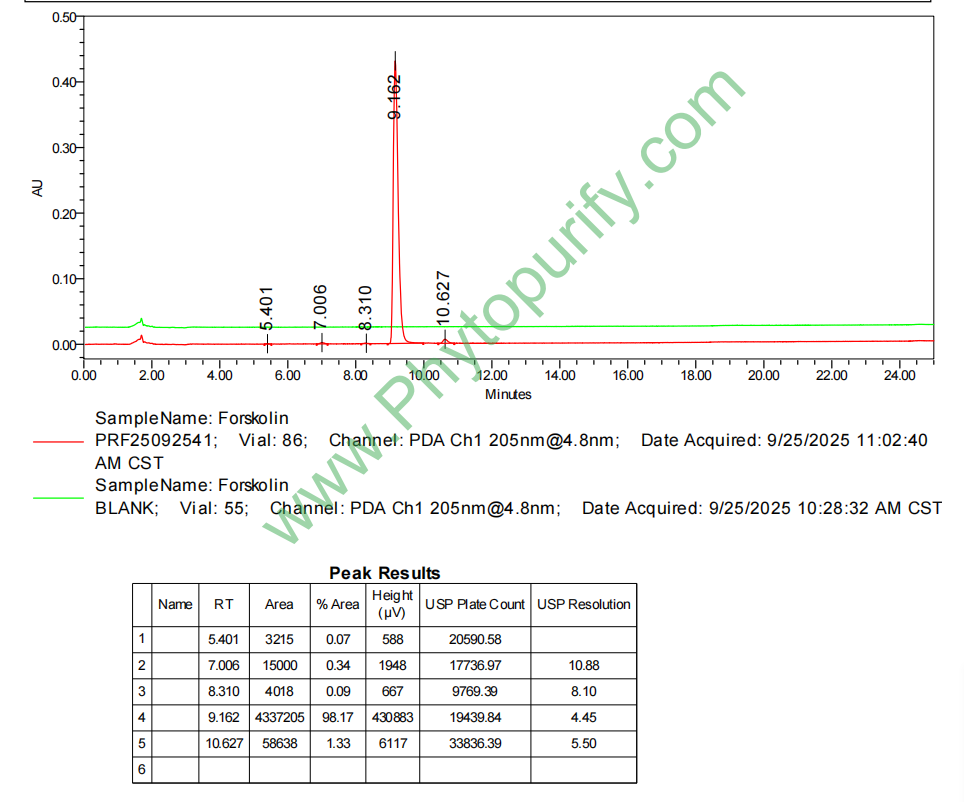
Purity: 95%~99%
Analysis Method: HPLC-DAD or/and HPLC-ELSD
Identification Method: Mass, NMR
Packing: Brown vial or HDPE plastic bottle
Storage: Store in a well closed container, protected from air and light. Put into refrigerate or freeze for long term storage.
Whenever possible, you should prepare and use solutions on the same day. However, if you need to make up stock solutions in advance, we recommend that you store the solution as aliquots in tightly sealed vials at -20℃. Generally, these will be useable for up to two weeks.
The product could be supplied from milligrams to grams
Inquire for bulk scale.
Description:
Oridonin has anticancer activity, might be useful as adjunctive therapy for individuals with lymphoid malignancies, including the lethal disease adult T-cell leukemia.It inhibits tumor growth in glioma by inducing cell cycle arrest and apoptosis, inhibits BxPC-3 cell growth through cell apoptosis.
References:
Sichuan Da Xue Xue Bao Yi Xue Ban. 2014 Nov;45(6):903-7.
Anti-leukemia effect of oridonin on T-cell acute lymphoblastic leukemia
To investigate the antileukemia effect of Oridonin on T-cell acute lymphoblastic leukemia cell line CEM.
METHODS AND RESULTS:
Human T-cell acute lymphoblastic leukemia cell line CEM was cultured in vitro. The 50% inhibition concentration (IC50) of Oridonin against CEM cells was examined using modified MTT assay. The cellular morphologic changes were observed using a light microscope. The percent of apoptosis of CEM cells after drug treatment was evaluated by flow cytometric analysis. The active levels of AKT/mTOR, RAF/MEK/ ERK, STAT5 signaling pathways and the expression levels of Bcl-2 and BAX were examined by Western blot. Oridonin inhibited the growth of CEM cells in time- and dose dependent manner and the ICs0 of Oridonin was (7. 37± 1. 99) μmol/L after 72 h treatment. The cellular membrane of CEM cells treated with Oridonin became unsharp, some of them disintegrated. Oridonin induced apoptosis in CEM cells and the percent of apoptosis rate after 0, 5, 7.5, 10 μmol/L Oridonin treatment for 24 h were (4. 8±2. 11)%, (19.03±12.54)% ,(40.27± 3.31) / and (57. 23 ± 6. 69)% respectively. Oridonin inhibited activation of mTOR, P70S6, 4EBP1, RAF. ERK and STAT5 signaling protein, which were constitutively activated in CEM cells, however, Oridonin had no inhibitory effect on AKT kinase. Oridonin down-regulated the level of anti apoptotic protein Bcl-2 and up-regulated the expression of pro-apoptotic protein Bax.
CONCLUSIONS:
Oridonin exerted antileukemia effect in CEM cells by inhibiting the activation of mTOR/P70/4EBP1, RAF/ERK and STATS signaling pathways, down-regulating the expression of Bel-2 and up-regulating the expression of BAX.
Zhong Yao Cai. 2014 Jul;37(7):1230-3.
Experimental study on anti-pancreatic cancer effect of oridonin.
To investigate the apoptotic effect of Oridonin in human pancreatic cancer cells PANC-1, and to explore the underlying mechanism.
METHODS AND RESULTS:
MTT assay was used to measure the cell viability. Apoptosis was determined by confocal laser scanning microscope after Hoechst 33342 staining and flow cytometry analysis after PI staining. The regulation of JNK and p38 MAPK signaling pathway proteins was examined by Western blot analysis. Treatment with Oridonin for 24 h resulted in a marked decrease in cell viability in a dose-dependent manner. The IC50 value was determined as 49.80 μmol/L for 24 h. After treatment with 50 micromol/L and 80 μmol/L Oridonin for 24 h, typical apoptotic nucleus alterations were observed with confocal laser scanning microscope and apoptotic rates of PANC-1 cells increased by flow cytometry analysis. Treatment with 80 μmol/L Oridonin down-regulated protein expression of JNK, p38 and increased the expression of p-JNK, p-p38. Furthermore, 80 μmol/L Oridonin treatment decreased the expression of down-stream proteins Caspase-9, Caspase-3 and PARP in the apoptotic pathway as well as activated the cleavage of Caspase-9.
CONCLUSIONS:
Oridonin can induce apoptosis of PANC-1 cells through JNK and p38 MAPK pathway proteins.
HPLC of Forskolin
Storage conditions:Short-term storage at 2~8℃, long-term storage at -20 ~ -80℃
Forskolin, also known as Coleonol, is a natural diterpenoid compound extracted from the roots of the Lamiaceae plant Coleus forskohlii. Since its first isolation and identification in the 1970s, Fossilin has received widespread attention due to its unique biological activity, particularly as an effective activator of adenylate cyclase (AC). It can significantly promote the generation of intracellular cyclic adenosine monophosphate (cAMP), thereby regulating various cellular signaling pathways, affecting cellular metabolism, differentiation, and functional status. In recent years, with the in-depth study of the cAMP signaling pathway in various physiological and pathological processes, the potential application value of Foscolin in cardiovascular diseases, ophthalmic diseases, metabolic disorders, tumors, and neurodegenerative diseases has gradually emerged.
This article aims to provide a systematic review of the chemical structure and physicochemical properties, plant sources and extraction methods, pharmacological activity and mechanism of action, pharmacological evaluation and pharmacokinetic characteristics of Foscolin, as well as its clinical application prospects and future research directions, in order to provide reference and guidance for researchers in the field of natural product pharmacology.
The chemical name of Fossilin is 7- β - hydroxy-8,13-bicycloditerpene-1,6-dione, with a molecular formula of C22H34O7 and a molecular weight of 410.5070. Its structural core is a diterpene skeleton containing multiple hydroxyl and ketone groups, with high polarity and complex stereochemical characteristics. The LogP value of Fossilin is about 1.452, indicating that it has moderate lipid solubility and is beneficial for penetrating cell membranes. The topological polar surface area (TPSA) is 113.29 Å ², indicating its polarity and hydrogen bond donor/acceptor ability, which is of great significance for its binding to biomolecule targets.
Low water solubility (0.2675 mg/mL) limits its solubility in aqueous media and affects its bioavailability. It is worth noting that Forskolin has good blood-brain barrier permeability, indicating its potential application value in central nervous system diseases. In terms of safety, Fosicolin did not exhibit hERG channel inhibitory activity, and the Ames mutagenicity test was negative, indicating that it has a good safety basis.
Foskohlin mainly comes from Coleus forskohlii Briq, a perennial herbaceous plant widely distributed in India, Nepal, and Southeast Asia. The roots of this plant are rich in Fossilin, which is an important component of traditional herbal medicine. Traditionally, Indian umbrella flower roots have been used to treat heart disease, hypertension, and digestive system disorders.
The extraction of Fossilin is usually carried out using organic solvent extraction method. Common solvents include methanol, ethanol, ethyl acetate, etc. Combined with ultrasonic assisted extraction or reflux extraction techniques, the extraction efficiency can be improved. The extract was concentrated, liquid-liquid partitioned, and purified by column chromatography to obtain high-purity Foscolin. In recent years, supercritical CO2 extraction and membrane separation technologies have also been introduced to achieve green and efficient extraction.
The optimization of the extraction process not only improves the yield, but also ensures the stability of the active ingredients in Foscolin, laying the foundation for its large-scale production and medicinal development.
Fossilin, as an adenylate cyclase activator, can significantly increase intracellular cAMP levels, regulate various cAMP dependent signaling pathways, and exhibit diverse pharmacological activities.
Cardiovascular system function
Fossilin activates AC, increases cAMP, promotes calcium influx into myocardial cells, produces positive inotropic effects, and enhances cardiac contractility. In addition, its ability to dilate blood vessels and reduce peripheral resistance helps to lower blood pressure. Animal experiments have shown that fluconazole can effectively improve heart function in heart failure models and has potential cardiovascular protective effects.
Platelet anti aggregation effect
Fossilin inhibits platelet activation and aggregation through the cAMP pathway, reducing the risk of thrombosis. This characteristic makes it have potential applications in preventing thrombotic diseases.
Eye pressure lowering effect
Fossilin can regulate the generation and excretion of aqueous humor in the eye, reduce intraocular pressure, and its related targets include carbonic anhydrase (CA2, CA4, CA12), adenylate cyclase (ADCY5), phosphodiesterase 4B (PDE4B), and cAMP dependent protein kinase (PRKACA). Its intraocular pressure lowering effect provides a new approach for the treatment of glaucoma.
Cell differentiation and autophagy induction
Fossilin can induce differentiation of various cell types, promote tissue repair and regeneration. At the same time, by activating the cAMP/PKA signaling pathway, inducing cellular autophagy, participating in the regulation of intracellular metabolic homeostasis and cellular protection under pathological conditions.
Nuclear receptor activation
Fossilin activates the pregnane X receptor (PXR) and farnesyl ester X receptor (FXR), regulates drug metabolizing enzymes and bile acid metabolism, affects liver detoxification and lipid metabolism processes, suggesting its potential application in metabolic diseases.
The core mechanism of action of Fossilin is the activation of adenylate cyclase, especially type I AC, with an IC50 of approximately 41 nM and an EC50 of approximately 0.5 μ M. Through this mechanism, Foscolin promotes the conversion of ATP to cAMP, activates cAMP dependent protein kinase A (PKA), and regulates the activity of downstream signaling molecules such as CREB (cAMP responsive element binding protein) and other transcription factors, thereby regulating gene expression.
In addition, Fossilin affects multiple related targets:
Through the synergistic effect of multiple targets mentioned above, Foscolin exerts a comprehensive regulatory effect in multiple physiological and pathological processes.
The physicochemical properties of Fossilin indicate that it has certain potential for medicinal use. The molecular weight of 410.5, moderate lipid solubility (LogP 1.452), and high polarity (TPSA 113.29) give it advantages in cell membrane penetration and targeted binding. The low water solubility limits its oral bioavailability and needs to be improved through pharmaceutical methods.
In terms of safety, Fossilin has no hERG channel inhibition and a negative Ames test, indicating a low risk of cardiac toxicity and mutagenicity.
Pharmacokinetic studies have shown that fluconazole is rapidly absorbed orally, but its bioavailability is limited by first pass effects and solubility. It is widely distributed in the body, especially able to penetrate the blood-brain barrier, indicating its potential application in central nervous system diseases. The metabolic pathway mainly involves the liver enzyme system, and excretion is mainly through bile and urine.
To enhance its clinical application value, current research focuses on formulation optimization, such as nanocarriers, liposome encapsulation, and eutectic technology, to improve its stability and bioavailability.
Fossilin has shown broad application prospects in multiple clinical fields due to its multi-target and multi pathway pharmacological activities
Glaucoma and ophthalmic diseases
Foscolin has become a potential candidate drug for glaucoma treatment by regulating the generation and excretion of aqueous humor in the eye, reducing intraocular pressure. Its unique mechanism of action is expected to be used in combination with existing drugs to improve therapeutic efficacy.
cardiovascular disease
Positive muscle strength and blood pressure lowering effects make fluconazole have therapeutic potential in diseases such as heart failure and hypertension. In the future, combined with modern drug delivery technology, it is expected to develop new cardiovascular drugs.
Metabolic diseases
By activating PXR and FXR, Forskolin regulates lipid metabolism and drug metabolizing enzymes, which may be applied to metabolic disorders such as non-alcoholic fatty liver disease (NAFLD) and hyperlipidemia.
Tumors and neurological disorders
The role of inducing cellular autophagy and differentiation provides new ideas for cancer treatment and neurodegenerative diseases. Its ability to penetrate the blood-brain barrier provides a foundation for the development of central nervous system drugs.
Future research should focus on in-depth analysis of the molecular mechanism of fossilin, optimizing its pharmacokinetic properties, conducting more preclinical and clinical trials, and verifying its safety and efficacy.
As a classic natural product, Fossilin has significant value in the field of pharmacology due to its unique adenylate cyclase activation function and multi-target mechanism of action. Its potential applications in cardiovascular, ophthalmic, metabolic, and neurological diseases demonstrate broad clinical translational prospects. In the future, combined with modern medicinal chemistry and formulation technology, Foscolin is expected to become a new type of drug for the treatment of various diseases. The in-depth mechanism research and clinical verification of the system will provide a solid foundation for its drug development and promote the sustainable development of natural product pharmacology.
