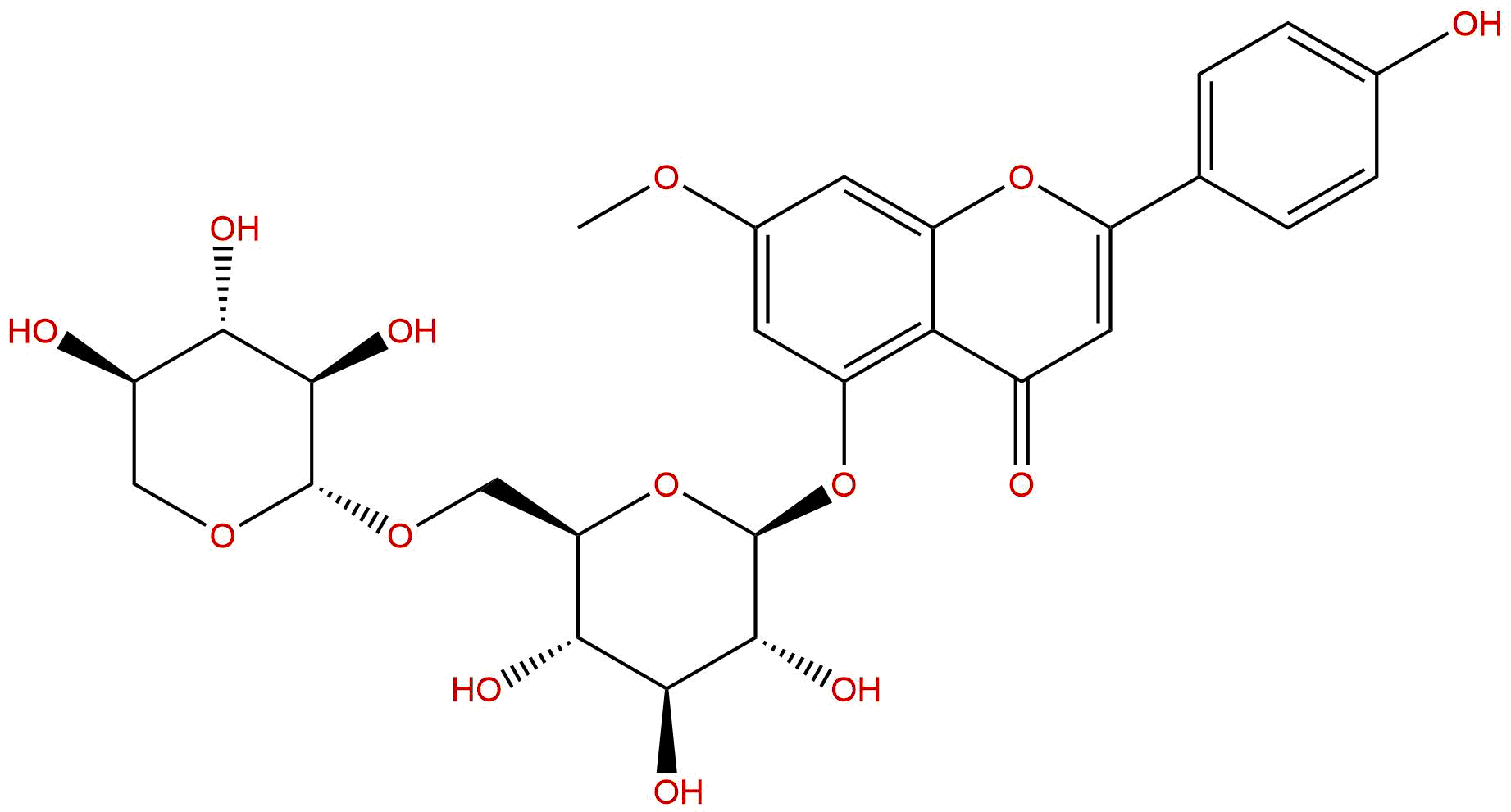


Product name: Yuankanin
Synonym name: Genkwanin 5-O-primeveroside
Catalogue No.: BP4692
Cas No.: 77099-20-8
Formula: C27H30O14
Mol Weight: 578.523
Botanical Source:
Type of Compound: Flavonoids
Purity: 95%~99%
Analysis Method: HPLC-DAD or/and HPLC-ELSD
Identification Method: Mass, NMR
Packing: Brown vial or HDPE plastic bottle
Storage: Store in a well closed container, protected from air and light. Put into refrigerate or freeze for long term storage.
Whenever possible, you should prepare and use solutions on the same day. However, if you need to make up stock solutions in advance, we recommend that you store the solution as aliquots in tightly sealed vials at -20℃. Generally, these will be useable for up to two weeks.
The product could be supplied from milligrams to grams
Inquire for bulk scale.
For Reference Standard and R&D, Not for Human Use Directly.
Storage conditions:Short-term storage at 2~8℃, long-term storage at -20 ~ -80℃
Yuankanin (CAS number: 77099-20-8) is a natural flavonoid glycoside compound with a chemical structure of genkwain-5-glucoside. Its sugar group consists of xylose and glucose. As a natural product with potential pharmacological activity, naringenin is mainly isolated from the above ground methanol extract of Gnidia involucrata, a plant in the Thymelaeaceae family. In recent years, with the deepening of pharmacological research on natural products, naringenin has gradually become a research hotspot in the field of drug development due to its significant anti-inflammatory activity and multi-target regulatory effects.
Anti inflammatory response is a key link in the pathogenesis of various diseases, involving complex regulation of multiple cytokines and signaling pathways. Yuangen glycoside exhibits good anti-inflammatory effects by regulating multiple key targets including IL-6, STAT3, CASP1, TRPV1, PTGS1, TNF, TRPA1, NOS2, PTGS2, and NFKB1, suggesting its potential application value in the treatment of inflammation related diseases. This article provides a systematic review of the chemical structure and physicochemical properties, plant sources and extraction methods, pharmacological activity and mechanism of action, pharmacological evaluation and pharmacokinetic characteristics of naringenin. It also looks forward to its clinical application prospects, aiming to provide theoretical basis and research direction for the development of natural product drugs in the future.
The chemical structure of genkwanin belongs to the flavonoid class, specifically genkwain-5-glucoside, and the sugar part is composed of xylose and glucose. Its molecular formula is C27H30O14 and its molecular weight is 578.5230. The structural characteristics of this compound include the benzene ring and pyran ring system of the flavonoid nucleus, and the glycosylation modification of the 5-hydroxy group, which endows it with strong water solubility and biological activity.
In terms of physical and chemical properties, the LogP value of naringenin is -0.1496, indicating its strong hydrophilicity and water solubility of 1.6444. It has good water solubility, which is conducive to absorption and distribution in vivo. Its topological polar surface area (TPSA) is 217.9700, and higher TPSA values are usually associated with lower cell membrane permeability, indicating limited transmembrane ability. The low permeability of the blood-brain barrier (BBB) indicates that naringenin is difficult to enter the central nervous system, reducing the risk of central side effects. The negative result of hERG channel inhibition experiment indicates a low risk of cardiac toxicity. The Ames test result is 0.6, indicating that its genetic toxicity risk is relatively low and has a good safety basis.
In summary, the chemical structure and physicochemical properties of naringenin provide a solid foundation for its use as a drug molecule, especially in the development of anti-inflammatory drugs, where hydrophilicity and safety are important considerations.
The main source of naringenin is the aboveground part of Gnidia involucrata, a plant in the Thymelaeaceae family. Gnidia involucrata is widely distributed in some parts of Africa and has traditionally been used to treat various inflammatory and infectious diseases. Its medicinal value has gradually been confirmed by modern science.
The extraction method usually uses methanol as a solvent to extract the aboveground parts of plants. The specific steps include: drying and crushing the collected plant materials, using 80% -100% methanol for multiple reflux or ultrasound assisted extraction, filtering and concentrating the extraction solution, and separating and purifying it through liquid-liquid distribution, column chromatography (such as silica gel column, C18 reverse phase column), and high performance liquid chromatography (HPLC) to obtain high-purity naringenin.
In recent years, with the advancement of extraction technology, green and efficient methods such as supercritical fluid extraction and microwave-assisted extraction have also been attempted to be applied to the extraction of naringenin, significantly improving extraction efficiency and purity, reducing the use of organic solvents, and meeting the environmental protection needs of modern natural product drug development.
The pharmacological activity of naringenin mainly focuses on anti-inflammatory effects, and there are also preliminary research reports on antioxidant and anti-tumor effects.
Numerous in vitro cell models and animal experiments have shown that naringenin can significantly inhibit the production and release of inflammatory mediators. Its targets include various inflammation related factors, including pro-inflammatory cytokines IL-6 and TNF - α, inflammatory signaling molecule STAT3, inflammation related enzymes PTGS1 (COX-1), PTGS2 (COX-2), NOS2 (iNOS), as well as inflammation mediated ion channels TRPV1 and TRPA1.
In macrophage and monocyte models, naringenin can inhibit LPS induced expression of IL-6 and TNF - α, and weaken inflammatory response. In animal inflammation models such as plantar swelling and inflammatory pain models, naringenin exhibits significant anti-inflammatory and analgesic effects, indicating its potential therapeutic value in inflammatory diseases such as arthritis and inflammatory bowel disease.
Partial studies have shown that naringenin has certain antioxidant activity, can scavenge free radicals, and alleviate oxidative stress damage. In terms of anti-tumor effects, naringenin inhibits tumor cell proliferation and promotes apoptosis by regulating the apoptosis related protein CASP1 and NF - κ B signaling pathway. However, the relevant mechanisms still need further in-depth research.
The anti-inflammatory mechanism of naringenin involves the regulation of multiple signaling pathways and key molecules, reflecting its multi-target and multi mechanism pharmacological characteristics.
Yuangen glycoside can significantly downregulate the expression levels of pro-inflammatory cytokines IL-6 and TNF - α. IL-6, as an important mediator in inflammatory response, participates in the activation of immune cells and the amplification of inflammatory signals; TNF - α is a key initiating factor in the inflammatory response. Yuangen glycoside reduces inflammation by inhibiting the production of these cytokines.
STAT3 is a core transcription factor in the IL-6 signaling pathway, involved in regulating the expression of inflammatory genes. Yuangen glycoside can inhibit the phosphorylation activation of STAT3, block its nuclear transcriptional activity, and thereby suppress the expression of inflammation related genes.
NF - κ B (NFKB1) is another key inflammatory signaling molecule that regulates the expression of various inflammatory factors and enzymes. Yuangen glycoside inhibits the activation of NF - κ B, reduces the expression of inflammatory enzymes such as PTGS2 (COX-2) and NOS2 (iNOS), and lowers the synthesis of inflammatory mediators.
PTGS1 (COX-1) and PTGS2 (COX-2) catalyze the synthesis of prostaglandins and are important enzymes in inflammatory reactions. Yuangen glycoside inhibits the activity of these two enzymes and reduces the production of inflammatory mediators.
TRPV1 and TRPA1 are key ion channels in inflammatory pain, regulating neuronal excitability and pain conduction. The regulation of these two channels by naringenin can help alleviate inflammatory pain.
CASP1 (caspase-1) plays an important role in inflammatory cell death (pyroptosis). Yuangen glycoside regulates CASP1 activity, affects the apoptosis process of inflammatory cells, and reduces tissue damage.
In summary, naringenin exerts its anti-inflammatory and related pharmacological effects through multi-target and multi pathway synergistic effects, reflecting the complex biological regulatory characteristics of natural products.
The pharmacological evaluation of naringenin includes physical and chemical properties, in vivo absorption, distribution, metabolism, and excretion (ADME) characteristics, and safety assessment.
The molecular weight of naringenin is 578.5230, slightly higher than the ideal range of traditional oral medications (<500), but still within an acceptable range. Its LogP value is -0.1496, indicating strong hydrophilicity and good water solubility, which is beneficial for formulation development. A high TPSA value suggests low cell membrane permeability, which may affect oral bioavailability.
At present, there is limited research on the pharmacokinetics of naringenin in vivo. Based on its physicochemical properties, it is speculated that its oral absorption may be limited, and its blood-brain barrier permeability is low, indicating that it mainly acts on peripheral tissues. In the future, systematic in vivo pharmacokinetic studies are needed, including absorption rates, distribution volumes, metabolic pathways, and excretion modes, to guide formulation design and optimize dosing regimens.
The hERG channel inhibition experiment showed a negative result, indicating a low risk of cardiac toxicity associated with naringenin. The Ames test result is 0.6, indicating that its genetic toxicity risk is relatively low and has a good safety basis. Combining its natural sources and traditional usage history, naringenin has good safety potential.
Yuangen glycoside, as a multi-target anti-inflammatory natural product, has broad clinical application potential. Inflammation is a common pathological basis for various chronic diseases such as rheumatoid arthritis, inflammatory bowel disease, chronic obstructive pulmonary disease, and metabolic syndrome. Yuangen glycoside has the potential to become an effective therapeutic candidate for these diseases by regulating key inflammatory factors and signaling pathways.
In addition, the antioxidant and anti-tumor potential of naringenin provides the possibility for its expanded application fields, especially in the regulation of tumor related inflammatory microenvironment, which has research value. In the future, its pharmacokinetics, toxicology, and preclinical efficacy evaluation should be strengthened to promote its clinical translation.
In terms of drug formulations, considering the water solubility and membrane permeability characteristics of naringenin, developing suitable delivery routes (such as oral sustained-release formulations, local delivery systems) and nanocarrier technology will help improve its bioavailability and therapeutic efficacy.
In summary, as a natural product with multi-target anti-inflammatory activity, naringenin has good prospects for drug development. In the future, by combining modern medicinal chemistry, pharmacology, and pharmaceutical technology, it is expected to achieve clinical application transformation and enrich the treatment methods of anti-inflammatory drugs.
As a natural flavonoid glycoside derived from Gnidia involucrata, naringenin exhibits significant anti-inflammatory activity and multi-target regulatory ability due to its unique chemical structure and excellent physicochemical properties. Its mechanism of action covers multi-level regulation of inflammatory cytokines, signal transduction pathways, inflammatory enzymes, and ion channels, reflecting the complex and effective biological regulatory characteristics of natural products.
The evaluation of medicinal properties shows that naringenin has good water solubility and safety, but its cell membrane permeability and oral bioavailability still need to be optimized. In the future, it is necessary to strengthen its pharmacokinetic and toxicological research, and combine modern formulation technology to promote its preclinical research and clinical trials.
In summary, as a multifunctional natural product, naringenin has broad prospects for anti-inflammatory and related disease treatment applications. In depth exploration of its pharmacological mechanisms and optimization of drug properties will provide important examples for the development of natural product drugs, and assist in the research and application of new anti-inflammatory drugs.
