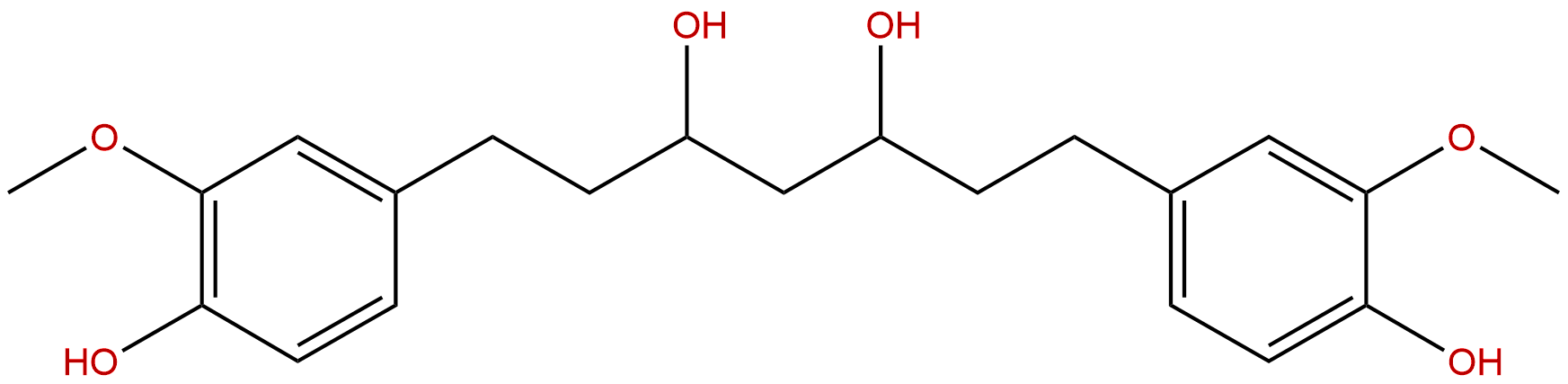


Product name: Octahydrocurcumin
Synonym name:
Catalogue No.: BP3276
Cas No.: 36062-07-4
Formula: C21H28O6
Mol Weight: 376.449
Botanical Source:
Physical Description: Powder
Type of Compound: Phenols
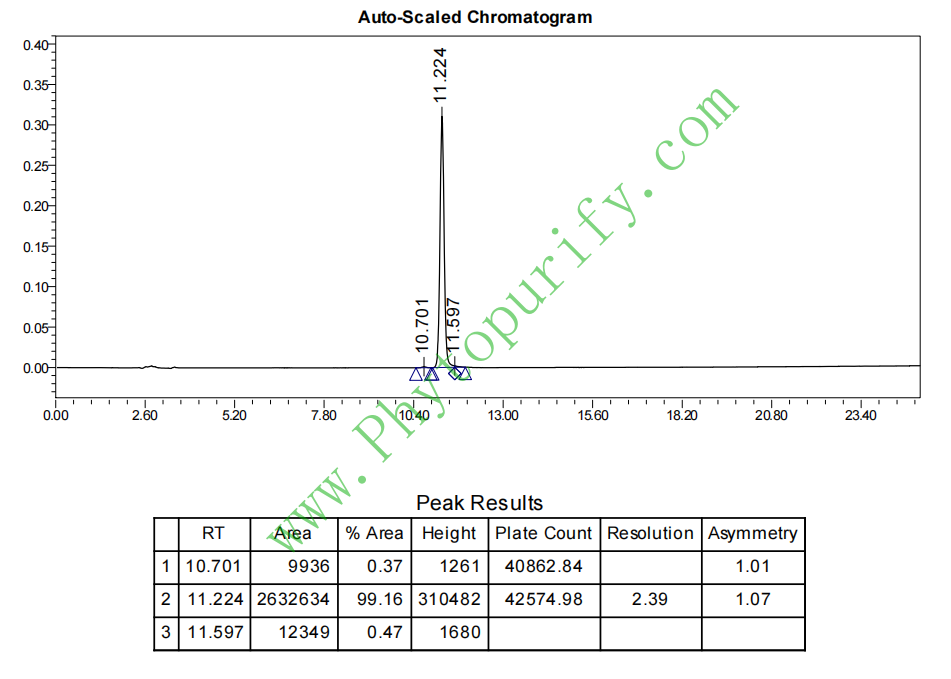
Purity: 95%~99%
Analysis Method: HPLC-DAD or/and HPLC-ELSD
Identification Method: Mass, NMR
Packing: Brown vial or HDPE plastic bottle
The product could be supplied from milligrams to grams. Inquire for bulk scale.
We provide solution to improve the water-solubility of compounds, thereby facilitating the variety of activity tests and clinic uses.
For Reference Standard and R&D, Not for Human Use Directly.
HPLC of Octahydrocurcumin
Storage conditions:Short-term storage at 2~8℃, long-term storage at -20 ~ -80℃
99.3800
2.4460
2.4440
.1419
4.8670
3.9868
Low
87.1991
2.9780
Yes
No
No
No
No
No
0.0
No
No
No
No
Natural products and their derivatives have always been an important source of innovative drug discovery. Curcumin, as turmeric(Curcuma longa L. The main active ingredients of () have attracted much attention due to their extensive pharmacological activities such as anti-inflammatory, antioxidant, and anti-tumor effects. However, its poor bioavailability and chemical instability limit its clinical application. To overcome these shortcomings, researchers are committed to developing its structural analogues and metabolites. Octahydroxycurcumin (OHC), chemical name 1,7-bis (4-hydroxy-3-methoxyphenyl) -3,5-heptanedione, CAS number 36062-07-4, is one of the main hydrogenated derivatives of curcumin generated by intestinal microbiota reduction metabolism in vivo. In recent years, studies have found that OHC not only retains some of the core biological activities of curcumin, but also exhibits potential advantages in stability, absorption, and target selectivity, especially in the treatment of inflammatory bowel diseases such as colitis. This article aims to provide a systematic review of the chemical properties, pharmacological activities, mechanisms of action, pharmacological properties, and clinical application prospects of octahydrocurcumin, in order to provide comprehensive scientific references for the in-depth research and development of this compound.
Octahydrocurcumin is a product of structural modification of curcumin. Its parent nucleus curcumin is composed of two adjacent methoxy hydroxyphenyl groups connected by a seven carbon chain (containing a β - diketone structure). The structural characteristics of octahydrocurcumin are the complete hydrogenation reduction of the β - diketone structure in its seven carbon chain and the double bonds connecting the two benzene rings to the side chains. Specifically, the two C=C double bonds (located in the enone chain) in its structure are saturated, forming a fully saturated heptanedione chain, while the benzene ring structure remains unchanged. This structural change changes its molecular formula from C21H20O6 of curcumin to C21H28O6, with a molecular weight of 376.4490.
In terms of physical and chemical properties, the saturated structure of OHC has brought significant changes. Its lipid water partition coefficient (LogP) is 2.4460, indicating that it has moderate lipophilicity, which is superior to curcumin (LogP of about 3.0), which may facilitate membrane penetration. The topological polar surface area (TPSA) is 99.38 Å ², reflecting the presence of multiple hydrogen bond donors (hydroxyl groups) and acceptors in the molecule. The predicted value of water solubility is 0.1419 mg/mL, which has improved compared to the extremely low water solubility of curcumin, but still belongs to the category of difficult solubility. These physicochemical parameters collectively determine the fundamental characteristics of its pharmacokinetics. Its saturated structure also significantly enhances chemical stability, avoiding the disadvantage of curcumin being easily degraded at physiological pH, laying the foundation for its stable existence in vivo.
Octahydrocurcumin is not the original component in turmeric plants, but a metabolic transformation product of curcumin in organisms. There are two main sources of curcumin: firstly, it is produced through the metabolic conversion of curcumin in the gut microbiota of mammals (especially humans and experimental animals); The second is to synthesize or semi synthesize curcumin through chemical or biocatalytic methods.
In vivo biotransformation After oral administration of curcumin, its absorption rate in the gastrointestinal tract is low, and most of it reaches the colon, where it is gradually reduced by the intestinal microbiota (such as Clostridium difficile, Pseudomonas aeruginosa, and Lactobacillus) through reductase action, producing a series of hydrogenated metabolites including dihydrocurcumin, tetrahydrocurcumin, hexahydrocurcumin, and ultimately octahydrocurcumin. OHC is considered one of the main terminal reducing metabolites, which explains why although curcumin has low oral bioavailability, it can still exert local pharmacological effects in the distal intestine (such as the colon) through active metabolites.
In vitro preparation method:
At present, OHC used for pharmacological research mainly relies on chemical synthesis. The optimization of its extraction and purification process, especially the development of green and efficient biocatalytic pathways, is a research direction for future large-scale preparation.
Octahydrocurcumin inherits the core pharmacological activity framework of curcumin and exhibits unique or stronger effects in multiple disease models, particularly in anti-inflammatory and intestinal protection.
anti-inflammatory activity This is the most prominent pharmacological activity of OHC. OHC exhibits strong anti-inflammatory effects in various animal models of acute and chronic inflammation. For example, in the carrageenan induced rat paw edema model and the xylene induced mouse ear swelling model, OHC can dose dependently inhibit edema. More importantly, in experimental colitis mouse models induced by dextran sulfate sodium (DSS) or 2,4,6-trinitrobenzenesulfonic acid (TNBS), oral administration of OHC can significantly reduce colon tissue damage, shorten colon length, and lower disease activity index, with effects comparable to or even better than the positive drug sulfasalazine. Its anti-inflammatory effect is not limited to local areas, but also has a regulatory effect on systemic inflammation.
antioxidant activity OHC retains the phenolic hydroxyl structure, giving it the ability to scavenge free radicals. Research has shown that OHC can effectively scavenge DPPH and ABTS free radicals, and exhibit iron ion reducing ability. In cell models, it can enhance the activity of antioxidant enzymes such as superoxide dismutase (SOD) and glutathione peroxidase (GPx), reduce the levels of lipid peroxidation products such as malondialdehyde (MDA), and alleviate oxidative stress damage.
Neuroprotective activity Although its blood-brain barrier permeability is low, some studies suggest that OHC or its further metabolites may be beneficial to the nervous system. In Alzheimer's disease cell models, OHC exhibits the potential to inhibit β - amyloid aggregation and alleviate neuronal toxicity. Its anti-inflammatory and antioxidant properties are also believed to help combat inflammation and oxidative damage in neurodegenerative diseases.
Other activities: The preliminary study also suggests that OHC may have anti-tumor (such as inhibiting the proliferation of some cancer cells), anti diabetes (improving insulin resistance), cardiovascular protection and other activities, but the evidence in these fields is still insufficient and needs more research to confirm.
Compared with curcumin, OHC exhibits stronger in vivo activity in intestinal inflammation models such as colitis, which may be directly related to its higher concentration and better metabolic stability in the colon.
The multiple pharmacological activities of octahydrocurcumin stem from its regulation of multiple key signaling pathways and molecular targets. The mechanism network of action for inflammatory diseases such as colitis has been extensively revealed, involving the following core targets and pathways:
Inhibition of TLR4/NF - κ B inflammatory axis This is the core mechanism of OHC's anti-inflammatory effect. Pathogen related molecular patterns such as lipopolysaccharides (LPS) activate Toll like receptor 4 (TLR4), triggering the downstream myeloid differentiation factor 88 (MyD88) dependent pathway, ultimately leading to nuclear translocation of the key subunit RELA (p65) of nuclear factor kappa B (NF - κ B), initiating gene transcription of pro-inflammatory factors such as TNF - α, IL-1 β, IL-6, etc. Research has shown that OHC can effectively inhibit the expression and activation of TLR4, block the phosphorylation and nuclear translocation of NF - κ B p65, and thus suppress the inflammatory cascade reaction upstream.
Regulating the MAPK signaling pathway The mitogen activated protein kinase (MAPK) pathway (including p38, JNK, and ERK/MAPK1) is another key pathway in inflammatory response. OHC has been shown to inhibit the phosphorylation of MAPK1 (ERK2), p38, and JNK induced by LPS or inflammatory stimuli, thereby reducing the production of pro-inflammatory mediators.
Regulating lipid metabolism related enzymes:
Intervention in cell apoptosis and pyroptosis In colitis, excessive epithelial cell death (apoptosis and pyroptosis) disrupts the intestinal barrier. OHC can downregulate pro apoptotic proteins and significantly inhibit the activation of NLRP3 inflammasome and its downstream effector protein caspase-1 (CASP1), thereby inhibiting cell apoptosis, reducing the mature release of IL-1 β and IL-18, and protecting intestinal epithelial integrity.
Affects protein kinase C (PKC) signaling Protein kinase C alpha (PRKCA) is involved in the regulation of various cellular processes. OHC may affect downstream inflammation and barrier function related signals by regulating PKC activity.
Regulating Carboxyesterase 1 (CES1)CES1 is a hydrolytic metabolic enzyme that also participates in the regulation of certain endogenous substances. The interaction between OHC and CES1 may affect its own metabolism or the balance of endogenous lipid mediators, and the specific mechanism is still under exploration.
In summary, octahydrocurcumin achieves its comprehensive effects of anti-inflammatory, antioxidant, and intestinal barrier protection through multi-target and multi pathway synergistic effects, providing a solid molecular basis for its treatment of complex multifactorial diseases such as colitis.
Based on the provided pharmacological parameters and existing research, the preliminary evaluation of the pharmacological properties of octahydrocurcumin is as follows:
Absorption, distribution, metabolism, excretion (ADME):
Preliminary evaluation of safety:
Current status of pharmacokinetic research Compared with curcumin, there are fewer reports on the pharmacokinetic studies of OHC. Limited animal studies have shown that OHC can be detected in plasma and colon tissue after oral administration, and its concentration and retention time in colon tissue may be better than curcumin, which is consistent with its local therapeutic advantages for colon diseases. However, key parameters such as absolute bioavailability, plasma protein binding rate, major metabolic organs, and elimination half-life need to be clarified through standardized pharmacokinetic studies.
Overall, octahydrocurcumin has shown good preliminary predictive characteristics in terms of cardiac safety and genetic toxicity risk, but its water solubility and bioavailability are challenges that need to be addressed through pharmaceutical methods. Comprehensive preclinical pharmacokinetic and toxicological studies are the necessary path towards clinical development.
Octahydrocurcumin has shown clear clinical potential, especially in the field of inflammatory bowel disease.
Main application directions:
Development Challenges and Strategies:
Future Prospects:
With the deepening understanding of the role of gut microbiota metabolites in health and disease, the research value of octahydrocurcumin, as a "biologically activated" form of curcumin, is increasingly prominent. It is not only a promising candidate drug molecule, but also a model for studying the relationship between metabolic transformation and drug efficacy in natural products. Future research will tend to: ① develop intelligent colon targeted delivery systems to achieve efficient enrichment of OHC at the lesion site; ② Explore its synergistic effects with other natural products or drugs; ③ Verify its efficacy using new models such as organoids and organ chips; ④ Explore its applications in a wider range of fields such as metabolic diseases and cancer prevention. Ultimately, through interdisciplinary collaboration, we aim to promote the transition of octahydrocurcumin from the laboratory to clinical practice, providing patients with new treatment options.
As a key hydrogenated metabolite of curcumin, octahydrocurcumin has become a highlight in the research of natural product derived drugs due to its enhanced chemical stability, unique pharmacokinetic characteristics, and potent anti-inflammatory activity against multiple targets and pathways such as colitis. It successfully extended the research perspective of curcumin from the prototype drug to its active metabolites in the body, revealing the important role of gut microbiota in the efficacy of traditional Chinese medicine. Although there are still challenges in terms of bioavailability in drug development, these challenges are expected to be gradually overcome through the integration of modern medicinal chemistry, pharmacy, and pharmacology methods. The systematic preclinical research and subsequent clinical translational exploration will ultimately reveal whether octahydrocurcumin can transform from a promising natural molecule into a truly beneficial therapeutic drug for patients with inflammatory bowel disease and other conditions. Continuous in-depth research on it will not only contribute to the development of new drugs, but also deepen our scientific understanding of the metabolism and activity of natural products.
