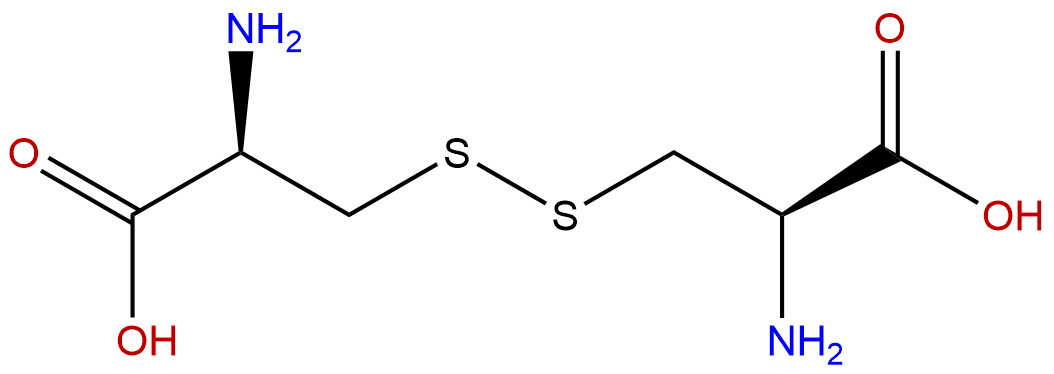


Storage conditions:Short-term storage at 2~8℃, long-term storage at -20 ~ -80℃
126.6400
-1.4419
-1.4498
.2514
.2568
1.3412
Low
31.1645
3.4974
Yes
Yes
Yes
No
No
No
0.0
No
No
No
No
L-Cysteine is a sulfur-containing amino acid widely present in the biological world, which is the oxidized dimer form of L-cysteine. Its chemical structure is composed of two cysteine molecules connected by a disulfide bond (- S-S -), with CAS registration number 56-89-3. In nature, L-cysteine is an important component of proteins, especially abundant in structural and functional proteins such as keratin and insulin. As a stable extracellular form of cysteine, L-cysteine exhibits important biological functions both in vivo and in vitro, particularly playing a crucial role in regulating redox balance, cellular signal transduction, and immune response.
In recent years, with the deepening understanding of the core role of oxidative stress in various diseases such as neurodegenerative diseases, cardiovascular diseases, tumors, and metabolic diseases, L-cysteine has received widespread attention due to its unique antioxidant activity. Research has shown that L-cysteine can activate the nuclear factor E2 related factor 2 (Nrf2) signaling pathway, upregulate the expression of a series of antioxidant enzyme genes, effectively eliminate reactive oxygen species (ROS), and protect cells from oxidative damage. In addition, the combined application of L-cysteine and L-theanine has shown potential in enhancing humoral immunity and regulating Th2 type immune responses, indicating its application prospects in immune regulation and vaccine adjuvant development. In clinical practice, L-cysteine has been used as an adjuvant therapy for cystinuria (a hereditary tubular transport disorder) and kidney stones, but its broader pharmacological effects and clinical application value still need to be further explored.
This review aims to systematically summarize the chemical and physicochemical properties, natural sources, extraction processes, pharmacological activities, molecular mechanisms, pharmacological characteristics, and clinical application prospects of L-cysteine, in order to provide comprehensive academic references for the in-depth research and development of this natural product.
The chemical name of L-cysteine is bis - β - thioalanine, with a molecular formula of C ₆ H ₁ ₂ N ₂ O ₄ S ₂ and a molecular weight of 240.3060 g/mol. The core of its structure is a symmetrical dimer formed by the covalent connection of two L-cysteine residues through disulfide bonds. Each cysteine unit contains an amino group (- NH ₂), a carboxyl group (- COOH), and a side chain sulfur group, but in cysteine, the two sulfur groups oxidize to form a stable disulfide bond, giving the molecule unique chemical stability. The disulfide bond can be reduced to two free thiol groups (- SH) under reducing conditions, and this reversible redox conversion is the basis for the biological function of L-cysteine.
In terms of physical and chemical properties, L-cysteine is a white crystalline powder, odorless, and slightly sweet. Its water solubility is relatively low, with a solubility of about 0.2514 mg/mL in water at 25 ℃, which is related to the balance between polar groups (amino, carboxyl) and non-polar disulfide bond regions in its molecule. The lipid water partition coefficient (LogP) of L-cysteine is -1.4419, indicating its strong hydrophilicity and difficulty in penetrating the lipid bilayer. The topological polar surface area (TPSA) is 126.6400 Å ², further confirming its polarity characteristics. These properties determine the absorption and distribution pattern of L-cysteine in the body: its oral bioavailability is limited and mainly relies on reductases in the intestine to convert it into cysteine for absorption. L-Cysteine is relatively stable in acidic environments, but is prone to oxidation or degradation under alkaline conditions. Its isoelectric point is about 5.0, and it mainly exists in the form of zwitterionic ions at physiological pH (7.4).
It is worth noting that L-cysteine has a low blood-brain barrier (BBB) penetration ability, which limits its direct application in central nervous system diseases. In addition, the hERG inhibition test result was negative, indicating a low risk of cardiac toxicity; The Ames test result is 0.0, indicating that it has no mutagenicity, which provides preliminary assurance for its safety as a drug candidate molecule.
L-Cysteine is widely present in animal and plant proteins, especially in tissues rich in keratin. In the plant kingdom, legumes, grains, nuts, and seed foods are common sources of L-cysteine. For example, soybean, peanut, sesame, oat, wheat germ and some algae (such as spirulina) all contain rich cystine residues. However, L-cystine in plants mostly exists in the form of bound form in proteins, with extremely low levels of free form. Therefore, the main way to obtain L-cysteine in industry is not through direct extraction, but through protein hydrolysis and subsequent separation and purification.
The traditional extraction methods are based on acid hydrolysis or enzymatic hydrolysis techniques. The acid hydrolysis method usually uses 6 M hydrochloric acid to hydrolyze raw materials rich in keratin (such as human hair, pig hair, feathers, wool, etc.) at 110-120 ℃, completely degrading the protein into an amino acid mixture. After neutralization, decolorization, and filtration, the hydrolysate is separated from the mixed amino acids by isoelectric point precipitation method, taking advantage of the extremely low solubility of L-cysteine at a specific pH. The crude product can be refined through steps such as recrystallization and activated carbon decolorization to obtain high-purity L-cysteine. This method has mature technology and low cost, but it has disadvantages such as severe hydrolysis conditions, partial amino acid destruction, and the generation of a large amount of waste acid.
Enzymatic hydrolysis, as a green alternative technology, has received attention in recent years. Using proteases such as papain, trypsin, alkaline protease, etc. to hydrolyze proteins under mild conditions (pH 6-8, temperature 40-60 ℃) can preserve the natural configuration of amino acids and avoid racemization. Enzymatic hydrolysate can be purified through steps such as ultrafiltration, ion exchange chromatography, and crystallization to obtain L-cystine with high optical purity. In addition, microbial fermentation is also a potential pathway for producing L-cysteine. Escherichia coli or Corynebacterium glutamicum can be genetically engineered to excessively synthesize and secrete cysteine, which is then oxidized and converted into cysteine. This method has the advantages of environmental friendliness and strong sustainability, but the yield and cost still need to be optimized.
In recent years, new separation technologies such as membrane separation, simulated moving bed chromatography, and aqueous two-phase extraction have also been attempted for the purification of L-cysteine, aiming to improve yield and purity, reduce energy consumption and pollution. Overall, the industrial production of L-cysteine is still mainly based on acid hydrolysis isoelectric point precipitation method, but a green and efficient biomanufacturing route is the future development direction.
The core pharmacological activity of L-cysteine lies in its antioxidant capacity. As a precursor of cysteine, L-cysteine is rapidly reduced to cysteine upon entering the cell, which is the rate limiting substrate for the synthesis of glutathione (GSH). GSH is the most important non enzymatic antioxidant in cells, directly involved in clearing ROS such as hydrogen peroxide and lipid peroxides, and maintaining the reduced state of protein thiol groups. Research has shown that treatment with L-cysteine can significantly increase intracellular GSH levels, thereby enhancing the antioxidant defense system of cells.
More importantly, L-cysteine can directly regulate the antioxidant signaling pathway. Multiple in vitro experiments have confirmed that L-cysteine can upregulate the expression of Nrf2 protein and promote its nuclear translocation, activating the Nrf2/ARE (antioxidant response element) signaling pathway. The activation of this pathway leads to transcriptional upregulation of a series of phase II detoxifying enzymes and antioxidant enzyme genes, including heme oxygenase-1 (HMOX1), quinone oxidoreductase 1 (NQO1), superoxide dismutase (SOD1, SOD2), catalase (CAT), glutathione peroxidase (GPX1), etc. These enzymes work together to form multiple layers of defense against oxidative stress.
In cell models, L-cysteine pretreatment can significantly alleviate cytotoxicity induced by oxidants such as hydrogen peroxide, tert butyl hydroperoxide, and Doxorubicin. For example, in cardiomyocytes, L-cysteine effectively protects cells from doxorubicin induced apoptosis by reducing ROS accumulation, inhibiting mitochondrial membrane potential decline, and caspase-3 activation. Similar protective effects have also been observed in liver cells and neurons, suggesting that L-cysteine has broad-spectrum cell protective potential.
The role of L-cysteine in immune regulation has received attention in recent years. Research has found that the combination of L-cysteine and L-theanine can significantly enhance the production of antigen-specific immunoglobulin G (IgG). The mechanism is related to the synergistic increase of intracellular GSH levels by the two: GSH acts as a key redox buffer, affecting the activation, differentiation, and function of T cells. Specifically, the increase in GSH levels is beneficial for the humoral immune response mediated by T helper cell 2 (Th2) and promotes the production of antibodies by B cells. This discovery suggests that L-cysteine may serve as an immune enhancer or vaccine adjuvant to enhance the immunogenicity of vaccines.
In addition, L-cysteine also has a regulatory effect on the function of macrophages and dendritic cells. By regulating the intracellular redox state, L-cysteine can affect the cytokine secretion profile of these antigen-presenting cells, thereby indirectly regulating the direction of adaptive immune response. However, further research is needed on the specific regulatory network of L-cysteine on the immune system and its potential applications in autoimmune or inflammatory diseases.
The most classic application of L-cysteine in clinical practice is the treatment of cystinuria. Cystinuria is an autosomal recessive genetic disorder caused by defects in the transport of cysteine, ornithine, arginine, and lysine in the renal tubules, resulting in high concentrations of cysteine in urine and the formation of cystine stones. Oral administration of L-cysteine (or cysteine) can increase the solubility of cysteine in urine and reduce stone formation. However, this application requires careful dosage control, as excessive intake may actually increase the risk of stones. In recent years, the combination therapy of L-cysteine with other drugs such as tiopronin and Captopril has shown better results in reducing stone recurrence.
Preliminary studies also suggest that L-cysteine may have anti-inflammatory, anti fibrotic, and neuroprotective effects. For example, in a pulmonary fibrosis model, L-cysteine alleviates collagen deposition by inhibiting the TGF - β 1/Smad signaling pathway and reducing oxidative stress. In the Parkinson's disease model, L-cysteine protects dopaminergic neurons by increasing GSH levels. However, these findings are mostly based on in vitro or animal experiments and still require clinical validation.
The pharmacological mechanism of action of L-cysteine can be summarized as follows:
Nrf2 is the core transcription factor that cells use to respond to oxidative stress. At rest, Nrf2 binds to Keap1 protein in the cytoplasm and is degraded by ubiquitination. When L-cysteine enters the cell, its reduction product cysteine and subsequent GSH synthesis increase, changing the intracellular redox state and causing conformational changes or modifications of Keap1, thereby releasing Nrf2. Activated Nrf2 translocates to the nucleus, forms heterodimers with small Maf proteins, binds to the ARE sequence in the promoter region of the target gene, and initiates transcription of downstream genes. These target genes include:
- antioxidant enzyme HMOX1, NQO1, SOD1, SOD2, CAT, GPX1, GST (glutathione S-transferase), etc.
- Detoxifying enzyme UGT (UDP glucuronate transferase), GCLC (glutamic acid cysteine ligase catalytic subunit), etc.
- Anti-inflammatory protein HO-1 (i.e. HMOX1) has anti-inflammatory and anti apoptotic effects.
Through this mechanism, L-cysteine not only directly increases GSH levels, but also establishes a long-lasting antioxidant defense system through transcriptional regulation.
L-Cysteine affects various redox sensitive signaling proteins by altering the intracellular GSH/GSSG ratio. For example, the activity of protein tyrosine phosphatases (PTPs) depends on the reduced state of cysteine at the active site. The increase in GSH levels can maintain the activity of PTPs, thereby negatively regulating the growth factor receptor and MAPK (mitogen activated protein kinase) signaling pathway, inhibiting excessive proliferation and inflammatory response. In addition, the activation of NF - κ B is also regulated by the redox state, and the increase of GSH can inhibit the activity of I κ B kinase, reduce the nuclear translocation of NF - κ B, and thus exert anti-inflammatory effects.
Although L-cysteine itself is not a direct ROS scavenger, its reduction products cysteine and GSH can directly react with ROS. GSH, catalyzed by glutathione peroxidase (GPX), reduces H ₂ O ₂ to water and oxidizes itself to GSSG. GSSG is subsequently reduced by glutathione reductase (GR) to form a cycle. This cycle is the main pathway for cells to clear peroxides.
L-Cysteine has a regulatory effect on the expression of MMP1 and MMP3. MMPs are key enzymes involved in extracellular matrix degradation and play important roles in tissue remodeling, inflammation, and tumor invasion. Research has shown that L-cysteine may help maintain extracellular matrix homeostasis and delay tissue fibrosis by inhibiting oxidative stress-induced MMP activation.
Tyrosinase is the rate limiting enzyme for melanin synthesis. The effect of L-cysteine on TYR activity has a dual nature: at low concentrations, it may inhibit the oxidative activity of tyrosinase by providing a reducing environment, while at high concentrations, it may directly inhibit enzyme activity by affecting copper ion coordination. This characteristic suggests the potential application of L-cysteine in skin whitening or pigmentation diseases, but related research is not yet sufficient.
Based on computational chemistry and experimental data, the pharmacological parameters of L-cysteine are as follows:
- molecular weight:240.3060 Da, Complies with the "Five Rules for Classified Drugs" (MW<500).
- LogP-1.4419, with strong hydrophilicity, suggests that its oral absorption may be limited.
- TPSA 126.6400 Å ², larger than 140 Å ² is usually not conducive to oral absorption, but L-cysteine can be absorbed through active transport mechanisms.
- Water solubility:0.2514 mg/mL, Belonging to low solubility compounds, it may affect the development of formulations.
- Blood-brain barrier penetration Low, which limits the application of the central nervous system.
- HERG inhibition No, the risk of cardiac toxicity is low.
- Ames test: 0.0, no mutagenicity.
Overall, L-cysteine has a good safety profile, but its low oral bioavailability is the main challenge for its drug development.
The pharmacokinetic studies of L-cysteine in vivo are relatively limited. After oral administration, L-cysteine is partially reduced to cysteine in the gastrointestinal tract, which is absorbed through neutral amino acid transporters (such as B ⁰ AT1) on small intestinal epithelial cells. Unreduced L-cysteine is absorbed through dipeptide transporter (PEPT1) or passive diffusion. Due to the water solubility and polarity of L-cysteine, its oral absorption rate is slow, and its estimated bioavailability is less than 30%.
After absorption, L-cysteine rapidly distributes to tissues throughout the body, especially at high concentrations in the liver, kidneys, and skin. In cells, L-cysteine is reduced to cysteine by glutathione reductase or thioredoxin reductase, the latter of which participates in GSH synthesis or protein synthesis. The metabolism of L-cysteine mainly occurs through the sulfur conversion pathway: cysteine can be metabolized into taurine, sulfate, or enter the tricarboxylic acid cycle. Its excretion is mainly through the kidneys, and it is excreted in its original form or metabolite form with urine.
The plasma half-life of L-cysteine is approximately 1-2 hours due to its rapid uptake and metabolism by cells. Intravenous injection or high-dose oral administration can significantly increase plasma concentration, but attention should be paid to the risk of renal tubular crystallization or stones caused by high-dose administration. At present, L-cysteine is commonly used as a nutritional supplement or medication in oral form, with a dosage range of 0.5-3 grams per day, taken in divided doses.
To overcome the disadvantage of poor oral absorption of L-cysteine, researchers have explored various formulation strategies. For example, forming a complex of L-cysteine with phospholipids or cyclodextrin can improve its water solubility and membrane permeability. Carrier systems such as nanoliposomes and solid lipid nanoparticles have also been used to encapsulate L-cysteine for sustained release and targeted delivery. In addition, prodrug design (such as esterification or amidation derivatives) can improve its lipid solubility and promote absorption. However, most of these strategies are still in the laboratory research stage and have not yet entered clinical applications.
The most mature application of L-cysteine in clinical practice is to treat cystinuria and prevent cystine stones. Oral administration of L-cysteine (or cysteine) can increase the solubility of cysteine in urine and reduce the risk of stone formation. However, this therapy needs to be carried out under the guidance of a doctor and accompanied by a large amount of drinking water and alkalizing urine. In addition, L-cysteine, as a nutritional supplement, is used to improve protein malnutrition, promote wound healing, and enhance immunity, and has a certain market share in the health product market.
neoadjuvant therapy L-Cysteine can alleviate normal tissue damage caused by chemotherapy drugs such as doxorubicin and cisplatin, and may enhance anti-tumor immune response by regulating immunity.
Immune regulation and vaccine adjuvants The combined application of L-cysteine and L-theanine has shown a synergistic effect in enhancing antibody production, and is expected to be developed as a novel vaccine adjuvant, especially suitable for the elderly or immunocompromised population.
Skin Health and Beauty L-Cysteine is an important raw material for keratin synthesis. Oral or topical administration can improve skin elasticity, reduce wrinkles, and promote hair growth. Its application in beauty and health products is quite common, but there is a lack of high-quality clinical evidence.
Anti fibrotic therapy L-Cysteine has shown protective effects in lung, liver, and kidney fibrosis models by inhibiting TGF - β 1 signaling and oxidative stress, and may become a candidate molecule for anti fibrotic drugs.
Despite the multifaceted pharmacological activities of L-cysteine, its clinical translation still faces many challenges:
- Low oral bioavailability New delivery systems or prodrugs need to be developed to improve absorption efficiency.
- The dose-response relationship is unclear The effective dose varies greatly in different disease models, and systematic pharmacological and pharmacokinetic studies are needed.
- Lack of long-term safety data Although short-term use is safe, the potential risks of long-term high-dose use (such as kidney stones and redox imbalance) need to be evaluated.
- The mechanism of action needs to be thoroughly analyzed Is the activation of the Nrf2 pathway by L-cysteine direct or indirect? Are there any other signaling pathways involved? These issues need to be clarified.
Future research should focus on: (1) developing highly bioavailable derivatives or formulations of L-cysteine; (2) Conduct multicenter, randomized controlled clinical trials to validate its efficacy in specific diseases; (3) Using omics techniques such as transcriptomics and metabolomics to comprehensively analyze its functional network; (4) Explore the synergistic effects of L-cysteine with other natural products or drugs.
L-Cysteine, as a naturally occurring sulfur-containing amino acid, has shown broad application prospects in antioxidant, immune regulation, kidney protection, and potential anti fibrosis fields due to its unique redox activity. It exerts cellular protective effects through multiple mechanisms such as activating the Nrf2/ARE signaling pathway, increasing GSH levels, and regulating redox sensitive signaling networks. Although the low oral bioavailability and drug defects limit its clinical translation, these obstacles are expected to be overcome through formulation innovation and structural modification. With the continuous deepening of understanding of the role of oxidative stress in the occurrence and development of diseases, L-cysteine, as a safe and multifunctional natural product, is expected to play a greater value in nutritional health, disease prevention, and adjuvant therapy. In the future, interdisciplinary collaborative research will drive L-cysteine from the laboratory to clinical practice, contributing to the cause of human health.
Batch can search by a CAS number,one per line
