| Catalog No | Package | Original Price | Price | Inventory | Quantity | Operating |
|---|---|---|---|---|---|---|
| BP4176-5mg | 5mg | $190.00 | Sign in |
|


Storage conditions:Short-term storage at 2~8℃, long-term storage at -20 ~ -80℃
55.7600
4.5310
4.5291
.0256
4.6601
4.2357
High
91.9708
2.2523
Yes
Yes
Yes
No
No
No
0.0
No
No
No
Yes
Capsiate (CAS number: 205687-01-0) is a natural product derived from plants of the chili genus and belongs to the Capsaicin class of analogues. Compared with capsaicin, capsaicin esters have significant non irritating characteristics, which have attracted widespread attention in the fields of food science, pharmacology, and functional nutrition. Capsaicin esters were initially isolated from CH-19 non irritating sweet red pepper varieties. As an orally active TRPV1 receptor agonist, it exhibits multiple biological activities, including analgesic, antioxidant, hypoglycemic, anti-inflammatory, and angiogenesis inhibitory effects. In recent years, with the in-depth study of TRPV1 channel and its related signaling pathways, capsaicin esters have become one of the hotspots in natural product pharmacology research due to their good safety and potential clinical application value.
This article will systematically review the chemical structure and physicochemical properties, plant sources and extraction methods, pharmacological activity and mechanism of action, drug evaluation and pharmacokinetic characteristics of capsaicin esters, and explore their potential applications in pain relief and metabolic diseases, as well as their future clinical development prospects and challenges.
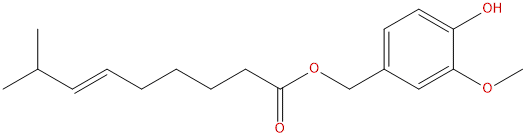
The chemical name of capsaicin ester is carboxylic acid ester of (6E) -8-methylnon-6-enoic acid and vanillol, with a molecular formula of C19H30O4 and a molecular weight of 306.4020. Its structural characteristic is a monomethoxybenzene compound formed by ester bonding between Capsiate acid and vanillol, belonging to the phenolic compound family. Unlike capsaicin, the ester bonds of capsaicin esters make it difficult to release free capsaicin in the oral and gastrointestinal tracts, thus exhibiting non irritating properties.
In terms of physicochemical properties, the LogP value of capsaicin ester is 4.5310, indicating its high lipid solubility, which is beneficial for cell membrane penetration and oral absorption. Its topological polar surface area (TPSA) is 55.76 Å ², indicating moderate polarity and favorable binding with biomolecules. Low water solubility (0.0256 mg/mL) suggests limited solubility in aqueous phase, but its high lipid solubility and small polarity make it easy to pass through the blood-brain barrier (BBB), providing a molecular basis for its pharmacological effects in the central nervous system. The hERG channel inhibition experiment showed a negative result, indicating a low risk of cardiac toxicity. The Ames mutagenicity test result is 0.0, indicating that its genotoxicity risk is low and it has good safety.
Capsaicin esters are mainly found in plants of the Capsicum genus, especially in the CH-19 sweet red pepper (Capsicum annuum L.) variety. Due to its unique genetic background, this variety contains almost no irritating capsaicin, but is rich in capsaicin esters. The fruit ripening period of this plant is the optimal time window for collection and extraction.
The extraction process usually adopts solvent extraction method, and commonly used organic solvents include ethanol, methanol, and ethyl acetate. During the extraction process, temperature and pH should be controlled to prevent hydrolysis of capsaicin esters. Modern extraction techniques such as ultrasound assisted extraction, microwave-assisted extraction, and supercritical fluid extraction have been applied to the efficient extraction of capsaicin esters, significantly improving yield and purity.
The crude extract after extraction is purified by column chromatography, high-performance liquid chromatography (HPLC) and other separation techniques to obtain high-purity capsaicin esters. The identification methods mainly include mass spectrometry (MS), nuclear magnetic resonance (NMR), and infrared spectroscopy (IR) to ensure the accurate and error free structure of the compound.
The pharmacological activities of capsaicin esters cover various physiological and pathological processes, mainly including the following aspects:
Capsaicin esters, as agonists of TRPV1 receptors, can regulate pain perception. TRPV1 channel is expressed in sensory neurons, mediating pain signal transduction induced by thermal and chemical stimuli. Capsaicin esters activate TRPV1, induce calcium influx, and regulate neuronal excitability, exhibiting analgesic effects. Compared with capsaicin, capsaicin esters are suitable for oral administration and have better tolerance due to their non irritating nature.
In addition, capsaicin esters also affect other related targets such as CNR1 (cannabinoid receptor 1), OPRD1 (delta opioid receptor), OPRM1 (μ - opioid receptor), etc., participating in the multi-target synergistic effect of pain regulation and enhancing its analgesic effect.
Capsaicin esters have significant antioxidant activity, which can eliminate free radicals and alleviate oxidative stress. Its phenolic structure endows it with excellent free radical capture ability, reduces intracellular ROS levels, and protects cells from oxidative damage.
In the inflammatory model, capsaicin esters alleviate the inflammatory response by inhibiting the expression of inflammatory mediators such as PTGS1 (COX-1) and PTGS2 (COX-2). In addition, it can also inhibit TRPA1 channels, reduce inflammation related neural excitability, and further exert anti-inflammatory effects.
Capsaicin esters activate TRPV1 channels, promote energy metabolism and fat oxidation, improve insulin sensitivity, and exhibit hypoglycemic effects. Animal experiments have shown that capsaicin ester can reduce blood glucose levels and improve the disorder of glucose and lipid metabolism, which has potential value in the treatment of type 2 diabetes.
The inhibitory effect of capsaicin esters on angiogenesis may be achieved by regulating endothelial cell function and related signaling pathways, demonstrating their potential application value in tumors and neovascular related diseases.
In addition, capsaicin esters exhibit anti allergic activity, which may be related to regulating immune cell function and inhibiting the release of allergic mediators, and are expected to be used as adjuvant therapy for allergic diseases.
The biological effects of capsaicin esters are mainly achieved through their activation of TRPV1 receptors. TRPV1 is a non selective cation channel widely distributed in sensory neurons and various tissue cells, participating in various physiological processes such as pain, inflammation, and metabolic regulation.
After capsaicin ester binds to TRPV1, it induces channel opening, causing calcium ion influx and activating downstream signaling pathways, including calcium dependent protein kinase (CaMK), protein kinase C (PKC), and MAPK pathways, regulating gene expression and cellular function. In addition, capsaicin esters also affect neurotransmitter receptors such as CNR1, OPRD1, OPRM1, and OPRK1, regulating nerve conduction and pain perception.
In inflammation regulation, capsaicin esters inhibit the expression of PTGS1 and PTGS2, reduce prostaglandin synthesis, and decrease the release of inflammatory mediators. At the same time, inhibiting TRPA1 channels reduces inflammation related neural excitability and pain.
Its hypoglycemic effect may involve promoting pancreatic beta cell function, enhancing insulin secretion and sensitivity, regulating fatty acid metabolism, promoting fat oxidation, and reducing metabolic stress.
In summary, capsaicin esters achieve diverse pharmacological effects through multi-target and multi pathway synergistic effects.
The pharmacological parameters of capsaicin esters indicate that they have good potential for drug development. Its molecular weight is 306.4, in accordance with Lipinski's rule, with a LogP of 4.53, indicating moderate lipid solubility, which is beneficial for membrane permeability and oral absorption. TPSA is 55.76 Å ², suitable for binding with biomolecules and supporting their biological activity.
The low water solubility (0.0256 mg/mL) is a major challenge in the development of its formulation, and its bioavailability needs to be improved through techniques such as nanocarriers, solid dispersions, or liposomes. Capsaicin esters can effectively penetrate the blood-brain barrier, indicating their potential application in central nervous system diseases.
In terms of safety, the hERG channel inhibition experiment was negative, reducing the risk of cardiac toxicity. The Ames test result is 0, indicating no significant mutagenicity and good safety.
Pharmacokinetic studies have shown that capsaicin esters are rapidly absorbed after oral administration, with higher bioavailability than capsaicin. Due to their ester bond structure, they can be hydrolyzed by esterases in the body, releasing active ingredients and exerting pharmacological effects. Its metabolism is mainly through the liver enzyme system, and its excretion pathways are mainly bile and urine. Moderate half-life is beneficial for maintaining stable blood drug concentration.
Capsaicin esters have broad clinical application potential due to their non irritating, high safety, and multiple pharmacological activities. Its analgesic effect makes it a novel candidate drug for the management of chronic pain, neuropathic pain, and inflammatory pain. Compared with traditional capsaicin, capsaicin esters have better oral tolerance and are suitable for long-term use.
In the field of metabolic diseases, capsaicin ester shows the potential to treat type 2 diabetes and obesity by regulating energy metabolism and insulin sensitivity. Its antioxidant and anti-inflammatory effects help alleviate chronic inflammatory states associated with metabolic syndrome.
In addition, the angiogenesis inhibition and anti allergic effects of capsaicin esters provide new treatment ideas for tumor therapy and allergic diseases.
Future research should focus on the clinical trial design of capsaicin esters, clarifying their effective dosage, safe dosage range, and long-term safety evaluation. Meanwhile, optimizing formulation technology and improving its water solubility and bioavailability will be the key to promoting its clinical application.
Capsaicin esters, as a natural product, have shown broad prospects for drug development due to their unique chemical structure and multi-target, multi mechanism pharmacological activities. Its non irritating and good safety advantages make it of great application value in the treatment of pain relief, metabolic diseases, and inflammation related diseases. In the future, through in-depth mechanism research and clinical validation, capsaicin esters are expected to become an important breakthrough in the field of natural product pharmacology, providing new strategies and choices for the treatment of related diseases.
