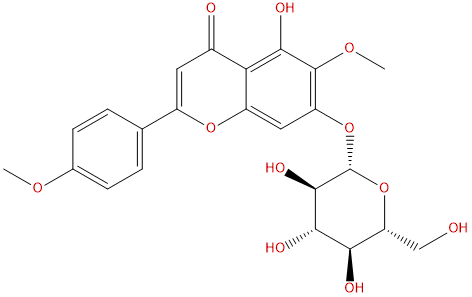


Product name: Linaroside
Synonym name: Pectolinarigenin 7-O-β-glucoside
Catalogue No.: BP4663
Cas No.: 53452-12-3
Formula: C23H24O11
Mol Weight: 476.434
Botanical Source:
Type of Compound: Flavonoids
Purity: 95%~99%
Analysis Method: HPLC-DAD or/and HPLC-ELSD
Identification Method: Mass, NMR
Packing: Brown vial or HDPE plastic bottle
Storage: Store in a well closed container, protected from air and light. Put into refrigerate or freeze for long term storage.
Whenever possible, you should prepare and use solutions on the same day. However, if you need to make up stock solutions in advance, we recommend that you store the solution as aliquots in tightly sealed vials at -20℃. Generally, these will be useable for up to two weeks.
The product could be supplied from milligrams to grams
Inquire for bulk scale.
For Reference Standard and R&D, Not for Human Use Directly.
Storage conditions:Short-term storage at 2~8℃, long-term storage at -20 ~ -80℃
Linaroside (CAS No. 53452-12-3) is a natural flavonoid product, which was initially isolated and identified from Lantana camara, a plant of the genus wutong. As a typical representative of flavonoids, Liuchuanxion-7-O-glucoside has attracted widespread attention in the field of natural product pharmacology in recent years due to its unique chemical structure and diverse biological activities. Its significant role in liver protection, especially in protecting against liver cell damage and antioxidant capacity, makes it a potential natural drug candidate molecule for liver disease treatment.
The liver, as an important metabolic and detoxifying organ in the human body, is susceptible to damage from various internal and external toxins and inflammatory reactions, leading to diseases such as hepatitis, liver fibrosis, and even cirrhosis. The current treatment methods for liver disease are limited and there are many side effects. Developing safe and effective liver protectants is of great clinical significance. Liuchuangyu flavon-7-O-glucoside exhibits good liver protective potential by regulating various oxidative stress-related enzymes and signaling pathways. This article will provide a systematic review of the chemical structure and physicochemical properties, plant sources and extraction methods, pharmacological activity and mechanism of action, pharmacological evaluation, and clinical application prospects of Liupangyu flavon-7-O-glucoside, aiming to provide theoretical basis and reference for its subsequent research and drug development.
Liuchuangyu flavone-7-O-glucoside belongs to the flavonoid glycoside class of flavonoids, with a molecular formula of C22H24O12 and a molecular weight of 476.4340. Its structural feature is that the flavonoid core is connected to a glucoside through a hydroxyl group at position 7, forming a 7-O-glucoside bond. The flavonoid parent nucleus has a typical C6-C3-C6 tricyclic structure, which includes two benzene rings (A, B rings) and one oxygen heterocyclic ring (C ring). The introduction of glucoside significantly increases the polarity and water solubility of the molecule.
In terms of physical and chemical properties, the LogP value of Liupangolin-7-O-glucoside is 0.4859, indicating its strong hydrophilicity and good water solubility (0.5220), which is beneficial for its absorption and distribution in vivo. The topological polar surface area (TPSA) is 168.2800, and higher TPSA values are usually associated with lower blood-brain barrier permeability, which is consistent with experimental data of low blood-brain barrier permeability. In addition, the compound does not inhibit hERG channels, and the Ames test result is 0.6, indicating a low risk of genotoxicity and good safety.
In summary, the chemical structure of Liuchuanxion-7-O-glucoside endows it with good water solubility and low toxicity risk, providing a solid foundation for its use as a drug molecule.
Salicornidin-7-O-glucoside mainly comes from Lantana camara, a plant of the genus wutong, which is widely distributed in tropical and subtropical areas and is often used as an ornamental plant and traditional herbal medicine. Lantana camara's leaves, flowers, and stems are rich in flavonoids, with a higher content of lutein-7-O-glucoside in the willow catfish.
The extraction method usually uses solvent extraction combined with chromatographic separation technology. The specific steps include:
In recent years, with the advancement of extraction techniques such as supercritical fluid extraction and molecular imprinting technology, it is expected to further improve the extraction efficiency and purity of Liuchuanxion-7-O-glucoside, laying the foundation for its large-scale production.
The pharmacological activity research of Liuchuangyu flavone-7-O-glucoside mainly focuses on its liver protective effect and antioxidant capacity. Numerous in vitro and in vivo experiments have shown that this compound can effectively alleviate liver cell damage, inhibit the progression of liver fibrosis, and exert anti-inflammatory and anti fibrotic effects by regulating the expression of oxidative stress-related enzymes.
Multiple animal model studies have shown that Liuchuanxion-7-O-glucoside can significantly reduce liver injury indicators induced by chemical toxins such as carbon tetrachloride and alcohol, including elevated levels of serum alanine aminotransferase (ALT) and aspartate aminotransferase (AST). Histopathological analysis confirmed that it can alleviate liver cell necrosis and inflammatory infiltration, and protect the structural integrity of the liver.
Liuchuan fish flavon-7-O-glucoside enhances the activity of endogenous antioxidant enzymes (such as SOD, CAT, GPX), clears excess reactive oxygen species (ROS), and reduces oxidative stress damage to liver cells. In vitro experiments have shown that the compound can effectively inhibit the generation of free radicals and protect cells from oxidative induced apoptosis.
Liuchuangyu flavon-7-O-glucoside also exhibits the ability to regulate the expression of inflammatory factors and fibrosis related genes. It inhibits the activation of hepatic stellate cells and slows down the process of liver fibrosis by downregulating transforming growth factor beta 1 (TGFB1) and related signaling pathways.
In addition, preliminary studies suggest that the compound may have certain anti-tumor and immune regulatory effects, but the relevant mechanisms still need further exploration.
The liver protective effect of Liuchuangyu flavone-7-O-glucoside involves multiple molecular signaling pathways and targets, mainly including antioxidant stress, anti-inflammatory response, and anti fibrotic mechanism.
This compound activates the nuclear factor E2 related factor 2 (NRF2) signaling pathway, promoting the expression of downstream antioxidant enzymes such as NAD (P) H quinone oxidoreductase 1 (NQO1), heme oxygenase 1 (HMOX1), superoxide dismutase 1 and 2 (SOD1, SOD2), catalase (CAT), glutathione peroxidase 1 (GPX1), etc., enhancing the antioxidant defense ability of cells, reducing the accumulation of ROS, and protecting liver cells from oxidative damage.
Liuchuangyu flavon-7-O-glucoside inhibits the activation of hepatic stellate cells and the proliferation of myofibroblasts by suppressing transforming growth factor beta 1 (TGFB1) and its downstream signaling, reducing the deposition of extracellular matrix and delaying the development of liver fibrosis. Meanwhile, the compound may also regulate the expression of actin alpha 2 (ACTA2), affecting the morphology and function of fibrosis related cells.
Matrix metalloproteinase-9 (MMP9), as an important enzyme for liver tissue remodeling, is also regulated by saxophosphatid-7-O-glucoside, promoting the repair and regeneration of damaged liver tissue.
In summary, Liuchuangyu flavone-7-O-glucoside exerts a comprehensive liver protective effect through multi-target and multi pathway synergistic effects.
From the perspective of medicinal properties, Liuchuanxion-7-O-glucoside exhibits ideal medicinal properties. Its molecular weight (476.4340) is within the appropriate range, and the LogP value (0.4859) indicates moderate hydrophilicity of the molecule, which is conducive to in vivo absorption. Although high TPSA (168.2800) limits its ability to cross the blood-brain barrier, it is not a disadvantage for liver targeted drugs and instead reduces the risk of central nervous system side effects.
In terms of safety, this compound does not inhibit hERG channels and reduces the risk of cardiac toxicity. The Ames test result (0.6) shows that its genotoxicity is low and has a good safety basis.
There is currently limited research on pharmacokinetics. Preliminary in vivo experiments have shown that the oral administration of Liupangolin-7-O-glucoside can be detected in the plasma, indicating its certain bioavailability. The structure of glucosides may be converted into more easily absorbable flavonoid nuclei through hydrolysis by gut microbiota, affecting their metabolic pathways in vivo. In the future, further systematic research is needed on its absorption, distribution, metabolism, and excretion (ADME) characteristics to clarify its in vivo dynamic behavior.
Given the multi-target and multi mechanism effects exhibited by Liuchuanxion-7-O-glucoside in the field of liver protection, its potential as a natural liver protectant is enormous. The future clinical application prospects are mainly reflected in the following aspects:
Adjuvant therapy for liver injury
Suitable for liver cell damage caused by drugs, alcohol, viruses, or other toxins, as an adjuvant therapy drug to alleviate liver dysfunction and promote liver repair.
Prevention and treatment of liver fibrosis
By inhibiting the progression of liver fibrosis, delaying the development of cirrhosis, and improving patient prognosis.
Chronic liver disease management
Combining existing antiviral or immunomodulatory therapies to improve the liver microenvironment and enhance treatment efficacy.
Safety and tolerability advantages
As a natural product, Liuchuangyuhuang-7-O-glucoside has a low risk of toxic side effects and is suitable for long-term use.
However, clinical translation still faces many challenges, including systematic pharmacokinetic studies, formulation development, determination of effective doses and dosing regimens, and the conduct of large-scale clinical trials. Future research should strengthen the pharmacological and toxicological evaluation of Liuchuanxion-7-O-glucoside, and explore its potential for combined use with existing liver disease treatment drugs.
Liuchuangyu flavone-7-O-glucoside, as a natural flavonoid glycoside derived from Lantana camara, exhibits significant liver protective activity due to its unique chemical structure and good physicochemical properties. By regulating various antioxidant enzymes and fibrosis related targets, it exerts antioxidant, anti-inflammatory, and anti fibrotic effects, providing new ideas and potential drug candidate molecules for the treatment of liver disease.
Although there is a preliminary understanding of its pharmacological mechanism, its pharmacokinetic properties and clinical applications still require further research. In the future, we should strengthen the systematic evaluation of Liuchuanxion-7-O-glucoside, promote its transformation from laboratory research to clinical application, and hope that it can become a safe and effective liver protection drug, bringing good news to liver disease patients.
