| Catalog No | Package | Original Price | Price | Inventory | Quantity | Operating |
|---|---|---|---|---|---|---|
| BP3937-20mg | 20mg | $85.00 | Sign in |
|


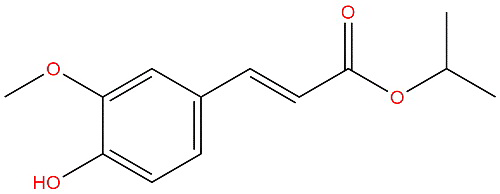
Product name: Isopropyl ferulate
Synonym name:
Catalogue No.: BP3937
Cas No.: 59831-94-6
Formula: C13H16O4
Mol Weight: 236.267
Botanical Source:
Physical Description:
Type of Compound:
Purity: 95%~99%
Analysis Method: HPLC-DAD or/and HPLC-ELSD
Identification Method: Mass, NMR
Packing: Brown vial or HDPE plastic bottle
Storage: Store in a well closed container, protected from air and light. Put into refrigerate or freeze for long term storage.
Whenever possible, you should prepare and use solutions on the same day. However, if you need to make up stock solutions in advance, we recommend that you store the solution as aliquots in tightly sealed vials at -20℃. Generally, these will be useable for up to two weeks.
The product could be supplied from milligrams to grams
Inquire for bulk scale.
For Reference Standard and R&D, Not for Human Use Directly.
Storage conditions:Short-term storage at 2~8℃, long-term storage at -20 ~ -80℃
55.7600
2.7621
2.7557
.1909
6.5482
7.5620
High
83.9268
2.0357
Yes
No
Yes
No
No
No
0.0
No
Yes
Yes
Yes
Natural products, as an important source of drug discovery, have written a brilliant chapter in the history of human health maintenance and disease treatment. Isolating, identifying, and elucidating the pharmacological effects of active ingredients from traditional herbs is an important paradigm in modern medicinal chemistry and pharmacology research. In this context, phenylpropanoid compounds have attracted much attention due to their wide range of biological activities. Ferulic acid, as a typical phenolic acid phenylpropanoid, is widely present in various medicinal plants such as Angelica sinensis, Ligusticum chuanxiong, and Ferula. It is known for its excellent antioxidant, anti-inflammatory, and cardiovascular protective effects. However, the high polarity and poor lipid solubility of natural ferulic acid limit its absorption and transmembrane transport in vivo. To improve its pharmacokinetic properties, researchers have synthesized various derivatives of ferulic acid through structural modification, among which isopropyl ferulate stands out.
Isopropyl ferulate, also known as 3- (4-hydroxy-3-methoxyphenyl) acrylic acid isopropyl ester, is a derivative formed by esterification of ferulic acid and isopropanol. This compound not only retains the phenolic hydroxyl active group of ferulic acid, but also significantly enhances its lipid solubility by introducing isopropyl groups, thereby enhancing its ability to penetrate biofilms. It is worth noting that isopropyl ferulate is not just an artificially synthesized product, it naturally exists in the traditional Chinese medicine Qianghuo(Notopterygium incisum)In the roots and stems. Qianghuo, as a commonly used traditional Chinese medicine herb for dispelling wind and dampness, dispersing cold and relieving pain, has always been a research hotspot in terms of its pharmacological substance basis. The discovery of isopropyl ferulate provides a new molecular basis for elucidating the anti-inflammatory and analgesic effects of Qianghuo.
In recent years, research on isopropyl ferulate has become increasingly in-depth, revealing its potential in multiple fields such as anti-inflammatory, antioxidant, neuroprotective, and antifungal effects. Especially its regulatory role on key signaling molecules such as IL-6, STAT3, TNF - α, and NF - κ B in the anti-inflammatory pathway makes it a potential candidate molecule for treating chronic inflammatory diseases such as arthritis and neuroinflammation. This article will provide a systematic review of the research progress of isopropyl ferulate from the aspects of chemical structure, plant origin, pharmacological activity, mechanism of action, pharmacological evaluation, and clinical application prospects, in order to provide reference for the in-depth development and utilization of this natural product derivative.
The chemical structure of isopropyl ferulate is based on the classical phenylpropanoid skeleton. Its parent nucleus is ferulic acid, which is 4-hydroxy-3-methoxycinnamic acid. At the carboxyl end of ferulic acid, an isopropyl group (- CH (CH3) ₂) is connected through esterification reaction to form an isopropyl structure. Its molecular formula is C ₁∝ H ₁₆ O ₄, and its molecular weight is 236.2670 g/mol. From the perspective of structural features, the molecule contains a benzene ring with a methoxy group (- OCH ∝) and a phenolic hydroxyl group (- OH) attached to it, as well as an alpha, beta unsaturated ester side chain. The presence of phenolic hydroxyl groups endows the molecule with a certain hydrogen supply ability and is a key functional group for its antioxidant activity; The α, β - unsaturated ester structures may participate in Michael addition reactions and interact with nucleophilic substances in living organisms.
In terms of physicochemical properties, isopropyl ferulate exhibits typical lipophilic characteristics. Its oil-water partition coefficient (LogP) is 2.7621, indicating that its solubility in lipid environment is much higher than that in aqueous phase. This characteristic is significantly enhanced compared to the parent compound ferulic acid (LogP about 1.5), indicating that the compound is more likely to penetrate cell membranes and biological barriers. Its topological polar surface area (TPSA) is 55.76 Å ², which is lower than the commonly recognized threshold for good oral absorption (140 Å ²), indicating its good oral absorption potential. The water solubility data (0.1909 mg/mL) further confirms its low water solubility characteristics, which may require the use of solubilization technology or prodrug strategies in actual formulation development.
It is worth noting that the blood-brain barrier (BBB) penetration ability of isopropyl ferulate was evaluated as "high". This characteristic is relatively rare in natural phenolic acid compounds, as most phenolic acid compounds are difficult to enter the brain due to their high polarity. High BBB penetration implies that isopropyl ferulate has the potential to treat central nervous system diseases such as neuroinflammation, Alzheimer's disease, or Parkinson's disease. In addition, computer simulation prediction results showed that the compound had no inhibitory effect on hERG potassium channels (hERG inhibition: No), and the Ames test result was negative (0.0), indicating a low risk of cardiac and genetic toxicity. This provides a positive signal for its subsequent drug safety evaluation.
Isopropyl ferulate was initially identified as the traditional Chinese medicine Qianghuo(Notopterygium incisum)One of the active ingredients. Qianghuo is a plant belonging to the Apiaceae family and the genus Qianghuo. Its dried rhizomes and roots have the effects of relieving surface coldness, dispelling wind and dampness, and relieving pain in traditional Chinese medicine theory. It is commonly used to treat wind cold colds, headaches, body aches, and rheumatism and rheumatism. Modern plant chemistry research has shown that Qianghuo contains various chemical components such as volatile oils, coumarins, phenolic acids, and polyacetylenes. Among them, phenolic acid components such as ferulic acid and its ester derivatives are considered important material basis for their anti-inflammatory and analgesic effects.
In addition to Qianghuo, isopropyl ferulate may also exist in other Umbelliferae plants or be generated as a metabolite of ferulic acid in the plant body. However, the main natural source reported in current literature is still mainly Qianghuo. In plants, ferulic acid usually exists in a bound state (such as ester bonds attached to cell wall polysaccharides) or in a free state. The generation of isopropyl ferulate may originate from the esterification reaction between ferulic acid and isopropanol catalyzed by specific enzymes in plant secondary metabolism, although this biosynthetic pathway has not been fully elucidated.
For the extraction of isopropyl ferulate, organic solvent extraction method is usually used. Due to its strong lipophilicity, ethanol, methanol, or ethyl acetate are commonly used extraction solvents. The classic extraction process is as follows: Grind the dried roots and rhizomes of Notopterygii, soak or reflux them with a certain concentration of ethanol (such as 70% -95% ethanol) at room temperature or heating conditions for extraction. After the extraction solution is concentrated under reduced pressure, a paste is obtained. Subsequently, the extract was preliminarily separated using liquid-liquid extraction method (such as sequentially extracting with petroleum ether, ethyl acetate, and n-butanol). Isopropyl ferulate is mainly enriched in the ethyl acetate extraction site due to its equipolarity.
Further purification and separation require the use of modern chromatographic techniques. Silica gel column chromatography is the most commonly used method, which uses petroleum ether ethyl acetate or chloroform methanol systems for gradient elution. In addition, high-performance liquid chromatography (HPLC) or preparative thin-layer chromatography can also be used for the preparation of high-purity samples. In recent years, high-speed countercurrent chromatography (HSCCC) has also been applied for the separation of isopropyl ferulate due to its high separation efficiency and minimal sample loss. During the separation process, isopropyl ferulate is usually used as a reference and tracked through UV detection (maximum absorption wavelength of about 320 nm) or mass spectrometry detection.
It is worth noting that due to the low content of isopropyl ferulate in natural plants and its relatively stable chemical properties, the synthesis method (i.e. direct esterification of ferulic acid with isopropanol) has become the main way to obtain this compound. The synthesis method not only has high yield, but also facilitates structural modification and large-scale production, providing sufficient material support for subsequent pharmacological research and drug development.
Anti inflammatory activity is one of the most prominent pharmacological effects of isopropyl ferulate. Numerous in vitro and in vivo experiments have confirmed that this compound can effectively inhibit the production and release of various inflammatory mediators. In a macrophage model stimulated by lipopolysaccharide (LPS), isopropyl ferulate can significantly reduce the mRNA expression and protein secretion levels of pro-inflammatory cytokines such as tumor necrosis factor - α (TNF - α), interleukin-6 (IL-6), and interleukin-1 β (IL-1 β). Meanwhile, it can also inhibit the expression of inducible nitric oxide synthase (iNOS, encoded by NOS2 gene) and cyclooxygenase-2 (COX-2, encoded by PTGS2 gene), thereby reducing the production of nitric oxide (NO) and prostaglandin E ₂ (PGE ₂). These effects collectively form the cellular basis for its anti-inflammatory effects.
In animal models, isopropyl ferulate also exhibits good anti-inflammatory effects. For example, in the rat paw swelling model induced by carrageenan and the mouse peritoneal capillary permeability increase model induced by acetic acid, oral or intraperitoneal injection of isopropyl ferulate can significantly alleviate the inflammatory response. In addition, in chronic inflammation models such as adjuvant arthritis models, this compound can alleviate joint swelling, reduce serum levels of inflammatory factors, and improve pathological damage to joint tissue. These results suggest that isopropyl ferulate is not only effective for acute inflammation, but also has therapeutic potential for chronic inflammatory diseases.
Isopropyl ferulate inherits the powerful antioxidant properties of ferulic acid. Its phenolic hydroxyl structure can effectively scavenge free radicals, including hydroxyl radicals (· OH), superoxide anion radicals (O ₂⁻ ·), and 2,2-diphenyl-1-picrylhydrazone radicals (DPPH ·). Compared with ferulic acid, the introduction of isopropyl groups enhances its lipid solubility, and isopropyl ferulate has a higher antioxidant efficiency in the biofilm system, which can better protect the cell membrane from lipid peroxidation damage.
In the cellular oxidative stress model, pretreatment with isopropyl ferulate can significantly reduce reactive oxygen species (ROS) levels, increase the activity of endogenous antioxidant enzymes such as superoxide dismutase (SOD) and glutathione peroxidase (GSH Px), and reduce the production of malondialdehyde (MDA). This antioxidant effect is closely related to its anti-inflammatory activity, as oxidative stress is often the initiating and amplifying factor of inflammatory responses. By inhibiting oxidative stress, isopropyl ferulate can block the inflammatory cascade reaction from the source.
Due to its high blood-brain barrier penetration, research on the neuroprotection of isopropyl ferulate has attracted much attention. In the neuronal cytotoxicity model induced by β - amyloid protein (A β), this compound can inhibit neuronal apoptosis, reduce excessive phosphorylation of tau protein, and improve mitochondrial dysfunction. In animal behavior experiments, long-term administration of isopropyl ferulate can improve the learning and memory abilities of Alzheimer's disease model mice and reduce the formation of senile plaques in the brain.
In addition, in the model of cerebral ischemia-reperfusion injury, isopropyl ferulate can reduce the volume of cerebral infarction, alleviate brain edema, inhibit excessive activation of microglia, and decrease the expression of pro-inflammatory cytokines in brain tissue. These effects are closely related to their dual mechanisms of anti-inflammatory and antioxidant effects. Isopropyl ferulate exerts a multi-target neuroprotective effect by inhibiting the activation of the NF - κ B pathway, reducing the release of inflammatory mediators, clearing free radicals, and alleviating oxidative stress damage.
Isopropyl ferulate has also been reported to have antifungal activity. Research has shown that this compound is effective against various pathogenic fungi, such as Candida albicans(Candida albicans)Cryptococcus neoformans(Cryptococcus neoformans)And some skin fungi have inhibitory effects. Its antifungal mechanism may be related to the destruction of fungal cell membrane integrity, inhibition of fungal cell wall synthesis, or interference with fungal mitochondrial function. This discovery provides candidate molecules for the development of new antifungal drugs, especially in addressing the increasingly serious problem of fungal resistance.
The pharmacological activity of isopropyl ferulate cannot be explained by a single mechanism, but is achieved by acting on multiple signaling pathways and molecular targets. Based on existing research, its core mechanism of action can be summarized as follows.
Nuclear factor kappa B (NF - κ B) is the core transcription factor in inflammatory response. In the resting state, NF - κ B binds to its inhibitory protein I κ B and exists in an inactive form in the cytoplasm. When cells are stimulated by LPS, TNF - α, etc., I κ B kinase (IKK, encoded by the IKBKB gene) is activated, which phosphorylates I κ B and leads to its ubiquitination degradation. The released NF - κ B (usually a p50/RELA heterodimer) is immediately translocated into the nucleus, initiating the transcription of downstream pro-inflammatory genes.
Isopropyl ferulate can effectively inhibit the activity of IKK, thereby blocking the phosphorylation and degradation of I κ B, and retaining NF - κ B in the cytoplasm. Specifically, the compound may achieve this inhibitory effect by directly binding to the active site of IKK or interfering with its upstream activation signal. In addition, isopropyl ferulate can also inhibit the nuclear translocation of RELA (p65) and its binding ability to DNA. By blocking the NF - κ B pathway, isopropyl ferulate can simultaneously downregulate the expression of multiple pro-inflammatory genes, including TNF - α, IL-6, IL-1 β, COX-2, and iNOS, thereby producing a broad-spectrum anti-inflammatory effect.
Signal transducer and activator of transcription factor 3 (STAT3) is a key molecule that connects cytokine signaling with gene transcription. After binding to receptors, cytokines such as IL-6 activate JAK kinase, which in turn phosphorylates STAT3. Phosphorylated STAT3 forms dimers, translocates into the nucleus, and regulates cell proliferation, survival, and expression of inflammation related genes.
Research has shown that isopropyl ferulate can inhibit IL-6-induced STAT3 phosphorylation, thereby blocking the activation of the STAT3 signaling pathway. This effect may be achieved by directly inhibiting JAK kinase activity or inducing the expression of STAT3 inhibitors such as SOCS3. The inhibition of the STAT3 pathway not only helps alleviate inflammatory responses, but may also have an inhibitory effect on tumor cell proliferation, as the sustained activation of STAT3 is closely related to the occurrence and development of various cancers.
Isopropyl ferulate has also been found to inhibit the activity of CASP1 (caspase-1). Caspase-1 is a downstream effector enzyme of inflammasomes such as NLRP3 inflammasome, responsible for cleaving pro-IL-1 β and pro-IL-18 into mature active forms. By inhibiting caspase-1, isopropyl ferulate can reduce the release of IL-1 β and IL-18, thereby inhibiting the inflammatory response mediated by inflammasomes.
In addition, the compound has a regulatory effect on the transient receptor potential (TRP) ion channel family members TRPV1 and TRPA1. TRPV1 and TRPA1 are important molecules for pain and inflammation perception. Isopropyl ferulate may inhibit neuronal excitability and neurogenic inflammation by antagonizing the activity of these channels, reducing calcium ion influx. This mechanism is highly consistent with its traditional analgesic effect in Qianghuo.
In summary, the mechanism of action of isopropyl ferulate exhibits a multi-target and multi pathway network regulatory feature. It simultaneously acts on NF - κ B, STAT3, caspase-1, and TRP ion channels, inhibiting inflammatory responses at multiple levels including transcriptional regulation, protein processing, and ion signal transduction. This multi-target characteristic gives it unique advantages in the treatment of complex diseases such as chronic inflammation and neurodegenerative diseases. It can simultaneously intervene in multiple key stages of the disease process, improve efficacy, and reduce the risk of drug resistance.
The conversion of natural products into clinical drugs must undergo strict pharmacological evaluation. Isopropyl ferulate has shown great potential in terms of physicochemical properties, pharmacokinetics, and safety, but it also faces some challenges.
As mentioned earlier, the molecular weight of isopropyl ferulate is 236.27 Da, which meets the requirement of Lipinski's "Five Rules" for molecular weight less than 500. Its LogP is 2.76, which is within the ideal range of lipid solubility (1-3) and is beneficial for oral absorption and transmembrane transport. The TPSA is 55.76 Å ², which is lower than 140 Å ², indicating its good oral bioavailability. In addition, the number of hydrogen bond donors (phenolic hydroxyl groups) and hydrogen bond acceptors (ester and methoxy groups) in the molecule of the compound conforms to the drug like rules. Therefore, from the perspective of physicochemical properties, isopropyl ferulate has the basic conditions to become an oral medication.
Pharmacokinetic studies are crucial for evaluating the in vivo processes of drugs. Although detailed pharmacokinetic data for isopropyl ferulate is not yet complete, its approximate outline can be inferred based on its structural characteristics and studies of similar compounds. Due to its high lipid solubility, isopropyl ferulate should be able to be rapidly absorbed in the gastrointestinal tract. However, ester compounds are easily hydrolyzed by esterases in the body, and isopropyl ferulate may be rapidly hydrolyzed by esterases into ferulic acid and isopropanol in plasma or liver. This means that its exposure form in the body may partially exist in the form of ferulic acid. The conversion mode of this prodrug active metabolite is not uncommon in drug design, and the key is whether isopropyl ferulate itself or its metabolite ferulic acid can reach effective concentrations in target tissues.
The high blood-brain barrier penetration is a major highlight of its pharmacokinetics. This means that isopropyl ferulate can enter the central nervous system and directly act on glial cells and neurons, thereby exerting neuroprotective and anti neuroinflammatory effects. This is particularly important for treating central nervous system diseases such as Alzheimer's disease and Parkinson's disease.
The early computer toxicology predictions were encouraging. The risk assessment of hERG inhibition is' no ', indicating that the compound has a low risk of causing cardiac QT interval prolongation. The Ames test result is negative (0.0), indicating that it does not have significant mutagenicity. These data preliminarily indicate that isopropyl ferulate has good safety. However, systematic in vivo toxicology studies are still needed, including acute toxicity, chronic toxicity, reproductive toxicity, and carcinogenicity tests, to comprehensively evaluate its safety. Especially considering that its ester structure may hydrolyze to produce isopropanol, attention should be paid to the cumulative effect and potential toxicity of isopropanol in the body.
The low water solubility (0.1909 mg/mL) of isopropyl ferulate is the main challenge facing its formulation development. Low water solubility may lead to incomplete oral absorption and limited bioavailability. To address this issue, various formulation strategies can be employed, such as preparing solid dispersions, liposomes, nanoemulsions, or cyclodextrin inclusion complexes. These technologies can improve the dispersion and dissolution rate of drugs, thereby enhancing their oral absorption. In addition, designing prodrugs or using penetration enhancers is also a feasible approach.
Based on the pharmacological activity and pharmacological characteristics of isopropyl ferulate, it has shown broad application prospects in multiple therapeutic fields.
The strong anti-inflammatory activity of isopropyl ferulate makes it a potential candidate drug for the treatment of chronic inflammatory diseases such as rheumatoid arthritis, inflammatory bowel disease, and chronic obstructive pulmonary disease. Its multi-target mechanism of action can simultaneously inhibit multiple inflammatory pathways, which may have better efficacy and lower resistance than drugs targeting a single target. Especially for chronic disease patients who require long-term medication, the lower toxicity risk is an important advantage.
Given its high blood-brain barrier penetration and neuroprotective effects, isopropyl ferulate has great potential in the treatment of neurodegenerative diseases such as Alzheimer's disease, Parkinson's disease, and multiple sclerosis. By inhibiting neuroinflammation, reducing oxidative stress, and regulating abnormal protein aggregation, this compound is expected to delay disease progression and improve patients' cognitive and motor abilities. In the future, conducting preclinical and clinical research targeting specific neurodegenerative diseases will be a key direction.
The regulatory effect of isopropyl ferulate on TRPV1 and TRPA1 channels, as well as its anti-inflammatory properties, make it valuable in the field of pain management. Especially for inflammatory pain and neuropathic pain, this compound may provide a treatment option different from traditional nonsteroidal anti-inflammatory drugs (NSAIDs) and opioids, with the potential to reduce side effects and addiction.
In the field of cosmetics, the antioxidant and anti-inflammatory properties of isopropyl ferulate make it an ideal skincare ingredient. It can be used to prepare products for anti-aging, whitening, and soothing the skin. Its lipophilicity makes it easy to penetrate the stratum corneum of the skin and exert its effects in deep layers of the skin. In addition, its antifungal activity also suggests that it can be used to treat certain skin fungal infections.
Despite the bright prospects, the research and development of isopropyl ferulate still faces many challenges. Firstly, it is necessary to conduct systematic pharmacokinetic studies to clarify its absorption, distribution, metabolism, and excretion processes in vivo, especially the rate and degree of ester hydrolysis. Secondly, in-depth toxicological evaluation is needed to ensure the safety of long-term medication. Thirdly, optimizing the formulation process and improving its bioavailability are key factors in promoting its clinical translation. Finally, using modern drug design methods such as structure based drug design, further structural optimization of isopropyl ferulate is carried out in order to obtain derivatives with stronger activity and higher selectivity.
Isopropyl ferulate, as the active ingredient of traditional Chinese medicine Qianghuo and a lipid soluble derivative of ferulic acid, combines the advantages of natural products and medicinal chemical modifications. Its unique chemical structure endows it with good lipid solubility and blood-brain barrier penetration, while its multi-target pharmacological activity, especially in regulating NF - κ B, STAT3, caspase-1, and TRP ion channels, makes it show significant potential in anti-inflammatory, antioxidant, neuroprotective, and antifungal fields. Preliminary drug evaluation shows that it has low toxicity and good drug like properties, but low water solubility and potential ester hydrolysis issues still need to be addressed through pharmaceutical methods.
Extracting active ingredients from traditional Chinese medicine and carrying out reasonable structural modifications is an effective approach for innovative drug discovery. The research process of isopropyl ferulate is a vivid manifestation of this strategy. In the future, with the in-depth elucidation of its mechanism of action, comprehensive analysis of pharmacokinetic characteristics, and continuous progress in formulation technology, isopropyl ferulate and its derivatives are expected to develop into new drugs for the treatment of chronic inflammation, neurodegenerative diseases, and pain, contributing to human health. At the same time, this study also provides useful references for the structural optimization and development of other natural phenolic acid compounds.
Batch can search by a CAS number,one per line
