| Catalog No | Package | Original Price | Price | Inventory | Quantity | Operating |
|---|---|---|---|---|---|---|
| BP5058-5mg | 5mg | $650.00 | Sign in |
|


Storage conditions:Short-term storage at 2~8℃, long-term storage at -20 ~ -80℃
With the increasing importance of natural products in drug research and development, flavonoids have become a hot topic in the treatment of various diseases such as antibacterial, anti-inflammatory, and anti-tumor due to their diverse biological activities and relatively low toxicity. Brevicornin, As a natural product of flavonols isolated from the traditional Chinese medicine Epimedium spp., it has gradually attracted the attention of the scientific research community in recent years due to its significant antibacterial activity and good pharmacological properties. This article aims to systematically review the chemical structure, physicochemical properties, plant sources, and extraction methods of Brevicornin, combined with its pharmacological activity research, to deeply explore its mechanism of action and molecular targets, evaluate its pharmacological and pharmacokinetic characteristics, and prospect its clinical application prospects, providing theoretical basis and research direction for subsequent drug development.
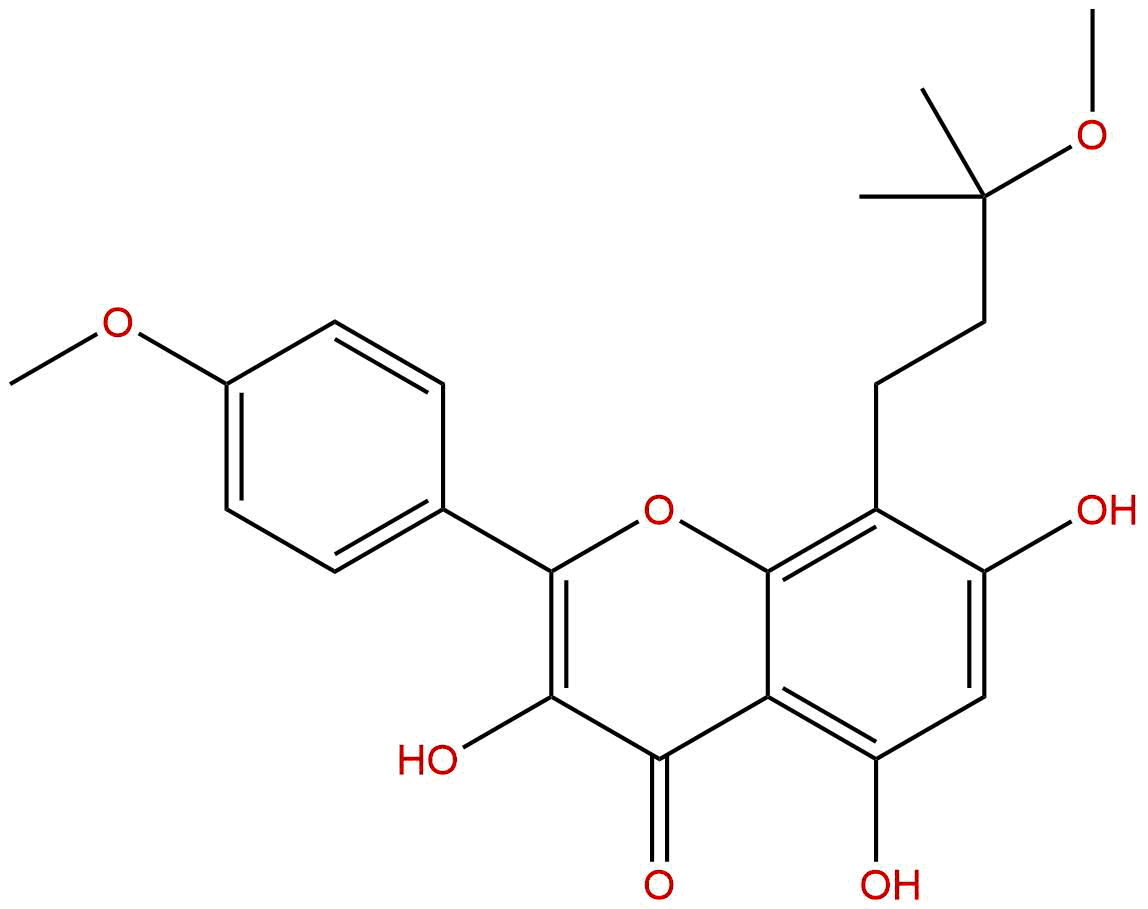
The molecular formula of Brevicornin is C25H28O6, with a molecular weight of 400.4270. Its chemical structure belongs to flavonols, with a typical flavonoid skeleton containing multiple hydroxyl and methoxy substituents, giving it a good basis for biological activity. According to the analysis of physical and chemical properties, the LogP value of Brevicornin is 3.6756, indicating that it has moderate lipid solubility, which is conducive to cell membrane penetration but not excessively hydrophobic. Its topological polar surface area (TPSA) is 109.36 Å ², reflecting the molecule's polarity and hydrogen bond donor/acceptor ability, which facilitates binding to biological targets. Low water solubility (0.0689 mg/mL) suggests limited solubility in aqueous phase, which may affect its bioavailability. The low penetration of the blood-brain barrier (BBB) suggests limited distribution in the central nervous system and may reduce central side effects. The negative result of hERG channel inhibition experiment indicates a low risk of cardiac toxicity. The Ames test score is 0.6, indicating a low risk of genotoxicity and good safety.
Brevicornin is mainly isolated from plants of the Epimedium genus. Epimedium is a perennial herbaceous plant of the Epimedium genus in the Berberidaceae family, widely distributed in China and East Asia. It is commonly used in traditional Chinese medicine to tonify the kidneys, strengthen yang, dispel wind and dampness. Its active ingredients are complex, and flavonoids are one of the main pharmacological active ingredients.
The common methods for extracting Brevicornin include organic solvent extraction, liquid-liquid partitioning, and chromatographic separation. Generally, ethanol or methanol is used as the extraction solvent to extract dried powder of Epimedium by reflux, followed by separation and purification using techniques such as silica gel column chromatography and reverse phase high performance liquid chromatography (RP-HPLC). Brevicornin with high purity can be structurally identified through methods such as mass spectrometry (MS) and nuclear magnetic resonance (NMR). In recent years, the application of ultrasound assisted extraction and microwave-assisted extraction technologies has improved extraction efficiency and purity, reduced solvent dosage and extraction time, and promoted the large-scale preparation of Brevicornin.
Brevicornin exhibits broad-spectrum antibacterial activity, particularly with significant inhibitory effects on Gram positive bacteria and certain Gram negative bacteria. In vitro experiments have shown that Brevicornin can effectively inhibit the growth of various clinically common pathogenic bacteria such as Staphylococcus aureus, Streptococcus pneumoniae, and Escherichia coli. In addition, Brevicornin exhibits potential inhibitory effects on certain drug-resistant strains, demonstrating its potential application in combating drug-resistant bacterial infections.
In addition to antibacterial effects, Brevicornin also exhibits various pharmacological activities such as antioxidant, anti-inflammatory, and immune regulation. Its antioxidant effect is achieved by clearing free radicals, reducing oxidative stress, and protecting cells from damage. The anti-inflammatory effect is mainly manifested by inhibiting the release of pro-inflammatory factors and reducing inflammatory reactions. Some studies have shown that Brevicornin can regulate immune cell function and enhance the body's immune defense ability.
The antibacterial mechanism of Brevicornin involves multiple molecular targets, mainly including bacterial DNA gyrase (GYRA), cell wall synthesis related proteins (FABI, FTSZ), dihydrofolate reductase (DHFR), membrane protein (MECA), β - lactam enzyme (PENA), fungal cytochrome P450 enzymes (ERG11, CYP51A1), and multidrug resistance associated transporter protein (CDR1).
These multi-target mechanisms endow Brevicornin with strong antibacterial activity and potential ability to inhibit drug-resistant bacteria, providing a theoretical basis for its development as a novel antibacterial drug.
The pharmacological parameters of Brevicornin indicate that it has good potential for drug development. Moderate molecular weight and LogP value are beneficial for its in vivo absorption and distribution. The TPSA value indicates that it has a certain polarity, which is helpful for target binding. Low water solubility is a major challenge in its pharmacokinetics, which may limit its oral bioavailability and require formulation improvement or structural modification optimization.
The low penetration of the blood-brain barrier reduces the risk of central nervous system toxicity, but at the same time limits its application in central infectious diseases. The hERG channel inhibition is negative and has a lower risk of Ames test, indicating a lower risk of cardiac and genetic toxicity and good safety.
Pharmacokinetic studies are still in the preliminary stage, and the characteristics of absorption, distribution, metabolism, and excretion in vivo need to be further clarified. Preliminary animal experiments have shown that the plasma concentration of Brevicornin can reach an effective level after oral administration, with a moderate half-life. It is mainly metabolized by the liver, and the activity and safety of metabolites need further research.
Brevicornin, as a natural flavonol compound, has the potential to become a novel antibacterial drug due to its broad-spectrum antibacterial activity and multi-target mechanism of action. Its inhibitory effect on drug-resistant strains provides a new approach to solving the problem of clinical antibiotic resistance. In addition, Brevicornin has advantages in the comprehensive treatment of infectious diseases due to its anti-inflammatory and immunomodulatory effects.
Future research should focus on the following aspects:
In summary, Brevicornin, as an important natural product of flavonols in Epimedium, exhibits excellent antibacterial activity and multi-target mechanism of action, and has good medicinal properties and safety. It has broad application prospects in the field of antibacterial drug research and development. In the future, through in-depth pharmacological mechanism research, structural optimization and clinical verification, Brevicornin is expected to become a new generation of safe and effective antibacterial drugs and provide new treatment strategies for combating bacterial resistance and related infectious diseases.
