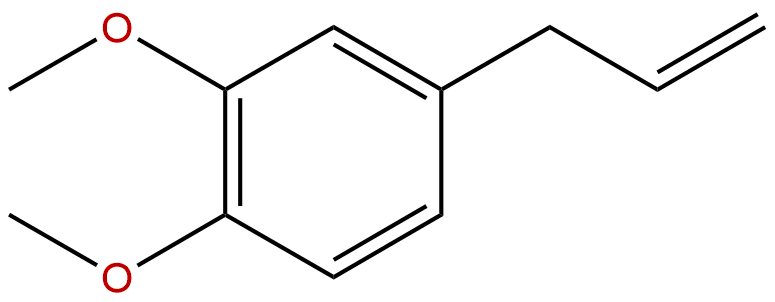


Synonym name: 1,2-Dimethoxy-4-(2-propenyl)benzene; 4-Allylveratrole
Catalogue No.: BP0940
Cas No.: 93-15-2
Formula: C11H14O2
Mol Weight: 178.231
Botanical Source: Present in many essential oils, e.g. nutmeg, mace and also many fruits, e.g. apple, banana, orange juice or peel, grapefruit, bilberry
Purity: 95%~99%
Analysis Method: HPLC-DAD or/and HPLC-ELSD
Identification Method: Mass, NMR
Packing: Brown vial or HDPE plastic bottle
Can be supplied from milligrams to grams.
For Reference Standard and R&D, Not for Human Use Directly.
Inquire for bulk scale.
Storage conditions:Short-term storage at 2~8℃, long-term storage at -20 ~ -80℃
Methyleugenol (CAS number: 93-15-2) is a naturally occurring phenylpropanoid compound, structurally O-methylated derivative of eugenol. As an important natural product, methyl eugenol is widely distributed in various aromatic plants, such as cinnamon, cloves, basil, and lemongrass. Its unique chemical structure endows it with diverse biological activities, especially exhibiting significant pharmacological potential in pain relief, anti-inflammatory, antibacterial, and antioxidant aspects. In recent years, with the in-depth study of the pharmacological mechanisms of natural products, methyl eugenol has attracted much attention due to its ability to regulate various pain related targets, and has become an important candidate molecule for the development of natural analgesic drugs.
This article aims to systematically review the chemical structure and physicochemical properties, plant sources, and extraction methods of methyl eugenol, explore its pharmacological activity and mechanism of action, evaluate its pharmacological properties and pharmacokinetic characteristics, and prospect its potential value in clinical applications. By integrating existing research results, provide scientific basis and theoretical support for the further development and application of methyl eugenol.
The chemical name of methyl eugenol is 1-methoxy-4- (2-propenyl) phenol, with a molecular formula of C11H14O2 and a molecular weight of 178.2310. Its structural core is a phenylpropanoid skeleton, containing a methoxy substituted benzene ring and an acrylic side chain. Methyl eugenol and eugenol have similar structures, but the difference is that the hydroxyl group on the benzene ring is methylated to methoxy, resulting in differences in their physicochemical properties and biological activities.
In terms of physicochemical properties, the LogP value of methyl eugenol is 2.9578, indicating moderate lipid solubility, which is beneficial for its penetration of lipid membranes, especially the blood-brain barrier (BBB) with high permeability, providing a basis for its pharmacological effects on the central nervous system. Its topological polar surface area (TPSA) is 18.46 Å ², indicating low molecular polarity, further supporting its good membrane permeability. Low water solubility (0.1043 mg/mL) suggests limited solubility in aqueous phase, which may affect its bioavailability. The hERG channel inhibition experiment result was negative, indicating a low risk of cardiac toxicity from methyl eugenol. The Ames test score is 0.6, indicating a low risk of genotoxicity, but further long-term toxicological studies are still needed for validation.
Methyl eugenol is widely present in essential oils of various aromatic plants, and its main sources include:
The extraction method mainly relies on the distillation extraction technology of plant essential oils. Steam distillation is the most commonly used process, which heats plant materials to evaporate volatile components with steam, and condenses to obtain essential oils. Subsequently, gas chromatography-mass spectrometry (GC-MS) was used to qualitatively and quantitatively analyze the essential oil components, confirming the presence and content of methyl eugenol.
In addition, supercritical CO2 extraction technology has gradually been applied to the extraction of methyl eugenol due to its mild and solvent-free characteristics, improving extraction efficiency and purity. Liquid liquid extraction, column chromatography, and other methods are commonly used for further purification.
The pharmacological activity research of methyl eugenol mainly focuses on its analgesic, anti-inflammatory, antibacterial, and antioxidant aspects, especially in the study of analgesic effects.
Methyl eugenol exhibits significant analgesic effects, involving various pain models including inflammatory pain, neuropathic pain, and acute pain. Both in vivo and in vitro experiments have shown that it can alleviate pain responses caused by thermal, mechanical, and chemical stimuli. Its analgesic activity is closely related to the regulation of various molecular targets, including ion channels, receptors, and enzymes.
Methyl eugenol can inhibit the release of inflammatory mediators, reduce the expression of inflammatory factors such as prostaglandin E2 (PGE2), tumor necrosis factor alpha (TNF - α), and interleukin (IL-1 β, IL-6), thereby alleviating the inflammatory response. Its inhibitory effect on cyclooxygenase (COX-1/PTGS1 and COX-2/PTGS2) is an important component of its anti-inflammatory mechanism.
Methyl eugenol exhibits inhibitory activity against various bacteria and fungi, particularly against Gram positive bacteria. In addition, it has the ability to scavenge free radicals and exhibits good antioxidant activity, which helps alleviate tissue damage related to oxidative stress.
The analgesic effect of methyl eugenol involves multiple molecular targets, mainly including:
Through multi-target synergistic effects, methyl eugenol can effectively alleviate various types of pain with relatively low side effects.
The pharmacological evaluation of methyl eugenol shows that it has good potential for drug development. The molecular weight is 178.23, in accordance with Lipinski's rule, with a LogP of approximately 2.96, indicating moderate lipophilicity and favorable cell membrane penetration. Low TPSA supports its good oral absorption and blood-brain barrier permeability, making it suitable for central nervous system action.
Low water solubility may limit its bioavailability, and it is necessary to improve solubility and stability through formulation technologies such as nanocarriers and liposomes. The hERG channel has no inhibitory effect and reduces the risk of cardiac toxicity. The Ames test results showed a low risk of genotoxicity, but the long-term toxicological safety still needs further verification.
In terms of pharmacokinetics, methyl eugenol is rapidly absorbed and widely distributed after oral administration, especially with high accumulation in the central nervous system. Metabolism mainly occurs through the oxidation and methylation pathways of the liver, and the safety of metabolites still needs further research. Excretion is mainly through urine and feces.
Methyl eugenol, as a natural multi-target analgesic, has broad clinical application prospects. Its efficient analgesic and anti-inflammatory activities make it potentially valuable for the treatment of chronic pain, neuropathic pain, and inflammatory diseases. Compared to traditional opioid drugs, methyl eugenol may have lower addiction and side effects, making it suitable for long-term use.
Future research should focus on the following aspects:
In addition, the potential of methyl eugenol in other fields such as antibacterial, antioxidant, and neuroprotective properties is also worth exploring and expanding its application scope.
Methyl eugenol, as an important natural phenylpropanoid compound, exhibits significant analgesic and anti-inflammatory potential due to its unique chemical structure and multi-target pharmacological activity. Its good pharmacological parameters and blood-brain barrier permeability provide favorable conditions for the development of central analgesic drugs. Although the current research results are encouraging, it still needs to be promoted for clinical application through systematic safety evaluation and clinical validation. In the future, with the development of natural product pharmacology and medicinal chemistry technology, methyl eugenol is expected to become a new generation of safe and effective analgesic drugs, bringing new breakthroughs to the field of pain management.
