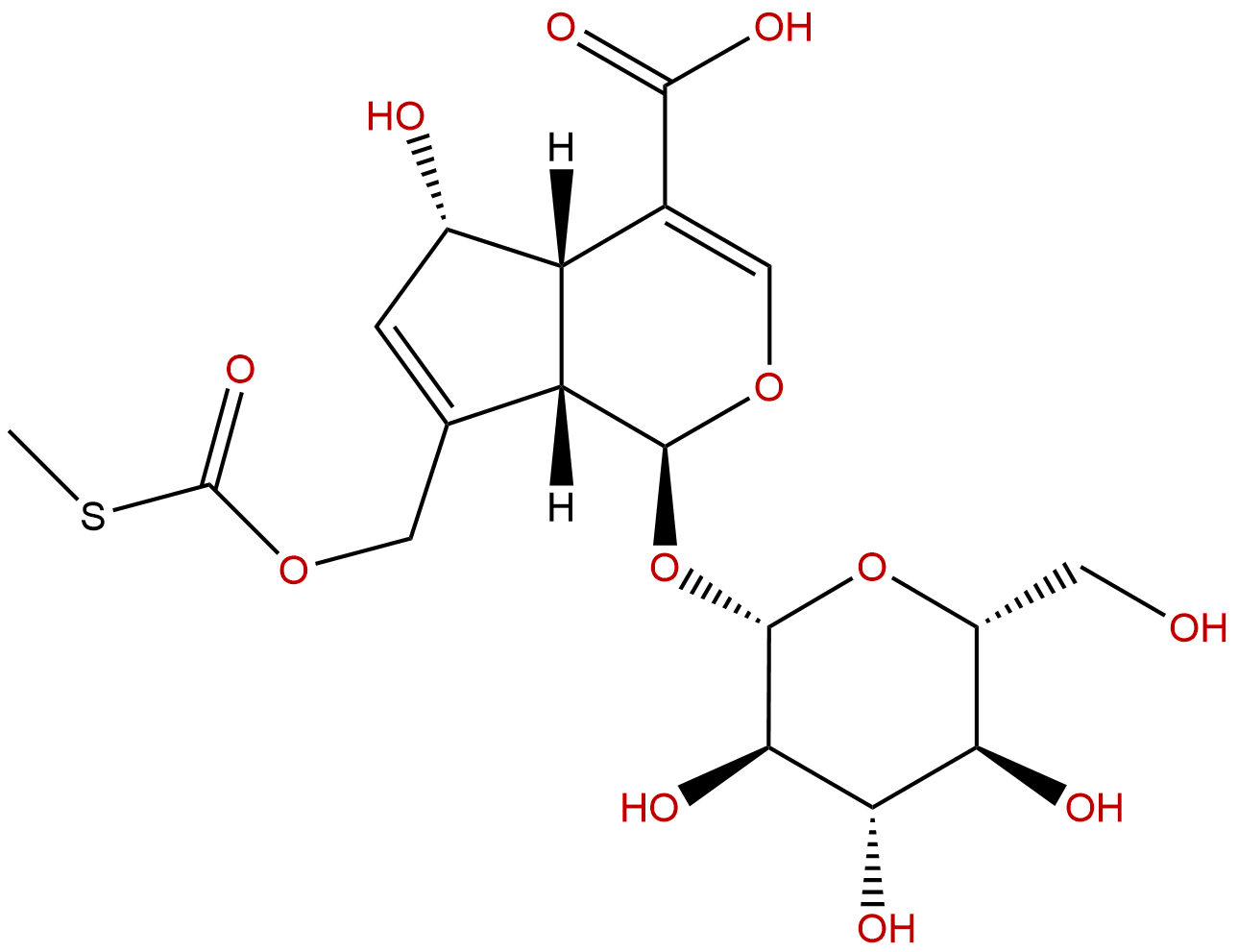


Product name: Paederosidic acid
Synonym name:
Catalogue No.: BP1654
Cas No.: 18842-98-3
Formula: C18H24O12S
Mol Weight: 464.438
Botanical Source: Paederia scandens
Physical Description: Powder
Type of Compound: Iridoids
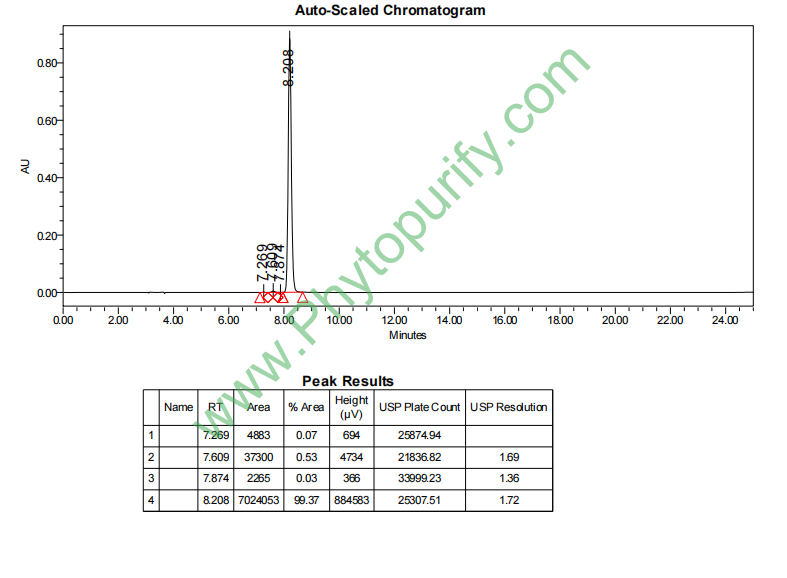
Purity: 95%~99%
Analysis Method: HPLC-DAD or/and HPLC-ELSD
Identification Method: Mass, NMR
Packing: Brown vial or HDPE plastic bottle
The product could be supplied from milligrams to grams. Inquire for bulk scale.
We provide solution to improve the water-solubility of compounds, thereby facilitating the variety of activity tests and clinic uses.
For Reference Standard and R&D, Not for Human Use Directly.
HPLC of Paederosidic acid
Storage conditions:Short-term storage at 2~8℃, long-term storage at -20 ~ -80℃
192.4400
-.9822
-2.5102
20.0623
.4864
.4395
Low
45.5330
5.0235
Yes
No
No
No
No
No
0.0
Yes
Yes
Yes
Yes
Natural products, as an important source of drug discovery, play an irreplaceable role in the history of human disease treatment. Among them, iridoid compounds have always been a hot topic in medicinal chemistry and pharmacology research due to their structural diversity and wide range of biological activities. Paederidic acid (CAS: 18842-98-3), as a cyclic terpenoid glycoside isolated from traditional medicinal plants, has attracted much attention in recent years due to its significant anti-cancer and anti-inflammatory activities. This compound was originally derived from plants in the family Rubiaceae and genus Caulis(Paederia scandens)The unique chemical structure of the intermediate separation and identification lays the foundation for its diverse biological activities. Modern pharmacological studies have shown that chicken droppings glycoside acid can not only effectively inhibit the proliferation of tumor cells such as lung cancer by inducing mitochondrial mediated apoptosis, but also demonstrate strong regulatory potential in various inflammatory disease models, especially in chronic inflammatory diseases such as arthritis, where its role involves regulating key inflammatory signaling pathways such as TNF, IL-6, and NF - κ B. This article aims to provide a systematic review of the chemical structure, plant sources, pharmacological activity, mechanism of action, pharmacological evaluation, and clinical application prospects of chicken manure vine glycoside acid, in order to provide comprehensive scientific references for the deep development and utilization of this natural product.
Chicken excrement vine glycoside acid is a monoterpene cyclic iridoid glycoside compound. Its molecular formula is C21H28O12 and its molecular weight is 464.4450. Its core structure is composed of a cyclopentanopyran (a characteristic skeleton of cyclohexene ether terpenes), which is connected to a glucose unit through a glycosidic bond. The carboxyl group (- COOH) in the structure is the reason why it is named "acid", and it is also an important functional group related to its water solubility and biological activity. This structure contains multiple chiral centers, which determine its specific stereoconfiguration and biological activity.
Based on its chemical structure, chicken droppings glycoside acid exhibits specific physicochemical properties. The calculated lipid water partition coefficient (LogP) is -0.9822, indicating that the compound has good hydrophilicity. The topologically polar surface area (TPSA) is as high as 192.4400 Å ², mainly attributed to the presence of multiple hydroxyl, carboxyl, and oxygen atoms on the sugar ring in the molecule, which are potential hydrogen bond donors and acceptors. The high TPSA and negative LogP values together explain its good water solubility (approximately 20.0623 mg/L). These properties suggest that the distribution of chicken droppings glycosides in the body may be more inclined towards hydrophilic environments, and their membrane permeability, especially their ability to penetrate the blood-brain barrier, is weak (predicted to be low), which to some extent limits their direct effects on central nervous system related diseases, but may also reduce the potential risk of neurotoxicity. In addition, preliminary pharmacological predictions showed no significant inhibitory risk on hERG potassium channels (hERG inhibition: No), and the Ames test predicted a value of 0.0, suggesting a low potential mutagenic risk and providing preliminary positive signals for its safety evaluation.
Chicken dung vine glycoside acid mainly comes from the Rubiaceae family, genus Chicken dung vine(Paederia)Plants, especially chicken droppings vine(Paederia scandens (Lour. Merr.) and its related species. Chicken droppings vine, as a traditional Chinese medicinal herb, has long been used in folk medicine in many Asian countries such as China, Japan, and India. It is commonly used to treat rheumatic pain, traumatic injuries, digestive disorders, and inflammation related diseases, providing a traditional basis for the modern research of its active ingredients.
The extraction of gallic acid from plant materials usually involves the use of organic solvent extraction combined with modern chromatographic separation techniques. The conventional process is as follows: first, the dried chicken manure vine whole grass or aboveground parts are crushed, and then subjected to reflux extraction or ultrasound assisted extraction using polar solvents such as methanol, ethanol, or aqueous ethanol. The crude extract was obtained by vacuum concentration of the extraction solution. Subsequently, macroporous adsorption resins (such as D101, AB-8) were used for preliminary enrichment, followed by gradient elution with water and different concentrations of ethanol. Chicken droppings glycoside acid is usually enriched in the elution sites of medium to high concentrations of ethanol (such as 30% -70% ethanol). Further purification requires the use of column chromatography techniques, often using silica gel column chromatography, reverse phase silica gel column chromatography (such as ODS-C18), and high-performance liquid chromatography (HPLC) to prepare the chromatography. By comparing the thin-layer chromatography (TLC) spot or HPLC analysis spectra with standard samples, and combining spectroscopic techniques such as nuclear magnetic resonance (NMR) and mass spectrometry (MS) for structural identification, high-purity chicken droppings glycoside monomers were ultimately obtained. Optimizing extraction solvents, temperature, time, and adopting new technologies such as microwave-assisted extraction and supercritical fluid extraction can help improve extraction efficiency and yield of target compounds.
Numerous in vitro and in vivo pharmacological studies have confirmed that chicken droppings glycoside acid has multiple biological activities, among which anti-tumor and anti-inflammatory activities are the most prominent.
1. Antitumor activity:
Chicken excrement vine glycoside acid exhibits growth inhibition and pro apoptotic effects on various tumor cell lines, especially in the study of lung cancer cells. Research has shown that this compound can dose - and time-dependent inhibit the proliferation of human non-small cell lung cancer A549 cells, H460 cells, and other cells. Its effects are not limited to lung cancer, but also show certain cytotoxicity to liver cancer, breast cancer, colon cancer and other cell lines. Animal model experiments further support its anti-tumor potential. For example, in a mouse model of lung cancer transplantation, intraperitoneal injection or gavage of chicken droppings glycoside acid can significantly inhibit the growth of tumor volume and weight, and has little effect on mouse body weight, indicating that it has a certain therapeutic window.
2. Anti inflammatory activity:
Chicken droppings glycoside acid has shown strong anti-inflammatory effects in various acute and chronic inflammation models. In acute inflammation models induced by carrageenan or acetic acid in mice, it can significantly reduce paw swelling and increase vascular permeability. More importantly, in animal models simulating human rheumatoid arthritis, such as collagen induced arthritis (CIA), treatment with chicken guanosine acid can effectively alleviate joint redness and improve joint pathological damage (such as synovial hyperplasia, inflammatory cell infiltration, cartilage destruction, and bone erosion). Its anti-inflammatory effect is closely related to the downregulation of pro-inflammatory cytokine levels in local joints and serum.
3. Other activities:
In addition to the core activities mentioned above, some studies also suggest that chicken guanosine may have antioxidant and hepatoprotective effects, and these activities intersect with its anti-inflammatory mechanism, forming a network of pharmacological effects.
The multiple pharmacological activities of chicken droppings vine glycosides stem from their precise regulation of multiple signaling pathways within cells, and their mechanisms of action have been extensively studied at the molecular and pathway levels.
1. Mechanism of anti-tumor effect:
The core mechanism of chicken droppings glycoside acid in anti-tumor treatment is to induce mitochondrial mediated endogenous apoptosis in tumor cells.
* Mitochondrial pathway activation: This compound can induce a decrease in mitochondrial membrane potential, leading to the opening of mitochondrial permeability transition pores and promoting the release of cytochrome c from mitochondria into the cytoplasm.
* Caspase cascade reaction: The released cytochrome c forms an apoptotic complex with Apaf-1, ATP/dATP, and procaspase-9, activating caspase-9 and subsequently activating downstream effector caspase-3 and caspase-7, ultimately leading to characteristic apoptotic changes such as DNA fragmentation and chromatin agglutination.
* Regulation of Bcl-2 family proteins: The process is often accompanied by upregulation of pro apoptotic proteins (such as Bax) and downregulation of anti apoptotic proteins (such as Bcl-2), thereby promoting increased mitochondrial outer membrane permeability.
* Other pathways: Some studies have also shown that chicken droppings glycosides may indirectly promote apoptosis or inhibit growth by regulating signaling pathways related to cell survival and proliferation, such as MAPK and PI3K/Akt.
2. Anti inflammatory mechanism and molecular targets:
The anti-inflammatory effect of chicken droppings glycoside acid, especially in arthritis, is mainly achieved through the inhibition of core inflammatory signaling pathways such as NF - κ B, and involves multiple key inflammatory mediator targets.
* Inhibition of NF - κ B signaling pathway: NF - κ B is the core transcription factor of inflammatory response. Chicken excrement vine glycoside acid can effectively inhibit the phosphorylation and degradation of I κ B α, thereby preventing the translocation of NF - κ B p65/p50 dimer (encoded by NFKB1 gene) to the nucleus, and ultimately downregulating the expression of a series of pro-inflammatory genes that depend on NF - κ B transcription.
* Downregulation of key inflammatory factors and enzymes:
* Cytokines: Significantly reduce the production and release of key pro-inflammatory cytokines such as tumor necrosis factor - α (TNF - α), interleukin-1 β (IL-1 β), and interleukin-6 (IL-6).
* Inflammatory mediator synthase: Inhibit the expression of cyclooxygenase-2 (PTGS2/COX-2) and reduce the production of inflammatory mediators such as prostaglandin E2.
* Matrix degrading enzymes: Downregulate the expression of matrix metalloproteinase-3 (MMP-3) and matrix metalloproteinase-13 (MMP-13). These two enzymes play a critical role in cartilage and bone matrix destruction in arthritis, and their activity is inhibited to help protect joint structure.
* Multi target collaboration: The synergistic inhibitory effect of chicken droppings glycoside acid on multiple targets such as TNF, IL1B, IL6, PTGS2, MMP3/13 enables it to intervene in multiple stages of the inflammatory cascade, resulting in strong overall anti-inflammatory and joint protective effects.
Although chicken droppings glycoside acid exhibits good in vitro activity, its drug like and in vivo pharmacokinetic (PK) properties are key factors determining its successful development as a drug.
1. Analysis of pharmacological parameters:
As mentioned earlier, chicken droppings glycoside acid has the characteristics of medium molecular weight and high hydrophilicity (low LogP, high TPSA). This is in line with the requirements of the "Rule of Five" regarding hydrogen bond donors and acceptors, but its high polarity may pose challenges to oral bioavailability. Its good water solubility is beneficial for making injections, but oral absorption may be limited by the low passive permeability of intestinal epithelial cells. The prediction of low blood-brain barrier permeability makes it unsuitable for the treatment of central nervous system diseases, but it may also avoid related side effects. The absence of hERG inhibition and Ames mutagenicity warning provides positive data for its early safety.
2. Current status of pharmacokinetic research:
At present, there are relatively limited reports on the pharmacokinetic studies of the chicken droppings vine glycoside system, which is a key direction for future research. Based on its glycoside structure, it can be inferred that its possible processes in vivo are as follows:
* Absorption: After oral administration, some of them may be hydrolyzed into aglycones under the action of gut microbiota or intestinal mucosal enzymes. The lipid solubility of aglycones may increase and they may be more easily absorbed, but the absorption efficiency of the prototype drug needs to be experimentally confirmed.
* Distribution: Due to its hydrophilicity, it is expected to be mainly distributed in the blood and extracellular fluid in the body, with limited tissue permeability, especially towards adipose tissue and the brain.
* Metabolism: As glycoside compounds, the liver and intestine may be their main metabolic sites, where II binding reactions such as hydrolysis, glucuronidation, and sulfation may occur.
* Excretion: The prototype drug and its metabolites may be mainly excreted through the kidneys and urine.
In the future, it is necessary to use technologies such as liquid chromatography-mass spectrometry (LC-MS/MS) to systematically study the blood drug concentration time curve after administration in animal models (rats, mice) and even humans, calculate key PK parameters such as absolute bioavailability, half-life, clearance rate, apparent distribution volume, and identify their main metabolites.
3. Formulation strategy:
To improve its oral bioavailability, advanced formulation technologies such as phospholipid complexes, cyclodextrin inclusion complexes, nanoemulsions, solid dispersions, or liposomes may be needed to enhance its membrane permeability and stability.
Chicken excrement vine glycoside acid, as a natural lead compound with clear anti-cancer and anti-inflammatory activities, has broad clinical application prospects, but also faces many challenges.
1. Potential application directions:
* Antitumor adjuvant therapy: Especially for lung cancer, it can be used as an adjuvant drug for chemotherapy or targeted therapy, enhancing efficacy by inducing apoptosis, or used to reduce the dosage of chemotherapy drugs to alleviate side effects. Its multi-target nature may also help overcome certain resistance issues.
* Inflammatory disease treatment: It has great potential in the treatment of chronic inflammatory diseases such as rheumatoid arthritis and osteoarthritis. By inhibiting the NF - κ B pathway, it can simultaneously regulate inflammatory factors, mediators, and destructive enzymes, achieving a "multi pronged" therapeutic effect that may be superior to single target inhibitors. It can also be explored for its application in other inflammatory diseases such as inflammatory bowel disease and dermatitis.
* Joint drug development: Consider combining it with existing anti-inflammatory drugs (such as nonsteroidal anti-inflammatory drugs, disease modifying anti rheumatic drugs) or anti-tumor drugs, which may produce synergistic effects, improve efficacy, or reduce their respective dosages and toxicity.
2. Challenges and future research directions:
* System pharmacology and safety evaluation: It is necessary to conduct long-term efficacy and systemic toxicity evaluations in animal models that are closer to human diseases, such as humanized tumor models and more comprehensive arthritis models, including acute toxicity, long-term toxicity, reproductive toxicity, etc.
* In depth pharmacokinetic studies: As mentioned earlier, it is necessary to comprehensively elucidate its ADME process in different species, clarify its bioavailability bottlenecks and main metabolic pathways, and provide a basis for dosage form optimization and clinical administration design.
* Deep exploration of the mechanism of action: Using techniques such as proteomics, metabolomics, and network pharmacology, further reveal the direct molecular targets of its action (such as whether it directly binds to specific kinases or receptors) and more complex regulatory networks.
* Structural optimization and derivative development: Using it as the parent nucleus, improve its pharmacokinetic properties (such as increasing lipid solubility and enhancing metabolic stability) through chemical modifications (such as glycosylation modification, esterification, and synthesis of prodrugs), and develop derivatives with higher activity and better drug properties.
* Clinical trial advancement: After completing sufficient preclinical research, gradually advancing Phase I (safety, pharmacokinetics), Phase II (efficacy exploration), and Phase III (confirmatory) clinical trials is the necessary path to transforming it into clinical drugs.
Chicken dung vine glycoside acid is a cyclic terpenoid glycoside compound with important biological activity isolated from the traditional medicinal plant chicken dung vine. Modern pharmacological research has fully revealed its multiple pharmacological activities, including inhibiting tumor growth by inducing mitochondrial apoptosis and exerting strong anti-inflammatory effects by targeting key pathways such as NF - κ B, downregulating various inflammatory mediators such as TNF - α, IL-6, COX-2, MMPs, etc. These effects have laid a solid scientific foundation for its application in the treatment of major diseases such as lung cancer and arthritis. Although there may be challenges in developing its pharmacological properties, such as low oral bioavailability, through in-depth pharmacokinetic studies, exploration of its mechanism of action, and optimization using advanced medicinal chemistry and formulation methods, chicken droppings glycosides have great potential to be developed as a novel multi-target anti-tumor or anti-inflammatory drug. It not only reflects the enormous value of extracting modern medicines from traditional herbs, but also provides a useful example for innovative research and development of natural products. Future research should focus on the translational medicine process, accelerating its transition from the laboratory to clinical practice, in order to benefit patients as soon as possible.
