Introduction/Overview
Natural products, as an important source of drug discovery, play an irreplaceable role in the history of human disease treatment. Among them, diterpenoid alkaloids have always been a hot topic in natural medicinal chemistry and pharmacology research due to their complex and diverse chemical structures and extensive biological activities. Lappaconin (CAS number: 23943-93-3) is a C19 type diterpenoid alkaloid isolated from plants of the Aconitum genus in the Ranunculaceae family. Traditionally, Aconitum plants have been used in folk medicine for pain relief, anti-inflammatory effects, etc., but their strong toxicity also limits their application. Gaowuning alkaloid, as a component with significant analgesic activity and relatively low toxicity in this genus of plants, has received widespread attention from researchers in recent years. Its unique chemical structure makes it not only a chiral catalyst for β - oxoester α - hydroxylation in organic synthesis, but also exhibits the potential for multi-target action in analgesic pharmacology, involving key targets such as transient receptor potential vanillic acid subtype 1 (TRPV1), cannabinoid receptor 1 (CNR1), opioid receptor system (OPRD1, OPRM1, OPRK1), and cyclooxygenase (PTGS1/2). This article aims to systematically review the chemical properties, plant sources, pharmacological activities, mechanisms of action, pharmacological evaluation, and clinical application prospects of Gaowuning alkaloid, in order to provide comprehensive scientific references for the in-depth research and potential drug development of this compound.
Chemical structure and physicochemical properties
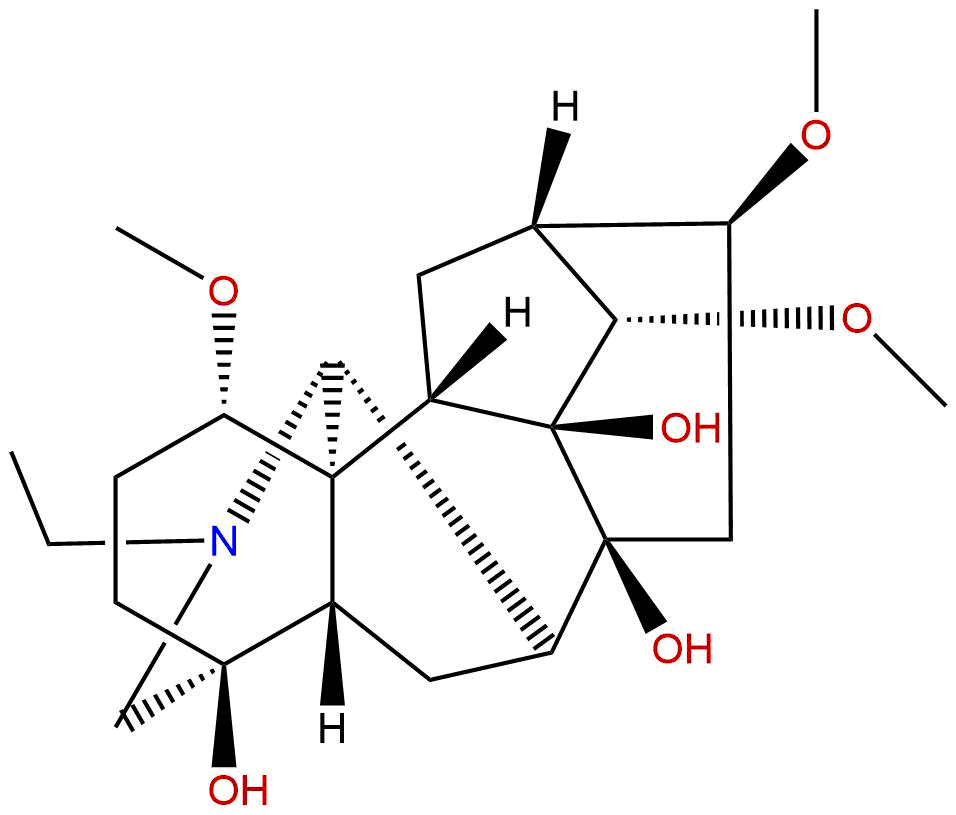
Gaowuning alkaloid is a typical C19-demethylditerpenoid alkaloid, with a molecular formula of C22H33NO6 and a molecular weight of 423.5500. Its basic skeleton is composed of a hexagonal nitrogen heterocyclic ring (pyridine ring) and multiple fused or bridged carbon ring systems. The structure contains multiple oxygen-containing functional groups, including hydroxyl and methoxy groups, which are crucial for its solubility and biological activity.
From the analysis of physical and chemical properties, the lipid water partition coefficient (LogP) of Gao Wuning alkali is 1.1700, indicating that it has a certain degree of lipophilicity, but not high hydrophobicity. Its topological polar surface area (TPSA) is 91.6200 Å ², reflecting the larger surface area occupied by polar atoms (such as N, O) in the molecule, which is consistent with the presence of multiple hydroxyl and methoxy groups in its structure. The water solubility value is 1.3834 mg/mL, indicating a moderately low solubility in water, which may affect its bioavailability to some extent. Based on its molecular weight (<500), moderate LogP value, and high TPSA value, it is preliminarily judged that it meets the basic requirements of the Rule of Five and has the preliminary chemical spatial basis to become an oral drug.
In addition, Gaowuning base has been proven to be an effective catalyst in the field of organic synthesis due to its specific chiral center in the molecule, for catalyzing asymmetric α - hydroxylation reactions of β - oxoesters, demonstrating its unique value in chemical synthesis.
Plant sources and extraction methods
Gaowuning alkaloid mainly comes from various plants in the Aconitum genus of the Ranunculaceae family, such as Aconitum sinomontanum and Aconitum kusnezofii. These plants are widely distributed in temperate regions of Asia and Europe, and are also found in many provinces of China. Although Aconitum plants have been used in traditional medicine, the toxicity of diterpenoid alkaloids such as aconitine in their roots is extremely strong, which limits their safe use. Gaowuning alkaloid often exists in the form of monoester or de ester, with relatively low toxicity, and is one of the active ingredients with development value in these plants.
The extraction of high wuning alkaloid from plant materials usually involves solvent extraction combined with modern chromatographic separation techniques. The classic process is as follows:
1. Raw material pretreatment Grind the dried roots and stems of Aconitum plants, usually alkalized with weak bases such as ammonia water, to make the alkaloids exist in free form and facilitate organic solvent extraction.
2. Solvent extraction Using methanol, ethanol, or acidic water (such as dilute hydrochloric acid, dilute acetic acid) for percolation, reflux, or ultrasound assisted extraction. After acid water extraction, the total alkaloids need to be alkalized and precipitated.
3. Preliminary purification After concentrating the extract, liquid-liquid extraction is performed using medium polarity solvents such as chloroform, dichloromethane, or ethyl acetate to enrich the alkaloid fraction.
4. Separation and purification Repeated separation is performed using methods such as silica gel column chromatography, alumina column chromatography, reverse phase silica gel column chromatography (such as ODS), and high performance liquid chromatography (HPLC). Alkaloids of different polarities are often separated using gradient elution systems such as chloroform methanol and petroleum ether ethyl acetate. Thin layer chromatography (TLC) and HPLC can be used to track and identify high wuning alkaloids.
5. appraisal The final pure product was structurally confirmed by techniques such as nuclear magnetic resonance (NMR, including 1H-NMR, 13C-NMR, 2D-NMR), mass spectrometry (MS), infrared spectroscopy (IR), and X-ray single crystal diffraction.
In recent years, green and efficient technologies such as supercritical fluid extraction (SFE) and high-speed countercurrent chromatography (HSCCC) have also been applied to the extraction and separation of high wuning alkaloids to improve yield and purity.
Pharmacological activity research
The most prominent and extensively studied pharmacological activity of Gaowuning alkaloid is Analgesic effect Numerous in vivo experiments have shown that Gaowuning alkaloid exhibits significant analgesic effects in various pain models such as mouse hot plate test, acetic acid writhing test, formalin test, and chronic neuropathic pain through intraperitoneal injection, subcutaneous injection, or oral administration. Its efficacy is stronger than that of nonsteroidal anti-inflammatory drugs such as aspirin, and its side effects are relatively small within a certain dose range, with no obvious physical dependence.
In addition to its core analgesic activity, the study also suggests that Gaowuning alkaloid may have other potential pharmacological effects:
* anti-inflammatory effect A certain anti-inflammatory effect was observed in the inflammation model of rat foot swelling induced by carrageenan, which may be related to its regulation of prostaglandin synthesis pathway.
* Local anesthesia effect Partial studies have shown that it has local anesthetic activity similar to lidocaine, which may be related to its impact on sodium ion channels in nerve cell membranes.
* Antiarrhythmic effect Early research suggests that it has an improving effect on certain experimental arrhythmias, but the specific mechanism and intensity need to be further elucidated.
It is worth noting that although the acute toxicity of high wuning alkaloids is much lower than that of diester alkaloids such as aconitine, there is still a certain therapeutic window, and high doses may cause toxicity to the heart and nervous system. Therefore, strict safety evaluation is needed in drug development.
Mechanism of action and molecular targets
The analgesic effect of Gaowuning alkaloid is not achieved through a single target, but exhibits the characteristics of multi-target and multi pathway synergy, which provides a theoretical basis for its development into a new type of multimodal analgesic drug. Existing research evidence suggests that it interacts with multiple key targets, including:
-
Opioid receptor system This is an important pathway for it to exert central analgesic effects. Research has shown that the analgesic effect of Gaowuning alkaloid can be partially blocked by the non selective opioid receptor antagonist naloxone. Further research has found that it has a certain affinity or regulatory effect on the δ - opioid receptor (OPRD1), μ - opioid receptor (OPRM1), and κ - opioid receptor (OPRK1), which may inhibit the transmission of pain signals in the spinal cord and brain by activating these receptors. This effect on multi subtype opioid receptors may help to produce potent analgesia while reducing side effects such as respiratory depression and addiction caused by traditional mu receptor agonists (such as morphine).
-
Transient receptor potential channel:
- TRPV1 receptor TRPV1 is a key molecular sensor mediating thermal pain and inflammatory pain. Gaowuning alkaloid has been found to be an effective antagonist of TRPV1 receptor, which can inhibit the influx of calcium ions and neuronal excitation caused by capsaicin or thermal stimulation, thereby blocking the pain signals of nociceptive thermal stimulation and inflammatory mediators.
- TRPA1 receptor TRPA1 is mainly involved in cold pain and chemical irritant pain. Gaowuning alkaloid may also have a regulatory effect on TRPA1, further expanding its analgesic spectrum.
-
Endogenous cannabinoid system Cannabinoid receptor 1 (CNR1) plays an important role in central and peripheral analgesia, as well as emotion regulation. There are studies suggesting that matrine may directly or indirectly affect the endogenous cannabinoid system, producing analgesic and anti-inflammatory effects by activating CNR1.
-
Cyclooxygenase pathway Cyclooxygenase-1 (PTGS1/COX-1) and cyclooxygenase-2 (PTGS2/COX-2) are key enzymes involved in prostaglandin synthesis, mediating inflammation and pain. Gaowuning alkaloid may exert peripheral anti-inflammatory and analgesic effects by inhibiting COX-2 activity, reducing the production of pain and inflammatory prostaglandins (such as PGE2).
-
Monoamine neurotransmitter system The 5-hydroxytryptamine transporter (SLC6A4) and dopamine D2 receptor (DRD2) are involved in regulating the pain descending inhibitory pathway. Gaowuning alkaloid may enhance central inhibitory function by affecting the reuptake of serotonin or dopaminergic signaling.
In summary, Gaowuning alkaloid synergistically exerts a multi-layered analgesic effect by simultaneously acting on multiple pain regulatory targets in the peripheral (such as TRPV1, TRPA1, COX-2) and central (such as opioid receptors, CNR1, monoamine systems), which may be the basis for its high efficiency and possibly low dependence mechanism.
Evaluation of drug properties and pharmacokinetics
Based on the provided parameters and existing research, a preliminary evaluation of the pharmacological properties of Gaowuning alkaloid is conducted
- Absorption and distribution Moderate LogP and TPSA values suggest that it may have some oral absorption potential, but the specific bioavailability needs to be experimentally verified. The parameter of "blood-brain barrier permeability: low" indicates that although it can act on central targets, its efficiency in crossing the blood-brain barrier may be limited, which may explain its strong analgesic effect but relatively mild central side effects (such as sedation and respiratory depression). Its effect may partially depend on peripheral targets and the synergistic effect of limited concentration entering the central nervous system.
- Metabolism and excretion As an alkaloid, its metabolism may mainly be catalyzed by the liver cytochrome P450 enzyme system, undergoing demethylation, hydroxylation and other reactions. Further pharmacokinetic studies are needed to clarify the specific metabolites, major metabolic enzyme subtypes, and excretion pathways (kidney or bile).
- Preliminary evaluation of safety:
- cardiotoxicity Inhibition of hERG potassium channels is the main risk leading to drug-induced long QT syndrome and apical torsion ventricular tachycardia. The "hERG inhibition: no" of Gaowuning alkaloid is a positive signal that reduces its potential risk of severe cardiac toxicity.
- Genotoxicity Ames test is a standard method for evaluating the mutagenicity of compounds. The parameter "Ames test: 0.3" is usually interpreted as not showing significant mutagenicity under test conditions (usually expressed as the number of revertant colonies, which needs to be judged based on specific experimental protocols, but a low value is usually a negative trend), which provides initial support for its long-term safety.
- therapeutic window Systematic acute toxicity, subchronic toxicity, and reproductive toxicity studies are still needed to determine its safe dose range.
At present, there is still a relative lack of research data on the pharmacokinetics of Gaowuning alkaloid system, such as absolute bioavailability, half-life, tissue distribution, plasma protein binding rate, etc. This is a key gap that must be filled in its preclinical development.
Clinical application prospects and prospects
Gaowuning alkaloid, as a natural compound with multi-target analgesic mechanism, has shown unique application prospects in the field of pain treatment.
-
Development of new multimodal analgesics Current clinical analgesics (such as opioids and NSAIDs) often have side effects such as addiction, gastrointestinal injury, and cardiovascular risk. Gaowuning alkaloids have the potential to achieve potent analgesia while reducing the risk of side effects caused by excessive inhibition of a single pathway by simultaneously regulating multiple pain pathways. For example, they may be developed into opioid substitutes or adjunctive drugs with lower dependence and lower risk of respiratory depression, or anti-inflammatory and analgesic drugs with less gastrointestinal damage.
-
Treatment of neuropathic pain The mechanism of neuropathic pain is complex, and the efficacy of existing drugs is limited. The antagonistic effect of lappanine on key ion channels involved in neuropathic pain, such as TRPV1 and TRPA1, provides a new possibility for its treatment of refractory pain, such as diabetes neuralgia and post herpetic neuralgia.
-
The potential of combination therapy Due to its unique mechanism of action, high wuning alkaloids may be used in combination with low-dose traditional opioid drugs or NSAIDs to produce a synergistic analgesic effect, thereby reducing the dosage and side effects of various drugs.
-
Challenges faced and future research directions:
- structural optimization By using medicinal chemical methods to modify the structure of Gao Wuning alkaloid, the aim is to improve its analgesic efficacy, oral bioavailability, blood-brain barrier selective permeability, and further reduce potential toxicity.
- Deep analysis of mechanism Molecular docking, site directed mutagenesis, gene knockout, and other techniques need to be used to accurately elucidate their binding patterns and properties of action (excitatory/antagonistic/allosteric regulation) with various targets (such as subtypes of opioid receptors).
- Systematic drug research Comprehensive preclinical pharmacokinetic and toxicological studies must be completed to clarify its ADME (absorption, distribution, metabolism, excretion) characteristics and safety window.
- Formulation development In response to its general water solubility, new drug delivery systems such as nano formulations, liposomes, and cyclodextrin inclusion complexes can be explored to improve its solubility and targeting.
Conclusion
Gaowuning alkaloid is a highly valuable diterpenoid alkaloid discovered from traditional medicinal plants. It not only demonstrates value as a chiral catalyst in organic synthesis, but also becomes a highlight in the field of pain drug development due to its significant analgesic activity mediated by multiple targets. Its chemical structure is unique, and preliminary pharmacological parameters indicate that it has a low risk of hERG inhibition and genetic toxicity, but low blood-brain barrier permeability. In terms of its mechanism of action, it extensively involves multiple pain signaling pathways such as opioid receptors, TRP channels, endogenous cannabinoid system, and cyclooxygenase, forming the theoretical basis for its multimodal analgesia. However, to successfully apply this promising natural molecule in clinical settings, there are still a series of challenges, including precise mapping of its mechanism of action, systematic and in-depth pharmacokinetic and toxicological evaluations, and structural optimization through rational drug design. In the future, interdisciplinary collaborative research will be crucial to fully explore the scientific connotation and medical value of high wuning alkaloids, which is expected to provide important lead compounds and new strategies for the development of efficient and low toxicity new analgesic drugs.