| Catalog No | Package | Original Price | Price | Inventory | Quantity | Operating |
|---|---|---|---|---|---|---|
| SBP00170-100mg | 100mg | $35.00 | Sign in |
|


Storage conditions:Short-term storage at 2~8℃, long-term storage at -20 ~ -80℃
40.4600
.7333
.7326
32.6434
3.2255
13.6462
Low
42.4941
1.5201
Yes
Yes
No
No
Yes
No
0.0
Yes
Yes
No
Yes
4-Hydroxybenzyl alcohol (4-HBA) is a natural phenolic compound widely present in various plants, and has attracted widespread attention in the fields of pharmacology and natural product chemistry due to its unique biological activity. As a natural product, 4-HBA exhibits significant anti-inflammatory, antioxidant, neuroprotective, and anti-tumor activities, particularly demonstrating potential therapeutic value in neurodegenerative diseases and tumor related research. This article provides a systematic review of the chemical structure and physicochemical properties, plant sources and extraction methods, pharmacological activity and mechanism of action, pharmacological evaluation, pharmacokinetic characteristics, and clinical application prospects of 4-HBA. The aim is to provide scientific basis and reference for the in-depth research and drug development of this compound.
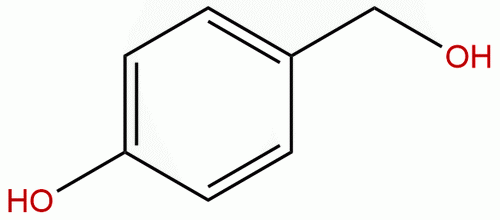
The chemical structure of 4-hydroxybenzyl alcohol is para hydroxy substituted benzyl alcohol, with a molecular formula of C7H8O2 and a molecular weight of 124.1390. Its structure contains a benzene ring, with a hydroxyl group (- OH) at position 1 and a hydroxymethyl group (- CH2OH) at position 4, making it a typical phenolic compound. This structure endows 4-HBA with good polarity and certain hydrophilicity, while maintaining the biological activity basis of phenolic compounds.
In terms of physical and chemical properties, the LogP value of 4-HBA is 0.7333, indicating that it has a moderate lipid water partition coefficient and a certain degree of lipid solubility and water solubility. Its topological polar surface area (TPSA) is 40.4600, reflecting that the molecule has good exposure of polar groups, which is conducive to binding with biomolecules. The water solubility is 32.6434, indicating that it has good solubility in aqueous media, which is beneficial for absorption and distribution in vivo. The blood-brain barrier has a low penetration ability, indicating limited ability to enter the central nervous system, but still has certain neuroprotective potential. The hERG channel inhibition experiment result was negative, indicating a low risk of cardiac toxicity for 4-HBA. The Ames mutagenicity test result was 0.0, indicating no significant genotoxicity.
4-hydroxybenzyl alcohol is widely distributed in various plants, especially in the Orchidaceae, Sapindaceae, and some medicinal plants where its content is relatively high. Species such as Dendrobium spp. and Equisetum spp. have been reported to contain abundant 4-HBA. It mostly exists in the form of free or bound state in plants, participating in plant antioxidant defense and metabolic regulation.
Common methods for extracting 4-HBA include solvent extraction, ultrasound assisted extraction, and liquid chromatography separation. Generally, ethanol or methanol is used as the extraction solvent, and ultrasonic assisted extraction is used to improve the extraction efficiency. Subsequently, purification and quantitative analysis were performed using liquid chromatography (HPLC) technology. In recent years, green extraction techniques such as supercritical CO2 extraction and microwave-assisted extraction have gradually been applied to the extraction of 4-HBA, improving extraction efficiency and environmental friendliness.
4-HBA exhibits significant anti-inflammatory activity. Multiple in vitro and in vivo studies have shown that 4-HBA can inhibit the expression of various pro-inflammatory factors, such as tumor necrosis factor - α (TNF - α), interleukin-1 β (IL-1 β), and cyclooxygenase-2 (COX-2). Its anti-inflammatory mechanism mainly involves regulating the nuclear factor kappa B (NF - κ B) signaling pathway, reducing the release of inflammatory mediators, and thereby alleviating tissue inflammatory responses.
As a phenolic compound, 4-HBA has excellent free radical scavenging ability. It can effectively eliminate reactive oxygen species (ROS) such as superoxide anions (O2 •−) and hydroxyl radicals (• OH), and alleviate oxidative stress damage. 4-HBA activates the nuclear factor erythroid associated factor 2 (NRF2) signaling pathway, promotes the expression of antioxidant enzymes such as glutathione peroxidase (GPx) and superoxide dismutase (SOD), and enhances cellular antioxidant defense capabilities.
The research on 4-HBA in the field of neuroprotection is particularly prominent. It can alleviate damage to nerve cells caused by oxidative stress, inflammation, and apoptosis, and protect nerve function. Related studies have shown that 4-HBA prevents neuronal apoptosis by regulating BCL2 family proteins (such as BCL2) and inhibiting caspase 3 (CASP3) activity. Meanwhile, 4-HBA also affects the expression of amyloid precursor protein (APP), β - secretase 1 (BACE1), and microtubule associated protein tau (MAPT), indicating its potential therapeutic value in neurodegenerative diseases such as Alzheimer's disease. In addition, the inhibitory effect of 4-HBA on acetylcholinesterase (ACHE) helps to increase the level of neurotransmitter acetylcholine and improve cognitive function.
Research on 4-HBA in the field of cancer has shown that it can inhibit angiogenesis and proliferation of tumor cells. It inhibits the formation of tumor neovascularization by suppressing vascular endothelial growth factor (VEGF) and related signaling pathways, limiting tumor growth and metastasis. In addition, 4-HBA can induce apoptosis of tumor cells, regulate cell cycle related proteins, and exert anti-tumor effects.
The multi-target mechanism of action of 4-HBA is the basis for its broad pharmacological activity. In terms of neuroprotection, 4-HBA mainly acts on the following molecular targets:
The synergistic regulation of these targets enables 4-HBA to exert multidimensional pharmacological effects in neuroprotection and anti-tumor.
The pharmacological parameters of 4-HBA indicate that it has certain potential for drug development. The molecular weight of 124.1390 is much lower than the upper limit of drug molecular weight, and the LogP value of 0.7333 conforms to Lipinski's rule, indicating that it has good membrane permeability and bioavailability. The TPSA is 40.4600, indicating that the molecular polarity is moderate and conducive to binding with the target protein. Good water solubility, conducive to formulation development and in vivo absorption.
The blood-brain barrier has a low penetration ability, which may limit the direct action of the central nervous system, but its brain distribution can be improved through structural modifications or carrier systems. The hERG channel inhibition experiment was negative, reducing the potential risk of cardiac toxicity. The Ames test is non mutagenic and has high safety.
In terms of pharmacokinetics, existing research is relatively limited. Preliminary in vivo experiments have shown that 4-HBA is well absorbed orally, with a moderate plasma half-life, and is mainly metabolized by the liver and excreted by the kidneys. Further systematic pharmacokinetic and toxicological studies are needed in the future to clarify its in vivo metabolic pathways and safe dosage range.
4-HBA, with its multi-target and multi mechanism pharmacological activity, has shown broad clinical application prospects, especially in the fields of neuroprotection and anti-tumor. In the adjuvant therapy of neurodegenerative diseases such as Alzheimer's disease and Parkinson's disease, 4-HBA is expected to improve patients' cognitive and motor function by inhibiting neuroinflammation, reducing oxidative stress, and regulating neurotransmitters. Its anti-tumor angiogenesis properties also provide new strategies for tumor treatment.
However, the clinical translation of 4-HBA still faces many challenges. Firstly, the low penetration rate of the blood-brain barrier limits the efficacy of its neurological effects, and it is necessary to enhance brain targeting through drug carriers, structural optimization, and other means. Secondly, the pharmacokinetic and toxicological data of the system are not yet sufficient, and larger scale animal experiments and preclinical studies are needed. Finally, the development of dosage forms and optimization of administration routes for 4-HBA will also be a focus of future research.
Future research should focus on the structural modification of 4-HBA, the development of nanocarrier delivery systems, combination therapy strategies, and preclinical efficacy and safety evaluations to promote its translation into clinical applications.
4-hydroxybenzyl alcohol, as a natural phenolic compound, has become an important object of pharmacological research in natural products due to its significant anti-inflammatory, antioxidant, neuroprotective, and anti-tumor activities. Its multi-target and multi mechanism mode of action provides new ideas and potential drug candidate molecules for the treatment of neurodegenerative diseases and tumors. Although the current understanding of its pharmacokinetics and clinical applications is limited, with advances in extraction and purification techniques, drug design, and delivery systems, 4-HBA is expected to play an important role in future drug development. The in-depth basic and applied research of the system will lay a solid foundation for its clinical translation and promote the widespread application of natural products in modern medicine.
