| Catalog No | Package | Original Price | Price | Inventory | Quantity | Operating |
|---|---|---|---|---|---|---|
| BP4716-5mg | 5mg | $420.00 | Sign in |
|


Storage conditions:Short-term storage at 2~8℃, long-term storage at -20 ~ -80℃
Natural products, as an important source of drug discovery, play an irreplaceable role in the development of anti-tumor drugs. 6-Aldehydo-Isoopiopogonone A (CAS number: 112500-90-0) is a novel natural flavonoid compound that has received widespread attention in recent years due to its significant anti-tumor activity. This compound is mainly isolated from the traditional Chinese medicinal herb, Ophiopogon japonicus, and exhibits multi-target and multi mechanism anticancer potential, especially in regulating tumor cell apoptosis, inhibiting tumor invasion and metastasis, and regulating the tumor microenvironment, showing unique advantages.
The purpose of this article is to systematically review the chemical structure and physicochemical properties, plant sources and extraction methods, pharmacological activity and mechanism of action, pharmacological evaluation and pharmacokinetic characteristics of 6-aldehyde isoquercetin A, and to prospect its clinical application prospects, providing theoretical basis and research reference for the further development and clinical translation of this compound.
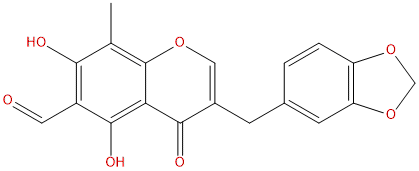
6-Aldehyde-Isoquercetin A belongs to the flavonoid class, with a molecular formula of C2H_18O6 and a molecular weight of 354.3140. Its structural characteristics include a typical flavonoid skeleton with aldehyde functional groups at position 6, which endows it with unique biological activity. The LogP value of the compound is 2.0854, indicating that it has moderate lipid solubility, which is beneficial for membrane penetration and in vivo distribution. The topological polar surface area (TPSA) is 106.2 Å ², indicating that it has a certain polarity that may affect its absorption and bioavailability.
Low water solubility (0.0315 mg/mL) indicates limited solubility in the aqueous phase and may require formulation optimization to improve bioavailability. The low penetration ability of the blood-brain barrier suggests limited distribution in the central nervous system, which is beneficial for reducing central nervous system toxicity and side effects. The hERG channel inhibition experiment result was negative, indicating that the compound has a low risk of cardiac toxicity. The Ames mutagenicity test result is 0.6, indicating a low risk of genetic toxicity and good safety.
6-Aldehyde-Iso Ophiopogon Flavonoids A mainly comes from Ophiopogon japonicus, a plant in the Liliaceae family. This plant is widely used in traditional Chinese medicine for nourishing yin, moistening lungs, clearing heat, and generating fluids. The rhizomes of Ophiopogon japonicus contain abundant flavonoids and saponins, among which 6-aldol-isoquercetin A is one of the important active ingredients.
The extraction method usually uses organic solvent extraction combined with column chromatography separation technology. The specific steps include:
In recent years, new technologies such as ultrasound assisted extraction and supercritical fluid extraction have also been applied to the extraction of this compound, improving extraction efficiency and purity.
A large number of in vitro and in vivo studies have shown that 6-aldehyde isoquercetin A has significant anti-tumor activity, manifested by various effects such as inhibiting tumor cell proliferation, inducing cell apoptosis, blocking tumor cell cycle, inhibiting tumor invasion and metastasis.
6-aldehyde isoflavone A can significantly inhibit the proliferation of many tumor cell lines (such as breast cancer, lung cancer, liver cancer, etc.), and the IC_50 value is generally lower than 10 μ M. This effect is closely related to its interference with the expression of cell cycle regulatory proteins and can induce G1 or G2/M phase arrest.
This compound promotes mitochondrial mediated cell apoptosis by regulating the expression of BCL2 family proteins, including anti apoptotic protein BCL2 and pro apoptotic protein MCL1. The activity of caspase-3 and caspase-9 related to apoptosis was significantly enhanced, indicating that they exert cytotoxicity by activating endogenous apoptotic pathways.
6-Aldehyde-Isoquercetin A can downregulate the expression of matrix metalloproteinase MMP2, inhibit the migration and invasion ability of tumor cells. In addition, by inhibiting tumor related signaling pathways, reducing the interaction between tumor cells and the matrix, and blocking the process of tumor metastasis.
This compound can inhibit the expression of tumor hypoxia inducible factor HIF1A, improve the hypoxic state of the tumor microenvironment, and reduce the drug resistance and invasiveness of tumor cells. At the same time, regulating tumor related inflammatory responses and enhancing the immune system's recognition and clearance of tumors.
The anti-tumor effect of 6-aldehyde isoquercetin A involves multiple signaling pathways and molecular targets, reflecting its multi-target drug properties.
As key anti apoptotic proteins, MCL1 and BCL2 play important roles in tumor cell survival. 6-Aldehyde-Isoquercetin A downregulates the expression of MCL1 and BCL2, disrupts mitochondrial membrane stability, and induces cell apoptosis.
STAT3 plays a central role in tumor cell proliferation, immune escape, and drug resistance. This compound can inhibit the phosphorylation activation of STAT3, block its transcriptional activity, and reduce the proliferation and survival ability of tumor cells.
MMP2, as a tumor cell matrix degrading enzyme, promotes tumor invasion and metastasis. 6-Aldehyde-Isoquercetin A significantly inhibits the expression and activity of MMP2, reducing the migration ability of tumor cells.
DNA topoisomerases TOP1 and TOP2A play a crucial role in DNA replication and transcription. This compound inhibits the activity of TOP1 and TOP2A, blocks the normal replication of tumor cell DNA, induces cell cycle arrest and apoptosis.
HIF1A regulates tumor hypoxia response, promotes angiogenesis and metabolic reprogramming. 6-Aldehyde-Isoquercetin A inhibits HIF1A expression, improves tumor hypoxic microenvironment, and reduces tumor drug resistance.
MAPK1 (ERK2) is involved in cell proliferation signal transduction, and ESR1 (estrogen receptor α) is particularly important in breast cancer. The regulatory effect of this compound on MAPK1 and ESR1 helps to inhibit the proliferation of tumor cells and the development of hormone dependent tumors.
Aromatase CYP19A1 catalyzes the synthesis of estrogen and promotes hormone dependent tumor growth. 6-aldehyde isoflavone A plays an anti breast cancer role by inhibiting CYP19A1 activity and reducing estrogen level.
The pharmacological parameters of 6-aldehyde isoquercetin A show that it has good potential for drug development. The LogP value is moderate, indicating good membrane permeability. Low water solubility is a major challenge in the development of drug formulations, which requires improving solubility and bioavailability through techniques such as nanocarriers, liposomes, or solid dispersions.
The low permeability of the blood-brain barrier reduces the risk of central nervous system side effects. HERG channel inhibition is negative, reducing the risk of cardiac toxicity. The Ames test results show that its genetic toxicity risk is low and its safety is good.
Pharmacokinetic studies have shown that the compound is rapidly absorbed orally, with a moderate half-life, and is mainly metabolized through the liver. Its metabolic pathway mainly involves the CYP450 enzyme system, especially CYP3A4, indicating the potential risk of drug interactions. Widely distributed in the body, but with lower concentrations in brain tissue. Excretion is mainly through bile and urine.
Based on the significant anti-tumor activity and good safety demonstrated by 6-aldehyde isoquercetin A in various tumor cell lines, its clinical development prospects are broad in the future. Especially, it has potential application value in adjuvant treatment of common malignant tumors such as breast cancer, lung cancer and liver cancer.
Future research should focus on the following aspects:
6-Aldehyde-Isoquercetin A, as a natural flavonoid compound with multi-target anti-tumor activity, exhibits excellent pharmacological activity and potential for drug development. It has become a powerful candidate molecule for the development of anti-tumor drugs by regulating tumor cell apoptosis, inhibiting invasion and metastasis, and improving the tumor microenvironment through multiple mechanisms. In the future, through in-depth mechanism research, dosage form optimization, and systematic pharmacokinetic and toxicological evaluation, it is expected to promote its clinical translation and benefit the vast number of cancer patients.
With the continuous advancement of natural product pharmacology and modern medicinal chemistry technology, the research on 6-aldehyde isoquercetin A will provide valuable experience and new ideas for the development of natural flavonoid anti-tumor drugs, and promote the innovation and application of natural products in the field of tumor treatment.
