


Synonym name: Leukamenin F; Wangzaozin B
Catalogue No.: BP0674
Cas No.: 79498-31-0
Formula: C20H28O4
Mol Weight: 332.44
Botanical Source: Rabdosia umbrosa, Isodon amethystoides and Rabdosia japonica
Purity: 95%~99%
Analysis Method: HPLC-DAD or/and HPLC-ELSD
Identification Method: Mass, NMR
Packing: Brown vial or HDPE plastic bottle
Can be supplied from milligrams to grams.
For Reference Standard and R&D, Not for Human Use Directly.
Inquire for bulk scale.
HPLC of glaucocalyxin A
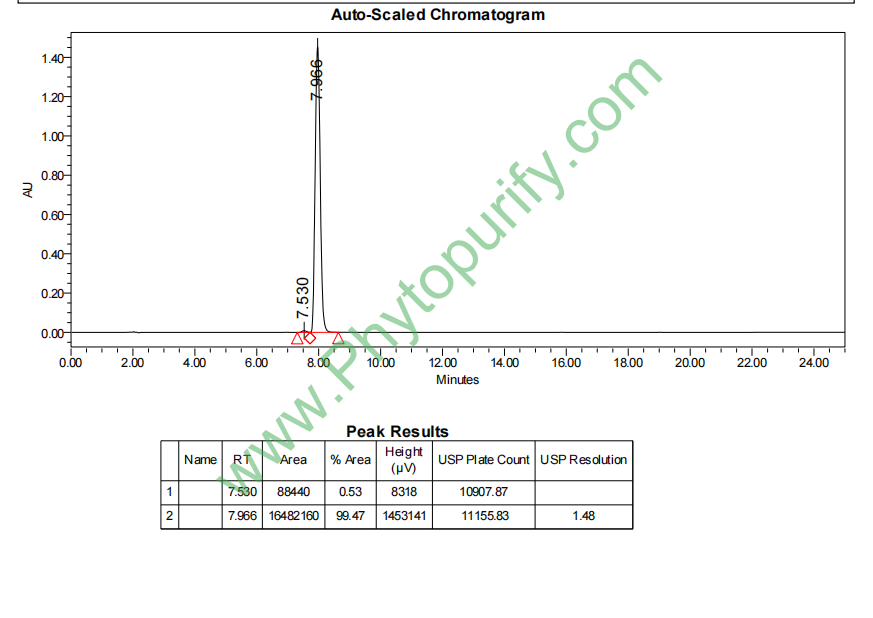
Storage conditions:Short-term storage at 2~8℃, long-term storage at -20 ~ -80℃
Glaucocalxin A (CAS number: 79498-31-0) is a natural product with significant biological activity, mainly derived from diterpenoid compounds of Rabdosia japonica var., a plant in the family Lamiaceae. As a type of natural product with diverse structures and extensive pharmacological activities, diterpenes have shown unique potential in the fields of anti-tumor, anti-inflammatory, antibacterial, and metabolic diseases. Blue sepal A has attracted much attention in pharmacological research in recent years due to its unique chemical structure and multi-target regulatory ability, especially in the treatment of malignant tumors such as osteosarcoma, showing good anti-tumor activity.
This review aims to systematically summarize the chemical structure and physicochemical properties, plant sources, and extraction methods of blue calyx A, explore its pharmacological activity and mechanism of action, evaluate its pharmacological properties and pharmacokinetic characteristics, and prospect its clinical application prospects, aiming to provide theoretical basis and research direction for subsequent basic and translational research.
Blue sepal A belongs to the labdane diterpenoid class of compounds with a typical diterpenoid skeleton structure. Its molecular formula is C20H28O4 and its molecular weight is 332.44. The structure of Blue Calyx A contains multiple unsaturated bonds and functional groups such as hydroxyl and ester groups, which endow it with certain polarity and biological activity.
In terms of physicochemical properties, the LogP value of Blue Calyx A is 1.9198, indicating its moderate lipid solubility, which is beneficial for membrane penetration and in vivo distribution. Its topological polar surface area (TPSA) is 74.6 Å ², indicating that the molecule has a good polarity distribution, which is conducive to binding with biomolecules. The low water solubility (0.1695 mg/mL) to some extent limits its oral absorption, but can be improved through formulation optimization. The high penetration of the blood-brain barrier indicates a potential risk of central nervous system activity or side effects. The hERG channel inhibition experiment showed a negative result, indicating a low risk of cardiac toxicity. The Ames test result is 0, indicating that Blue Calyx A has no significant genotoxicity.
Blue sepal A is mainly found in Rabdosia japonica var., a plant widely distributed in East Asia. It is used in traditional Chinese medicine for clearing heat, detoxifying, promoting blood circulation, and relieving pain. Blue sepal A, as one of the main active ingredients of this plant, has been purified through various extraction and separation techniques in recent years.
Common extraction methods include organic solvent extraction (such as ethanol and methanol extraction), combined with liquid-liquid partitioning and column chromatography separation. The specific process is usually as follows: dry plants are crushed and refluxed with 70% ethanol for extraction, concentrated and partitioned with ethyl acetate, and then further purified by silica gel column chromatography or reverse phase high performance liquid chromatography (RP-HPLC) to obtain bluecalyx A. In recent years, supercritical CO2 extraction technology and microwave-assisted extraction technology have also been applied to improve extraction efficiency and purity.
The optimization of the extraction process not only improved the yield of blue-green acid, but also laid the foundation for subsequent pharmacological research and formulation development.
The most well-known pharmacological effect of Blue Calyx A is its anti-tumor activity. Multiple in vitro and in vivo studies have shown that Blue Calyx A can significantly inhibit the proliferation, migration, and invasion of various tumor cells, especially in osteosarcoma cell lines. Its anti-tumor effect is mainly achieved by inducing cell apoptosis, blocking cell cycle progression, and inhibiting tumor related signaling pathways.
Research has shown that Blue Calyx A can induce apoptosis in osteosarcoma cells by regulating the PI3K/Akt signaling pathway, inhibiting the nuclear translocation of transcription factor GLI1. GLI1 is a key transcription factor in the Hedgehog signaling pathway, involved in the proliferation and survival of tumor cells. The mechanism of action of Blue Calyx A provides a molecular basis for its anti osteosarcoma effect.
In addition, BLCA has also been reported to have a certain inhibitory effect on other tumor types, such as breast cancer and lung cancer, suggesting that its anti-tumor spectrum is broad.
Although the research on bluecalyx A mainly focuses on the field of anti-tumor, its regulatory potential on targets related to hyperglycemia is gradually being recognized. Relevant targets include EHMT2, UBP2, PAI1, AMPK, SGLT2, GCK, APP, BACE1, CES1, PTPN1, etc. These targets play an important role in glucose metabolism, insulin signal transduction and diabetes complications.
Blue calyx A may regulate the AMPK signaling pathway, promote glucose metabolism and energy balance, inhibit SGLT2, thereby reducing renal glucose reabsorption and improving hyperglycemia. In addition, its effects on epigenetic and signaling regulatory factors such as EHMT2 and PTPN1 suggest that blue calyx A may have the potential to regulate the expression of sugar metabolism related genes.
Although related research is still in the early stages, the development prospects of blue-green acid as a multi-target regulator in the field of metabolic diseases are worth further exploration.
In addition to anti-tumor and anti hyperglycemic effects, blue calyx A also exhibits certain anti-inflammatory and antioxidant activities, which help alleviate inflammation related diseases. It reduces inflammation and protects tissue cells by inhibiting the NF - κ B signaling pathway and regulating intracellular redox status.
The pharmacological mechanism of action of Blue Calyx A is complex, involving multiple signaling pathways and molecular targets. Its anti-tumor effect mainly relies on the regulation of the PI3K/Akt signaling pathway. The PI3K/Akt pathway is an important regulatory axis for cell proliferation, survival, and metabolism, and abnormal activation is common in various tumors. Blue sepal A inhibits the activity of PI3K, blocks the phosphorylation of Akt, and thereby inhibits the nuclear translocation of downstream GLI1 transcription factors, inducing tumor cell apoptosis.
GLI1, as a key effector molecule in the Hedgehog signaling pathway, plays an important role in the occurrence and development of tumors. The inhibition of GLI1 by Blue Calyx A reveals its molecular basis for anti-tumor activity.
In terms of metabolic regulation, Blue Calyx A acts on multiple targets:
In addition, the effects of blue calyx A on APP and BACE1 suggest that it may play a potential role in neurodegenerative diseases such as Alzheimer's disease, especially considering its good blood-brain barrier penetration.
The pharmacological parameters of Blue Calyx A indicate that it has good drug compatibility and safety. The molecular weight of 332.44 conforms to Lipinski's "drug similarity rule", and LogP (1.9198) indicates moderate lipid solubility, which is beneficial for oral absorption. The TPSA is 74.6 Å ², indicating moderate polarity that facilitates biofilm penetration.
The low water solubility (0.1695 mg/mL) may limit its oral bioavailability, but it can be effectively improved through pharmaceutical techniques such as nanocarriers and solid dispersions. The high blood-brain barrier penetration provides potential treatment for central nervous system diseases, but also requires attention to the risk of central toxicity.
The hERG channel inhibition experiment was negative, reducing the risk of cardiac toxicity. The Ames test showed no mutagenicity, indicating a low risk of genetic toxicity.
At present, the pharmacokinetic studies of blue calyx A are relatively limited. Preliminary data shows that its metabolism in vivo is mainly through the liver enzyme system, and its excretion pathways include bile and urine. Moderate half-life suggests that effective blood drug concentration can be maintained through a reasonable dosing regimen. Further systematic pharmacokinetic and toxicological evaluations are needed in the future to provide a basis for clinical translation.
Blue sepal A, as a natural product with multiple targets and mechanisms, exhibits excellent anti-tumor potential, especially in the field of osteosarcoma treatment with unique advantages. It induces tumor cell apoptosis by regulating the PI3K/Akt-GLI1 signaling pathway, providing a new approach for targeted therapy of malignant tumors such as osteosarcoma.
In addition, the regulatory potential of blue calyx A on hyperglycemia related targets suggests its application prospect in the treatment of diabetes and metabolic syndrome. Combining its multiple pharmacological activities such as anti-inflammatory and antioxidant effects, blue calyx A is expected to become a candidate molecule for the development of multifunctional drugs.
Future research should focus on the following aspects:
Blue sepal A, as a natural product derived from Rabdosia japonica var., has shown broad application prospects in the fields of anti-tumor and metabolic diseases due to its unique chemical structure and multi-target regulatory ability. It induces apoptosis in osteosarcoma cells by regulating the PI3K/Akt-GLI1 signaling pathway, providing a new strategy for tumor treatment. At the same time, the potential regulatory effect of bluecalyx A on targets related to hyperglycemia provides a theoretical basis for its development in the treatment of metabolic diseases.
Although the research on Blue Calyx A is still in the basic and early stage of transformation, its good pharmacological parameters and safety evaluation have laid a solid foundation for subsequent clinical applications. In the future, through interdisciplinary collaborative research, blue calyx A is expected to become an important representative of natural product drug development, promoting the widespread application of natural products in modern medicine.
