


Synonym name: Butylscopolammonium bromide; Hyoscine butyl bromide; Buscopan; Scobutil; Scopolan
Catalogue No.: BP1273
Cas No.: 149-64-4
Formula: C21H30BrNO4
Mol Weight: 440.378
Botanical Source:
Purity: 95%~99%
Analysis Method: HPLC-DAD or/and HPLC-ELSD
Identification Method: Mass, NMR
Packing: Brown vial or HDPE plastic bottle
Can be supplied from milligrams to grams.
For Reference Standard and R&D, Not for Human Use Directly.
Inquire for bulk scale.
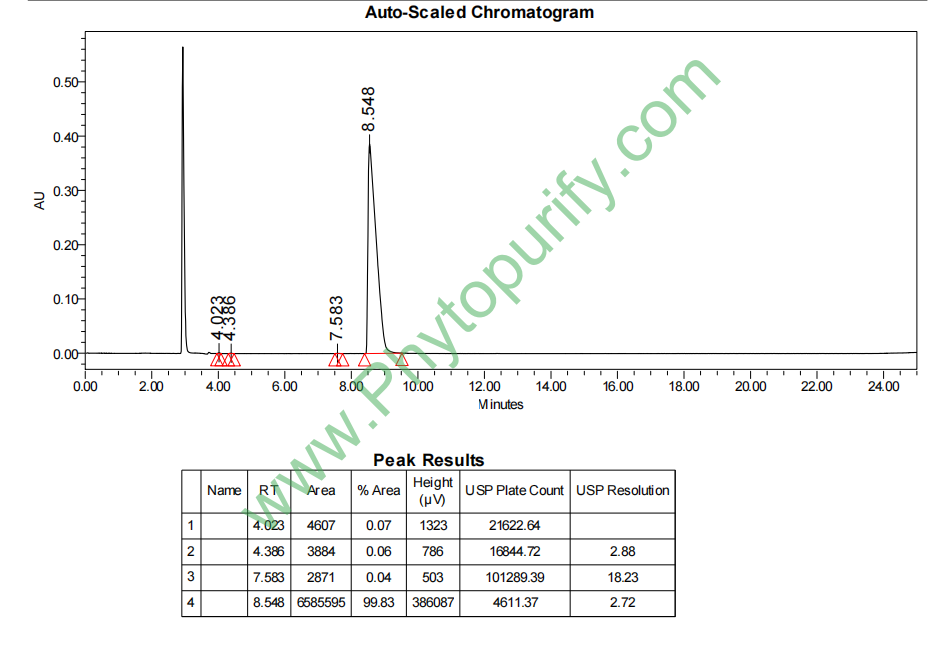
HPLC of Scopolamine butylbromide
Storage conditions:Short-term storage at 2~8℃, long-term storage at -20 ~ -80℃
59.0600
-.9314
-.9320
.8731
.6674
3.4164
Low
54.4767
5.1932
No
No
No
No
No
No
0.9
No
No
No
No
Scopolamine butylbromamide, CAS number 149-64-4, is a classic antispasmodic drug widely used in clinical practice. As a quaternary ammonium derivative of scopolamine, it selectively acts on peripheral smooth muscles by antagonizing muscarinic acetylcholine receptors (mAChR), effectively relieving spastic pain in various internal organs such as the gastrointestinal tract, biliary tract, and urogenital tract. Since its clinical application in the mid-20th century, this drug has become an important choice for the treatment of functional gastrointestinal diseases (such as irritable bowel syndrome), acute gastrointestinal spasms, and preoperative inhibition of glandular secretion due to its clear efficacy and relatively controllable side effects. Unlike scopolamine, which can penetrate the blood-brain barrier, its quaternary ammonium salt structure endows it with significant peripheral selectivity, thereby avoiding adverse reactions in the central nervous system such as drowsiness and hallucinations, greatly improving its clinical safety and tolerability. This article aims to systematically review the chemical properties, plant sources, pharmacological activities, molecular mechanisms of action, pharmacological characteristics, and clinical applications of scopolamine hydrobromide, and to provide prospects for its future research and development directions.
The chemical name of scopolamine butyrobromide is (1R, 2R, 4S, 5S, 7s) -9-butyl-7- (3-hydroxy-1-oxo-2-phenylpropoxy) -9-methyl-3-oxa-9-azacyclo [3.3.1.0 ², ⁴] nonane-9-ium bromide. Its molecular formula is C ₂₁ H ∝₀ BrNO ₄, and its molecular weight is 360.4740.
Structurally, the compound has scopolamine (a tropane alkaloid) as its parent nucleus, with a butyl group (- C ₄ H ₉) attached to its tertiary amine nitrogen atom, forming a quaternary ammonium salt and a bromide ion (Br ⁻) salt. This structural modification is the key to its pharmacological properties:
1. Characteristics of quaternary ammonium salts The positively charged quaternary ammonium nitrogen atom significantly enhances its polarity, making it difficult to penetrate the blood-brain barrier composed of lipid bilayers, thus limiting its pharmacological effects mainly to the peripheral nervous system.
2. Ester bond structure The ester bond (connecting the tryptophan moiety) in the molecule is a site that is easily hydrolyzed by esterases, affecting its metabolism and duration in vivo.
3. Chiral center There are multiple chiral centers in the molecule, and their absolute configurations (1R, 2R, 4S, 5S, 7s) are crucial for their affinity with muscarinic receptors.
The key physicochemical property parameters are as follows:
* Lipid water partition coefficient (LogP)-0.9314 indicates that the compound has strong hydrophilicity, which is consistent with its quaternary ammonium salt structure.
* Topological Polarity Surface Area (TPSA)59.0600 Å ² reflects the contribution of polar atoms and functional groups in the molecule, further explaining its hydrophilic properties.
* Water solubility:0.8731 mg/mL, It has good water solubility and is easy to make into injections or oral solutions.
* Blood-brain barrier permeability The prediction is' low ', which is consistent with the chemical properties of its quaternary ammonium salt and is the structural basis for its peripheral selectivity.
* HERG inhibition Predicted as' no ', indicating a low likelihood of causing prolonged QT interval in the heart (potential risk of arrhythmia).
* Ames test When the value is 0.9, it is generally considered to be less than 1.5 and not dose-dependent, indicating a low risk of mutagenicity, but it needs to be evaluated in conjunction with complete toxicological data.
These physicochemical properties collectively determine the pharmacokinetic behavior of scopolamine succinate, such as its small distribution volume, mainly distributed in extracellular fluid, and difficult to enter the central nervous system.
Scopolamine butyl bromide is not directly derived from plants, but is a semi synthetic derivative. Its active parent nucleus, Scopolamine (also known as scopolamine), is mainly extracted from various plants in the Solanaceae family.
1. Plant source:
The traditional plant sources of scopolamine include:
* Hyoscyamus niger Also known as the Heavenly Fairy, it is an important source plant in history.
* Datura stramonium The whole plant is toxic and contains various tropane alkaloids.
* Datura metel One of the main components of the traditional Chinese anesthesia formula "Ma Fei San".
* Anisodus tanguticus Chinese specialty plants are important resources for extracting hyoscyamine and scopolamine.
The alkaloids in these plants usually exist in the form of left-handed forms and combine with organic acids (such as tryptophan) to form esters.
2. Extraction and semi synthesis:
The industrial production of scopolamine hydrobromide usually follows the following steps:
* Plant raw material extraction Crush dry plant roots, stems, leaves, or seeds and extract them with dilute acid (such as sulfuric acid or hydrochloric acid) to convert alkaloids into water-soluble salts.
* Separation and purification of alkaloids Alkalize the acidic water extract to free alkaloids, and then extract with organic solvents such as chloroform and dichloromethane. By repeated acid-base treatment, chromatographic separation (such as column chromatography), or crystallization techniques, high-purity scopolamine free base or its salt (such as hydrobromide) can be isolated from mixed alkaloids.
* Quaternary ammonium reaction (semi synthetic)React purified scopolamine with bromobutane (or other butylating reagents) in a suitable solvent (such as acetone, ethanol). The tertiary amine nitrogen atom in the molecule of scopolamine nucleophilically attacks the carbon atom of bromobutane, undergoes alkylation reaction, generates the quaternary ammonium cation of butylscopolamine, and combines with the bromide ion to form the final scopolamine salt.
* Refined and finished products The reaction product undergoes refining steps such as recrystallization, filtration, and drying to obtain white or off white crystalline powder that meets pharmaceutical standards.
Modern production also explores the use of plant cell culture, microbial fermentation, or synthetic biology methods to produce scopolamine precursors, in order to break free from dependence on plant resources and achieve sustainable and controllable production.
The core pharmacological activity of scopolamine succinate is Spasmodic effect Relaxing the smooth muscles of the internal organs. Numerous in vitro and in vivo studies have confirmed its inhibitory effect on smooth muscle spasms in various organ systems.
1. Gastrointestinal antispasmodic effect:
This is its main clinical application foundation. It can significantly inhibit the contraction of isolated intestinal tubes (such as guinea pig ileum and rat jejunum) caused by agonists such as acetylcholine, barium chloride, histamine, etc. In the overall animal model, it can effectively alleviate intestinal spasms and peristalsis caused by neostigmine, serotonin, or physical stimulation, and reduce intestinal pressure. Its antispasmodic effect is stronger than atropine, and its impact on normal physiological peristalsis is relatively small.
2. Spasmodic effect on the urinary and reproductive system:
This medicine can relax the bladder detrusor muscle and ureteral smooth muscle, and can be used to alleviate spasmodic pain caused by bladder overactivity or stones. For uterine smooth muscle, it can also inhibit its spasmodic contractions and is used to treat dysmenorrhea.
3. Inhibition of glandular secretion:
As an anticholinergic drug, it can competitively antagonize the partial secretion function of acetylcholine on salivary glands, sweat glands, bronchial glands, and gastric wall cells. This characteristic allows it to be used in pre anesthesia administration to reduce respiratory secretions and prevent aspiration.
4. Other potential activities:
Recent studies suggest that muscarine receptors may play a role in tumor cell proliferation and migration. There have been sporadic clinical observations and basic studies exploring the potential value of scopolamine succinate in inhibiting the progression of certain cancers (such as colorectal cancer) or alleviating cancer pain, but there is still a lack of large-scale, high-quality evidence-based medicine evidence, and its mechanism and efficacy need to be further explored.
It should be emphasized that due to its quaternary ammonium salt structure, almost all of the pharmacological activities mentioned above occur in the periphery. Its antagonistic effect on central mAChR is minimal, therefore it does not possess the sedative, amnestic, or hallucinogenic central effects that scopolamine or atropine may produce.
The mechanism of action of scopolamine succinate is clear, that is, as a competitive antagonist, it acts on Muscarinic acetylcholine receptor (mAChR)。
1. Target Overview:
MAChR belongs to the G protein coupled receptor (GPCR) superfamily and is one of the main receptors for the endogenous neurotransmitter acetylcholine (ACh). It is distributed in tissues such as the central and peripheral nervous systems, smooth muscles, glands, and heart. Currently, 5 subtypes (M1-M5) have been cloned. Scopolamine hydrobromide exhibits antagonistic activity against all these subtypes, with a reported IC50 of approximately 55.3 nM, indicating its potent and broad-spectrum mAChR antagonistic ability.
2. Effects and effects on different subtypes:
* M2 receptor (CHRM2)Mainly distributed in the heart (sinoatrial node, atrium) and smooth muscle. In the heart, excitement causes a decrease in heart rate (negative chronotropic effect). Scopolamine succinate antagonizes M2 receptors, which may lead to a mild increase in heart rate (peripheral anti vagal effect), but due to its difficulty in entering deep cardiac tissue, this effect is usually weaker than atropine. In smooth muscle, M2 receptors inhibit adenylate cyclase through Gi/o protein and may directly regulate ion channels through G β - γ subunits, participating in the regulation of smooth muscle contraction.
* M3 receptor (CHRM3)This is the most critical subtype that mediates peripheral spasmolytic and glandular inhibitory effects. Smooth muscles widely present in the gastrointestinal tract, bladder, bronchi, uterus, as well as exocrine glands such as salivary glands, sweat glands, and gastric wall cells. The M3 receptor activates phospholipase C (PLC) through Gq/11 protein, producing inositol triphosphate (IP3) and diacylglycerol (DAG), leading to the release of intracellular calcium ions ([Ca ² ⁺] i) and smooth muscle contraction. Scopolamine succinate blocks the binding of ACh to M3 receptors, thereby inhibiting this signaling pathway, relaxing smooth muscles, and reducing glandular secretion.
* M1, M4, M5 receptors M1, M4, and M5 receptors are abundantly expressed in the central nervous system and are involved in cognition, memory, motor control, and more. Due to poor blood-brain barrier permeability, scopolamine succinate does not significantly affect these central subtypes at therapeutic doses. In peripheral tissues, M1 receptors are present in the autonomic ganglia and certain glands, while the distribution of M4 and M5 is relatively limited.
3. Molecular mode of action:
The molecular structure of scopolamine hydrobromide is partially similar to that of ACh (both containing positively charged nitrogen atoms and ester bond regions), allowing it to enter the ACh binding pocket of mAChR. After binding to the receptor, it does not activate downstream G protein signal transduction, but instead blocks the binding of endogenous ACh through steric hindrance, thereby exerting competitive inhibitory effects. The butyl chain and supporting ring system in its molecule may enhance hydrophobic interactions with the transmembrane region of the receptor, increasing affinity.
Based on its chemical structure and physicochemical properties, scopolamine succinate exhibits typical pharmacokinetic characteristics of quaternary ammonium anticholinergic drugs.
1. Absorption:
After oral administration, due to its high polarity and poor lipid solubility, its absorption in the gastrointestinal tract is incomplete and irregular, resulting in low bioavailability (usually<10%). Mainly absorbed slowly through passive diffusion in the upper small intestine. Muscle or intravenous injection can avoid first pass effects and quickly reach effective blood drug concentrations.
2. Distribution:
After drug absorption or injection into the bloodstream, due to its quaternary ammonium salt properties, it is mainly distributed in the extracellular fluid and difficult to penetrate the cell membrane and lipid barrier. Manifested as a small cloth volume. Most importantly, its extremely low blood-brain barrier permeability ensures its central safety. It can also pass less through the placental barrier and can be secreted in small amounts with breast milk.
3. Metabolism:
The metabolism of scopolamine succinate in the body is relatively simple. Its main metabolic pathway is the hydrolysis of ester bonds, which are broken down into scopolamine (or further hydrolyzed into hyoscyamine and tropic acid) and butyl moiety under the action of liver and non-specific esterase. Scopolamine still has activity, but theoretically it may pose risks due to its ability to enter the central nervous system, although its concentration in circulation is usually very low. The prototype drug and its metabolites are mainly excreted through the kidneys.
4. Excretion:
Renal excretion is its main elimination pathway. After intravenous injection, a considerable proportion of the prototype drug is excreted through urine within 24 hours. Unabsorbed drugs taken orally are directly excreted through feces. The elimination half-life is relatively short, about several hours, and requires multiple daily doses to maintain efficacy.
5. Comprehensive evaluation of drug properties:
* Advantage The mechanism of action is clear, the effect is fast (especially for injections), the peripheral selectivity is high (good safety), the treatment window is relatively wide, there is no serious cardiac toxicity (low hERG risk), and the risk of mutagenicity is low (Ames test negative).
* disadvantage The low oral bioavailability limits the stability and predictability of the efficacy of its oral formulations; The duration of action is relatively short; It has typical anticholinergic peripheral side effects, such as dry mouth, blurred vision, constipation, difficulty urinating, tachycardia, etc., especially when the dosage is too high or used in sensitive populations (such as the elderly, prostate hyperplasia patients, glaucoma patients), caution should be exercised.
As an old drug, the core clinical application of scopolamine succinate is already very mature, but there is still room for development in dosage form optimization, exploration of new indications, and combination therapy.
1. Deepening of existing clinical applications:
* Functional gastrointestinal diseases In the treatment of irritable bowel syndrome (IBS, especially subtypes with abdominal pain and spasms as the main symptoms) and functional dyspepsia, it remains a first-line or second-line option for rapid symptom relief. Future research could focus on precise patient stratification (such as based on biomarkers or clinical phenotypes) to determine the population most likely to benefit.
* Acute spastic pain When dealing with renal colic, biliary colic, and acute gastroenteritis spasm pain in the emergency department, its injectable form can quickly take effect. Exploring its combination with low-dose analgesics (such as nonsteroidal anti-inflammatory drugs) may achieve synergistic effects, reduce individual dosages and side effects.
* Preparation before Endoscopic/Imaging Examination By utilizing its ability to inhibit gastrointestinal peristalsis, it can be used before colonoscopy, CT colon imaging and other examinations to reduce intestinal peristalsis artifacts, improve image quality and examination success rate.
2. Application of new dosage forms and technologies:
To improve the efficiency of oral administration and patient compliance, the new drug delivery system is worth exploring:
* Oral sustained-release preparations Develop sustained-release tablets or capsules to extend the duration of drug action, achieve once daily administration, and smoothly control symptoms.
* Mucosal drug delivery system Oral instant films and cheek mucosal patches can partially avoid first pass effects, improve bioavailability, and achieve rapid onset of action.
* Targeted delivery system In theory, a colon targeted delivery system can be designed to release drugs locally in the colon for the treatment of IBS, mainly characterized by left lower abdominal pain and abnormal bowel movements, while minimizing systemic exposure and side effects.
3. Exploration of new indications:
* Cancer pain and treatment assistance As mentioned earlier, preliminary studies suggest that it may alleviate visceral cancer pain. In addition, there is a hypothesis that it may inhibit the growth of certain cholinergic signaling pathway dependent tumors by blocking mAChR. This requires rigorous preclinical mechanism research and subsequent clinical trial validation.
* Chronic pelvic pain syndrome For non infectious chronic pelvic pain associated with smooth muscle spasm, its therapeutic potential can be explored.
* Other smooth muscle dysfunction diseases Adjuvant treatment for conditions such as achalasia of the cardia and dysfunction of the Oddi sphincter.
4. Safety reassessment and personalized medication:
In the context of an aging society, special attention should be paid to the safety of this drug in elderly patients. Systematically study its interactions with commonly used medications in the elderly, such as other anticholinergic drugs, antipsychotics, and antidepressants, as well as its potential long-term effects on cognitive function (although the risk is low, it is not zero). Pharmacogenomics research may help identify populations that are particularly sensitive to drug efficacy or side effects.
Scopolamine butyl bromide is a classic peripheral anticholinergic antispasmodic drug that has been tested over time. It effectively alleviates visceral smooth muscle spasms by antagonizing muscarinic receptors (especially M3 subtype) in peripheral tissues, and plays an irreplaceable role in functional gastrointestinal diseases, acute abdominal pain, and preoperative preparation. The peripheral selectivity conferred by its quaternary ammonium salt structure is its core advantage over similar drugs such as atropine and scopolamine, laying a solid foundation for its safety. Despite pharmacokinetic shortcomings such as poor oral absorption and limited duration of action, as well as classic anticholinergic side effects, its clear efficacy and controllable risks have always placed it in the clinical treasure trove. Looking ahead to the future, through the development of new drug delivery technologies, optimization of applicable populations based on precision medicine, and rigorous exploration of potential new indications, this old drug is expected to regain new vitality and continue to contribute to relieving patients' pain. Meanwhile, continuous attention to its long-term safety in special populations is the key to ensuring its rational use of drugs.
