


Synonym name: Hyosol; Scopamin; Scopos; Tranaxine
Catalogue No.: BP1274
Cas No.: 114-49-8
Formula: C17H22BrNO4
Mol Weight: 384.27
Botanical Source:
Purity: 95%~99%
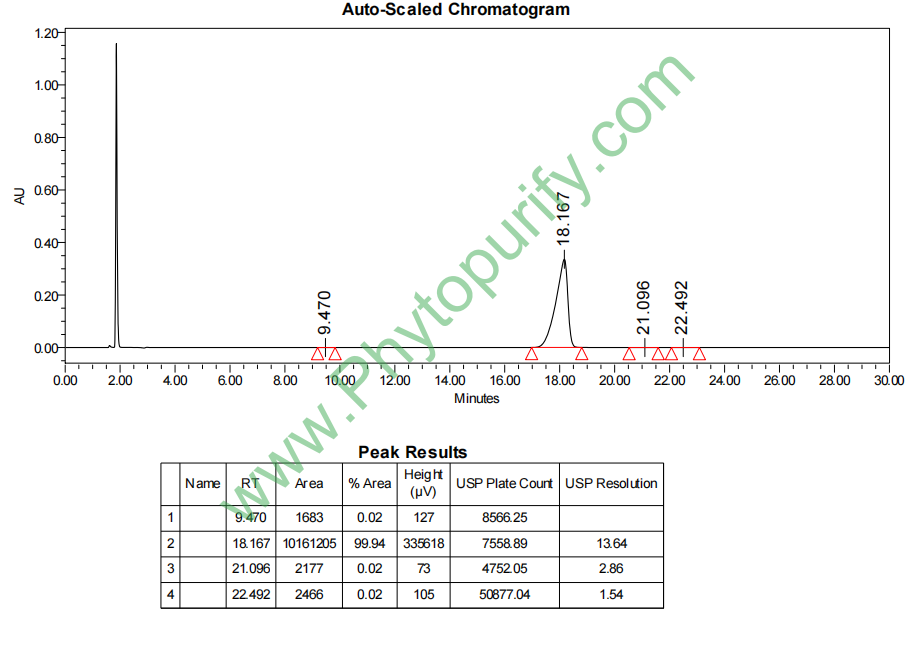
Analysis Method: HPLC-DAD or/and HPLC-ELSD
Identification Method: Mass, NMR
Packing: Brown vial or HDPE plastic bottle
Can be supplied from milligrams to grams.
For Reference Standard and R&D, Not for Human Use Directly.
Inquire for bulk scale.
HPLC of Scopolamine hydrobromide
Storage conditions:Short-term storage at 2~8℃, long-term storage at -20 ~ -80℃
62.3000
1.1999
1.0625
3.2694
1.7713
11.2695
High
55.1165
4.8322
No
No
No
No
No
No
1.5
No
No
No
No
Scopolamine hydrobromide, also known as 6 β, 7 β - epoxy-1 α H, 5 α H-tropan-3 α - ol (-) tropane ester hydrobromide trihydrate, CAS number 114-49-8, is the hydrobromide form of the classic tropane alkaloid scopolamine. As a high affinity, non selective muscarinic acetylcholine receptor antagonist, its most notable feature is its ability to efficiently penetrate the blood-brain barrier and directly act on the central nervous system. Since its isolation and identification from Solanaceae plants in the late 19th century, this compound has attracted much attention for its powerful peripheral anticholinergic effects (such as spasmolysis and inhibition of glandular secretion) and unique central nervous system effects. In clinical practice, its injections and transdermal patches have been widely used for the prevention and treatment of postoperative nausea, vomiting, motion sickness, and in some cases, intestinal spasms. However, its side effects of inducing memory impairment and delirium also make it a classic pharmacological tool for studying the relationship between the cholinergic system and neurological and psychiatric disorders such as learning and memory, Alzheimer's disease, etc. In recent years, with the deepening of research on its molecular target interactions, signaling pathway regulation, and potential new indications such as depression and drug addiction, scopolamine hydrobromide has continued to gain new vitality in the fields of neuroscience and pharmacology. This article aims to systematically review the chemical properties, plant sources, pharmacological activities, mechanisms of action, medicinal properties, and clinical applications of scopolamine hydrobromide, in order to provide comprehensive references for related research and development.
The molecular formula of scopolamine hydrobromide is C17H21NO4 · HBr · 3H2O, with a molecular weight of 303.3580 (calculated as anhydrous free base). Its chemical structure is based on the tropane (hyoscyamine) core, which is composed of a trophinol (hyoscyamine) moiety and a trophinic acid (hyoscyamine) moiety connected by ester bonds. The key structural difference between scopolamine and atropine (racemic hyoscyamine) is the presence of a β - oriented epoxy bridge (oxycyclopropane structure) between the 6th and 7th carbon atoms in the trophinol portion of scopolamine, which significantly alters its spatial conformation and pharmacological properties.
The epoxy bridge structure is the structural basis for the relatively lower lipid solubility of scopolamine compared to atropine, but with stronger central permeability. Its stereochemistry is in the L-configuration (left-handed), with much higher activity than its right-handed isomer. After salt formation with hydrobromic acid, its water solubility is significantly improved, making it easier to make formulations such as injections. The key parameters related to drug properties show that its lipid water partition coefficient (LogP) is about 1.20, indicating moderate lipophilicity; The topological polar surface area (TPSA) is 62.30 Å ², which is relatively small and consistent with its ability to penetrate the blood-brain barrier; The predicted water solubility is 3.27 mg/mL, which belongs to the solubility range. These physical and chemical properties collectively determine its excellent membrane permeability and central distribution characteristics. In addition, an Ames test result of 1.5 (usually considered negative if the ratio is less than 2) suggests a low risk of mutagenicity, while a negative hERG inhibition indicates a low risk of causing QT interval prolongation in the heart, providing some support for its clinical safety.
Scopolamine and its salts mainly come from various plants in the Solanaceae family, especially the genus Scopola(Hyoscyamus)Mandala genus(Datura)And the belladonna genus(Atropa)The species. For example, goldenrod(Datura metel L.)、 Scopola(Hyoscyamus niger L.)、 Mandala(Datura stramonium L. And belladonna(Atropa belladonna L. These are traditional medicinal resource plants, among which scopolamine often coexists with other tropane alkaloids such as atropine.
Traditional extraction methods are mostly based on the generality of alkaloids. The general process is to crush dry plant materials (such as seeds, leaves, and roots), soak or percolate them in dilute acid (such as hydrochloric acid, sulfuric acid) solution, and dissolve alkaloids in salt form. The acidic water extract is alkalized (usually using ammonia or lime water) to make the alkaloids free and precipitate, and then extracted with organic solvents (such as chloroform, dichloromethane). After concentrating the organic phase, crude total alkaloids were obtained. Due to the similar physicochemical properties between scopolamine and structurally similar compounds such as atropine, separation and purification are key challenges. Classic methods include pH gradient extraction, repeated recrystallization, or chromatographic separation (such as alumina column chromatography). Modern technology often uses techniques such as high-performance liquid chromatography (HPLC) or high-speed countercurrent chromatography (HSCCC) for high-purity preparation. After separating scopolamine from the total base, it can be reacted with hydrobromic acid to form a salt, further purified and crystallized to obtain the pure product of scopolamine hydrobromide. In recent years, plant tissue culture and synthetic biology methods have also been explored for the production of scopolamine, in order to achieve resource sustainability and process controllability.
The pharmacological activity of scopolamine hydrobromide is extensive and complex, mainly due to its antagonistic effect on the cholinergic system, especially the muscarinic receptors.
1. Central nervous system activity:
Its most notable activity is the damage to learning and memory. In various animal models such as Morris water maze and passive avoidance experiments, intraperitoneal or subcutaneous injection of scopolamine hydrobromide can dose dependently lead to spatial memory and working memory deficits, making it the "gold standard" tool for simulating cholinergic functional impairment (such as some symptoms of Alzheimer's disease). In addition, it also has significant sedative and hypnotic effects. At therapeutic doses, it can produce drowsiness, while at high doses, it may cause central excitatory symptoms such as restlessness, hallucinations, delirium, etc. (contradictory reactions). In recent years, studies have also found that the dose of scopolamine used in flaxseed intoxication exhibits rapid antidepressant potential in clinical studies, and its mechanism may be related to the rapid regulation of the glutamatergic system and neuroplasticity.
2. Peripheral anticholinergic activity:
This is the core of its clinical application. It can strongly inhibit smooth muscle contraction and has a good antispasmodic effect on gastrointestinal, biliary, and urinary tract spasms. At the same time, it can inhibit the secretion of various exocrine glands such as salivary glands, sweat glands, and bronchial glands, so it can be used for pre anesthesia administration to reduce respiratory secretions. Its paralyzing effect on the ciliary muscle and pupillary sphincter muscle leads to pupil dilation and regulatory paralysis (photophobia, blurred near vision).
3. Anti vomiting and anti motion sickness activity:
This is one of its most important therapeutic applications. Its anti motion sickness effect is believed to be achieved through the inhibition of cholinergic transmission from the vestibular nucleus to the vomiting center, as well as possible inhibition of higher centers in the cerebral cortex. For postoperative nausea and vomiting, its mechanism of action involves central anticholinergic effects and competitive antagonism of 5-hydroxytryptamine 3 (5-HT3) receptors (research shows an IC50 of approximately 2.09 μ M), providing a new mechanistic perspective for its application in the prevention of chemotherapy-induced nausea and vomiting.
4. Other activities:
The study also suggests that scopolamine may have anti-inflammatory and anti shock effects (improving microcirculation), but its clinical significance remains to be further clarified.
The core mechanism of pharmacological action of scopolamine hydrobromide is to act as a competitive antagonist, blocking the binding of endogenous neurotransmitter acetylcholine to muscarinic acetylcholine receptor (mAChR).
1. Main targets: muscarinic receptors (M1-M5):
Scopolamine has high affinity for mAChR of all five subtypes (M1-M5) and is a non selective antagonist. These receptors belong to the G protein coupled receptor superfamily.
- M1, M3, M5 receptors Mainly through coupling with Gq/11 protein, phospholipase C (PLC) is activated to produce inositol triphosphate (IP3) and diacylglycerol (DAG), leading to intracellular calcium ion mobilization and protein kinase C (PKC) activation. Scopolamine antagonizes these receptors, mediating smooth muscle relaxation (such as gastrointestinal M3) and glandular secretion inhibition (such as salivary gland M3) in the periphery, and is closely related to cognitive impairment (such as cortical and hippocampal M1) and the development of psychiatric symptoms in the central nervous system.
- M2 and M4 receptors Mainly coupled with Gi/o protein, it inhibits adenylate cyclase (AC), reduces intracellular cyclic adenosine monophosphate (cAMP) levels, and regulates potassium and calcium ion channels. Antagonism of the M2 receptor in the sinoatrial node of the heart leads to increased heart rate (relieving vagal nerve suppression). The blockade of M2 and M4 receptors in the central nervous system may affect the negative feedback regulation of acetylcholine release and exacerbate dysfunction of the cholinergic system.
among which,Spasmodic effect Mainly antagonizes the abundant smooth muscles of organs such as the gastrointestinal tract and urinary tract M3 receptor Directly related, it also involves the antagonism of M2 receptors (M2 receptor activation usually promotes smooth muscle contraction through indirect pathways).
2. Secondary target: 5-HT3 receptor:
As mentioned earlier, scopolamine can competitively antagonize 5-HT3 receptors with micromolar potency. The 5-HT3 receptor is a ligand gated ion channel that is highly expressed in the peripheral vagus nerve endings and central posterior zone (vomiting chemosensory trigger zone). Antagonising this receptor can block the signal transduction of vomiting reflex caused by chemotherapy drugs, radiation, or gastrointestinal stimulation, which supplements the mechanism of its anti vomiting effect, especially providing another pathway beyond central anticholinergic action.
3. Central cognitive impairment mechanism:
The mechanism of inducing memory defects is complex, mainly attributed to the blockade of M1 receptors on key neurons (such as interneurons and pyramidal cells) in brain regions such as hippocampus and prefrontal cortex, which damages long-term potentiation (LTP), neuronal excitability, and synaptic plasticity closely related to learning and memory. Meanwhile, antagonism of M2 and M4 self receptors may disrupt the fine regulation of acetylcholine release, further disrupting the homeostasis of cholinergic neurotransmission.
From the perspective of medicinal properties, scopolamine hydrobromide is an "old medicine" with distinct characteristics. Its molecular weight is moderate, and the LogP value shows that it has good lipid solubility and permeability. The TPSA is small, and these characteristics are consistent with High blood-brain barrier permeability The highly consistent known facts enable it to quickly distribute and exert its effects in the central nervous system.
In terms of pharmacokinetics:
- absorb Oral absorption is rapid but incomplete, with significant first pass effects and low bioavailability (about 20-40%). Therefore, injection (subcutaneous, intramuscular, intravenous) or transdermal patch (transdermal absorption) administration is commonly used in clinical practice, the latter of which can provide stable and persistent blood drug concentrations, particularly suitable for the prevention of motion sickness.
- distribution After intravenous injection, it quickly distributes throughout the body and, due to its lipophilicity, can be widely distributed in various tissues, including the central nervous system. The plasma protein binding rate is not high.
- Metabolism Mainly metabolized in the liver, through the hydrolysis of ester bonds to generate tropinol and tropionic acid, the latter further participating in in in vivo metabolism. Topenol can undergo glucuronidation. Its metabolism involves esterase and non-specific enzyme systems.
- excretion Metabolites and small amounts of prototype drugs are mainly excreted through the kidneys and urine. The elimination half-life (t1/2) is about 2-4 hours, but the duration of pharmacological effects (especially central effects) may exceed the blood drug half-life.
Safety evaluation:
Its treatment window is relatively narrow. Common adverse reactions are related to peripheral anticholinergic effects, including dry mouth, blurred vision, constipation, difficulty urinating, tachycardia, etc.The most important thing to be wary of is the side effects on the central nervous system From drowsiness, dizziness, memory impairment to hallucinations, confusion, agitation, etc., especially in elderly patients, postoperative delirium is easily induced. Contraindications include glaucoma (especially angle closure type), urinary retention caused by prostatic hypertrophy, pyloric obstruction, myasthenia gravis, etc. Although the risk of hERG inhibition is low, severe toxic symptoms such as arrhythmia and high fever may still occur in excess due to extensive anticholinergic effects, which can be rescued by cholinergic drugs such as huperzine.
At present, the clinical application of scopolamine hydrobromide is very mature, mainly focusing on:
1. Prevention and treatment of motion sickness Transdermal patches are the preferred solution for long-term prevention.
2. Prevention and treatment of postoperative nausea and vomiting Often used as part of a multimodal antiemetic regimen.
3. spasmolysis Used for relieving smooth muscle spasms such as gastrointestinal, biliary, and renal colic.
4. Administer medication before anesthesia Reduce respiratory secretions and maintain airway patency.
5. Other Previously used for tremor paralysis, manic psychosis, etc., it has now been replaced by safer drugs.
Future research and development prospects may focus on the following directions:
1. New dosage forms and precision drug delivery systems:
Develop a new delivery system to improve its therapeutic index. For example, in order to prevent postoperative delirium, research is being conducted on whether peripheral selective effects can be achieved through nanocarriers or local administration (such as intraoperative incision infiltration), maximizing the relief of spasms and pain while minimizing central side effects. New routes such as nasal administration may also provide the possibility for rapid central action (such as antidepressant).
2. Exploration of new indications for neurological and psychiatric disorders:
- depression Based on preliminary clinical evidence of its rapid antidepressant potential, in-depth research on the efficacy, optimal dosage, and mechanism of action (involving rapid regulation of glutamatergic and monoaminergic systems) of single or short-term administration for refractory depression is a highly attractive direction.
- Drug addiction and withdrawal Preclinical studies have shown that scopolamine may affect neural circuits associated with addictive memory or be used to intervene in substance dependence and withdrawal symptoms.
- The instrumental value of cognitive impairment models As a tool for establishing cholinergic cognitive impairment models, it will continue to play an irreplaceable role in drug screening and mechanism research for neurodegenerative diseases such as Alzheimer's disease.
3. Deep exploration of the mechanism of action and optimization of target selectivity:
Although non selectivity is its characteristic, it also leads to a wide spectrum of side effects. In the future, through structural modification, the development of analogs with higher selectivity for specific mAChR subtypes (such as M3 receptor antagonists that retain peripheral antispasmodic effects but reduce their ability to penetrate the blood-brain barrier or act on M2 receptors in the heart) or 5-HT3 receptors is expected to yield new compounds with fewer side effects and stronger specificity.
4. Combination therapy strategy:
In the fields of antiemetic and anesthesia, we will conduct in-depth research on its synergistic effects with 5-HT3 receptor antagonists (such as ondansetron), NK1 receptor antagonists, dexamethasone, and other drugs, optimize the combination therapy regimen to improve efficacy and reduce individual doses and side effects.
As a classic natural product drug with over a hundred years of application history, hyoscyamine hydrobromide has already surpassed the scope of simple spasmolysis and antiemetic drugs in terms of value. It is like a precise 'molecular surgical knife', with its efficient and non selective antagonistic effect on the cholinergic system, not only providing effective treatment for various clinical diseases, but also playing an indispensable role in basic neuroscience research - from revealing the cholinergic mechanism of learning and memory, to simulating cognitive deficits in neurodegenerative diseases, and exploring new paths for rapid antidepressant treatment. Its high blood-brain barrier penetration ability is a double-edged sword of its pharmacological effects, bringing both strong central effects and unique therapeutic potential, as well as significant neurological and psychiatric side effects that cannot be ignored. In the future, with a more refined analysis of its molecular mechanism, the development of novel drug delivery systems, and subtype selective drug design, scopolamine hydrobromide and its derivatives are expected to continue serving clinical treatment on a safer and more effective level, and deepen human understanding of complex brain functions and diseases. This compound, which emerged from ancient plants, still contains rich scientific connotations and potential for transformation, and is worthy of continuous attention and exploration.
