


Synonym name:
Catalogue No.: BP0404
Cas No.: 25127-29-1
Formula: C20H21NO4
Mol Weight: 339.391
Botanical Source: Alkaloid from Stephania capitata, Stephania sasakii and Stephania venosa (Menispermaceae)
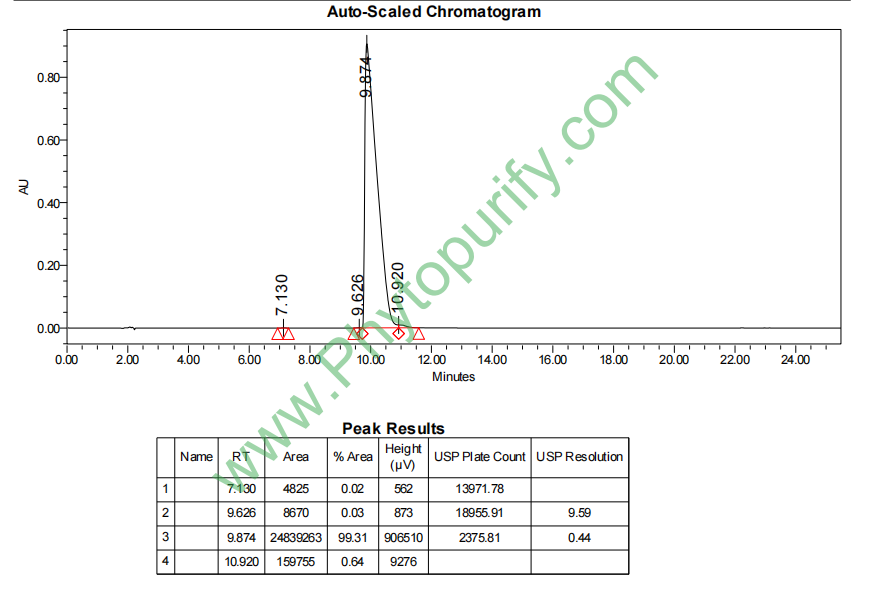
Purity: 95%~99%
Analysis Method: HPLC-DAD or/and HPLC-ELSD
Identification Method: Mass, NMR
Packing: Brown vial or HDPE plastic bottle
Can be supplied from milligrams to grams.
For Reference Standard and R&D, Not for Human Use Directly.
Inquire for bulk scale.
HPLC of Crebanine
Storage conditions:Short-term storage at 2~8℃, long-term storage at -20 ~ -80℃
Crebanine, CAS number 25127-29-1, is an isoquinoline alkaloid derived from plants of the Stephania genus. As an important member of natural products, Kebanning has received widespread attention in the field of pharmacology due to its multi-target and multi pathway biological activities. In recent years, Kebanning has shown significant pharmacological potential in anti-tumor, neuroprotective, anti-inflammatory, and antibacterial aspects, especially in the research of hepatocellular carcinoma (HCC) and cerebral ischemia related diseases. Its characteristics as an antagonist of the α 7-nicotinic acetylcholine receptor (α 7-nAChR) provide a theoretical basis for further understanding its mechanism of action and developing new therapeutic drugs.
This article will provide a systematic review of the chemical structure and physicochemical properties, plant sources, and extraction methods of Kebanning. The focus will be on its pharmacological activity and mechanism of action, and a comprehensive evaluation will be conducted based on its pharmacological parameters. Finally, the clinical application prospects will be discussed, aiming to provide reference for natural product pharmacology and new drug development.
Kebanning belongs to the isoquinoline alkaloid class, with a molecular formula of C2H23NO4 and a molecular weight of 339.39. Its structure contains a typical isoquinoline skeleton with multiple oxygen functional groups and nitrogen atoms, providing a chemical basis for its interactions with various biological targets. The LogP value of Kebanning is about 3.0, indicating its moderate lipid solubility, which is beneficial for penetrating cell membranes and the blood-brain barrier (BBB), which is particularly important in its neuroprotective effect. Its topological polar surface area (TPSA) is 55.82 Å ² and the number of hydrogen bond acceptors is 5, both of which are within the ideal range for drug molecules to penetrate the cell membrane.
From the perspective of physical and chemical properties, the structure of Kebanning is stable, with a certain balance of water solubility and lipid solubility, making it suitable for oral and injection administration routes. Its blood-brain barrier penetration ability is high, supporting its potential application in central nervous system diseases. At present, safety indicators such as liver toxicity, cardiac toxicity, and hERG channel inhibition are not yet clear, and further systematic research is needed.
Kebanning is mainly isolated from plants of the Stephania genus. Stephania plants are widely distributed in tropical and subtropical regions of Asia and have been traditionally used in traditional medicine to treat diseases such as inflammation, pain, and tumors. Kebanning, as one of the main alkaloids in this genus of plants, its content and distribution are significantly affected by plant species, growth environment, and harvesting period.
The extraction method usually uses organic solvent extraction combined with column chromatography separation technology. The general steps include: crushing the dried Stephania plant material, reflux extraction with methanol or ethanol, concentrating the extract, and enriching alkaloids through acid-base adjustment. Subsequently, separation and purification were carried out using silica gel columns or C18 reverse phase columns, and the purity was monitored by high-performance liquid chromatography (HPLC). In recent years, the application of ultrasound assisted extraction and supercritical fluid extraction technology has improved the extraction efficiency and purity of kepanin, laying the foundation for its large-scale preparation.
Kebanning exhibits significant anti proliferative, anti migratory, and invasive abilities in various cancer cell models. Its inhibitory effect on hepatocellular carcinoma (HCC) cell lines is particularly prominent, as it can induce cell apoptosis and block cell cycle progression. Mechanism studies have shown that Kebannin triggers an explosion of reactive oxygen species (ROS), disrupts intracellular redox balance, and promotes the activation of apoptosis related signaling pathways.
In addition, Kebanning has regulatory effect on breast cancer related targets such as AMPK, BCL2, STAT3, ESR2, ABCB1, ABCG2, PRKCA, MAPT, NFE2L2 and TOP1, showing its multi target action characteristics. By inhibiting the drug resistance mechanisms of tumor cells, such as ABCB1 and ABCG2 mediated drug efflux, Kebanning has the potential to serve as an adjuvant chemotherapy drug.
Kebanning, as an antagonist of α 7-nAChR (IC50 of 19.1 μ M), exhibits good neuroprotective effects in neurological diseases. It can alleviate the excessive activation of NOX2 in microglia, reduce ROS and peroxidation reactions, and exhibit significant antioxidant properties. Animal model studies have shown that Kebanning can effectively improve cerebral ischemia-reperfusion injury in rats with middle cerebral artery occlusion and reperfusion (MCAO/R), and alleviate neuronal damage.
In addition, Kebanning significantly improved Scopolamine induced cognitive impairment in ICR mice, indicating its potential application value in Alzheimer's disease and other cognitive impairment diseases. This effect may be closely related to its regulation of NF - κ B, MAPK, and AKT/FoxO3a signaling pathways.
Kebanning exhibits high inhibitory activity against Gram positive animal pathogenic bacteria, demonstrating its potential as a natural antibacterial agent. Its mechanism of action has not been fully elucidated, and it is speculated that it may involve bacterial cell membrane disruption or inhibition of key enzyme activity. In the future, combined with structural optimization, it is expected to develop new antibacterial drugs.
Kebanning can inhibit the voltage dependent sodium current in guinea pig ventricular myocytes, indicating its regulatory effect on cardiac electrophysiology. This characteristic may provide new ideas for the treatment of diseases such as arrhythmia, but it also suggests that its cardiac safety needs further evaluation.
The multi-target mechanism of action of Kebanning mainly involves the following aspects:
Antagonistic effect of α 7-nAChR
Kebanning, as an antagonist of α 7-nAChR, can regulate neurotransmitter release and inflammatory response, reducing neurological damage. Alpha 7-nAChR plays a crucial role in cognitive function, inflammation regulation, and tumor microenvironment, and the antagonistic effect of Kebannin provides the basis for its neuroprotection and anti-tumor effects.
ROS mediated cell apoptosis
Kebanning induces reactive oxygen species burst, disrupts intracellular redox balance, activates mitochondrial pathways and apoptosis related protein expression, and promotes cancer cell apoptosis. The accumulation of ROS simultaneously inhibits the migration and invasion ability of tumor cells.
Signal pathway regulation
MAPK pathway By regulating MAPK members such as ERK, JNK, and p38, Kebannin regulates the balance between cell proliferation and apoptosis.
NOX2 inhibition and antioxidant activity
Kebanning exerts antioxidant and neuroprotective effects by inhibiting the excessive activation of NOX2 in microglia, reducing ROS generation.
Cardiac sodium current suppression
Kebanning inhibits voltage dependent sodium channels and affects the action potential of myocardial cells, suggesting its potential role in cardiac electrophysiological regulation.
Multi target anti-tumor mechanism
Kebanin regulates a variety of targets related to breast cancer, including drug efflux pumps ABCB1 and ABCG2, anti apoptotic protein BCL2, signal transduction factor STAT3, etc., and plays a comprehensive anti-tumor role.
The molecular weight (339.39) and LogP (3.0) of Kebanning comply with Lipinski's rules, indicating good oral bioavailability potential. Its TPSA is 55.82 Å ² and the number of hydrogen bond receptors is 5, both of which are conducive to cell membrane penetration and blood-brain barrier passage, supporting its application in central nervous system diseases.
At present, there is a lack of safety data on the hepatotoxicity, cardiotoxicity, and hERG channel inhibition of ketoconazole, and a systematic toxicological evaluation is needed. The high penetration ability of the blood-brain barrier suggests that it may lead to central nervous system side effects, and close attention should be paid to dosage and safety window.
Pharmacokinetic research is still in its infancy, and in the future, it is necessary to clarify its absorption, distribution, metabolism, and excretion (ADME) characteristics, especially the interactions of metabolic enzymes and in vivo half lives, in order to provide a basis for clinical dosage form design.
With its multi target and multi-channel pharmacological activities, kebanin has shown broad application prospects in the fields of hepatocellular carcinoma, breast cancer, cerebral ischemia and other major diseases. As an α 7-nAChR antagonist and ROS regulator, it provides new ideas for the treatment of neurodegenerative diseases and tumors. Combining its antibacterial and cardiac electrophysiological regulatory effects, Kebanning is expected to become a candidate molecule for the development of multifunctional drugs.
Future research should focus on:
Kebanning, as a natural isoquinoline alkaloid with rich pharmacological activity, has shown significant value in the fields of anti-tumor, neuroprotective, and antibacterial activities due to its multi-target regulatory ability. Its unique mechanism of action and good pharmacokinetic parameters provide a solid foundation for the development of new drugs. Although its safety and pharmacokinetic data are currently incomplete, with further research, Kebanning is expected to become an important breakthrough in the development of natural product drugs, bringing new hope for the treatment of related diseases. Future research needs to strengthen mechanism analysis, optimize structure and clinical translation, and promote the forefront of clinical application of ketoconazole.
