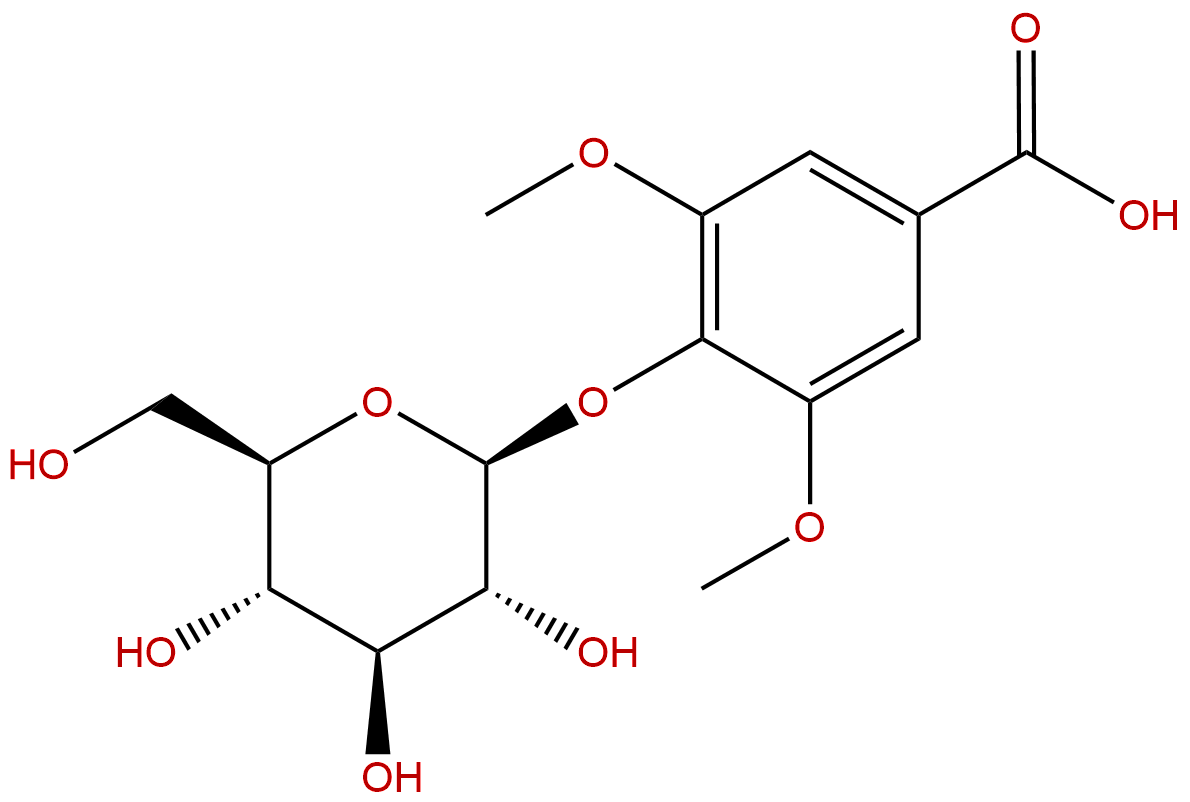
| Catalog No | Package | Original Price | Price | Inventory | Quantity | Operating |
|---|---|---|---|---|---|---|
| SBP01371-5mg | 5mg | $390.00 | Sign in |
|


Product name: Glucosyringic acid
Synonym name:
Catalogue No.: SBP01371
Cas No.: 33228-65-8
Formula: C15H20O10
Mol Weight: 360.315
Botanical Source:
Physical Description: Powder
Type of Compound: Phenols
Purity: 95%~99%
Analysis Method: HPLC-DAD or/and HPLC-ELSD
Identification Method: Mass, NMR
Packing: Brown vial or HDPE plastic bottle
The product could be supplied from milligrams to grams. Inquire for bulk scale.
We provide solution to improve the water-solubility of compounds, thereby facilitating the variety of activity tests and clinic uses.
For Reference Standard and R&D, Not for Human Use Directly.
Storage conditions:Short-term storage at 2~8℃, long-term storage at -20 ~ -80℃
155.1400
-.2946
-2.7292
32.7772
.5704
.1330
Low
53.8636
3.4710
Yes
No
No
No
No
No
0.0
Yes
No
Yes
Yes
Natural products, as an important source of drug discovery, play an irreplaceable role in the long history of human struggle against diseases. From the classic analgesic morphine and antimalarial artemisinin to the modern anti-tumor drug paclitaxel, plant secondary metabolites continue to provide valuable lead compounds for modern drug development due to their unique chemical diversity and biological activity. Among numerous natural phenolic acid compounds with pharmacological activity, syringic acid and its glycoside derivatives have attracted much attention due to their wide range of biological activities. Glucosyringic acid, as a natural product formed by the combination of syringic acid and glucose through glycosidic bonds, not only inherits the antioxidant and anti-inflammatory properties of the parent nucleus syringic acid, but also exhibits unique pharmacokinetic advantages and biological activity spectrum due to glycosylation modification.
Lilac acid glucoside, chemical name 4-hydroxy-3,5-dimethoxybenzoic acid - β - D-glucopyranoside, CAS number 33228-65-8, molecular formula C ₁₅ H ₂₀ O ₁₀. This compound was initially isolated and identified from the Saxifraga Montana H. plant, and subsequently found in various medicinal plants and daily dietary sources such as olives, grapes, certain berries, and grains. In recent years, with the deepening of research on natural anti-inflammatory drugs, syringic acid glucoside has gradually become a research hotspot in the field of natural product pharmacology due to its significant anti-inflammatory activity, clear molecular targets, and good safety. Especially in chronic inflammation related diseases such as neuroinflammation, metabolic inflammation, and autoimmune diseases, eugenol glucoside has shown potential therapeutic value. This article will provide a systematic review of the research progress of syringic acid glucoside from the aspects of chemical structure, plant origin, pharmacological activity, mechanism of action, medicinal evaluation, and clinical application prospects, in order to provide scientific basis for the in-depth development and utilization of this natural product.
Lilac acid glucoside belongs to the phenolic acid glycoside class, and its core structure consists of two parts: the glycoside part is syringic acid, and the sugar part is β - D-glucopyranose. Dingxiang acid itself is a 3,5-dimethoxy derivative of gallic acid (3,4,5-trihydroxybenzoic acid), with a carboxyl group (- COOH) and a phenolic hydroxyl group (- OH) attached to its benzene ring, as well as two methoxy groups (- OCH ∝). In syringic acid glucoside, glucose molecules are connected to the phenolic hydroxyl oxygen atom of syringic acid through β - glycosidic bonds, forming O - β - D-glucoside. This structural feature endows the compound with unique physicochemical properties.
In terms of molecular weight, syringic acid glucoside has a molecular weight of 360.3150 Da and belongs to the category of small molecule natural products. The lipid water partition coefficient (LogP) of the compound is -0.2946, indicating that it has good hydrophilicity, which is mainly attributed to the multiple hydroxyl groups carried by the glucose groups in the molecule. The polar surface area (TPSA) is as high as 155.1400 Å ², further confirming its strong polarity characteristics. The water solubility parameter is 32.7772 mg/mL, indicating good water solubility, which provides favorable conditions for its absorption and distribution in organisms. It is worth noting that the blood-brain barrier (BBB) permeability of this compound has been evaluated as low, which is consistent with its high polarity and low fat solubility characteristics, suggesting that it may require special delivery strategies in the treatment of central nervous system diseases. In addition, the hERG inhibition prediction was negative, and the Ames test result was 0.0, indicating that it has no significant risk of cardiac toxicity and genetic toxicity, and has good safety.
In terms of spectral characteristics, the UV absorption of syringic acid glucoside mainly comes from the benzene ring structure, usually with characteristic absorption peaks in the range of 220-280 nm. In the infrared spectrum, characteristic absorption of hydroxyl groups (~3400 cm ⁻¹), carbonyl groups (~1700 cm ⁻¹), and glycosidic bonds (~1100 cm ⁻¹) can be observed. In nuclear magnetic resonance hydrogen and carbon spectra, the terminal proton signal of the sugar moiety (δ H 4.5-5.5 ppm, J value about 7-8 Hz) is the key evidence for confirming the β - configuration glycosidic bond. These structural features not only provide a basis for the identification of compounds, but also lay the foundation for their subsequent structural modification and structure-activity relationship research.
Lilac acid glucoside is widely distributed in nature, but was initially isolated from the Saxifraga Montana H. plant in the family Saxifragaceae. Traditionally, plants of the Tiger Ear Grass genus have been used to treat inflammatory diseases such as skin inflammation and respiratory infections, providing ethnic pharmacological clues for searching for active ingredients from this genus of plants. In addition to Saxifraga Montana, this compound has also been found in various other plants, such as the fruit and leaves of olives (Olea europaea), the skin and seeds of grapes (Vitis vinifera), certain berries (such as blueberries and cranberries), and grains (such as oats and wheat). In addition, the presence of syringic acid glucoside has also been detected in metabolite analysis of some traditional medicinal plants such as Salvia miltiorrhiza and Scutellaria baicalensis. This widespread distribution suggests that it may have important physiological functions in the plant kingdom, such as participating in plant defense, antioxidant stress, etc.
Extracting syringic acid glucoside from plant materials usually follows the classic process of natural product chemistry. Due to its good water solubility and moderate polarity, commonly used extraction solvents include methanol, ethanol, water, or their mixed solvents. Specifically, using a certain concentration of ethanol water solution (such as 70% ethanol) for cold soaking or hot reflux extraction can effectively extract phenolic glycosides, including syringic acid glucoside. After vacuum concentration of the extraction solution, preliminary separation is carried out through liquid-liquid extraction (such as using petroleum ether, ethyl acetate, n-butanol in sequence), and syringic acid glucoside is usually enriched in the n-butanol phase.
Further purification mainly relies on various chromatographic techniques. Silica gel column chromatography is one of the most commonly used separation methods, which uses solvent systems such as chloroform methanol water or ethyl acetate methanol water for gradient elution to achieve preliminary separation. Due to the presence of phenolic hydroxyl and sugar groups in syringic acid glucoside, its interaction with the stationary phase is complex, and therefore it often requires the combination of other chromatographic techniques. Macroporous adsorption resin (such as D101, AB-8) chromatography can be used for de sugar and preliminary enrichment of crude extracts. High performance liquid chromatography (HPLC), especially preparative HPLC, uses a reverse phase C18 column and acetonitrile water or methanol water (often with a small amount of formic acid or acetic acid added) as the mobile phase to obtain high-purity monomer compounds. In addition, high-speed countercurrent chromatography (HSCCC), as a liquid-liquid distribution chromatography technique, has been successfully applied in the separation and purification of syringic acid glucoside in recent years due to its advantages of irreversible adsorption and high sample recovery rate.
In terms of structural identification, in addition to classical spectroscopic methods (UV, IR, NMR, MS), determining the type and configuration of sugar groups through acid hydrolysis or enzyme hydrolysis, as well as confirming the connection position of glycosidic bonds through two-dimensional nuclear magnetic resonance techniques (such as HMBC, HSQC), are necessary steps to confirm the structure of the compound.
The pharmacological activity research of syringic acid glucoside mainly focuses on the anti-inflammatory field, but in recent years, its antioxidant, neuroprotective, and metabolic regulatory effects have gradually been revealed.
anti-inflammatory activity This is the pharmacological activity of the compound that has received the most attention. Multiple in vitro and in vivo studies have shown that syringic acid glucoside can significantly inhibit inflammatory responses in various inflammatory models. In a macrophage model stimulated by lipopolysaccharide (LPS), this compound can dose dependently reduce the production of pro-inflammatory cytokines such as tumor necrosis factor - α (TNF - α), interleukin-6 (IL-6), and interleukin-1 β (IL-1 β). At the same time, it can also inhibit the release of nitric oxide (NO) and prostaglandin E2 (PGE2), which is closely related to the inhibition of inducible nitric oxide synthase (iNOS/NOS2) and cyclooxygenase-2 (COX-2/PTGS1) expression. In animal models, such as the carrageenan induced rat paw swelling model, the mouse ear xylene induced inflammation model, and the colitis model, oral or intraperitoneal injection of syringic acid glucoside can effectively reduce edema, inhibit inflammatory cell infiltration, and lower the levels of pro-inflammatory factors in inflammatory tissues.
antioxidant activity The phenolic hydroxyl structure of syringic acid glucoside endows it with the ability to scavenge free radicals. In vitro chemical experiments (such as DPPH, ABTS, FRAP methods) have confirmed its moderate antioxidant activity. At the cellular level, this compound can reduce the increase in reactive oxygen species (ROS) levels caused by oxidative stress inducers such as H ₂ O ₂ and tert butyl hydroperoxide, protecting cells from oxidative damage. Its antioxidant mechanism may include direct clearance of free radicals, chelation of transition metal ions (such as Fe ² ⁺), and activation of intracellular antioxidant defense systems (such as the Nrf2/ARE pathway).
Neuroprotective effect Given that chronic neuroinflammation is the core pathological feature of neurodegenerative diseases such as Alzheimer's disease and Parkinson's disease, the anti-inflammatory activity of syringic acid glucoside provides the possibility for its application in the field of neuroprotection. Research has shown that this compound can inhibit the excessive activation of microglia (immune cells in the brain) and reduce the release of neurotoxic factors such as TNF - α, IL-6, and NO. In the neurotoxic model induced by β - amyloid protein (A β), pretreatment with syringic acid glucoside can alleviate neuronal apoptosis and improve synaptic plasticity. However, its low BBB permeability is a challenge, suggesting that strategies such as intranasal administration or nanocarrier delivery may be needed to enhance its brain distribution.
Other activities The preliminary study also suggested that syringate glucoside may have anti diabetes activity, and retard carbohydrate absorption by inhibiting α - glucosidase activity; And it also has certain hepatoprotective activity, reducing transaminase levels and alleviating liver cell necrosis in chemical liver injury models. In addition, its potential regulatory effects on TRPV1 and TRPA1 channels may be related to its analgesic and anti itch effects, and are worth further exploration.
The pharmacological activity of syringic acid glucoside, especially its anti-inflammatory effect, is achieved through multi-target and multi pathway synergistic regulation. Based on existing research, its core mechanism of action can be summarized as follows:
1. Regulating the NF - κ B signaling pathway Nuclear factor kappa B (NF - κ B) is the core transcription factor in inflammatory response. In the resting state, NF - κ B (usually a p50/p65/RELA heterodimer) binds to the inhibitory protein I κ B and exists in an inactive form in the cytoplasm. When stimulated by LPS, TNF - α, etc., I κ B kinase (IKK, including IKK α, IKK β/IKBKB, and IKK γ) is activated, phosphorylating I κ B, leading to its ubiquitination degradation. The released NF - κ B is immediately translocated into the nucleus, initiating the transcription of downstream pro-inflammatory genes such as TNF - α, IL-6, IL-1 β, iNOS, COX-2. Research has shown that syringic acid glucoside can inhibit the activity of IKK β, reduce the phosphorylation and degradation of I κ B α, thereby blocking the nuclear translocation and transcriptional activity of NF - κ B. This directly leads to the downregulation of the expression of the aforementioned pro-inflammatory factors and enzymes.
2. Inhibit the STAT3 signaling pathway Signal transducer and activator of transcription factor 3 (STAT3) is another signaling pathway closely related to inflammation and immunity. After binding to cytokines such as IL-6 and their receptors, JAK kinase is activated, which phosphorylates STAT3 to form dimers and integrate into the nucleus, regulating the expression of target genes. The sustained activation of STAT3 is associated with chronic inflammation and tumorigenesis. Lilac acid glucoside has been found to inhibit IL-6-induced STAT3 phosphorylation, thereby blocking its signaling pathway. This may be one of the important mechanisms by which it reduces IL-6 levels and breaks the positive feedback loop of inflammation.
3. Regulating NLRP3 inflammasome NLRP3 inflammasome is a multi protein complex, and its activation is a key step in the activation of CASP1 (cysteine aspartate protease 1) and the mature secretion of IL-1 β and IL-18. Abnormal NLRP3 inflammasome activation is associated with various inflammatory diseases. Preliminary evidence suggests that syringic acid glucoside may inhibit the assembly and activation of NLRP3 inflammasomes by suppressing ROS production or interfering with upstream signals such as potassium ion efflux, thereby reducing the cleavage of CASP1 and the release of IL-1 β.
4. Adjust TRP channel Transient receptor potential (TRP) channels, especially TRPV1 and TRPA1, are important ion channels on sensory neurons involved in the perception of pain, itching, and neurogenic inflammation. These channels can be activated by various inflammatory mediators (such as prostaglandins, bradykinin) and oxidative stress products. Lilac acid glucoside has been listed as a potential target for these two channels. Although the specific mechanism is not fully understood, it is speculated that it may inhibit TRPV1/TRPA1 mediated calcium influx and neuropeptide release by directly antagonizing or indirectly regulating the phosphorylation status of channels, thereby exerting analgesic and anti-inflammatory effects.
5. Other targets and pathways In addition to the aforementioned core pathways, syringic acid glucoside may also enhance cellular defense capabilities by activating the Nrf2/ARE antioxidant pathway; By inhibiting the MAPK (such as p38, ERK, JNK) signaling pathway, the expression of inflammatory factors is synergistically suppressed. Its multi-target action characteristics give it unique advantages in intervening in complex inflammatory networks.
The evaluation of drug properties is a crucial step in transitioning natural products from laboratory research to clinical applications. Based on the provided parameters and existing literature, a preliminary evaluation of the pharmacological properties of syringic acid glucoside is conducted.
Physical and chemical properties and drug like properties As mentioned earlier, the molecular weight of syringic acid glucoside is moderate (360.3 Da), which meets the requirements of Lipinski's Rule of Five for molecular weight (<500 Da). Its LogP is -0.29, much lower than 5, indicating strong hydrophilicity, which may lead to poor lipid solubility and weak membrane permeability. The TPSA is as high as 155 Å ², far exceeding the commonly believed passive diffusion upper limit (about 140 Å ²), further indicating that its oral absorption may be poor. Good water solubility (32.8 mg/mL) is its advantage, which is beneficial for formulation development. Overall, the physicochemical properties of this compound tend to be hydrophilic, and its oral bioavailability may be low, but it is suitable for development as an injection or topical formulation.
Pharmacokinetic characteristics At present, there are few detailed studies on the pharmacokinetics of syringic acid glucoside in vivo, but reasonable inferences can be made based on its structural characteristics. After oral administration, its glycosidic bonds may be hydrolyzed by β - glucosidase produced by the gut microbiota, releasing aglycones syringic acid and glucose. Therefore, after oral administration, the main substances detected in the blood may be syringic acid and its further metabolites (such as sulfation, glucuronidation complexes). This "prodrug" characteristic means that its in vivo activity may be partially or entirely attributed to nucleosides. Intravenous injection can avoid first pass effects and intestinal metabolism, allowing the prototype drug to enter the systemic circulation directly. Its low BBB permeability limits the therapeutic application of central nervous system diseases, but may be more advantageous for peripheral inflammatory diseases such as arthritis, colitis, and dermatitis.
safety evaluation The preliminary safety data is encouraging. HERG inhibition prediction is negative, indicating a lower risk of prolonging QT interval and inducing arrhythmia. The Ames test result is 0.0, indicating no mutagenicity. These data are consistent with the low toxicity characteristics of many natural phenolic acid compounds. However, systematic toxicology research, including acute toxicity, long-term toxicity, reproductive toxicity, etc., is still a necessary task to advance it to clinical trials.
Structural optimization strategy Given the low oral bioavailability and poor BBB permeability of syringic acid glucoside, its pharmacological properties can be improved through structural modification in the future. For example: 1) Acetylation or methylation of hydroxyl groups on sugar groups can improve lipid solubility; 2) Design as a prodrug, such as esterifying carboxyl groups to release the original drug after enzymatic hydrolysis in the body; 3) Develop novel drug delivery systems, such as liposomes, nanoparticles, phospholipid complexes, etc., to encapsulate the compound and enhance its oral absorption or targeted delivery capability.
Based on the clear anti-inflammatory activity, multi-target mechanism of action, and good preliminary safety of syringic acid glucoside, it has shown broad clinical application prospects in the treatment of various inflammation related diseases.
1. Chronic inflammatory diseases Such as rheumatoid arthritis, inflammatory bowel disease (Crohn's disease, ulcerative colitis), etc. This type of disease has a long course and requires long-term medication. Lilac acid glucoside can inhibit the inflammatory cascade from multiple levels by suppressing NF - κ B, STAT3, and NLRP3 inflammasomes, and is expected to become an alternative or complementary therapy to traditional anti-inflammatory drugs (such as nonsteroidal anti-inflammatory drugs and glucocorticoids), especially in situations where side effects need to be reduced.
2. Metabolic disorders Obesity, type 2 diabetes and nonalcoholic fatty liver disease (NAFLD) are closely related to chronic low-grade inflammation (metabolic inflammation). The anti-inflammatory and antioxidant activities of syringic acid glucoside, as well as its potential alpha glucosidase inhibitory activity, make it promising in improving insulin resistance and regulating glucose and lipid metabolism. Its good water solubility is also conducive to the development of oral liquids or functional food additives.
3. Neurodegenerative diseases Although BBB permeability is its bottleneck, brain delivery is expected to be achieved through strategies such as intranasal administration, nanocarriers, or coupling with BBB transporter ligands. Once this obstacle is overcome, the inhibitory effect of syringic acid glucoside on microglial activation and the alleviation of neuroinflammation will provide new candidate molecules for the treatment of Alzheimer's disease and Parkinson's disease.
4. Skin inflammation and wound healing Its anti-inflammatory and antioxidant activities make it suitable for treating skin inflammations such as atopic dermatitis and psoriasis. The development of local topical preparations (such as cream and gel) can avoid the shortcomings of poor oral absorption, directly act on the focus, and play an anti-inflammatory, antipruritic and healing promoting role.
prospect Despite the promising prospects, the clinical translation of syringic acid glucoside still faces many challenges. Firstly, more in-depth pharmacokinetic studies are needed to clarify its metabolic pathways, bioavailability, and tissue distribution in vivo. Secondly, it is necessary to establish more reliable animal models, especially chronic disease models, to verify their long-term efficacy and safety. Furthermore, the study of structure-activity relationships is not yet sufficient, and it is necessary to systematically investigate the effects of sugar types, connection positions, and glycoside modifications on activity to guide structural optimization. Finally, extracting from plants is costly, and developing biosynthetic or chemical synthesis methods to achieve large-scale production is the key to promoting its industrialization. With the continuous advancement of modern medicinal chemistry, pharmacology, and pharmaceutical technology, syringic acid glucoside, an ancient and novel natural product, is expected to contribute new strength to human health in the near future.
As a natural phenolic acid glycoside derived from plants, syringic acid glucoside occupies an important position in the field of natural product pharmacology due to its unique chemical structure, significant anti-inflammatory activity, and multi-target mechanism of action. This article systematically reviews its chemical and physicochemical properties, plant sources and extraction, pharmacological activity, molecular mechanisms, drug evaluation, and clinical application prospects. Research has shown that this compound exerts broad-spectrum anti-inflammatory effects by regulating multiple key signaling nodes such as NF - κ B, STAT3, NLRP3 inflammasomes, and TRP channels, and has an improving effect on pathological processes such as oxidative stress and nerve damage. Its good water solubility and preliminary safety evaluation have laid the foundation for its subsequent development, but drug defects such as low oral bioavailability and poor BBB permeability also urgently need to be addressed. In the future, through structural modification, new formulation technology, and in-depth in vivo pharmacological and toxicological research, it is expected to fully tap the therapeutic potential of syringic acid glucoside, enabling it to truly move from a "candidate molecule" in the laboratory to clinical practice, providing new strategies and choices for the prevention and treatment of inflammation related diseases.
Batch can search by a CAS number,one per line
