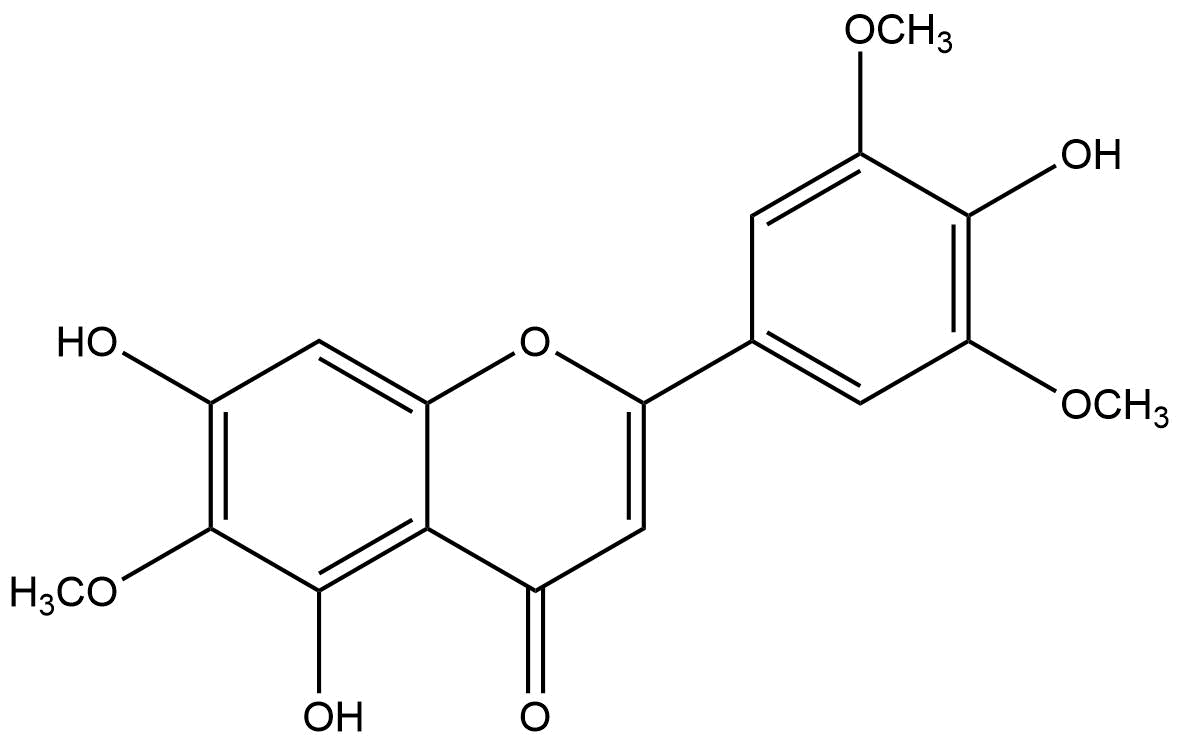


Product name: 6-Methoxytricin
Synonym name: 4',5,7-Trihydroxy-3',5',6-trimethoxyflavone
Catalogue No.: BP2094
Cas No.: 76015-42-4
Formula: C18H16O8
Mol Weight: 360.318
Botanical Source: Artemisia argyi Levl.et Vant.
Type of Compound: Flavonoids
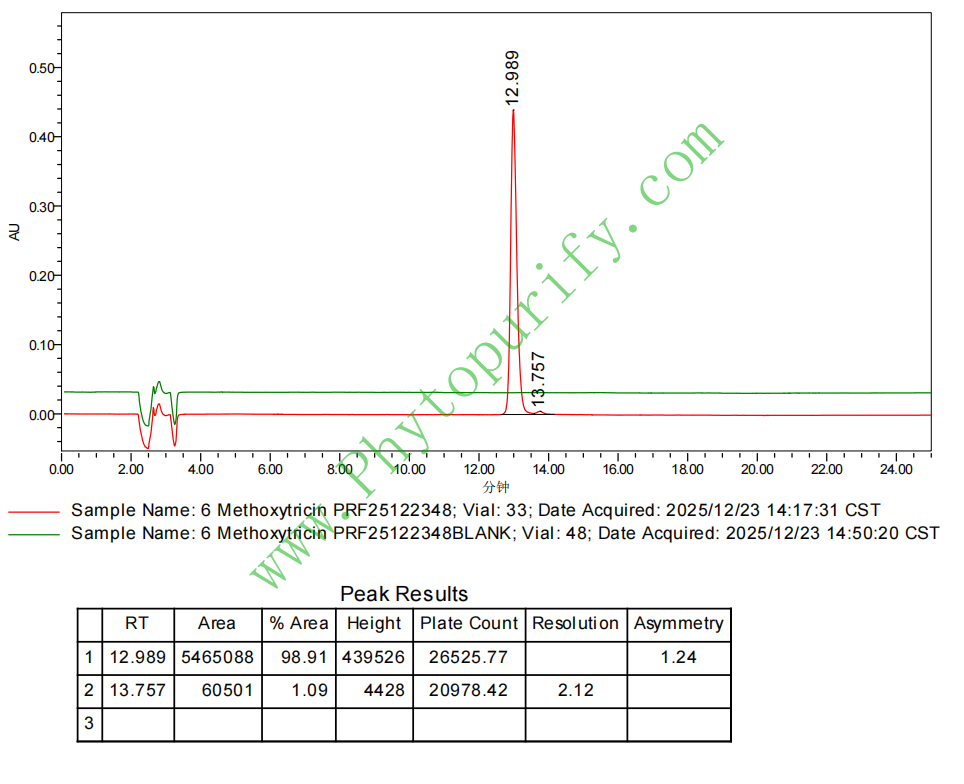
Purity: 95%~99%
Analysis Method: HPLC-DAD or/and HPLC-ELSD
Identification Method: Mass, NMR
Packing: Brown vial or HDPE plastic bottle
Storage: Store in a well closed container, protected from air and light. Put into refrigerate or freeze for long term storage.
Whenever possible, you should prepare and use solutions on the same day. However, if you need to make up stock solutions in advance, we recommend that you store the solution as aliquots in tightly sealed vials at -20℃. Generally, these will be useable for up to two weeks.
The product could be supplied from milligrams to grams
Inquire for bulk scale.
For Reference Standard and R&D, Not for Human Use Directly.
HPLC of 6-Methoxytricin
Storage conditions:Short-term storage at 2~8℃, long-term storage at -20 ~ -80℃
118.5900
2.1639
1.8339
.0134
4.1154
17.3407
Low
89.9981
2.5538
Yes
No
Yes
No
Yes
No
0.6
Yes
No
Yes
No
6-methoxytricin (CAS number: 76015-42-4) is a natural flavonoid compound isolated from Artemisia iwayomogi, a plant of the Artemisia genus. As an important member of the flavonoid family, 6-methoxyalfalfa extract has attracted widespread attention in the field of natural product pharmacology in recent years due to its unique chemical structure and diverse biological activities. Especially in the prevention and treatment of diabetes and its complications, 6-methoxy alfalfa showed significant inhibition of aldose reductase (AR) and advanced glycation end products (AGE), showing potential therapeutic value. In addition, although research on its antiviral activity is still in its early stages, the mechanism of action of 6-methoxyalfalfa extract on influenza virus related targets such as neuraminidase (NA), hemagglutinin (HA), M2 ion channel protein, PB2, and PA protein is gradually being revealed, indicating its potential in antiviral drug development.
This review aims to systematically summarize the chemical structure and physicochemical properties, plant sources and extraction methods, pharmacological activity and mechanism of action of 6-methoxyalfalfa extract, and comprehensively analyze its clinical application prospects based on drug evaluation and pharmacokinetic data. The aim is to provide theoretical basis and practical guidance for subsequent drug development and clinical research.
6-methoxyalfalfa extract belongs to flavonoid compounds, with a molecular formula of C20H16O7 and a molecular weight of 360.3180. Its structural feature is that the hydroxyl group at position 6 of the tricin skeleton is replaced by a methoxy group, forming 6-methoxy tricin. This structure endows it with strong antioxidant capacity and multiple biological activities.
In terms of physicochemical properties, the LogP value of 6-methoxyalfalfa extract is 2.1639, indicating its moderate lipid solubility, which is beneficial for membrane penetration and bioavailability. Its topological polar surface area (TPSA) is 118.59 Å ², indicating that the molecule has a certain polarity that facilitates binding with biomolecules such as enzymes and receptors. Low water solubility (0.0134 mg/mL) suggests limited solubility in aqueous phase, which may affect its oral absorption and bioavailability. The low permeability of the blood-brain barrier suggests limited distribution in the central nervous system, which has certain advantages for the treatment of non central system diseases. The negative result of hERG channel inhibition experiment indicates a low risk of cardiac toxicity. The Ames test result is 0.6, indicating a low risk of genotoxicity.
In summary, the physicochemical properties of 6-methoxyalfalfa extract are suitable for further drug development, especially in the treatment of non central system diseases.
6-methoxy alfalfa extract is mainly isolated from Artemisia iwayomogi, a plant of the Artemisia genus. Artemisia iwayomogi is a traditional herb widely distributed in East Asia, historically used to treat various diseases including inflammation, infections, and metabolic disorders. This plant is rich in various types of flavonoids and volatile oil components, making it a valuable resource for natural product drug research.
The common methods for extracting 6-methoxyalfalfa extract include solvent extraction, chromatographic separation, and purification. Generally, methanol or ethanol is used as the extraction solvent, and crude extracts containing flavonoids are extracted through ultrasound assisted extraction or reflux extraction. Subsequently, high-purity 6-methoxyalfalfa extract was obtained through separation and purification using techniques such as silica gel column chromatography and reverse phase high-performance liquid chromatography (RP-HPLC). In recent years, the application of supercritical fluid extraction and membrane separation technology has also provided new ideas for improving extraction efficiency and purity.
In addition, seasonal and geographical differences in plant sources have a significant impact on the content of 6-methoxy alfalfa extract, and optimizing planting and harvesting conditions is of great significance for stabilizing yield.
The role of 6-methoxy alfalfa in the prevention and treatment of diabetes and its complications has been widely studied. Its main targets include aldose reductase (AR) and advanced glycation end products (AGEs), which play a key role in the pathological process of diabetes.
Aldose reductase is the rate limiting enzyme in the polyol pathway, which catalyzes the reduction of glucose to sorbitol. Overactivation leads to increased intracellular osmotic pressure and oxidative stress, and promotes the development of diabetes complications such as retinopathy, nephropathy and neuropathy. The inhibitory effect of 6-methoxyalfalfa extract on AR is significant, with an IC50 value of 30.29 μ M, indicating good enzyme inhibitory activity.
Late glycation end products are non enzymatic glycation products of proteins, lipids, and nucleic acids, which can trigger oxidative stress and inflammatory reactions, exacerbating tissue damage. The inhibitory effect of 6-methoxyalfalfa extract on the formation of AGEs is also significant, with an IC50 value of 134.88 μ M, indicating its potential in slowing down AGEs mediated pathological processes.
In addition, 6-methoxy alfalfa further alleviates diabetes related tissue damage and improves metabolic disorder through antioxidant and anti-inflammatory effects.
Although the antiviral research of 6-methoxyalfalfa extract is still in its preliminary stage, previous studies have shown that it has a certain inhibitory effect on influenza virus. The key targets of influenza virus include neuraminidase (NA), hemagglutinin (HA), M2 ion channel protein, polymerase subunit PB2, and PA. 6-methoxyalfalfa extract may interfere with the adsorption, invasion, replication, and release processes of viruses by binding to these targets.
Its moderate lipid solubility and low blood-brain barrier permeability are beneficial for exerting antiviral effects in peripheral tissues such as the respiratory tract. In the future, further validation of its specific mechanism against influenza virus through molecular docking and cell experiments will provide a basis for the development of new antiviral drugs.
In addition to the main activities mentioned above, 6-methoxyalfalfa extract also exhibits certain anti-inflammatory, antioxidant, and cell protective effects. It has broad pharmacological significance by regulating various signaling pathways such as NF - κ B, MAPK, etc., inhibiting the expression of inflammatory factors, and reducing oxidative stress damage.
The mechanism of action of 6-methoxyalfalfa extract is mainly achieved through the following aspects:
Aldehyde reductase (AR) inhibition
6-Methoxyalfalfa can bind to the active site of AR, competitively inhibit its catalytic activity, reduce the production of sorbitol, alleviate cell osmotic pressure and oxidative stress, and prevent the occurrence of complications of diabetes. Molecular simulation shows that its methoxy and hydroxyl groups form hydrogen bonds and hydrophobic interactions with key amino acid residues of AR, enhancing binding affinity.
Inhibition of advanced glycation end products (AGEs) formation
By capturing the active intermediate in glycosylation reactions, 6-methoxyalfalfa extract inhibits the generation of AGEs, reduces inflammation and oxidative reactions caused by AGEs binding to receptors (RAGE), and protects tissue function.
Antioxidant and anti-inflammatory effects
6-methoxyalfalfa extract can scavenge free radicals, inhibit lipid peroxidation, and alleviate oxidative stress. At the same time, by regulating the NF - κ B and MAPK signaling pathways, the expression of pro-inflammatory cytokines such as TNF - α and IL-6 is reduced, exerting anti-inflammatory effects.
Anti influenza virus effect
6-methoxyalfalfa extract may block the binding and release of the virus to host cells by binding to the virus surface proteins HA and NA. In addition, inhibition of M2 ion channels and polymerase subunits PB2 and PA interferes with the process of virus replication. Molecular docking and in vitro experiments support its multi-target antiviral potential.
The pharmacological parameters of 6-methoxyalfalfa extract show that it has good potential for drug development:
In terms of pharmacokinetics, there are few existing studies. Preliminary in vivo experiments have shown that 6-methoxyalfalfa extract is absorbed quickly after oral administration, but its bioavailability is limited by low water solubility. Its metabolism is mainly through the liver enzyme system, and the metabolites have not been fully identified. The main excretion pathways are bile and urine. In the future, systematic ADME (absorption, distribution, metabolism, excretion) research needs to be conducted to clarify its in vivo kinetic characteristics.
As a natural flavonoid, 6-methoxy alfalfa has shown broad application prospects in the prevention and treatment of diabetes and its complications due to its significant aldose reductase and AGEs inhibitory activity. Diabetes patients suffer from multiple organ damage due to long-term hyperglycemia. 6-methoxy alfalfa is expected to become a new adjuvant drug for comprehensive treatment of diabetes through multi-target regulation.
In addition, its potential anti influenza virus activity provides new ideas for the prevention and treatment of respiratory virus infections. Considering the issue of resistance to existing antiviral drugs, the multi-target mechanism of action of 6-methoxyalfalfa extract may effectively reduce the risk of resistance and has the potential to be developed as a novel antiviral drug.
Future research should focus on:
Through interdisciplinary cooperation, 6-methoxy alfalfa is expected to become an important drug candidate in the field of diabetes complications and virus infection treatment.
As a natural flavonoid from Artemisia iwayomogi, 6-methoxy alfalfa has shown significant research value in the field of anti diabetes complications and anti influenza virus by virtue of its unique chemical structure and diverse biological activities. Its effective inhibition of aldose reductase and advanced glycation end products reveals its potential in the comprehensive prevention and treatment of diabetes; Meanwhile, the multi-target antiviral effect provides a new direction for the development of novel anti influenza drugs. The evaluation of drug properties shows that it has a good foundation for drug development, but its water solubility and pharmacokinetic properties still need to be optimized.
In the future, through in-depth mechanism research, structural optimization and pre clinical validation, 6-methoxy alfalfa is expected to become an important breakthrough in the development of natural product drugs, bringing new treatment options for patients with diabetes and virus infection. The multi-target characteristics and low toxicity advantages of natural products make them irreplaceable in modern drug development, and the research and application prospects of 6-methoxyalfalfa extract are worth looking forward to.
