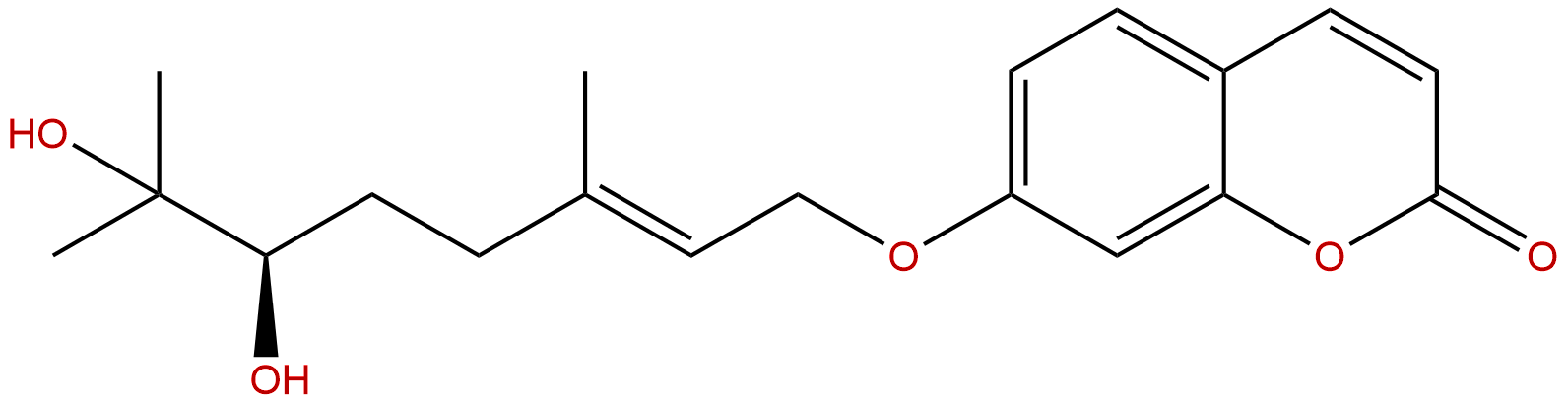


Product name: Marmin
Synonym name:
Catalogue No.: SBP02182
Cas No.: 14957-38-1
Formula: C19H24O5
Mol Weight: 332.396
Botanical Source:
Physical Description: Powder
Type of Compound: Coumarins
Purity: 95%~99%
Analysis Method: HPLC-DAD or/and HPLC-ELSD
Identification Method: Mass, NMR
Packing: Brown vial or HDPE plastic bottle
The product could be supplied from milligrams to grams. Inquire for bulk scale.
We provide solution to improve the water-solubility of compounds, thereby facilitating the variety of activity tests and clinic uses.
For Reference Standard and R&D, Not for Human Use Directly.
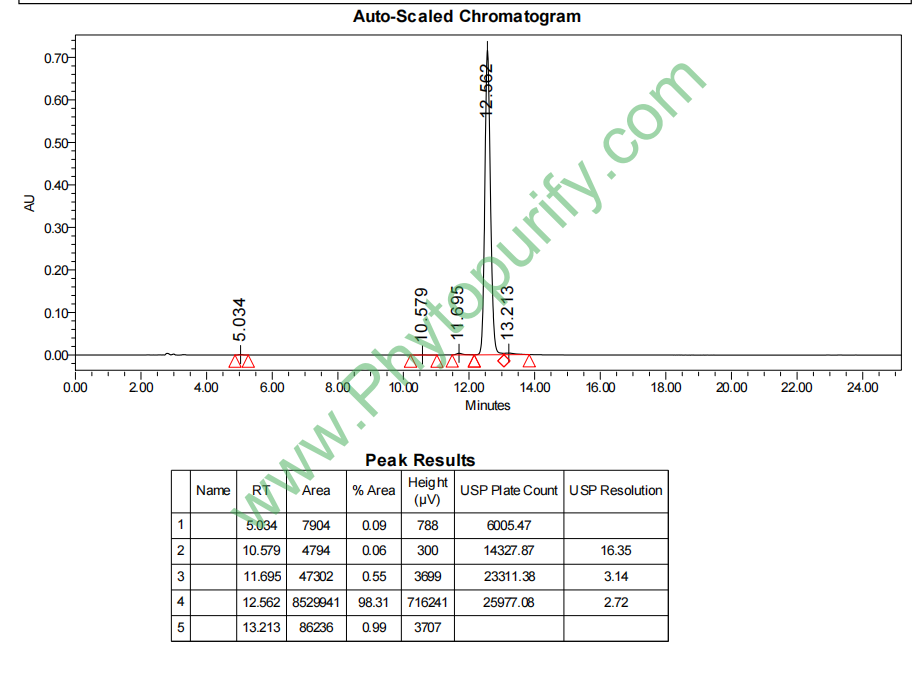
HPLC of Marmin
Storage conditions:Short-term storage at 2~8℃, long-term storage at -20 ~ -80℃
79.9000
2.8404
2.8404
.0469
1.3156
7.4400
Low
86.4793
3.1096
No
No
Yes
No
No
Yes
0.3
No
Yes
Yes
Yes
Natural products, as an important source of drug discovery, play an indispensable role in the long history of human struggle against diseases. Isolating and identifying active ingredients from traditional herbs, and elucidating their pharmacological mechanisms of action, is an important paradigm in modern medicinal chemistry and pharmacology research. Among the numerous biologically active natural product families, coumarin compounds have attracted much attention due to their structural diversity and extensive pharmacological activities, such as anti-inflammatory, antioxidant, anticoagulant, anti-tumor, etc. Marmin, as a structurally unique coumarin compound, was originally derived from the traditional Indian medicinal plant, the kumquat(Aegle marmelos It was isolated from the immature bark of Correa, and its discovery and research provide modern scientific basis for understanding the traditional uses of this plant.
Malmin's discovery is rooted in the in-depth exploration of the medicinal value of kumquat. Muju, also known as "Bael" in the Ayurvedic medical system of India, is widely used in the treatment of digestive system diseases, inflammation, infections, and other illnesses in its fruit, leaves, roots, bark, and other parts. Early studies have shown that extracts from tangerines have significant anti-inflammatory, antihistamine, and antispasmodic activities. Based on these traditional applications and preliminary pharmacological clues, researchers devoted themselves to finding the active substance basis, and ultimately successfully isolated and identified Malmin. Preliminary pharmacological evaluations have revealed that Malmin can competitively antagonize histamine induced smooth muscle contractions, which not only explains the traditional efficacy of Mujiu in relieving gastrointestinal spasms, but also provides a lead compound for its development as a novel antihistamine or anti-inflammatory drug.
In recent years, with the deepening of research, the biological activity spectrum of Malmin has been continuously expanded. In addition to its classic antihistamine effect, increasing evidence suggests that Malmin has enormous potential in the field of anti-inflammatory treatment. Research has shown that it can regulate multiple key inflammatory signaling pathways, such as inhibiting the activation of nuclear factor kappa B (NF - κ B) and downregulating pro-inflammatory cytokines (such as tumor necrosis factor alpha, TNF - α); The expression of interleukin-6 and IL-6, as well as the regulation of cyclooxygenase-2 (COX-2) and nitric oxide synthase (iNOS) activity, are used to exert their anti-inflammatory effects. These findings elevate Malmin from a simple natural antihistamine product to an anti-inflammatory candidate molecule with multi-target and multi pathway regulatory potential. This article aims to provide a comprehensive and systematic review of the chemical structure, physicochemical properties, plant origin, extraction methods, pharmacological activity, mechanism of action, medicinal properties, and clinical application prospects of Malmin, in order to provide reference for the in-depth research and development of this natural product.
The chemical structure of Marmin belongs to the furan coumarin class, and its core skeleton is composed of a coumarin mother nucleus fused with a furan ring. Specifically, its chemical name is usually 7- [(2E) -3,7-dimethyl-2,6-octadien-1-yl] oxy-2H-1-benzopyran-2-one, or simply 7-geraniocoumarin. The structural feature is that the hydroxyl group at position 7 of the coumarin ring is replaced by a geranyl side chain. This monoterpene side chain composed of ten carbon atoms contains two double bonds (one of which is in the trans configuration), endowing the Malmin molecule with a certain degree of lipophilicity and potentially having a significant impact on its interaction with biological targets. The presence of the side chain of the aromatic leaf group distinguishes Malmin structurally from other simple coumarins such as heptaphylline or umbelliferone.
From the perspective of physical and chemical properties, the molecular formula of Malmin is C ₁₉ H ₂₄ O3, with a molecular weight of 332.40 g/mol. According to the calculated chemical parameters, its lipid water partition coefficient (LogP) is 2.84, indicating that the compound has a moderate degree of lipophilicity, which facilitates its penetration of the cell membrane and binding to membrane receptors or intracellular targets. Its topological polar surface area (TPSA) is 79.90 Å ², which conforms to the general rule of oral drugs (usually TPSA<140 Å ²), indicating its good oral absorption potential. However, Malmin has poor water solubility, with a calculated water solubility of only 0.0469 mg/mL, which may pose a challenge to its oral bioavailability. In terms of stability, as a coumarin compound, Malmin is relatively stable under conventional storage conditions (avoiding light, drying, low temperature), but may be sensitive to strong light, strong bases, and strong oxidants, leading to ring opening or side chain oxidation degradation of lactones. In addition, preliminary computer simulation predictions show that Malmin has low blood-brain barrier permeability, suggesting that it may mainly act on peripheral tissues and have a lower risk of central nervous system side effects. Meanwhile, the prediction result of hERG inhibition was negative, indicating a low risk of cardiac toxicity such as prolonged QT interval. The Ames test result is 0.3, usually considered negative or weakly positive, indicating a low risk of genetic toxicity. These preliminary pharmacological parameters provide positive signals for the subsequent development of Malmin.
The main natural source of Malmin is the Rutaceae plant in the genus Rutaceae(Aegle marmelos Correa)。 This plant is native to the Indian subcontinent and Southeast Asia, and is a medicinal tree widely used in traditional medicine. Although various parts of the wood orange (such as the fruit, leaves, and roots) contain multiple active ingredients, Malmin was initially isolated from its immature bark. In addition, there are also reports indicating that Malmin is found in other Rutaceae plants, such as certain species of the Dragon's Palm Blood genus(Toddalia)Or Huangpi genus(Clausena)There are also trace amounts present in plants, but the bark of tangerine trees is currently recognized as the most important and abundant source.
Extracting and purifying Malmin from the bark of tangerines typically follows the classic process of natural product chemistry. Firstly, wash the collected immature bark of the tangerine tree, dry it in the shade or at low temperature, and then crush it into coarse powder. The extraction method often uses solvent extraction, and based on the moderate lipophilicity of Malmin, organic solvents with moderate polarity, such as methanol, ethanol, or their aqueous solutions, are often selected as extraction solvents. For example, multiple percolation or reflux extractions with 95% ethanol at room temperature or heating conditions can effectively dissolve Malmin and other lipophilic components (such as other coumarins, alkaloids, terpenes, etc.) from plant matrices. After filtration and vacuum concentration of the extract, the total extract is obtained.
Subsequently, various chromatographic techniques are required to separate and purify the total extract. The commonly used preliminary separation methods include liquid-liquid extraction (such as sequentially extracting with solvents of different polarities such as petroleum ether, ethyl acetate, n-butanol, etc.), enriching Malmin in the ethyl acetate or n-butanol extraction site. Further purification relies on column chromatography technology. Silica gel column chromatography is the most commonly used method, usually using normal phase silica gel and gradient elution with mixed solvents such as petroleum ether ethyl acetate or chloroform methanol. Collect fractions containing Malmin through thin-layer chromatography (TLC) monitoring. For impurities that are difficult to separate, other chromatographic techniques can be combined, such as Sephadex LH-20 gel column chromatography (separation according to molecular size), preparative high performance liquid chromatography (Pre HPLC), etc., to obtain high-purity marmine monomer. Finally, the structure of the obtained compound was confirmed by spectroscopic techniques such as nuclear magnetic resonance spectroscopy (NMR) and mass spectrometry (MS). In recent years, with the promotion of green chemistry concepts, some new extraction techniques, such as ultrasound assisted extraction and microwave-assisted extraction, have also been attempted to improve the extraction efficiency and yield of Malmin and reduce the use of organic solvents.
Malmin was first discovered and its most classic pharmacological activity is its antihistamine effect. The study used an isolated guinea pig ileum model and found that Malmin can concentration dependently inhibit smooth muscle contraction induced by histamine. Further kinetic analysis indicates that this inhibitory effect belongs to competitive antagonism, where Malmin competes with histamine to bind to the histamine H1 receptor, thereby blocking histamine signaling without affecting the downstream maximal effect of the receptor. This discovery not only provides a molecular level explanation for the use of kumquat in traditional medicine to treat gastrointestinal spasms such as diarrhea and dysentery, but also suggests that Malmin may have the potential to be developed as a natural H1 receptor antagonist and an anti allergic drug. Compared with classic antihistamines such as diphenhydramine, the sedative side effects of Malmine may be smaller, but its specific selectivity and efficacy still need further research.
In recent years, the anti-inflammatory activity of Malmin has become a research hotspot. Multiple in vitro and in vivo experiments have confirmed its significant anti-inflammatory effect. In cell models, Malmin can significantly inhibit the release of various key pro-inflammatory mediators by macrophages (such as RAW 264.7 cells) stimulated by lipopolysaccharide (LPS). Specifically manifested as:
- Inhibit the production of nitric oxide (NO)Malmin reduces the excessive production of NO during inflammation by downregulating the expression of inducible nitric oxide synthase (iNOS, encoded by the NOS2 gene), thereby alleviating NO mediated tissue damage and inflammatory response.
- Inhibition of prostaglandin E2 (PGE2) synthesis Malmin can reduce the process of arachidonic acid metabolism into inflammatory prostaglandins by inhibiting the activity or expression of cyclooxygenase-2 (COX-2, encoded by PTGS1/PTGS2 genes).
- Downregulate the expression of pro-inflammatory cytokines Malmin can significantly reduce the mRNA and protein levels of key pro-inflammatory cytokines such as tumor necrosis factor - α (TNF - α) and interleukin-6 (IL-6) induced by LPS.
In animal models, Malmin also exhibits good anti-inflammatory activity. For example, in the carrageenan induced rat paw swelling model and the acetic acid-induced mouse peritoneal capillary permeability increase model, oral or intraperitoneal injection of Malmin can effectively alleviate inflammatory reactions, and its effect is comparable or better than positive control drugs (such as indomethacin), and it shows lower gastrointestinal irritation. These research results strongly support the development value of Malmin as a novel anti-inflammatory natural product.
In addition to its antihistamine and anti-inflammatory effects, preliminary studies also suggest that Malmine may have other biological activities. For example, there are reports that Malmin exhibits certain antioxidant activity and can scavenge free radicals, which may complement its anti-inflammatory effects. In addition, based on its coumarin parent nucleus, some studies have explored its anticoagulant or anti-tumor activity, but the relevant evidence is still insufficient and needs further verification. At present, Malmin's research focus is still mainly on anti-inflammatory and anti allergic fields.
The complex pharmacological activity of Malmin stems from its regulation of multiple molecular targets and signaling pathways. Based on existing research, its mechanism of action mainly involves the following aspects:
As mentioned earlier, the most direct mechanism of action of Malmin is to act as a competitive antagonist on the histamine H1 receptor. This receptor is a G protein coupled receptor (GPCR) that plays a central role in allergic reactions and inflammation. When histamine binds to H1 receptors, it activates phospholipase C (PLC), leading to an increase in intracellular calcium ion concentration and triggering effects such as smooth muscle contraction and increased vascular permeability. Malmin effectively blocks this signaling cascade by competing with histamine for the binding site of H1 receptor, thereby exerting its anti allergic and antispasmodic effects. Although there have been no reports on the crystal structure of the Malmin H1 receptor complex, molecular docking studies may provide clues for its binding mode.
NF - κ B is the core transcription factor of inflammatory response, regulating the expression of numerous pro-inflammatory genes including TNF - α, IL-6, COX-2, iNOS. Research has shown that Malmin can significantly inhibit NF - κ B activation induced by LPS and other stimuli. Its mechanism of action may include:
- Inhibition of the activity of I κ B kinase (IKK, encoded by the IKBKB gene)IKK is a key upstream kinase in the NF - κ B pathway, responsible for phosphorylating and degrading the inhibitory protein I κ B of NF - κ B. Malmin may inhibit the activity of IKK directly or indirectly, thereby preventing the degradation of I κ B.
- Inhibition of nuclear translocation of p65 subunit RELA (p65) is a major functional subunit of NF - κ B. Malmin treatment can inhibit the translocation of phosphorylated p65 from the cytoplasm to the nucleus, thereby reducing its binding to DNA and ultimately downregulating the transcription of pro-inflammatory genes.
STAT3 is another important inflammatory and immune regulatory signaling pathway involved in the signaling of cytokines such as IL-6. After binding to the receptor, IL-6 activates JAK kinase, which phosphorylates STAT3, forming a dimer and transferring it into the nucleus to regulate gene expression. Research has found that Malmin can inhibit IL-6-induced STAT3 phosphorylation, thereby blocking the signaling pathway. This may be one of the mechanisms by which Malmin downregulates the expression of IL-6 itself and other STAT3 target genes (such as certain acute phase proteins).
The targets of Malmin mentioned in the literature also include CASP1 (caspase 1), TRPV1, and TRPA1. CASP1 is a key effector protein of inflammasomes such as NLRP3 inflammasome, responsible for cleaving pro-IL-1 β and pro-IL-18 into mature pro-inflammatory cytokines. Whether Malmin affects the inflammasome pathway by inhibiting the activity of CASP1 is a direction worth exploring. TRPV1 and TRPA1 are members of the transient receptor potential (TRP) ion channel family, playing important roles in nociceptive and neurogenic inflammation. Whether Malmin can directly act on these ion channels to exert analgesic or anti-inflammatory effects is currently lacking direct evidence, but it provides new ideas for future mechanism research.
In summary, the mechanism of action of Malmin exhibits the characteristics of multi-target and multi pathway. It can directly antagonize membrane receptors (H1R) and inhibit the production of inflammatory mediators by regulating intracellular signal transduction (NF - κ B, STAT3). This multi-level regulatory mode is the structural basis for its strong anti-inflammatory activity and possibly low side effects.
Advancing Malmin from a natural product lead compound to a clinical candidate drug requires a systematic evaluation of its pharmacological properties. Based on the provided parameters and existing literature, a preliminary analysis of its pharmacological potential can be conducted.
Physical and chemical properties and drug like properties The molecular weight (332.40 Da) and LogP (2.84) of Malmin both conform to the range of Lipinski's "Five Rules" (MW<500, LogP<5), indicating its good drug like properties. TPSA (79.90 Å ²) is also within the ideal range, which is beneficial for oral absorption. However, its water solubility (0.0469 mg/mL) is poor and belongs to low solubility drugs, which may be the main limiting step for its oral absorption. Improving water solubility is the key to the development of Malmin formulations, which can be achieved through techniques such as salt formation, preparation of solid dispersions, liposome encapsulation, or nanocrystals.
Pharmacokinetic properties Currently, there are few reports on the in vivo pharmacokinetic studies of Malmin. Based on its physical and chemical properties, it can be inferred that:
- absorb Oral absorption may be incomplete and limited by its low water solubility. Its LogP value suggests that it may be absorbed through passive diffusion, but the absorption rate and degree need to be experimentally verified.
- distribution Moderate lipophilicity makes it easy to distribute into tissues. Predicting low blood-brain barrier permeability suggests a low risk of central side effects, but its distribution characteristics in inflammatory tissues are worth paying attention to.
- Metabolism As a coumarin compound, Malmin is likely to undergo extensive phase I and phase II metabolism in the liver. The side chains of aromatic leaves may undergo oxidation (such as epoxidation and hydroxylation), and the coumarin lactone ring may undergo hydrolysis. The combination reactions of glucuronidation and sulfation are also common metabolic pathways. Clarifying its main metabolites and metabolic enzymes (such as CYP450 enzyme system) is crucial for predicting drug interactions.
- excretion Metabolites may be mainly excreted through bile and urine.
safety evaluation Preliminary computer predictions indicate that Malmin has no risk of hERG inhibition (low cardiac toxicity) and a negative Ames test result (low genetic toxicity risk). These are positive signals. However, a comprehensive safety evaluation still requires systematic in vitro and in vivo toxicological studies, including acute toxicity, subchronic toxicity, reproductive toxicity, teratogenicity, etc. It is particularly important to note that some natural coumarins (such as furanocoumarin) have phototoxicity, and whether Malmin also has similar issues requires phototoxicity testing.
The unique pharmacological activity spectrum and preliminary good drug properties of Malmin have opened up broad prospects for its clinical application.
1. Antiallergic and anti-inflammatory drugs This is the most direct application direction of Malmin. As a natural H1 receptor antagonist, it also possesses strong anti-inflammatory activity (by inhibiting the NF - κ B and STAT3 pathways), making it uniquely advantageous in the treatment of allergic diseases such as allergic rhinitis, urticaria, and asthma. Compared with traditional antihistamines, Malmin not only quickly alleviates allergic symptoms, but also inhibits inflammatory reactions from the source, potentially providing a more comprehensive therapeutic effect. In addition, its application in chronic inflammatory diseases such as inflammatory bowel disease (IBD) and rheumatoid arthritis is also worth exploring.
2. Treatment of gastrointestinal diseases Based on its dual effects of spasmolytic and anti-inflammatory, Malmin is expected to be used for the treatment of gastrointestinal functional disorders such as irritable bowel syndrome (IBS) and functional dyspepsia. It can alleviate smooth muscle spasms and reduce inflammation of intestinal mucosa, which may be more advantageous than single acting drugs.
3. Analgesic drugs Given the close relationship between inflammation and pain, as well as its potential impact on TRPV1/TRPA1, Malmin may have analgesic effects. In the future, its effectiveness in models of inflammatory pain and neuropathic pain can be studied.
Future research directions:
- In depth mechanism research Using gene knockout/knock in animal models, CRISPR-Cas9 technology, proteomics, and other methods, accurately elucidate the direct targets of Malmin in vivo (especially other targets outside the H1 receptor), and analyze the molecular details of its interaction with signaling pathways such as NF - κ B and STAT3.
- Research on Structure Modification and Structure Activity Relationship Using Malmin as the lead compound, structural modifications were carried out on its aromatic side chain and coumarin nucleus through chemical synthesis or biotransformation methods, aiming to improve its water solubility, enhance target affinity, improve pharmacokinetic properties, and reduce potential side effects. Systematically study its structure-activity relationship to provide guidance for developing better derivatives.
- Formulation development To address the issue of poor water solubility, new drug delivery systems have been developed, such as self microemulsifying drug delivery systems (SMEDS), lipid nanoparticles, cyclodextrin inclusion complexes, etc., to improve their oral bioavailability.
- Systematic Toxicological Evaluation Conduct comprehensive preclinical safety evaluations, including long-term toxicity, reproductive toxicity, phototoxicity, etc., to lay a safety foundation for clinical trials.
- Combination therapy research Explore the synergistic effect of Malmin with existing anti-inflammatory drugs (such as nonsteroidal anti-inflammatory drugs, glucocorticoids) or antihistamines, in order to achieve the goal of reducing dosage, enhancing efficacy, and reducing side effects.
Malmin, a natural coumarin derived from the traditional medicinal plant Muju, has become a remarkable research hotspot in the field of natural product pharmacology due to its unique chemical structure and multifaceted pharmacological activities, especially its dual effects of antihistamine and anti-inflammatory. From its initial discovery as a competitive antagonist of histamine H1 receptor to a deeper understanding of its regulation of multiple inflammatory signaling pathways such as NF - κ B and STAT3, our understanding of Malmin has entered a new stage. The preliminary pharmacological evaluation results, such as good drug like properties, low cardiac toxicity, and low genetic toxicity risk, have added confidence to its subsequent development.
However, from laboratory research to clinical application, Malmin still faces many challenges. The bioavailability issues caused by its low water solubility, unclear metabolic pathways in vivo, and lack of comprehensive toxicological data are all urgent challenges that need to be overcome. Future research should focus on optimizing its structure through medicinal chemical methods, improving its delivery efficiency using advanced formulation technologies, and accurately elucidating its target and in vivo fate using modern molecular biology techniques. We have reason to believe that with the continuous deepening of research, Malmin and its derivatives are expected to demonstrate unique clinical value in the fields of anti allergy, anti-inflammatory, and related disease treatment, contributing the wisdom and power of natural products to human health.
