


Synonym name: beta-Febrifugine
Catalogue No.: BP0264
Cas No.: 24159-07-7
Formula: C16H19N3O3
Mol Weight: 301.346
Botanical Source: Alkaloid from Root and leaves of the Chinese drug Ch'ang Shan (Dichroa febrifuga) and from Hydrangea spp. (Hydrangeaceae)
Purity: 95%~99%
Analysis Method: HPLC-DAD or/and HPLC-ELSD
Identification Method: Mass, NMR
Packing: Brown vial or HDPE plastic bottle
Can be supplied from milligrams to grams.
For Reference Standard and R&D, Not for Human Use Directly.
Inquire for bulk scale.
HPLC of Febrifugine
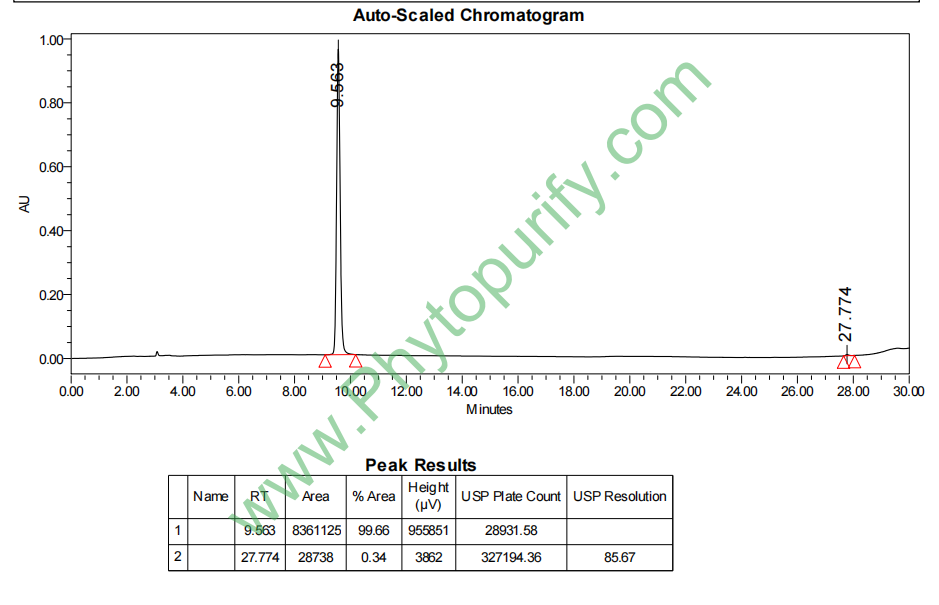
Storage conditions:Short-term storage at 2~8℃, long-term storage at -20 ~ -80℃
Malaria, as a type of malignant malaria parasite(Plasmodium falciparum)The serious infectious diseases caused by it have long been a major challenge in the global public health field. With the continuous emergence of resistance to antimalarial drugs, it is urgent to develop new, efficient, and low toxicity antimalarial drugs. Natural products, as an important source of drug discovery, provide rich chemical structures and biologically active molecules. Febrifugine, as a typical quinazolinone alkaloid, has been extracted from the traditional Chinese medicine Changshan since the early 20th century(Dichroa febrifuga)Separated from it, it has attracted much attention due to its significant anti malarial activity.
In recent years, in addition to the traditional antimalarial effect, Changshan B has also shown potential pharmacological value in the field of anti-tumor, especially in the inhibition of bladder cancer, showing the ability to induce apoptosis and regulate steroid metabolism. This article aims to systematically review the chemical structure, sources, pharmacological activity, mechanism of action, and drug properties of Changshan alkali B, explore its clinical application prospects, and provide theoretical basis for subsequent drug development and clinical translation.
The molecular formula of Febrifugene B in Changshan is C16H19N3O2, with a molecular weight of 301.34, and it belongs to quinazolinone alkaloids. Its structural core is a polycyclic heterocyclic skeleton containing a quinazolinone ring system, with multiple hydrogen bond acceptors (5). The molecular polarity is moderate, with a topological polar surface area (TPSA) of 85.8 Å ² and a LogP value of 0.19, indicating good water solubility and lipid solubility balance.
Structurally, the quinazolinone group of Changshan alkali provides a key binding site for its biological activity, which can form stable interactions with various biomolecules. In addition, its molecules have high blood-brain barrier permeability, suggesting potential applications in central nervous system diseases. However, its safety indicators such as hepatotoxicity, cardiotoxicity, and hERG channel inhibition are currently unclear and require further systematic evaluation.
Changshan alkali B was originally derived from the traditional Chinese medicine Changshan(Dichroa febrifuga Obtained through separation in Lour. Changshan is a plant of the Ranunculaceae family, widely distributed in southern China and Southeast Asia. It is traditionally used to treat symptoms such as malaria and fever. Changshan alkali B, as one of the main active ingredients in Changshan, although its content is not high, it has significant biological activity.
The extraction process usually uses organic solvent extraction combined with acid-base extraction method. The specific steps include: crushing the dried rhizomes of Changshan, reflux extraction with methanol or ethanol, concentrating the filtrate and adjusting the pH to acidic with hydrochloric acid solution, then extracting the alkaline components with organic solvents (such as ethyl acetate), and finally separating and purifying Changshan alkali ethyl through column chromatography. In modern research, the application of ultrasound assisted extraction and high-performance liquid chromatography (HPLC) technology has improved extraction efficiency and purity.
The most well-known pharmacological effect of Changshan alkaloid B is its inhibitory effect on Plasmodium falciparum. Both in vitro and in vivo experiments have shown its effectiveness Plasmodium falciparum It has significant inhibitory effect and exhibits good activity against multiple drug-resistant strains. Its anti malaria mechanism involves multiple biological targets, including Plasmodium's DNA synthase, membrane transporters, and metabolic enzyme system.
Recent studies have found that Changshan B can play an anti-tumor role in bladder cancer cells by inhibiting DNA synthesis and inducing apoptosis. In addition, it can also reduce intracellular steroid levels, interfere with the endocrine regulation of tumor cells, and thus inhibit tumor growth. The cell experiment showed that the proliferation ability of bladder cancer cells was significantly decreased and the apoptosis rate was increased after treatment with Changshan alkaloid B, suggesting that it has potential value in the development of anticancer drugs.
In addition to anti malaria and anti-tumor effects, Changshan alkaline B also exhibits certain inhibitory effects on inflammatory responses induced by certain bacterial lipopolysaccharides (LPS), suggesting its potential anti-inflammatory activity. However, relevant research is still in its preliminary stage and requires further in-depth exploration.
The pharmacological mechanism of Changshan alkaloid B is complex, involving multiple signaling pathways and molecular targets.
Regarding malaria, Changshan alkaloid B mainly exerts its effects through the following targets:
Through multi-target synergistic effects, Changshan alkaloid B effectively inhibits the growth and reproduction of malaria parasites.
In bladder cancer, Changshan alkaloid B plays a role through the following ways:
In addition, Changshan alkaline B may indirectly affect the survival and metastasis ability of tumor cells by regulating inflammatory factors and oxidative stress status.
The molecular weight of Changshan alkali B (301.34) is within the ideal range of drug molecules, and the LogP value (0.19) indicates its strong hydrophilicity, which is beneficial for in vivo distribution. The TPSA is 85.8 Å ², indicating its good cell membrane penetration ability and oral bioavailability. The number of hydrogen bond receptors is 5, which conforms to Lipinski's rule and is conducive to stable binding with target proteins.
The high permeability of the blood-brain barrier suggests that it may affect the central nervous system, but potential neurotoxicity risks should also be monitored. The safety indicators such as hepatotoxicity, cardiotoxicity, and hERG channel inhibition are not yet clear and need to be given special attention in subsequent pharmacological and toxicological studies.
At present, there is limited research on the pharmacokinetics of Changshan alkaloid B. Animal experiments have shown that its oral absorption is fast, the plasma half-life is moderate, and it is mainly metabolized through the liver. The metabolites have not been fully identified. Given its structural characteristics, it is speculated that it may be metabolized through the CYP450 enzyme system, posing a potential risk of drug interactions.
In the future, systematic research on absorption, distribution, metabolism, excretion (ADME) and toxicology is needed to clarify their in vivo behavior and safety window, providing a basis for clinical development.
Changshan alkaloid B, as a natural quinazolinone alkaloid, has broad clinical application prospects due to its significant anti malarial activity and potential anti-tumor effects. In the field of antimalarial drugs, facing the increasingly severe problem of drug resistance, Changshan alkaloid B and its derivatives are expected to become candidate molecules for the new generation of antimalarial drugs. By optimizing its structure and drug design, improving its selectivity and safety will further promote its clinical translation.
In the field of anti-tumor, especially for the treatment of bladder cancer, Changshan alkaloid B has demonstrated a unique mechanism of action and good pharmacological activity. In the future, targeted drugs and immunotherapy strategies can be combined to explore the synergistic effects of their combination therapy. In addition, based on its high blood-brain barrier permeability, the potential application of Changshan alkaloid B in central nervous system diseases also deserves further research.
However, the safety evaluation of Changshan alkali B is not yet complete, and key indicators such as liver toxicity, cardiac toxicity, and genetic toxicity need to be systematically evaluated. The pharmacokinetic characteristics and formulation development are also key bottlenecks in clinical application. In the future, interdisciplinary cooperation should be strengthened, utilizing modern medicinal chemistry, pharmacology, and pharmacokinetic techniques to promote the conversion of Changshan alkaloid B into clinical drugs.
Changshan alkali B, as a natural product with unique structure and multiple biological activities, exhibits dual potential for anti malaria and anti-tumor effects. Its multi-target mechanism of action provides new ideas for anti malaria and anti-cancer treatments. Although there are still many challenges in drug formulation, safety, and pharmacokinetics, with the deepening of research and technological progress, Changshan alkali B is expected to become an important breakthrough in the development of natural product drugs. Future research should focus on structural optimization, safety evaluation, and preclinical studies to promote their early clinical application and benefit patients.
