![[1,3]Dioxolo[4,5-j]pyrrolo[3,2,1-de]phenanthridinium,4,5-dihydro-2-hydroxy-](/upload/0201/09bdc48f114662a948d637b64973bfef.png)


Product name: Lycobetaine
Synonym name: 72510-04-4
Catalogue No.: BP3981
Cas No.: 2121-12-2
Formula: C16H12NO3+
Mol Weight: 266.275
Botanical Source:
Physical Description:
Type of Compound:
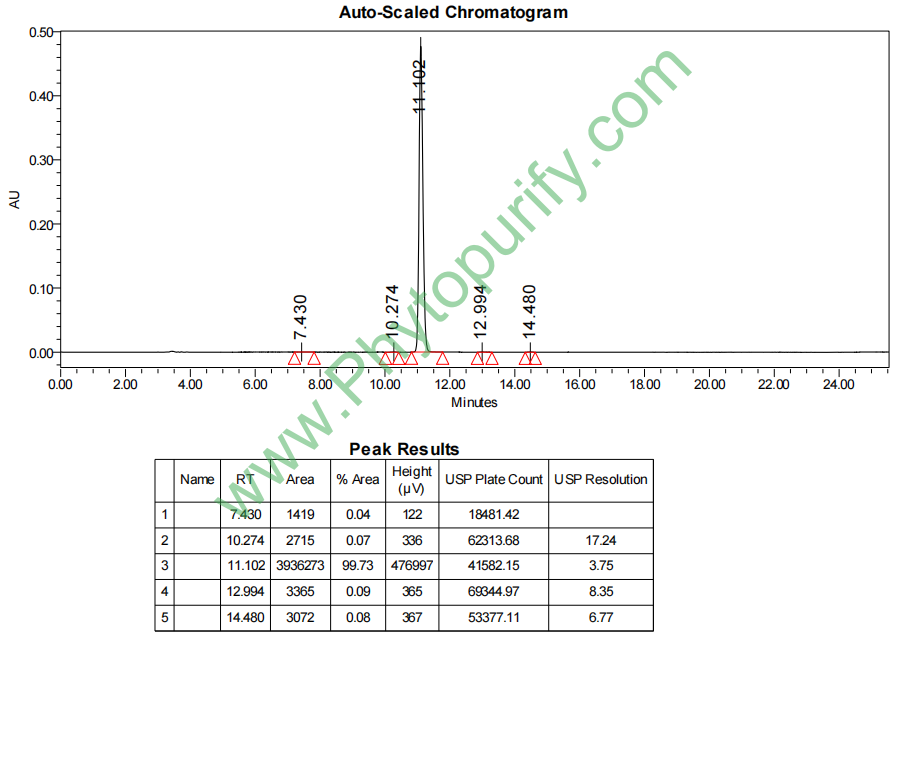
Purity: 95%~99%
Analysis Method: HPLC-DAD or/and HPLC-ELSD
Identification Method: Mass, NMR
Packing: Brown vial or HDPE plastic bottle
Storage: Store in a well closed container, protected from air and light. Put into refrigerate or freeze for long term storage.
Whenever possible, you should prepare and use solutions on the same day. However, if you need to make up stock solutions in advance, we recommend that you store the solution as aliquots in tightly sealed vials at -20℃. Generally, these will be useable for up to two weeks.
The product could be supplied from milligrams to grams
Inquire for bulk scale.
For Reference Standard and R&D, Not for Human Use Directly.
HPLC of Lycobetaine
Storage conditions:Short-term storage at 2~8℃, long-term storage at -20 ~ -80℃
42.5700
-.2826
-.2988
.3904
.7288
10.8180
High
29.2185
3.1732
No
No
No
No
Yes
Yes
2.4
No
No
No
No
As a major disease threatening human health worldwide, malignant tumor has a high incidence rate and mortality. Despite breakthroughs in new treatment strategies such as targeted therapy and immunotherapy in recent years, chemotherapy drugs remain one of the fundamental means of clinical anti-tumor therapy. However, traditional chemotherapy drugs generally have limitations such as poor selectivity, significant toxic side effects, and susceptibility to drug resistance. This has prompted researchers to continue searching for novel structures, unique mechanisms of action, and higher safety anti-tumor lead compounds from natural products.
Amaryllidaceae plants, as an important source of traditional medicinal plants, have long been used in folk medicine to treat various diseases. This family of plants is rich in various structurally specific isoquinoline alkaloids, among which lycorine and its derivatives have attracted much attention due to their significant biological activity. Lycobetine (CAS number: 72510-04-4), as an oxidized derivative of lycorine, is a natural alkaloid with a quaternary ammonium salt structure. Compared with the parent compound lycorine, oxidized lycorine has significantly improved chemical stability and water solubility. More importantly, its anti-tumor activity spectrum is more extensive, and its mechanism of action exhibits multi-target and multi pathway characteristics.
In recent years, with the continuous deepening of research on oxidized lycorine, its potential in the field of anti-tumor has gradually been revealed. Research has shown that oxidized lycorine can exert broad-spectrum anti-tumor activity by regulating multiple targets such as apoptosis related proteins (MCL1, BCL2), signaling pathways (STAT3, MAPK1), transcription factors (HIF1A), topoisomerases (TOP1, TOP2A), and matrix metalloproteinases (MMP2). In addition, its regulatory effects on estrogen receptor (ESR1) and aromatase (CYP19A1) also suggest its potential value in the treatment of hormone dependent tumors. This article will provide a systematic review of the research progress of oxidized lycorine from the aspects of chemical structure, plant origin, pharmacological activity, mechanism of action, medicinal evaluation, and clinical application prospects, in order to provide reference for the further development and utilization of this natural product.
Oxidized lycorine belongs to the pyrrolophenanthridine alkaloid class, and its core skeleton is composed of a four ring system, including a phenanthridine ring system fused with a pyrrole ring. Compared with lycorine, the most significant structural feature of oxidized lycorine is the presence of a quaternary ammonium nitrogen atom (N ⁺) in its molecule, which allows the compound to exist in the form of zwitterionic ions. The quaternary ammonium salt structure endows oxidized lycorine with unique physicochemical properties, including good water solubility and high polarity, which is in sharp contrast to its parent compound lycorine.
From the molecular formula, the precise molecular weight of oxidized lycorine is 266.2760 Da, belonging to the category of small molecule compounds. The lipid water partition coefficient (LogP) of the compound is -0.2826, indicating its hydrophilicity, which is consistent with the structural characteristics of the presence of quaternary ammonium cations and multiple polar groups in its molecule. The topological polar surface area (TPSA) is 42.5700 Å ², which is at a moderate level, indicating that the compound may have some membrane permeability, but its passive diffusion ability may be limited due to its ionic properties.
The water solubility parameter of oxidized lycorine is 0.3904, which is relatively high and allows it to maintain a certain solubility concentration under physiological conditions, which is beneficial for the development of drug formulations. It is worth noting that the blood-brain barrier penetration of this compound has been evaluated as "high", which is of great significance for the treatment of central nervous system tumors or brain metastases, but may also increase the risk of central nervous system toxicity.
In terms of chemical stability, the quaternary ammonium salt structure of oxidized lycorine makes it relatively stable under acidic conditions, but ring opening or degradation reactions may occur in alkaline environments. In addition, the phenolic hydroxyl and vinyl bonds in the molecule also make it sensitive to oxidation conditions, which needs to be taken into account in the development and storage of formulations. From the perspective of medicinal chemistry, the structural modification space of oxidized lycorine is relatively large, and its quaternary ammonium group, phenolic hydroxyl group, and aromatic ring system can all serve as sites for structural modification, providing a basis for subsequent structure-activity relationship research and lead compound optimization.
Oxidized lycorine is mainly found in plants of the Amaryllidaceae family, with Lycoris being the main source. China is one of the main distribution areas of the Allium genus, with common species including Lycoris radiata, Lycoris aurea, and Lycoris sprengeri. In addition, the presence of oxidized lycorine has also been detected in plants of the Alliaceae family, such as Narcissus and Clivia.
In terms of distribution within the plant body, oxidized lycorine is mainly enriched in the bulb area, which is consistent with the accumulation pattern of alkaloids in lycorine plants. As a nutrient storage organ, bulbs contain abundant secondary metabolites, among which alkaloids are usually the most abundant. There are significant differences in the content of oxidized lycorine in different species, regions, and harvest seasons of Alliaceae plants, which poses challenges for the quality control and resource development of medicinal materials.
The extraction method of oxidized lycorine mainly adopts the traditional process of acid water extraction organic solvent extraction. The specific process usually includes: soaking or percolating the dried and crushed plant materials in an acidic aqueous solution (such as 0.5% -2% hydrochloric acid or sulfuric acid) to extract alkaloids in the form of salts in the aqueous phase; After filtration, adjust the pH to alkaline with alkaline solution (such as ammonia or sodium hydroxide) to free the alkaloids; Then extract with organic solvents such as chloroform, dichloromethane, or ethyl acetate; Finally, the crude extract of total alkaloids was obtained by vacuum concentration.
The separation and purification of allicin oxide from total alkaloids usually require the use of multiple chromatographic techniques. Silica gel column chromatography is the most commonly used preliminary separation method, which uses solvent systems such as chloroform methanol or ethyl acetate methanol for gradient elution. For alkaloids with similar structures, further purification is carried out using preparative high-performance liquid chromatography (HPLC) or high-speed countercurrent chromatography (HSCCC). In recent years, with the advancement of separation technology, new methods such as molecular imprinting technology and ionic liquid extraction have also been attempted to be applied to the separation and purification of oxidized lycorine. These methods have shown certain advantages in improving selectivity and extraction efficiency.
It is worth noting that the content of oxidized lycorine in plants is usually low and often coexists with structurally similar compounds such as lycorine and pseudo lycorine, which poses difficulties for the preparation of high-purity samples. Therefore, establishing an efficient, environmentally friendly, and scalable extraction and purification process is of great significance for the in-depth research, development, and utilization of oxidized lycorine.
The most noteworthy pharmacological activity of oxidized lycorine is its anti-tumor effect. A large number of in vitro studies have shown that lycorine oxide has significant proliferation inhibitory activity on a variety of human tumor cell lines, and its scope of action covers leukemia, liver cancer, lung cancer, breast cancer, stomach cancer, colon cancer, cervical cancer and other malignant tumors. It is worth noting that the toxicity of oxidized lycorine to normal cells is relatively low, showing a certain degree of selectivity, which provides important evidence for its use as a candidate anti-tumor drug.
In leukemia cell lines, oxylycorine has shown strong inhibitory effects on cell lines such as HL-60, K562, U937, etc., with IC50 values typically at the micromolar level. For solid tumors, lycorine oxide also showed good inhibitory activity on HepG2 (liver cancer), A549 (lung cancer), MCF-7 (breast cancer), SGC-7901 (gastric cancer) and other cell lines. In addition, the study also found that oxidized lycorine has a certain killing effect on multidrug-resistant cell lines (such as MCF-7/ADR), suggesting its potential to overcome tumor resistance.
The in vivo anti-tumor experiment further verified the therapeutic effect of oxidized lycorine. In various animal models of transplanted tumors, oxidized lycorine can significantly inhibit tumor growth and prolong the survival of tumor bearing animals. For example, in the S180 sarcoma mouse model, intraperitoneal injection of oxidized lycorine can significantly inhibit the growth of tumor volume; In the H22 liver cancer mouse model, oxidized lycorine also showed dose-dependent anti-tumor effects. It is worth noting that the toxicity of oxidized lycorine at effective doses is relatively mild, mainly manifested as gastrointestinal reactions and bone marrow suppression, but to a lesser extent than traditional chemotherapy drugs.
In addition to anti-tumor activity, oxidized lycorine also exhibits various other pharmacological effects. In terms of anti-inflammatory activity, oxidized lycorine can inhibit lipopolysaccharide (LPS) - induced macrophage inflammatory response and reduce the release of pro-inflammatory factors such as tumor necrosis factor - α (TNF - α) and interleukin-6 (IL-6). In terms of antiviral activity, studies have reported that oxidized lycorine has inhibitory effects on certain RNA viruses, but its antiviral mechanism is not fully understood. In addition, oxidized lycorine also exhibits certain anti platelet aggregation and anti fibrotic activities, which provide possibilities for its multi-purpose development.
The anti-tumor mechanism of oxidized lycorine is very complex, involving the regulation of multiple signaling pathways and molecular targets, exhibiting typical multi-target action characteristics.
Oxidized lycorine can induce tumor cell apoptosis by regulating the expression of BCL-2 family proteins. Research has shown that treatment with oxidized allicin can downregulate the expression of anti apoptotic proteins MCL1 and BCL2, while upregulating the levels of pro apoptotic proteins BAX and BAK, leading to a decrease in mitochondrial membrane potential, release of cytochrome c, and activation of caspase cascade reaction, ultimately inducing cell apoptosis. It is worth noting that MCL1, as an important anti apoptotic protein in the BCL-2 family, is overexpressed in various tumors and closely related to chemotherapy resistance. The downregulation of MCL1 by oxidized lycorine provides a molecular basis for overcoming drug resistance.
Signal transducer and activator of transcription factor 3 (STAT3) is continuously activated in various malignant tumors, promoting tumor cell proliferation, survival, and angiogenesis. Oxidized lycorine can inhibit the phosphorylation activation of STAT3, block its nuclear translocation, and inhibit the transcription of downstream target genes such as Cyclin D1, Survivor, VEGF, etc. This mechanism of action is closely related to the anti proliferative and pro apoptotic effects of oxidized lycorine, and provides a theoretical basis for its use in STAT3 driven tumor therapy.
Topoisomerases (TOP1 and TOP2A) are essential enzymes in DNA replication and transcription processes, and are also targets of various clinical anti-tumor drugs such as camptothecin and anthracycline. Research has found that oxidized lycorine can inhibit the activity of TOP1 and TOP2A, leading to DNA damage and replication fork arrest, which in turn triggers cell cycle arrest and apoptosis. Unlike classical topoisomerase inhibitors, oxylycorine may exert its effects through different binding modes, which can help overcome resistance to existing drugs.
Hypoxia inducible factor-1 alpha (HIF1A) is a key transcription factor for tumor adaptation to the hypoxic microenvironment, and its overexpression is closely related to tumor angiogenesis, metabolic reprogramming, and metastasis. Oxidized lycorine can inhibit the protein expression and transcriptional activity of HIF1A, thereby downregulating the expression of its downstream target gene vascular endothelial growth factor (VEGF) and exerting anti angiogenic effects. In addition, oxidized lycorine can also inhibit the expression and activity of matrix metalloproteinase MMP2, thereby suppressing the invasion and metastasis ability of tumor cells.
For hormone dependent tumors, oxidized lycorine shows regulatory effects on the estrogen signaling pathway. Research has shown that oxidized lycorine can downregulate the expression of estrogen receptor alpha (ESR1) and inhibit the activity of aromatase (CYP19A1). Aromatase is a key enzyme for androgen to estrogen conversion, which is highly expressed in hormone dependent tumors such as breast cancer. The inhibitory effect of lycorine oxide on CYP19A1 suggests that lycorine may have therapeutic potential similar to aromatase inhibitor, which provides a new idea for the treatment of hormone dependent tumors such as breast cancer.
The mitogen activated protein kinase (MAPK) pathway plays an important role in cell proliferation, differentiation, and survival. Oxidized lycorine can affect the phosphorylation status of MAPK1 (ERK2), but its specific effect may vary depending on cell type and treatment conditions. In certain tumor cells, oxidized lycorine can inhibit the phosphorylation of ERK and block proliferation signaling; In other cells, apoptosis may be induced by activating stress-related MAPK pathways such as JNK and p38. This differential regulatory effect reflects the complexity of the mechanism of action of oxidized lycorine.
Based on the aforementioned physicochemical properties, the pharmacological characteristics of oxidized lycorine can be summarized as follows: the molecular weight (266.28 Da) conforms to the typical range of small molecule drugs (<500 Da); The LogP value is -0.2826, indicating strong hydrophilicity, which is beneficial for the development of water-soluble formulations, but may affect membrane permeability and oral absorption; The TPSA is 42.57 Å ², which is at a moderate level and theoretically has a certain membrane permeability; Good water solubility (0.3904), conducive to in vivo delivery.
It is worth noting that the blood-brain barrier penetration of oxidized lycorine has been evaluated as "high", which may be advantageous in the treatment of brain tumors, but also increases the risk of central nervous system toxicity. The hERG inhibition assessment was negative, indicating a low risk of the compound causing cardiac QT interval prolongation, which is a favorable safety feature. The Ames test result is 2.4, indicating a possible genetic toxicity risk, which needs to be given special attention and further verification in subsequent development.
At present, there is insufficient systematic research on the pharmacokinetics of oxidized lycorine, and the existing data mainly comes from animal experiments. Preliminary studies have shown that after intravenous injection, oxidized lycorine is widely distributed in the body and can reach major organs such as the liver, kidneys, lungs, and spleen. Due to its quaternary ammonium salt structure, the oral bioavailability of oxidized lycorine may be low, consistent with its high polarity and hydrophilicity characteristics. Therefore, current research mostly adopts the injection administration route.
In terms of metabolism, oxidized lycorine may undergo phase I and phase II metabolic reactions in the liver, including oxidation, reduction, methylation, glucuronic acid binding, etc. The activity and toxicity of its metabolites still need further research. In terms of excretion pathways, due to the strong hydrophilicity of oxidized lycorine, it is speculated that it is mainly excreted through the kidneys in its original form or metabolite form. The key pharmacokinetic parameters such as half-life are yet to be systematically determined.
The safety evaluation of oxidized lycorine is still in the preliminary stage. Animal experiments have shown that the acute toxicity of oxidized lycorine is low, but repeated administration may cause gastrointestinal reactions and mild bone marrow suppression. Compared with the parent compound lycorine, the toxicity of oxidized lycorine is reduced, which may be due to its quaternary ammonium salt structure changing the molecular charge distribution and membrane interaction characteristics. However, the positive results of Ames test suggest the need for further evaluation of its genetic toxicity, including in vivo micronucleus test, chromosome aberration test, etc. In addition, there is still a lack of safety evaluation data on long-term toxicity, reproductive toxicity, immune toxicity, etc., which is a key issue that must be addressed in the clinical translation of oxidized lycorine.
Based on the multi-target mechanism of action and broad-spectrum anti-tumor activity of oxidized lycorine, its potential indications cover various malignant tumors. Particularly noteworthy areas include: refractory tumors resistant to traditional chemotherapy drugs, such as multidrug resistant leukemia and breast cancer; STAT3 or HIF1A driven invasive tumors; Hormone dependent breast cancer, especially the type sensitive to aromatase inhibitors; And central nervous system tumors that require crossing the blood-brain barrier.
Given the multi-target nature of oxidized lycorine, combination therapy may be an important strategy to maximize its clinical value. The combination use with conventional chemotherapy drugs such as cisplatin, paclitaxel, doxorubicin, etc. may produce synergistic effects, reducing their respective dosages and toxicity. The combination use with targeted drugs such as BCL-2 inhibitors and STAT3 inhibitors may enhance efficacy and delay the development of drug resistance. In addition, the combination of oxidized lycorine and immune checkpoint inhibitors is also a direction worth exploring, as their induced immunogenic cell death may enhance anti-tumor immune response.
The quaternary ammonium salt structure of oxidized lycorine is both its advantage (good water solubility) and its disadvantage (poor oral absorption). Therefore, improving its oral bioavailability through prodrug design or structural modification is an important research direction. For example, converting quaternary ammonium groups into reversible tertiary amine precursors and releasing active drugs through enzymatic hydrolysis or chemical conversion in vivo; Alternatively, the phenolic hydroxyl group can be esterified to enhance its lipophilicity. In addition, based on the binding mode between oxidized lycorine and various targets, structural optimization through computer-aided drug design is expected to obtain derivatives with higher selectivity and stronger activity.
Despite the excellent anti-tumor potential demonstrated by oxidized lycorine, its clinical translation still faces many challenges. Firstly, the pharmacokinetic characteristics are not yet clear, especially the key parameters such as oral bioavailability, metabolic stability, and in vivo distribution need to be systematically studied. Secondly, there is a lack of safety evaluation data, especially for genetic toxicity and long-term toxicity, which require further verification. Again, the limited yield from plant sources requires the development of chemical synthesis or semi synthesis routes as a prerequisite for achieving large-scale production. Finally, although the multi-target effect of oxidized lycorine is its advantage, it also increases the complexity of the mechanism of action research and the unpredictability of clinical applications.
Oxidized allicin, as a natural alkaloid derived from plants in the Alliaceae family, has shown significant research value in the field of natural product drug development due to its unique quaternary ammonium salt structure and multi-target anti-tumor activity. From a chemical structure perspective, oxidized lycorine has both hydrophilicity and certain membrane permeability, and its blood-brain barrier penetration ability provides the possibility for treating central nervous system tumors. From the perspective of pharmacological activity, oxidized lycorine exerts broad-spectrum anti-tumor effects by regulating multiple targets such as MCL1, BCL2, STAT3, TOP1/2A, HIF1A, MMP2, ESR1, CYP19A1, and has the potential to overcome multidrug resistance.
However, research on oxidized lycorine is still in its early stages and there is still a long way to go before it can be clinically applied. Future research should focus on the following aspects: systematically elucidating its pharmacokinetic characteristics and in vivo metabolic pathways; Improve safety evaluation, especially genetic toxicity and long-term toxicity research; Develop efficient chemical or biological synthesis methods to solve drug source problems; Improve its drug properties through structural optimization and formulation design; Explore reasonable combination therapy strategies to improve treatment efficacy and reduce toxicity.
In summary, as a leading compound in the development of natural anti-tumor drugs, oxidized lycorine has unique structural characteristics and multiple pharmacological activities, which are worthy of further research and development. With the continuous deepening of related research, oxidized lycorine and its derivatives are expected to provide new options for tumor treatment and contribute new examples to the modernization of natural medicine research.
