


Synonym name: Tinosporin
Catalogue No.: BP0383
Cas No.: 546-97-4
Formula: C20H22O6
Mol Weight: 358.39
Botanical Source: Columbo root, Jateorhiza palmata and from Tinospora cordifolia
Purity: 95%~99%
Analysis Method: HPLC-DAD or/and HPLC-ELSD
Identification Method: Mass, NMR
Packing: Brown vial or HDPE plastic bottle
Can be supplied from milligrams to grams.
For Reference Standard and R&D, Not for Human Use Directly.
Inquire for bulk scale.
HPLC of Columbin
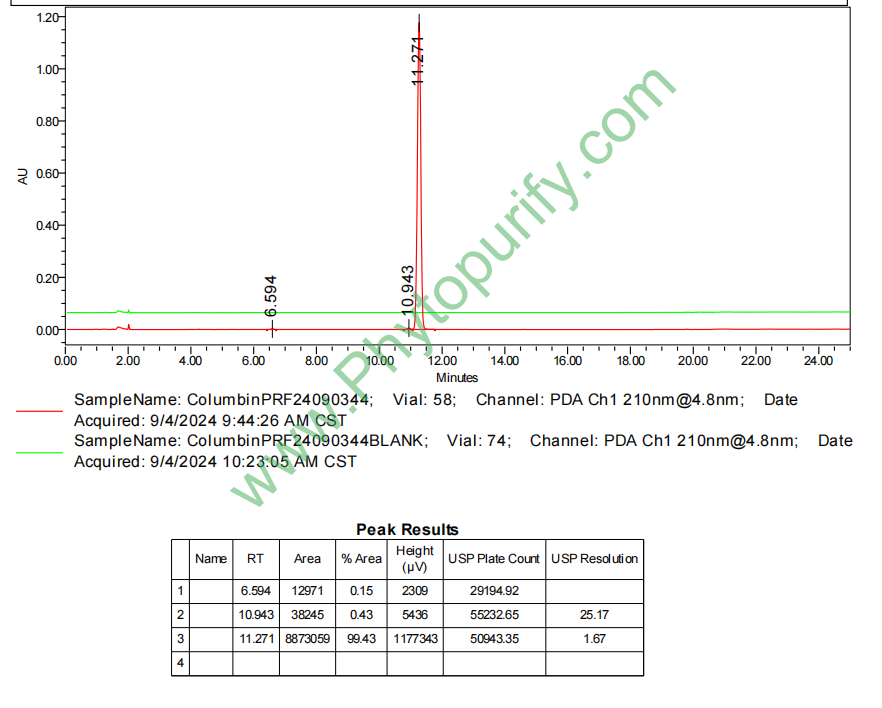
Storage conditions:Short-term storage at 2~8℃, long-term storage at -20 ~ -80℃
Columbin is a naturally occurring diterpenoid furan lactone compound, first isolated from plants in the Rutaceae family. As a natural product with significant biological activity, gulombin has attracted widespread attention due to its oral activity and diverse pharmacological effects. In recent years, with the deepening of pharmacological research on natural products, gulombin has shown unique potential in anti-inflammatory, antiparasitic, and antimalarial fields. Its ability to selectively inhibit cyclooxygenase-2 (COX-2) enzyme provides the molecular basis for its anti-inflammatory effect; At the same time, the effects of gulombin on various malaria parasite related targets suggest its application value in the development of anti malaria drugs. This article will provide a systematic review of the chemical structure and physicochemical properties, plant sources and extraction methods, pharmacological activity and mechanism of action of gulombin, and explore its clinical application prospects and future research directions based on drug evaluation and pharmacokinetic data.
Gulenbin (CAS number: 546-97-4) belongs to the class of diterpenoid furanolactones, with a molecular formula of C20H22O6 and a molecular weight of 358.38. Its structural features include a typical furan lactone ring system and a polycyclic diterpene skeleton, with multiple hydroxyl and carbonyl functional groups, endowing it with high polarity and biological activity. In terms of physical and chemical properties, the LogP value of Gulenbin is 1.85, indicating moderate hydrophobicity and facilitating oral absorption; The topological polar surface area (TPSA) is 92.83 Å ², indicating that it has a certain polarity and is conducive to binding with biomolecules. Gulenbin contains six hydrogen bond receptors, which may be involved in the binding of various enzymes and receptors. In addition, the blood-brain barrier penetration ability of Gulenbin is relatively low, indicating its limited distribution in the central nervous system, which to some extent reduces the risk of central neurotoxicity. Toxicological evaluation shows that gulombin has no significant hepatotoxicity, cardiotoxicity, or hERG channel inhibitory effect, and is relatively safe.
Gurulin mainly exists in plants of the Rutaceae family, such as Calumbae Radix and its related species. In traditional Chinese medicine, these plants are often used to treat diseases such as inflammation and parasitic infections. The extraction of gulombin usually adopts organic solvent extraction method, combined with multi-stage column chromatography purification technology to obtain high-purity compounds. The specific methods include:
In recent years, supercritical fluid extraction and microwave-assisted extraction techniques have also been applied to the extraction of gulombin, improving extraction efficiency and purity.
Gulenbin, as a selective COX-2 inhibitor, exhibits significant anti-inflammatory activity. In vitro experiments showed that the half effective concentration (EC50) of gulombin for COX-2 was 53.1 μ M, which was much lower than the inhibitory concentration for COX-1 (EC50=327 μ M), indicating its high selectivity for COX-2. COX-2 is an inducible cyclooxygenase in inflammatory response, catalyzing the production of prostaglandins and participating in the production of inflammatory mediators. Gulenbin exerts anti-inflammatory effects by inhibiting COX-2 activity and reducing the synthesis of inflammatory mediators. In animal models, gulombin significantly inhibited the expression of inflammatory factors such as tumor necrosis factor - α (TNF - α) and interleukin-6 (IL-6), reducing pathological damage to inflammatory tissues.
Trypanosoma infection is a pathogen of various tropical diseases, and Gulenbin exhibits good inhibitory effects on Trypanosoma. In vitro experiments have shown that gulombin can inhibit the growth and reproduction of trypanosomes, and the mechanism may involve interference with parasite energy metabolism and cell membrane function. This effect provides a theoretical basis for the development of antiparasitic drugs with Gulenbin.
Gulenbin has shown multi-target action characteristics in anti malaria research. Malaria is caused by Plasmodium spp. and involves multiple key protein targets throughout its lifecycle. Gulenbin has been found to act on malaria parasite related targets such as PFCRT, PFMDR1, PFDHFR, PFK13, PFATP6, PFCYTBC, PFPK, PFCYT, PFCYTb, and PfATG8. These targets cover drug transport, metabolic enzymes, protein kinases, and autophagy related proteins, indicating that gulombin may inhibit the growth and survival of malaria parasites through multiple mechanisms. Although the direct in vivo evidence for anti malaria is currently insufficient, its multi-target nature provides new ideas for the design of anti malaria drugs.
Gulenbin blocks the key step of prostaglandin synthesis by specifically binding to the COX-2 active site. Molecular docking and dynamic simulations show that the furanolactone ring of Gulenbin forms a stable binding with the hydrophobic pocket of COX-2, while its hydroxyl group enhances its affinity with the enzyme active center through hydrogen bonding. Compared with COX-1, the structural differences of COX-2 make it easier for gulombin to enter its active pocket, explaining its higher selectivity.
The mechanism of action of Gulenbin on multiple key proteins of Plasmodium is still in the research stage. PFCRT and PFMDR1 are membrane transporters of malaria parasites, involved in drug uptake and excretion. Gulenbin may reverse drug tolerance of malaria parasites by regulating the function of these proteins. PFDHFR is a key enzyme in folate metabolism, and inhibiting its activity can block the nucleic acid synthesis of malaria parasites. PFK13 and PFATP6 are protein kinases and calcium pumps, respectively, which affect the signal transduction and ion homeostasis of malaria parasites. PFCYTBC, PFPK, PFCYT, and PFCYTb are involved in the mitochondrial electron transport chain, and gulombin may cause malaria parasite death by interfering with energy metabolism. PfATG8 participates in autophagy and regulates intracellular homeostasis, and the effect of gulombin on it may affect the survival mechanism of malaria parasites.
The inhibition of Trypanosoma cruzi by Gulombin may be related to its interference with parasite cell membrane integrity and energy metabolism. Research has shown that gulombin can induce an increase in parasite cell membrane permeability, leading to leakage of cell contents and death. In addition, gulombin may inhibit the mitochondrial function of parasites, reduce ATP production, and inhibit their growth.
Gulenbin exhibits ideal characteristics in terms of medicinal properties. Its molecular weight is 358.38, which conforms to the ideal range of Lipinski rule. The LogP value of 1.85 indicates that it has moderate lipid solubility and is conducive to oral absorption. The TPSA is 92.83 Å ², indicating good cell membrane permeability. The number of hydrogen bond receptors is 6, which is moderate and conducive to stable binding with target proteins.
Toxicological evaluation shows that gulombin has no significant hepatotoxicity or cardiotoxicity, and does not inhibit hERG channels, reducing the risk of drug cardiac safety. Its blood-brain barrier penetration ability is relatively low, reducing the possibility of central nervous system side effects. The Ames mutagenicity test data is still lacking, but existing safety information supports its potential as a candidate drug.
In terms of pharmacokinetics, the oral bioavailability of gulombin is good, and its distribution in the body is mainly limited to peripheral tissues. The metabolic pathway may involve hydroxylation of liver enzymes and glucuronic acid binding. Excretion is mainly through the kidneys and bile. Further systematic evaluation of its in vivo metabolic kinetic parameters and drug interaction risks is needed in the future.
As a natural diterpenoid furan lactone, gulombin has shown broad clinical application prospects due to its multiple pharmacological activities of anti-inflammatory, anti parasitic, and anti malaria. In the field of anti-inflammatory drugs, the COX-2 selective inhibitory effect of gulombin makes it a promising new candidate for nonsteroidal anti-inflammatory drugs (NSAIDs), especially for patients who need to reduce gastrointestinal side effects. Its anti trypanosomal activity provides a new drug option for the treatment of tropical parasitic diseases. In terms of anti malaria, the multi-target mechanism of action of gulombin provides a potential strategy for solving the problem of drug resistance in malaria.
Future research should focus on the in vivo pharmacological validation, toxicological system evaluation, and preclinical safety studies of gulombin. Meanwhile, based on its structural characteristics, designing and synthesizing derivatives of gulombin, optimizing their pharmacological and pharmacokinetic properties, will help promote its clinical translation. Combining modern drug delivery systems, such as nanocarriers or targeted drug delivery technologies, can also enhance the bioavailability and tissue selectivity of gulombin.
As a natural product with significant biological activity, gulombin has shown important research value and application potential in the fields of anti-inflammatory, antiparasitic, and anti malaria due to its unique chemical structure and diverse pharmacological effects. Its good pharmacokinetic parameters and safety evaluation have laid the foundation for subsequent drug development. In the future, through in-depth mechanism research, structural optimization, and preclinical studies, gulombin is expected to become an important representative of new natural medicines, providing new solutions for the treatment of related diseases.
