


Synonym name: Melissyl alcohol; Myricyl alcohol; Prosopol
Catalogue No.: BP1404
Cas No.: 593-50-0
Formula: C30H62O
Mol Weight: 438.825
Botanical Source: many plant waxes and plant extracts, such as those from Mucuna aterrima, Heliotropium subulatum, Haloxylon salicornicum and Phyllanthus amarus
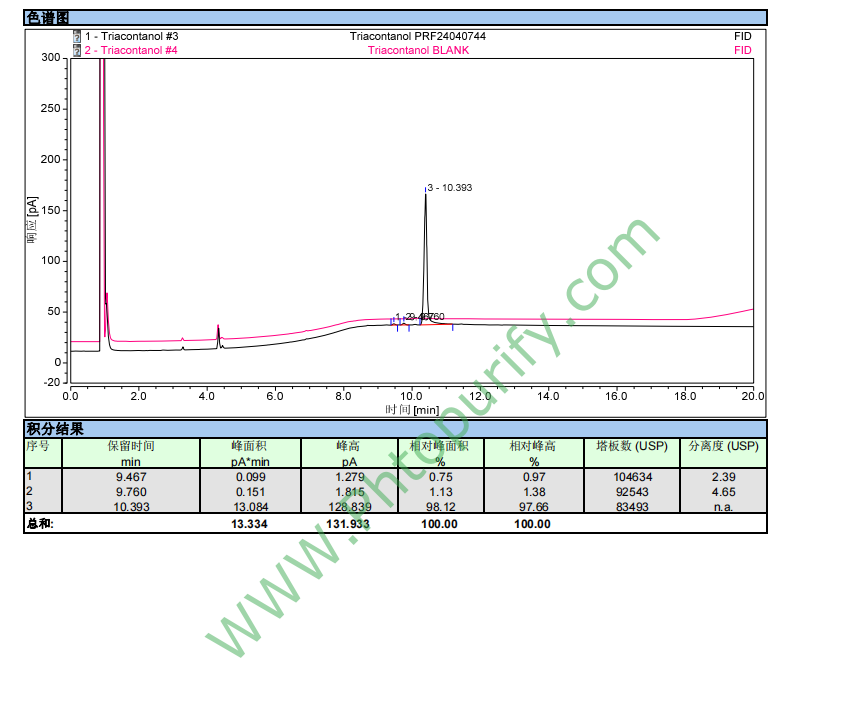
Purity: 90%~95%
Analysis Method: HPLC-DAD or/and HPLC-ELSD
Identification Method: Mass, NMR
Packing: Brown vial or HDPE plastic bottle
Can be supplied from milligrams to grams.
For Reference Standard and R&D, Not for Human Use Directly.
Inquire for bulk scale.
HPLC of Triacontanol
Storage conditions:Short-term storage at 2~8℃, long-term storage at -20 ~ -80℃
20.2300
13.2258
13.2247
.0000
4.6763
3.8220
High
97.7955
1.5042
Yes
No
No
No
No
No
0.0
No
No
No
No
As an important treasure trove for drug discovery and development, natural products continue to provide modern medicine with lead compounds with novel structures and diverse activities. Among them, fatty alcohol compounds have attracted much attention due to their wide range of biological activities. Triacontanol, also known as 1-triacontanol, is a long-chain saturated primary fatty alcohol with a molecular skeleton consisting of thirty carbon atoms and a hydroxyl group at the end. Despite its seemingly simple structure, the application of this compound in agriculture has been extensively studied since its discovery of significant plant growth regulatory activity in the 1970s. In recent years, with the expansion of research, the pharmacological activities of triacontanol in the biomedical field, especially in skin repair and regeneration, have gradually been revealed, showing remarkable prospects for transitioning from plant growth regulators to potential skin repair therapeutic agents. As the largest organ in the human body, the repair of skin damage is a complex biological process involving inflammation, cell proliferation, migration, differentiation, and extracellular matrix remodeling. It involves the intricate regulation of various growth factors, cytokines, and proteases. When this process is disrupted, it can lead to delayed healing, excessive scar formation, or chronic ulcers. Therefore, it is of great significance to search for active substances that can safely and effectively regulate the key links of skin repair. This article aims to systematically review the chemical properties, plant sources, and extraction methods of triacontanol, with a focus on its pharmacological activity, mechanism of action, and molecular targets in skin repair. It also evaluates and prospects its pharmacological properties and clinical application prospects.
The chemical name of triacontanol is 1-triacontanol or n-triacontanol, and its CAS registration number is 593-50-0. Structurally, it is a straight chain saturated fatty alcohol with the molecular formula C ∝₀ H ₆₂ O and a molecular weight of 438.8250. Its structural feature is the presence of a super long alkyl chain (triacontane) composed of 30 carbon atoms, where one methyl hydrogen at the end of the chain is replaced by a hydroxyl group (- OH) to form a primary alcohol structure, thus classified as a super long chain primary fatty alcohol (fatty alcohol ratio of 30:0).
This ultra long carbon chain structure determines the unique physicochemical properties of triacontanol. Firstly, it has extremely strong lipid solubility, with a calculated lipid water partition coefficient (LogP) of up to 13.2258, indicating its high lipophilicity and hydrophobicity. Consistent with this, its water solubility is extremely low and is typically considered insoluble in water (marked as 0.0000 in the data sheet). Its topological polar surface area (TPSA) is only 20.23 Å ², reflecting the limited polarity provided by a single hydroxyl group. These properties imply that triacontanol is difficult to directly disperse and absorb in conventional aqueous biological systems, posing challenges to its bioavailability and formulation development. At room temperature, triacontanol appears as white flaky or needle shaped crystals with high melting and boiling points. From the perspective of medicinal chemistry, its enormous molecular weight and extremely high LogP value far exceed the range of the Rule of Five, indicating that its oral absorption may face significant obstacles. However, for local skin administration, its strong lipophilicity may facilitate penetration of the lipid barrier in the stratum corneum of the skin, providing a theoretical basis for the development of its topical formulations. Preliminary safety evaluation shows that the Ames test result is negative (0.0), indicating no mutagenicity; The lack of inhibitory effect on hERG potassium channels suggests that it may not pose a potential risk of cardiac toxicity, laying a preliminary safety foundation for its further development.
Triacontanol is not unique to any particular plant, but is widely present as a natural ingredient in the wax of various plant skins, seed oils, and secretions of certain insects. Common plant sources rich in triacontanol include sugarcane wax from Saccharum officinarum, alfalfa leaves, bamboo leaves, tea leaves, apple peels, and the wax layer on the epidermis of many grasses. In addition, its presence has also been detected in the leaves of some traditional medicinal plants such as Moringa oleifera. In plants, triacontanol usually forms plant epidermal wax together with other long-chain fatty acids, aldehydes, alkanes, etc., which plays a protective role in preventing non transpiration loss of water, resisting ultraviolet radiation and pathogen infection.
Extracting and purifying triacontanol from these natural raw materials typically requires a series of physical and chemical methods. The classic extraction process begins with organic solvent extraction. Common solvents include non-polar or weakly polar solvents such as chloroform, n-hexane, petroleum ether, and ether, which can effectively dissolve the lipid components in plant wax. After obtaining the crude extract, the ester components in the wax need to be hydrolyzed through saponification reaction (heating under alkaline conditions) to release free fatty alcohols and fatty acids. Subsequently, preliminary separation is carried out by utilizing the difference in solubility between fatty alcohols and fatty acids in organic solvents, or by column chromatography techniques such as silica gel column chromatography and alumina column chromatography. Due to the low content of triacontanol in the mixture and its similar properties to other long-chain alcohols such as hexadecanol and octadecanol, the preparation of high-purity triacontanol often requires more refined separation methods. Recrystallization is a commonly used purification method, and by selecting appropriate solvents (such as acetone, ethyl acetate, or mixed solvents) for multiple recrystallizations, high-purity triacontanol crystals can be obtained. Modern separation techniques, such as preparative high-performance liquid chromatography (HPLC), especially reverse phase chromatography, can achieve more efficient and rapid separation of triacontanol from structurally similar compounds. In addition, supercritical CO ₂ extraction technology, as a green and low-temperature extraction method, has also been explored for selective extraction of wax components from plant materials, but its subsequent separation and purification steps are still indispensable.
Early research on triacontanol mainly focused on its effect as a plant growth regulator, which can significantly promote seed germination, root development, photosynthesis, and yield of various crops at extremely low concentrations (ppm level). In recent years, its pharmacological activity on the human body, especially its repairing effect on skin tissue, has become a research hotspot.
Numerous in vitro and in vivo experimental evidence suggests that triacontanol plays a positive role in multiple stages of skin repair. At the cellular level, studies have shown that triacontanol can promote the proliferation and migration of human skin fibroblasts and keratinocytes, which are key steps in wound re epithelialization and granulation tissue formation. In animal models, local application of triacontanol can effectively accelerate the healing process of full-thickness skin defect wounds. Organizational analysis shows that wounds treated with triacontanol have more complete epithelial regeneration, thicker granulation tissue rich in neovascularization, and more orderly and abundant deposition of collagen fibers. Further research reveals that the reparative effect of triacontanol is not only reflected in accelerating healing speed, but may also improve healing quality. For example, it may promote the synthesis of type III collagen (closer to normal skin structure) by regulating collagen metabolism, while moderately regulating the excessive deposition of type I collagen, potentially reducing the risk of pathological scar formation (such as hypertrophic scars or keloids). In addition, its anti-inflammatory and antioxidant activities have also been reported, which can alleviate early inflammatory reactions and oxidative stress damage in wounds, creating a more favorable microenvironment for repair. In addition to its direct repairing effect, triacontanol has also been explored as a functional cosmetic additive for improving skin moisturization, elasticity, and anti-aging due to its good skin affinity and potential barrier repair function.
The molecular mechanism of triacontanol promoting skin repair has not been fully elucidated, but existing research suggests that its effect is the result of multi-target and multi pathway synergy, involving the regulation of multiple biological processes such as extracellular matrix metabolism, growth factor signaling, cell adhesion and migration. Based on the provided target information, the mechanism of action network can be summarized as follows:
Regulating the balance of matrix metalloproteinases (MMPs)MMPs are key enzymes that degrade extracellular matrix (ECM) and are crucial during the matrix remodeling stage of wound healing. However, their overexpression can lead to excessive degradation of ECM and hinder repair. Research has shown that triacontanol can downregulate the overexpression of MMP-1 (collagenase-1), MMP-2 (gelatinase A), and MMP-9 (gelatinase B). This helps maintain the necessary ECM structure during the repair phase, providing a stable scaffold for cell migration and angiogenesis, and preventing the formation of chronic ulcers.
Activate growth factor related signaling pathways Triadecanol may promote repair by affecting various growth factors and their receptors.
Promote extracellular matrix synthesis and assembly Collagen is the main component of the skin's ECM. Triacontanol can upregulate the gene expression of type III collagen (COL3A1) and type IV collagen (COL4A1). Type III collagen is an important component of early granulation tissue and normal skin dermis, and its increase helps to form more flexible repair tissues. Type IV collagen is the main component of the basement membrane and is crucial for the reconstruction and stability of the epidermal dermal junction.
Affects cell adhesion and migration Integrin β 1 (ITGB1) is an important adhesion molecule receptor on the cell surface, mediating the interaction between cells and ECM components such as collagen and fibronectin. It is crucial for cell migration, spreading, and signal transduction. Triacontanol may enhance the adhesion and directional migration ability of fibroblasts and keratinocytes in the wound bed by regulating the expression or activity of ITGB1.
In summary, triacontanol may promote beneficial ECM synthesis and assembly by inhibiting excessive ECM degradation (downregulating MMPs), upregulating COL3A1 and COL4A1, activating pro proliferative and angiogenic signals (involving EGFR, FGF2, VEGFA), and finely regulating key fibrosis related pathways (TGFB1) through a synergistic network, while enhancing cell-matrix interactions (ITGB1), thus comprehensively promoting the development of ordered and high-quality healing of skin wounds.
From the perspective of drug development, the drug likeness of triacontanol presents distinct characteristics and challenges.
Advantage aspects Firstly, its natural origin and long history of use in agriculture suggest that it has good biocompatibility and low acute toxicity. Preliminary in vitro toxicology data (Ames negative, no hERG inhibition) also support its safety. Secondly, extremely high lipophilicity (LogP>13) may translate into good stratum corneum penetration ability for local skin administration, making it easy to achieve effective concentrations locally on the skin, while the systemic absorption may be low, thereby reducing the risk of systemic side effects. This makes it very suitable to be developed as a delivery system for topical preparations, such as cream, gel, ointment or new carriers (liposomes, nanoemulsions, solid lipid nanoparticles).
Challenges and limitations The main challenge lies in its extremely poor water solubility and huge molecular weight. This results in an expected extremely low oral bioavailability, making it unsuitable for development as an oral formulation. Even in local administration, how to effectively formulate it into a stable, uniform, and user-friendly dosage form is still a major challenge, usually requiring the use of surfactants, co solvents, or advanced nanocarrier technology. Its high blood-brain barrier permeability (predicted as "high") suggests that if it is absorbed by the system, it may easily enter the central nervous system, which may be advantageous for brain targets. However, for drugs that mainly act on peripheral skin, potential unknown central effects need to be considered.
Pharmacokinetic study At present, there is a lack of systematic pharmacokinetic studies on triacontanol in mammals, which is related to its positioning as an external drug and the difficulty of analysis and detection. It can be inferred that the main pharmacokinetic processes of topical application include: release from the formulation, penetration into the stratum corneum of the skin, distribution in the dermis and subcutaneous tissue, and binding to local cellular targets to exert pharmacological effects. A small amount that may be absorbed into the systemic circulation through skin microvasculature is expected to be highly bound to plasma proteins and mainly metabolized by the liver (possibly gradually shortening the carbon chain through ω - or β - oxidation) before being excreted by the kidneys or bile. Due to its strong lipophilicity, it may accumulate in adipose tissue. In future development, it is necessary to clarify the skin pharmacokinetic characteristics, systemic exposure levels, and their relationship with efficacy and safety after local administration through standardized preclinical and clinical studies.
The pharmacological activity of triacontanol in the field of skin repair has depicted broad potential prospects for its clinical application, but its transformation still requires solid research and development work.
Potential application directions:
1. Treatment of chronic difficult to heal wounds: such as diabetes foot ulcer, venous ulcer, pressure injury, etc. These wound healing delays are often associated with overexpression of MMPs, lack of growth factors, insufficient angiogenesis, and recurrent infections. The multi-target regulatory effects of triacontanol, particularly the inhibition of MMPs, promotion of angiogenesis (VEGFA), and ECM synthesis (COL3A1), may make it a new option for adjuvant therapy of such diseases.
2. Burn and acute trauma repair Used to accelerate the healing of burn wounds and surgical wounds, reduce the risk of infection, and possibly improve the appearance and function of the healed skin by adjusting the collagen ratio (type III/I), reducing scars.
3. Skin barrier repair and anti-aging cosmetics As a functional ingredient, it is used to repair damaged skin barriers caused by dryness, sensitivity, photoaging, etc., and enhance skin moisturizing and elasticity. It promotes collagen synthesis and inhibits the activity of MMPs, which is highly compatible with the demand for anti-aging.
4. Adjuvant treatment for skin diseases May be used for skin care of certain skin diseases with skin barrier dysfunction or delayed repair, such as atopic dermatitis and psoriasis vulgaris (stable phase).
Future research and development focus:
1. Innovation in formulation technology This is the core bottleneck for the clinical application of triacontanol. It is necessary to develop efficient, stable, and transdermal delivery systems, such as lipid based nanocarriers (nanostructured lipid carriers, liposomes), microemulsions, liposomes, etc., to improve their dispersibility, stability, and skin permeability in aqueous matrices.
2. Deep analysis of the mechanism of action More cellular and molecular level research is needed to precisely elucidate how triacontanol interacts with the aforementioned targets (such as EGFR, ITGB1), whether it is directly bound or indirectly regulated? What is the upstream signal perception mechanism? Are there any key receptors or pathways that have not yet been discovered?
3. Preclinical and clinical evaluation of the system: Carry out standardized animal pharmacodynamics experiments to verify its efficacy in different types of wound models (diabetes wounds, infected wounds, etc.). Conduct a comprehensive preclinical toxicology evaluation (including local irritation, allergenicity, long-term toxicity, etc.). Ultimately, by designing rigorous clinical trials, evaluate its safety, efficacy, and optimal medication regimen in the human body.
4. Structural optimization and derivative development Given the limitations of its prototype molecule in terms of physicochemical properties, structural modifications can be considered, such as preparing more water-soluble prodrugs (such as phosphate esters and polyethylene glycol derivatives), or synthesizing their analogues to improve drug properties while retaining activity.
Triadecanol, a plant derived long-chain fatty alcohol, is transitioning from its traditional role as a plant growth promoter to a candidate drug for skin repair with multi-target regulatory potential. It exhibits encouraging biological effects in accelerating wound healing and improving repair quality by regulating the synergistic network of MMPs, growth factors, collagen synthesis, and cell adhesion related targets. Although its extreme hydrophobicity and enormous molecular weight pose significant challenges to drug development, this precisely indicates its most likely successful application pathway - topical application. In the future, through breakthroughs in formulation, in-depth elucidation of the mechanism of action, and standardized clinical verification, triacontanol is expected to be developed into a new type of topical drug or high-end functional skincare raw material for treating chronic wounds and improving skin repair quality, providing a natural source and multi-functional new choice for the field of skin repair. The research process also inspires us to maintain an open perspective in the exploration of natural products, as many known compounds may contain novel pharmacological activities against human diseases that have not yet been discovered.
