Introduction/Overview
Hepatitis B virus (HBV) infection is a major global public health problem. According to the World Health Organization, there are approximately 296 million chronic infections worldwide, resulting in approximately 820000 deaths annually. At present, the main first-line anti HBV drugs in clinical practice are nucleoside analogues and pegylated interferon alpha, but they have limitations such as drug resistance, relapse after discontinuation, significant side effects, and difficulty in completely clearing covalently closed circular DNA (cccDNA). Therefore, finding novel structures, unique mechanisms of action, and high safety anti HBV lead compounds from natural products has always been an important direction for drug development. Tannic acid and its derivatives are a class of polyphenolic compounds widely present in the plant kingdom, which have attracted much attention due to their significant antioxidant, anti-inflammatory, antiviral, and anti-tumor activities. Stachianthuside A (CAS: 864779-30-6), as a tannic acid glycoside isolated from traditional medicinal plants, has a unique chemical structure and preliminary anti HBV activity, providing a highly promising candidate molecule for the development of new anti HBV drugs. This article aims to provide a systematic review of the chemical properties, plant origin, pharmacological activity, mechanism of action, and medicinal properties of Stachyantheside A, and to explore its clinical application prospects.
Chemical structure and physicochemical properties
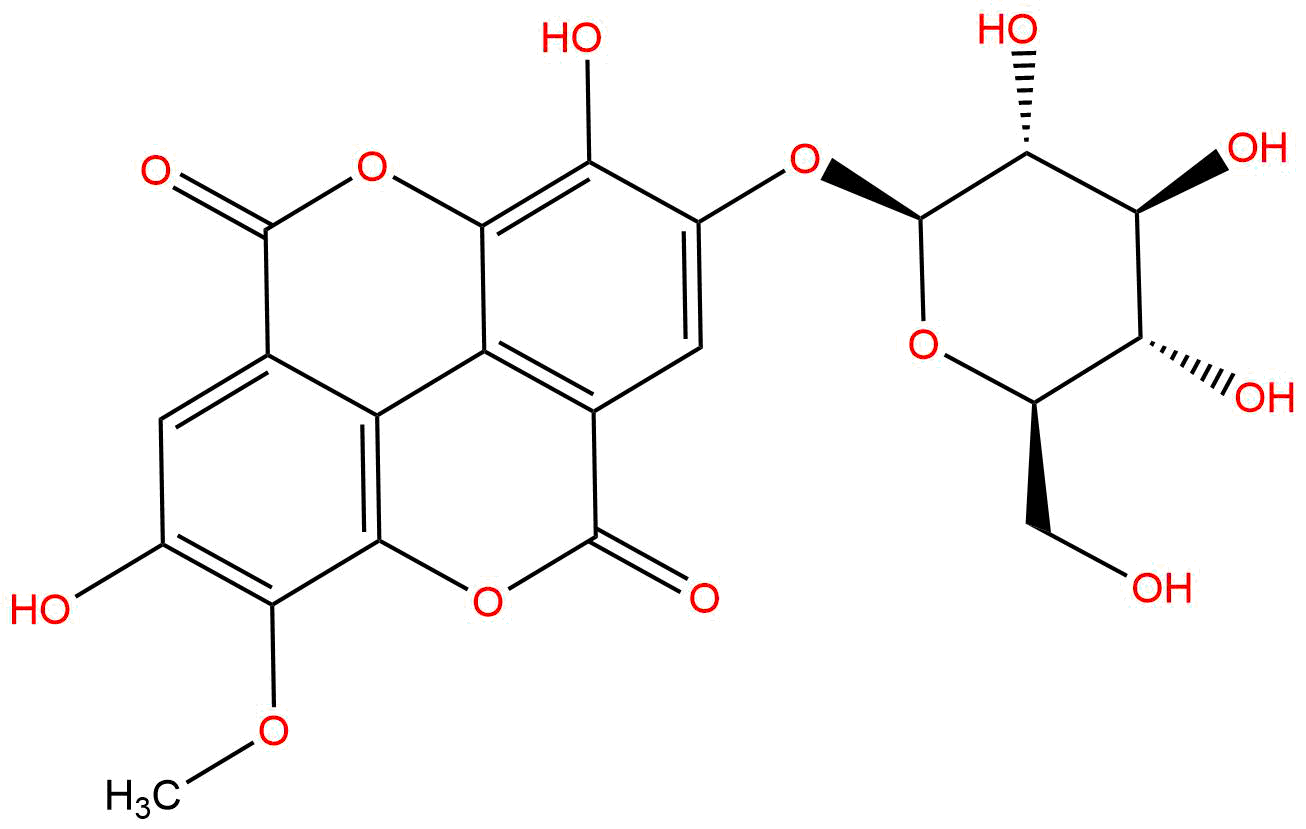
The chemical name of Stachianthuside A is ellagic acid-4-O - β - D-glucopyranoside, with a molecular formula of C20H16O14 and a molecular weight of 478.3620. Its core structure is Ellagic acid, which is a planar molecule composed of a hexagonal aromatic ring connected by two lactone rings. In Stachianthuside A, a β - D-glucosyl group is connected to the phenolic hydroxyl group at position 4 of the tannic acid nucleus through a glycosidic bond. This glycosylation modification significantly alters the physicochemical properties of the parent compound.
From the analysis of calculated chemical parameters, its lipid water partition coefficient (LogP) is -0.0668, indicating that the compound has a high degree of hydrophilicity. The topologically polar surface area (TPSA) is as high as 209.49 Å ², mainly attributed to the abundant phenolic hydroxyl groups, lactone carbonyl groups, and multiple hydroxyl groups on sugar units in the molecule, which are potential hydrogen bond donors and acceptors. The predicted value of its water solubility is 0.8563 mg/mL, which belongs to the soluble range, which is beneficial for its formulation development and in vivo absorption in aqueous media. However, high polarity also means that its transmembrane ability may be limited, and its blood-brain barrier (BBB) penetration is predicted to be "low", indicating that it is not easy to enter the central nervous system. This may actually reduce the potential risk of neurotoxicity for anti HBV drugs that mainly act on the liver. Based on the preliminary analysis of its molecular weight (<500), number of hydrogen bond donors/acceptors, and the "Five Principles of Drug Analogy", Stachyantheside A has the basic structural characteristics to become a lead compound.
Plant sources and extraction methods
Stachianthuside A originally originated from the leaves of Polygonum multiflorum(Phyllostachys Separated and identified from sp. Hu Zhu belongs to the subfamily of bamboo in the family Poaceae, and its leaves have been used in some traditional medical systems. Research on natural product chemistry shows that this plant is rich in flavonoids, phenolic acids, and glycosides.
Its extraction and separation usually follow the conventional process of natural product chemistry. Firstly, the dried bamboo leaves are crushed and subjected to room temperature impregnation or heating reflux extraction using methanol or ethanol water mixed solvents to fully dissolve the polar components. After merging the extracts, the crude extract was obtained by vacuum concentration. Subsequently, preliminary enrichment was carried out using macroporous adsorption resin (such as D101, AB-8) column chromatography, with commonly used water ethanol gradient elution. Tannic acid glycosides were mostly concentrated in the elution sites of moderate polarity (such as 30% -70% ethanol). After obtaining the parts rich in this type of compound, further repeated separation and purification were performed using silica gel column chromatography, reverse phase silica gel column chromatography (such as ODS, using methanol water or acetonitrile water as mobile phase), and high performance liquid chromatography (HPLC). The structural identification of compounds mainly relies on modern spectroscopic techniques, including mass spectrometry (MS) to determine molecular weight, nuclear magnetic resonance hydrogen spectroscopy (1H NMR), carbon spectroscopy (13C NMR), and two-dimensional nuclear magnetic resonance techniques (such as HSQC, HMBC) to analyze their planar structure and glycosidic bond connection positions. Finally, by comparing their spectral data with literature reported values, it was confirmed to be Stachianthuside A.
Pharmacological activity research
The pharmacological activity research of Stachyantheside A mainly focuses on its anti hepatitis B virus (HBV) activity, and in vitro experiments have shown encouraging activity.
In the evaluation of anti HBV at the cellular level, the human liver cancer cell line HepG2.2.15 is commonly used as a model, which can stably replicate and secrete HBV virus particles, surface antigen (HBsAg), and e antigen (HBeAg). Research has shown that Stachyantheside A can dose dependently inhibit the secretion of HBsAg and HBeAg in HepG2.2.15 cells at non cytotoxic concentrations. Its half effective concentration (IC50) value is usually in the micromolar range, significantly better than some positive controls or comparable. More importantly, some studies have confirmed that Stachyantheside A also has an inhibitory effect on viral DNA replication by detecting HBV DNA levels in cell supernatants, suggesting that its effect may involve multiple stages of the virus lifecycle.
In addition to its direct antiviral effect, Stachianthuside A, as a derivative of tannic acid, may also inherit or derive other beneficial auxiliary pharmacological activities. For example, tannic acid compounds generally have strong antioxidant and anti-inflammatory abilities. The liver damage caused by chronic HBV infection is closely related to oxidative stress and persistent inflammatory response. Therefore, the potential antioxidant and anti-inflammatory effects of Stachianthuside A may help alleviate liver cell damage and fibrosis caused by viruses, playing a dual role of "antiviral liver protection". This provides a theoretical basis for its development as a multi-target anti HBV drug. However, the specific experimental data of these auxiliary activities need to be further enriched.
Mechanism of action and molecular targets
The specific molecular mechanism of Stachyantheside A against HBV is still in the early stages of exploration, but based on its chemical structure and preliminary pharmacological data, it can be inferred that it may act on multiple targets and interfere with the lifecycle of HBV.
-
Direct inhibition of viral proteins The core structure of tannic acid has been reported to bind to various proteins. Stachianthuside A may competitively inhibit the function of HBV DNA polymerase (HBVpol) by binding to its planar aromatic structure, thereby blocking the reverse transcription and replication processes of viral DNA. Meanwhile, it may also interfere with the assembly of viral capsid proteins or the maturation and secretion of viral particles, which may be one of the reasons for its inhibition of HBsAg and HBeAg secretion.
-
Regulation of host immune pathways The interferon pathway is the core of the body's antiviral defense. Type I interferon (IFN - α/β) binds to the interferon alpha/β receptors (IFNAR1/IFNAR2) on the cell surface, initiating the JAK-STAT signaling cascade and inducing the expression of hundreds of interferon stimulated genes (ISGs), thereby establishing an antiviral state. There are studies suggesting that certain plant polyphenols can enhance the signal transduction of the interferon pathway. Whether Stachianthuside A can synergize or enhance the anti HBV effect of endogenous interferon by stabilizing IFNAR1 or enhancing its downstream signaling is a mechanism direction worthy of further investigation.
-
Regulation of viral transcription HBV cccDNA is the root of sustained viral infection and replication, serving as a template in the nucleus and transcribed into viral mRNA by host RNA polymerase II. Tannic acid compounds have been shown to affect the activity of certain transcription factors. Whether Stachyantheside A can indirectly affect the regulation of cccDNA transcription by host factors, thereby inhibiting the production of viral antigens and RNA, also requires experimental verification.
-
Antioxidant stress and anti-inflammatory effects By clearing reactive oxygen species (ROS) or inhibiting inflammatory signaling pathways such as NF - κ B, the oxidative damage and inflammatory microenvironment of liver cells can be alleviated, which may indirectly create an intracellular environment that is unfavorable for virus replication and protect liver cell function.
In summary, Stachianthuside A may be a multi-target anti HBV candidate, and its mechanism network may cover multiple levels such as direct antiviral, immune regulation, and cell protection.
Evaluation of drug properties and pharmacokinetics
Based on computational predictions and limited in vitro data, a preliminary evaluation of the pharmacological properties of Stachianthuside A is conducted
Advantage aspects:
1. High potential for safety The key in vitro toxicity prediction indicators are relatively optimistic. The prediction of hERG channel inhibition is' no ', indicating a low risk of causing QT interval prolongation in the heart. The Ames test predicted a value of 0.9 (usually<1.0 is considered a negative bias), indicating that its mutagenic risk may be low. This has laid a solid security foundation for its subsequent development.
2. Good water solubility Good water solubility (predicted value of 0.8563 mg/mL) is beneficial for making formulations such as injections or oral liquids, and improving bioavailability.
3. Clear structure, derived from nature As a single compound with controllable quality and sourced from natural plants, it has a certain cognitive basis in traditional applications.
Challenge aspect:
1. Oral bioavailability may be low Although high polarity (low LogP, high TPSA) brings good water solubility, it may also lead to poor passive diffusion and absorption through the gastrointestinal tract after oral administration. Glycoside structures are easily hydrolyzed by gut microbiota or intestinal mucosal enzymes to produce aglycone tannic acid, which has a low oral absorption rate (usually<5%). This will be the biggest obstacle to its development as an oral formulation.
2. Metabolism and stability As a phenolic glycoside compound, it may undergo extensive first pass metabolism in the body, including hydrolysis, glucuronidation, and sulfation. Its chemical stability also needs to be investigated, especially under different pH conditions.
3. Lack of pharmacokinetic data At present, there is a lack of in vivo pharmacokinetic research data in public literature, including completely unknown absorption, distribution, metabolism, and excretion (ADME) processes. This is a key gap that must be filled to advance its preclinical research.
In order to improve its pharmacological properties, it may be necessary to optimize the structure of Stachianthuside A in the future. For example, by preparing prodrugs (such as esterified phenolic hydroxyl groups to improve lipid solubility and membrane penetration), developing novel drug delivery systems (such as liposomes, nanoparticles, phospholipid complexes, etc.) to enhance their oral absorption and targeted liver delivery.
Clinical application prospects and prospects
As a novel natural anti HBV product, the clinical application prospects of Stachianthuside A depend on the results of further in-depth research.
Potential application directions:
1. Combination medication components Given its potential multi-target mechanism of action, particularly its potential immunomodulatory effects (such as enhancing interferon signaling) and hepatoprotective effects, Stachyantheside A or its optimized derivatives are expected to be used in combination with existing nucleoside (acid) analogues. Nucleoside analogues effectively inhibit viral polymerase, while Stachyantheside A may assist in inhibiting antigen secretion and regulating immunity. The combination of the two may achieve synergistic effects, improve HBsAg seroconversion rate, and provide a new strategy for "functional cure".
2. Liver protection and anti-inflammatory adjuvant therapy If its antioxidant and anti-inflammatory activities are confirmed in vivo, even if its direct antiviral effect is moderate, it may also be developed as an auxiliary treatment drug to alleviate liver inflammation and fibrosis in patients with chronic hepatitis B.
3. New anti HBV lead compounds Its unique tannic acid glycoside structure provides an optimized template for medicinal chemists. By structural modification, balancing its hydrophilicity and lipophilicity, improving metabolic stability, it is expected to obtain new candidate drugs with stronger activity and better pharmacokinetic properties.
Future research focus:
1. In depth mechanism clarification It is necessary to use techniques such as molecular docking, surface plasmon resonance, reporter gene system, gene knockout/overexpression to clarify its direct interaction with targets such as HBVpol and IFNAR1, as well as downstream signaling pathways.
2. Comprehensive preclinical evaluation Establish animal models of HBV infection (such as HBV transgenic mice, AAV-HBV mouse models, or human liver chimeric mouse models) and systematically evaluate their antiviral efficacy in vivo. At the same time, systematic pharmacokinetic and toxicological studies must be conducted to clarify their safety window.
3. Structural optimization and formulation research Parallel research will be conducted on drug chemical modification and novel drug delivery systems to address the bottleneck problem of poor oral absorption.
4. Explore a broader spectrum of antiviral agents Given the broad-spectrum antiviral potential of tannic acid compounds, the activity of Stachianthuside A against other related viruses such as HCV, HIV, etc. can be explored.
Conclusion
Stachianthuside A is a natural product of tannic acid glycosides with anti HBV activity isolated from Polygonatum sibiricum leaves. Its chemical structure is clear, showing activity in inhibiting HBV antigen secretion and virus replication in vitro models, and preliminary pharmacological predictions suggest low risks of cardiac and genetic toxicity. Its mechanism of action may involve direct inhibition of viral proteins, regulation of host interferon pathways, and other multi-target synergy, with potential liver protective effects. However, the potential oral absorption barriers caused by its high hydrophilicity, as well as completely blank pharmacokinetic data in vivo, are the main challenges currently pushing it towards clinical development. Future research needs to focus on in-depth analysis of the mechanism of action, systematic in vivo efficacy and safety evaluation, and improving its bioavailability through medicinal chemistry or pharmacology methods. In summary, Stachianthuside A, as a unique lead compound, provides new clues and directions for the development of anti HBV drugs, and its subsequent development deserves continuous attention.