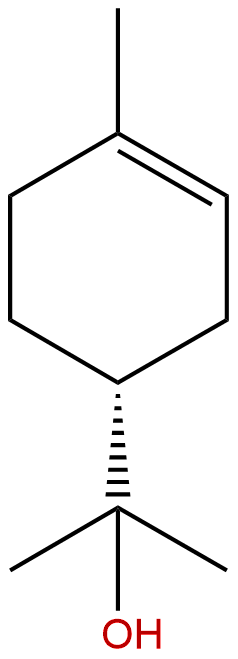


Synonym name: Terpinol; Terpineol 350
Catalogue No.: BP0158
Cas No.: 98-55-5
Formula: C10H18O
Mol Weight: 154.253
Botanical Source: Widely distributed in nature (>260 sources) as the chiral or racemic forms. Both stereoisomers occur widely in essential oils (Artemisia, Cinnamomum, Juniperus, Eucalyptus and Mentha spp.)
Purity: 95%~99%
Analysis Method: HPLC-DAD or/and HPLC-ELSD
Identification Method: Mass, NMR
Packing: Brown vial or HDPE plastic bottle
Can be supplied from milligrams to grams.
For Reference Standard and R&D, Not for Human Use Directly.
Inquire for bulk scale.
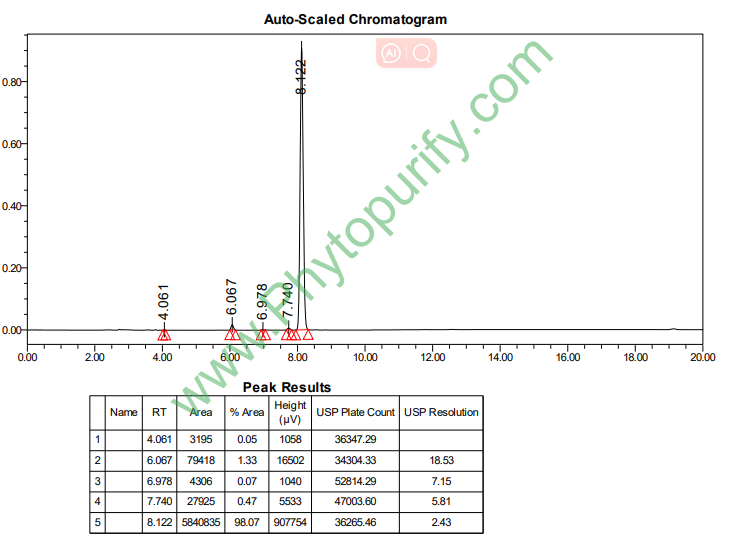
HPLC of Alpha-Terpineol
Storage conditions:Short-term storage at 2~8℃, long-term storage at -20 ~ -80℃
20.2300
2.6000
2.4000
1.5000
High
Yes
No
No
No
No
No
Alpha Terpineol (CAS number: 98-55-5) is a natural terpenoid alcohol compound widely present in various plant essential oils, especially in Eucalyptus urophylla(Eucalyptus globulus The content in Labill is relatively abundant. As an important plant metabolite, alpha terpineol has attracted much attention due to its diverse biological activities, covering multiple fields such as anti-tumor, anti-inflammatory, antibacterial, antifungal, and neuroprotective effects. In recent years, with the in-depth development of natural product pharmacology, the pharmacological mechanism, molecular targets and pharmaceutical characteristics of α - terpineol have been gradually revealed, showing its potential application value in metabolic syndrome, infectious diseases, inflammatory pathological conditions, neuropathic pain and other diseases.
This article provides a systematic review of the chemical structure and physicochemical properties, plant sources, and extraction methods of alpha terpineol, with a focus on its pharmacological activity and mechanism of action. Combined with pharmacological evaluation and pharmacokinetic data, it explores its clinical application prospects and future research directions, aiming to provide comprehensive and authoritative reference materials for researchers in the field of natural product pharmacology.
Alpha terpineol is a monoterpene alcohol with the chemical name prop-2-ol substituted at position 2 by 4-methylcyclohexene-3-en-1-yl. Its molecular formula is C10H18O and its molecular weight is 154.25. Structurally, α - terpineol contains a cyclohexene ring with one hydroxyl group and a 4-methyl substituent, and is a common monocyclic monoterpene alcohol in terpenoids. Its physical and chemical properties are as follows:
Toxicological data shows that the LD50 of alpha terpineol is approximately 4300 mg/kg, indicating its low acute toxicity. The liver toxicity, cardiac toxicity, and hERG channel inhibition experiments were all negative, and the Ames mutagenicity test also showed no mutagenicity, indicating its high safety and good potential for drug development.
Alpha terpineol is widely present in the essential oils of various aromatic plants, especially eucalyptus(Eucalyptus globulus The content in Labill is relatively significant. In addition, alpha terpineol can also be detected in plants such as pine needles, lavender, lemon eucalyptus, basil, and thyme. Its main form of existence is free monoterpene alcohols, which participate in plant defense mechanisms and signal transduction as secondary metabolites.
The extraction method mainly relies on the distillation technology of plant essential oils, including steam distillation and volatile solvent extraction. In recent years, in order to improve extraction efficiency and purity, supercritical CO2 extraction technology and microwave-assisted extraction methods have gradually been applied to the extraction of alpha terpineol. The selection of extraction process has a significant impact on the quality and biological activity of the product, and optimizing extraction conditions is the key to achieving industrial production.
The purification steps usually use techniques such as column chromatography and high-performance liquid chromatography (HPLC) to ensure the acquisition of high-purity alpha terpineol to meet the needs of pharmacological research and clinical applications.
Numerous in vitro and in vivo studies have confirmed that alpha terpineol has significant anti-tumor activity. Its main mechanism of action is to inhibit the nuclear factor kappa B (NF - κ B) signaling pathway, block tumor cell proliferation, and promote apoptosis. As a key transcription factor for tumor cell survival, proliferation, and anti apoptosis, the inhibition of NF - κ B activity is of great significance for tumor treatment. Alpha sitosterol can reduce the nuclear translocation of NF - κ B and the expression of downstream inflammatory factors and anti apoptotic proteins, thereby inhibiting the growth of tumor cells.
In addition, some studies have shown that alpha terpineol can regulate the p38 MAPK and ERK signaling pathways, further affecting the expression of cell cycle and apoptosis related proteins, and enhancing anti-tumor effects.
Alpha terpineol has a significant inhibitory effect on inflammatory response. It inhibits the production of inflammatory mediators (such as TNF - α, IL-1 β, IL-6, etc.) in human macrophages stimulated by lipopolysaccharide (LPS) by interfering with the NF - κ B, p38 MAPK, and ERK MAPK pathways, thereby reducing the inflammatory response. This mechanism of action lays the foundation for its potential therapeutic value in various inflammatory diseases.
Animal experiments have shown that alpha terpineol can alleviate tissue damage in inflammatory models and reduce the expression of inflammatory factors, indicating its good anti-inflammatory therapeutic potential.
α - terpineol exhibits inhibitory effects on various pathogenic bacteria and fungi, especially exhibiting strong antibacterial activity against periodontal disease associated bacteria and cariogenic bacteria. Its antibacterial mechanism may involve disrupting the integrity of bacterial cell membranes, interfering with cellular metabolism and protein synthesis.
In addition, alpha terpineol has an effect on fungi such as Trichophyton mentagrophytes Exhibiting antifungal activity, it can cause irreversible fungal cell division and inhibit fungal growth. This characteristic makes it potentially valuable for the prevention and treatment of skin fungal infections and oral infections.
Alpha terpineol has excellent blood-brain barrier penetration ability, demonstrating its potential to play a role in the central nervous system. Related studies have shown that alpha terpineol can alleviate neuropathic pain and reduce neuroinflammatory responses, possibly by regulating the expression of neurotransmitters and inflammatory mediators.
Its anti-inflammatory and antioxidant properties also provide a theoretical basis for neuroprotection, and are expected to be applied in the treatment of neurodegenerative diseases and chronic pain.
Alpha terpineol exhibits a certain regulatory effect in metabolic syndrome related diseases. By activating AMPK and regulating metabolism related targets such as PPAR γ, α - terpineol may improve lipid metabolism abnormalities and insulin resistance, and has potential intervention value for metabolic diseases.
In addition, α - terpineol has been studied for various diseases such as diarrhea, infection, and inflammation, demonstrating broad pharmacological activity and application prospects.
The multiple pharmacological effects of alpha terpineol are attributed to its regulation of multiple signaling pathways and molecular targets:
In summary, α - terpineol achieves its broad pharmacological activity through the synergistic action of multiple targets and pathways.
Alpha terpineol has good medicinal properties:
In the future, it is necessary to strengthen systematic research on the in vivo metabolism kinetics of alpha terpineol to guide clinical dose design and optimization of dosing regimens.
Alpha terpineol has shown broad clinical application prospects due to its diverse pharmacological activities and good safety:
Future research should focus on preclinical pharmacokinetic evaluation, formulation development, and clinical trials of alpha terpineol to further validate its safety and efficacy. Meanwhile, based on its multi-target mechanism of action, explore combination therapy strategies to enhance therapeutic efficacy.
As a widely sourced and biologically active natural terpenoid alcohol, alpha terpineol has demonstrated significant pharmacological value in various fields such as anti-tumor, anti-inflammatory, antibacterial, neuroprotective, and metabolic regulation. Its good safety and drug properties have laid a solid foundation for clinical application. In the future, with the in-depth analysis of pharmacological mechanisms and advances in formulation technology, alpha terpineol is expected to become an important candidate molecule in the development of natural product drugs, providing new drug options for the treatment of various diseases.
Continuous basic and clinical research will drive alpha terpineol from the laboratory to clinical practice, promote the development and innovation of natural product pharmacology, and benefit a wide range of patients.
