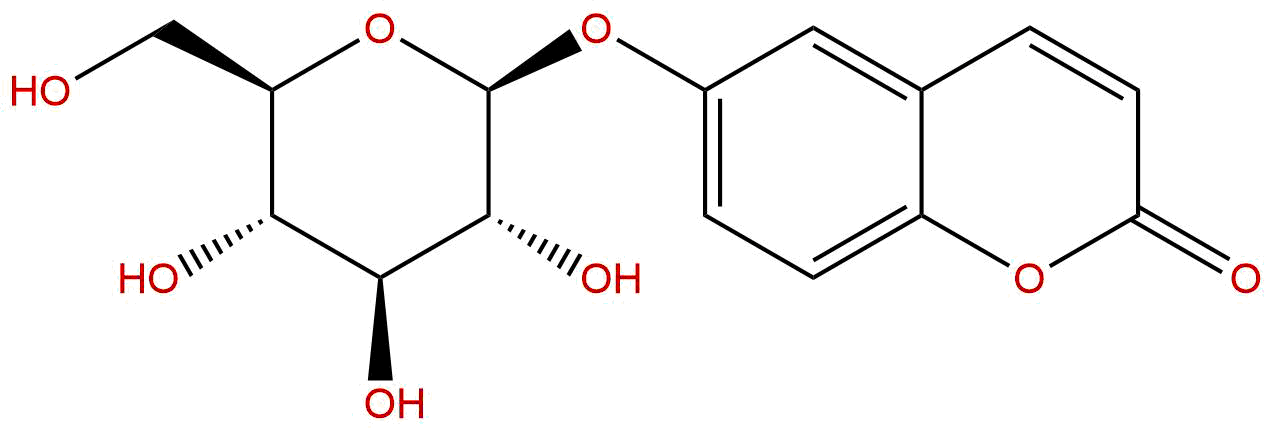


Product name: 6-(β-D-Glucopyranosyloxy)-2H-1-benzopyran-2-one
Synonym name: 6-(β-D-吡喃葡萄糖氧基)-2H-1-苯并吡喃-2-酮;6-O-葡萄糖基香豆素
Catalogue No.: BP2396
Cas No.: 220640-27-7
Formula: C15H16O8
Mol Weight: 324.285
Botanical Source:
Type of Compound: Coumarins
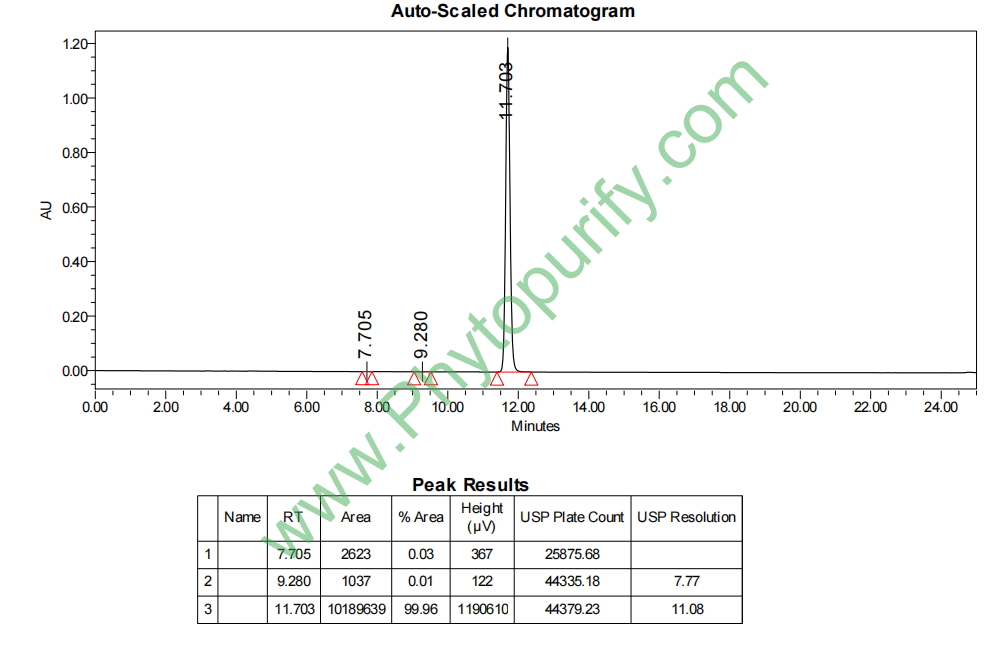
Purity: 95%~99%
Analysis Method: HPLC-DAD or/and HPLC-ELSD
Identification Method: Mass, NMR
Packing: Brown vial or HDPE plastic bottle
Storage: Store in a well closed container, protected from air and light. Put into refrigerate or freeze for long term storage.
Whenever possible, you should prepare and use solutions on the same day. However, if you need to make up stock solutions in advance, we recommend that you store the solution as aliquots in tightly sealed vials at -20℃. Generally, these will be useable for up to two weeks.
The product could be supplied from milligrams to grams
Inquire for bulk scale.
For Reference Standard and R&D, Not for Human Use Directly.
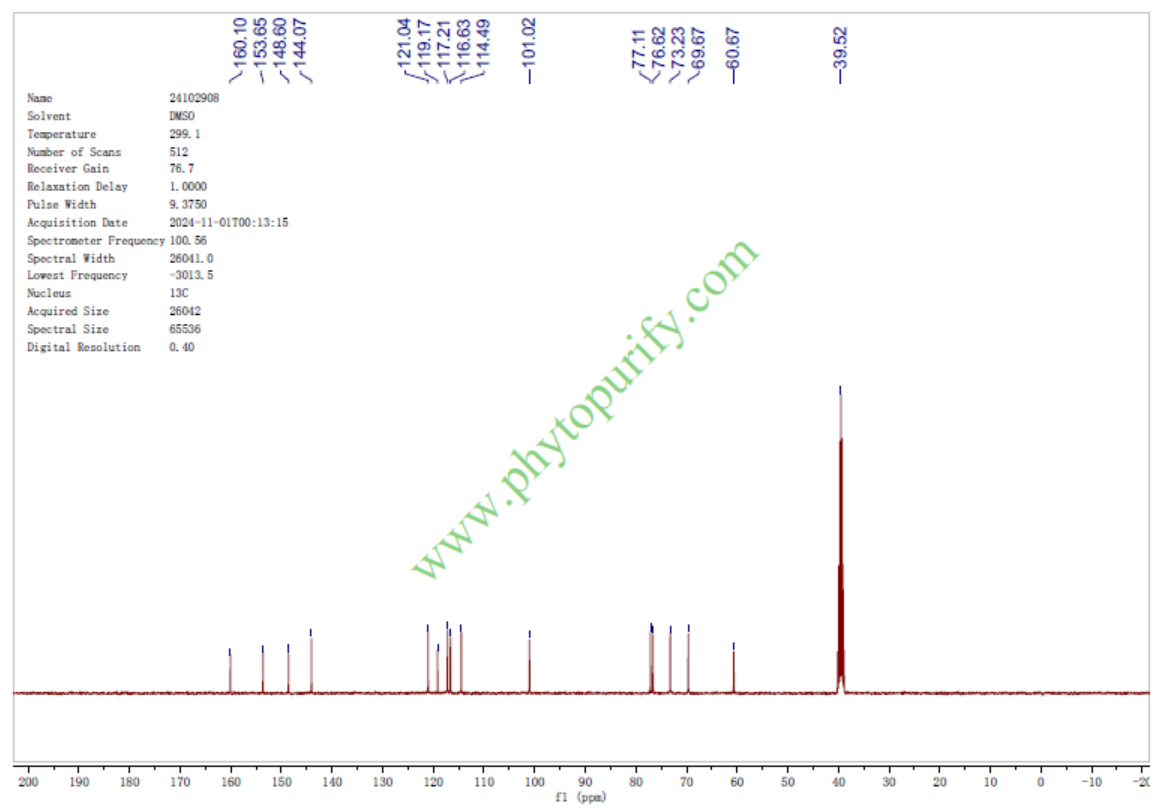
NMR of 6-(β-D-Glucopyranosyloxy)-2H-1-benzopyran-2-one
HPLC of 6-(β-D-Glucopyranosyloxy)-2H-1-benzopyran-2-one
Storage conditions:Short-term storage at 2~8℃, long-term storage at -20 ~ -80℃
129.5900
-.2612
-.2609
6.7028
.7135
.3045
Low
38.6553
3.5341
Yes
No
No
No
Yes
Yes
0.9
Yes
Yes
Yes
Yes
Natural products, as an important source of drug discovery and development, have long played an indispensable role in the human fight against diseases. Among them, coumarins are a class of secondary metabolites widely present in the plant kingdom, with their basic parent nucleus being benzo [a] - pyranone. This type of compound has diverse structures and rich pharmacological activities, including anti-inflammatory, antioxidant, anti-tumor, anticoagulant, antiviral, and neuroprotective effects, and has always been a hot topic in natural product chemistry and pharmacology research. In recent years, with the deepening understanding of the importance of glycosylation modification in natural products, coumarin glycosides have attracted much attention due to their unique physicochemical properties and biological activities.
Coumarin-6-O-glucoside (6- (β - D-Glucopyranosyloxy) -2H1-benzopyran-2-one), as a typical coumarin monoglycoside, is characterized by a glucose group connected to the 6th carbon atom of the coumarin nucleus through a β - glycosidic bond. This glycosylation modification not only significantly changes the polarity and water solubility of the parent coumarin, but also may affect its interaction mode with biological targets, thereby exhibiting unique pharmacological activities different from its aglycone. Existing research indicates that this compound has potential application value in the field of neurological diseases, especially in sedation and anti anxiety. Its mechanism of action may involve the regulation of multiple targets closely related to emotion regulation and neurotransmitter transmission, such as monoamine oxidase A (MAOA), serotonin transporter (SLC6A4), dopamine D2 receptor (DRD2), serotonin 1A receptor (HTR1A), and gamma aminobutyric acid type A receptor alpha 1 subunit (GABRA1).
This review aims to systematically review the research progress of coumarin-6-O-glucoside, and explore its chemical structure and physicochemical properties, plant sources and extraction methods, pharmacological activity, mechanism of action and molecular targets, drug evaluation and pharmacokinetic properties from multiple dimensions. It also looks forward to its clinical application prospects, in order to provide comprehensive scientific basis for further research and development of this natural product.
The chemical structure of coumarin-6-O-glucoside is clear, and its core skeleton is 2H-1-benzopyran-2-one (i.e. coumarin), which is connected to a β - D-glucopyranose group through an oxygen atom (- O -) on the 6th carbon atom of the mother nucleus. The systematic nomenclature (IUPAC) for this compound is 6- (β - D-Glucopyranosyloxy) -2H1-benzopyran-2-one. Its molecular formula is C ₁₅ H ₁₆ O ₈, and its molecular weight is 324.2850 g/mol. Structurally, this molecule combines the hydrophobic planar structure of the coumarin parent nucleus with the hydrophilicity brought by multiple hydroxyl groups of the glucose group, making it a typical "amphiphilic" molecule.
Physical and chemical properties are key factors determining the biological activity and drug properties of compounds. The lipid water partition coefficient (LogP) of coumarin-6-O-glucoside is -0.2612, which indicates its strong hydrophilicity and better solubility in the aqueous phase than in the lipid phase. This characteristic is closely related to the glucose group containing multiple polar hydroxyl groups in its molecule. Its polar surface area (TPSA) is 129.5900 Å ², which is a relatively large value, typically indicating that the compound has low membrane permeability. The water solubility parameter is 6.7028, further confirming its good water solubility. These physicochemical properties collectively determine the absorption, distribution, metabolism, and excretion (ADME) process of the compound in the body. For example, higher water solubility and larger polar surface area are often unfavorable for passive diffusion through cell membranes, especially the blood-brain barrier (BBB). In fact, existing data also indicates that its blood-brain barrier penetration ability is relatively low (BBB: low). In addition, preliminary toxicity prediction results showed that the compound has a low risk of inhibiting hERG potassium channels (related to cardiac toxicity) (hERG inhibition: No), and showed negative results in Ames test (bacterial revertant mutation test: 0.9), suggesting that it may not have significant genetic toxicity. These physicochemical properties and preliminary safety assessment data provide important foundational information for subsequent pharmacological research and drug development.
Coumarin-6-O-glucoside is not a rare compound and has been discovered and identified in various medicinal plants. Its plant sources are extensive, mainly distributed in plant groups such as Apiaceae, Asteraceae, Fabaceae, Rubiaceae, etc. For example, the presence of this compound has been reported in traditional medicinal plants used for calming the nerves, such as Valeriana officinalis, Gentiana macrophylla, and certain citrus plants. In addition, coumarin-6-O-glucoside has also been detected in some plants with anti-inflammatory or antioxidant activity, such as Apium graveolens and certain Salvia plants. Its content varies significantly among different plants and is usually influenced by various factors such as plant species, growth environment, harvest season, and location.
The extraction of this compound usually follows the classic process of natural product chemistry and needs to be optimized based on its physicochemical properties. Due to the good water solubility of coumarin-6-O-glucoside, traditional solvent extraction methods often use solvents with higher polarity. Common extraction solvents include methanol, ethanol, water, or their mixed solvents (such as different concentrations of methanol/water or ethanol/water). The extraction methods include room temperature immersion, heating reflux, ultrasound assisted extraction, and microwave-assisted extraction. Among them, ultrasound assisted extraction is widely used due to its simple operation, high efficiency, and good protection of thermosensitive components. After filtration and concentration of the extract, crude extract is obtained.
Further separation and purification are key steps in obtaining high-purity coumarin-6-O-glucoside. Due to the complex composition of plant crude extracts, it is usually necessary to combine multiple chromatographic techniques. Common methods include:
1. Liquid-liquid extraction By using solvents of different polarities (such as petroleum ether, ethyl acetate, n-butanol, etc.) for fractional extraction of crude extracts, the target compound can be enriched in n-butanol or aqueous phase.
2. Column chromatography method This is the most essential purification method. Common stationary phases include silica gel, macroporous adsorption resin (such as D101, HP-20), polyamide and dextran gel (such as Sephadex LH-20). The eluent usually uses chloroform methanol water or methanol water systems with different ratios. Macroporous adsorption resin is particularly suitable for separating water-soluble glycoside compounds, and preliminary separation can be achieved through gradient elution.
3. High performance liquid chromatography (HPLC)For mixtures with similar structures that are difficult to separate, preparative HPLC is the ultimate means of obtaining high-purity monomeric compounds. Usually, a reverse phase C18 chromatography column is used, with acetonitrile water or methanol water system as the mobile phase, combined with a UV detector (usually at the characteristic absorption wavelength of coumarin, such as around 320 nm) for monitoring and collection.
Through the above extraction, separation, and purification processes, pure coumarin-6-O-glucoside can be obtained that meets the needs of structural identification and pharmacological activity research. Its structure is usually confirmed by techniques such as nuclear magnetic resonance spectroscopy (NMR, including ¹ H-NMR, ¹ ³ C-NMR, 2D-NMR), mass spectrometry (MS), and ultraviolet spectroscopy (UV).
Existing research has revealed that coumarin-6-O-glucoside exhibits various pharmacological activities, particularly in the field of the nervous system, while also demonstrating potential in other areas.
1. Sedative and anti anxiety effects
This is the pharmacological activity of the compound that has received the most attention. Multiple in vitro and in vivo experimental evidence supports its significant sedative and anti anxiety effects. In classic animal behavior models such as the Elevated Cross Maze Test (EPM), Open Field Test (OFT), and Light Dark Box Test (LDB), experimental animals given coumarin-6-O-glucoside showed a significant reduction in anxiety like behavior, such as prolonged open arm dwell time and increased central region activity. Meanwhile, in the pentobarbital induced sleep experiment, the compound can synergistically prolong sleep time, reduce sleep latency, and exhibit significant sedative and hypnotic effects. Its activity intensity is positively correlated with dosage, and no significant damage to motor coordination ability was observed (such as in the baton rotation experiment), suggesting that it may have good safety.
2. Neuroprotective effect
In addition to regulating emotional behavior, coumarin-6-O-glucoside also exhibits certain neuroprotective potential. In vitro cell experiments have shown that in neuronal cell models damaged by oxidative stress (such as hydrogen peroxide H ₂ O ₂ induction) or excitotoxicity (such as glutamate induction), pretreatment with this compound can improve cell survival, reduce lactate dehydrogenase (LDH) release, decrease intracellular reactive oxygen species (ROS) levels, and inhibit cell apoptosis. These effects may be related to their antioxidant and anti apoptotic properties.
3. Other potential activities
Preliminary studies also suggest that coumarin-6-O-glucoside may have other biological activities. For example, some in vitro experiments have found that it has certain anti-inflammatory activity and can inhibit the production of nitric oxide (NO) and pro-inflammatory cytokines (such as TNF - α, IL-6) in macrophages stimulated by lipopolysaccharide (LPS). In addition, there are sporadic reports that it may have a weak inhibitory effect on the proliferation of certain tumor cell lines, but relevant research is not yet in-depth, and the conclusion needs further verification.
The pharmacological activity of coumarin-6-O-glucoside, especially its sedative and anti anxiety effects, is the result of the synergistic action of multiple molecular targets. Based on existing research, its mechanism of action mainly involves the regulation of monoaminergic and GABAergic systems.
1. Regulation of monoamine energy system
Monoamine neurotransmitters such as serotonin (5-HT), dopamine (DA), and norepinephrine (NE) play a central role in emotion regulation. Coumarin-6-O-glucoside may affect the system in the following ways:
- Inhibition of monoamine oxidase A (MAOA)MAOA is a key enzyme for degrading monoamine neurotransmitters. Inhibiting MAOA activity can increase the levels of 5-HT, NE, and DA in synaptic cleft, thereby producing antidepressant and anti anxiety effects. Molecular docking and enzyme activity assays showed that coumarin-6-O-glucoside can bind to the active site of MAOA and inhibit its activity in a concentration dependent manner.
- Regulating 5-hydroxytryptamine transporter (SLC6A4)SLC6A4 is responsible for reuptake of 5-HT from synaptic cleft to presynaptic neurons and is a classic target of selective serotonin reuptake inhibitors (SSRIs). This compound may inhibit the reuptake of 5-HT by interacting with SLC6A4, thereby increasing the concentration of 5-HT in synaptic cleft and exerting anti anxiety effects.
- Acting on the 5-hydroxytryptamine 1A receptor (HTR1A)HTR1A is an important subtype of the 5-HT receptor family, mainly distributed in brain regions such as the raphe nucleus and hippocampus. The HTR1A on the presynaptic membrane acts as a self receptor and can inhibit the release of 5-HT upon activation; The activation of HTR1A in the postsynaptic membrane mediates anti anxiety and anti depression effects. Coumarin-6-O-glucoside may act as a partial agonist or forward allosteric modulator of HTR1A, producing anti anxiety effects by activating postsynaptic HTR1A receptors.
- Affects dopamine D2 receptor (DRD2)DRD2 plays a crucial role in reward, motivation, and motor control. Although its role in anxiety disorders is complex, research suggests that moderate activation of DRD2 in the midbrain limbic system may help alleviate anxiety. The regulatory effect of this compound on DRD2 may be a complementary mechanism to its anti anxiety spectrum.
2. Regulation of the GABAergic system
Gamma aminobutyric acid (GABA) is the most important inhibitory neurotransmitter in the central nervous system. GABAA receptors are the main targets of classic sedative hypnotic drugs such as benzodiazepines.
- Acting on GABAA receptor alpha 1 subunit (GABRA1)GABRA1 is one of the main subunits that make up GABAA receptors, widely distributed in the cerebral cortex, hippocampus, and cerebellum. Benzodiazepines enhance the activation effect of GABA on receptors by binding to the site between GABRA1 and γ 2 subunits, thereby exerting sedative, anti anxiety, and anticonvulsant effects. Research suggests that coumarin-6-O-glucoside may enhance GABA mediated chloride ion influx through positive allosteric regulation by interacting with the benzodiazepine binding site on the GABRA1 subunit, thereby enhancing central inhibitory effects. This may be the main molecular basis for its sedative effect.
3. Multi target synergistic effect
It is worth noting that coumarin-6-O-glucoside does not act on a single target, but instead produces a synergistic sedative and anti anxiety effect by simultaneously regulating multiple targets such as MAOA, SLC6A4, HTR1A, DRD2, and GABRA1. This "multi-target" mode of action may make it more effective than drugs targeting a single target, and may have a lower risk of side effects, as its intensity of action is relatively mild and less likely to cause excessive activation or inhibition of receptor function.
To develop natural products into clinical drugs, a comprehensive evaluation of their drug like and pharmacokinetic (ADME) properties is necessary. The preliminary pharmacological data of coumarin-6-O-glucoside has provided important clues for its drug development potential.
1. Evaluation of drug properties
- Physicochemical properties As mentioned earlier, the compound has a moderate molecular weight (324.28), which meets the requirements of Lipinski's Rule of Five for molecular weight (<500). But its LogP is negative (-0.26), indicating strong hydrophilicity, which is usually not conducive to oral absorption and permeation through biofilms. Its TPSA is relatively large (129.59 Å ²), indicating poor passive diffusion ability. Therefore, the compound may not belong to the ideal "drug like" molecule, and its oral bioavailability may be low.
- Security prediction The preliminary toxicity prediction results are encouraging. HERG inhibition has a low risk and reduces the potential risk of cardiac toxicity (QT interval prolongation). The Ames test is negative, indicating that it may not have mutagenicity. These data provide preliminary guarantees for its safety, but more comprehensive in vivo toxicology studies (such as acute toxicity, long-term toxicity, reproductive toxicity, etc.) are needed to verify it.
2. Pharmacokinetic characteristics
- absorb Due to its good water solubility, low LogP, and high TPSA, coumarin-6-O-glucoside has poor ability to passively diffuse through gastrointestinal epithelial cells. Its oral absorption may mainly rely on active transport mediated by intestinal transporters such as glucose transporters GLUTs or sodium glucose cotransporters SGLTs. Therefore, its oral bioavailability may not be high, and there may be significant individual differences and food effects.
- distribution This compound has good water solubility and is mainly distributed in plasma and extracellular fluid. Its binding rate with plasma proteins remains to be studied. The most crucial thing is that its blood-brain barrier penetration ability is predicted to be 'low'. This is a huge challenge for a drug targeting the central nervous system. Although it may have limited transport through glucose transporters on the BBB (such as GLUT1), overall, its concentration in the brain may be low. This suggests that in order to achieve central efficacy, it may be necessary to develop non oral routes of administration (such as nasal administration) or design prodrug strategies.
- Metabolism As a glycoside compound, coumarin-6-O-glucoside is likely to be hydrolyzed by glycosidases in the gut microbiota or liver in vivo, releasing the aglycone (6-hydroxycoumarin). Glycosides may further undergo phase II metabolism (such as glucuronidation, sulfation) or phase I metabolism (such as hydroxylation). Therefore, its efficacy in the body may be the result of the combined action of the prototype drug and metabolites.
- excretion Due to its high water solubility, this compound and its metabolites are likely to be mainly excreted in urine through the kidneys in their original form or in the form of bound compounds.
Summary The pharmacological evaluation of coumarin-6-O-glucoside presents a situation of both opportunities and challenges. Its good water solubility and initial safety are its advantages, but its low oral bioavailability and low central nervous system penetration are its main shortcomings. Future pharmaceutical chemistry research should focus on how to overcome these barriers, such as improving oral absorption and brain delivery efficiency through structural modifications (such as prodrug design, introduction of lipophilic groups) or novel drug delivery systems (such as nanoparticles, liposomes).
Based on the unique pharmacological activity spectrum and mechanism of action of coumarin-6-O-glucoside, it has shown certain potential in clinical translation, but also faces many challenges.
1. Potential clinical application areas
- Anxiety disorder and insomnia This is its most direct potential application area. It produces sedative and anti anxiety effects through the synergistic action of multiple targets (MAOA, SLC6A4, HTR1A, GABRA1), and has good preliminary safety. It is expected to be developed as a new type of anti anxiety or sedative hypnotic drug with fewer side effects. Especially for patients who have poor response or intolerance to existing benzodiazepines (prone to dependence and tolerance) or SSRIs (slow onset, multiple side effects), it may provide a new treatment option.
- Neurodegenerative diseases Its neuroprotective effects (antioxidant, anti apoptotic) suggest that it may have potential value as an adjuvant therapy for neurodegenerative diseases such as Alzheimer's disease and Parkinson's disease. By reducing oxidative stress and neuronal damage, it may delay disease progression.
- Functional gastrointestinal diseases Given the close association between anxiety and functional gastrointestinal diseases such as irritable bowel syndrome (IBS), the central anti anxiety effect and possible peripheral anti-inflammatory effect of this compound make it of certain exploratory value in the treatment of brain gut axis related diseases.
2. Challenges faced and future research directions
- Pharmacokinetic bottleneck As mentioned earlier, low oral bioavailability and low BBB penetration are the biggest obstacles limiting its clinical translation. Future research priorities should include:
- Prodrug design By chemical modification, the hydroxyl group on the glucose group is esterified or etherified to improve lipid solubility, allowing it to be interpreted by enzymes in the body and release the prototype drug.
- Drug delivery system Using nanotechnology (such as polymer nanoparticles, liposomes, solid lipid nanoparticles) to encapsulate the compound and improve its oral absorption and brain targeting. Direct nasal administration into the brain is also a worthwhile avenue to explore.
- structural optimization On the basis of maintaining the core pharmacophore, explore the effects of other sugar groups (such as mannose, galactose) or non sugar substituents on activity and pharmacokinetic properties.
- In depth elucidation of the mechanism of action Although multiple potential targets have been identified, the interaction network between each target, the exact binding mode in vitro, and the specific effects in different brain regions still need to be validated through more precise experiments such as gene knockout animal models, brain slice electrophysiological recordings, and optogenetic techniques.
- Comprehensive safety evaluation The current toxicity data is mainly based on computer predictions and preliminary in vitro experiments. Systematic in vivo toxicology studies must be conducted, including acute toxicity, subchronic toxicity, reproductive and developmental toxicity, as well as potential effects on important organs such as the liver and kidneys, to comprehensively evaluate their safety.
- Conversion from preclinical to clinical After completing sufficient pharmacological, pharmacokinetic, and toxicological studies, rigorous clinical trials (phases I to III) need to be designed to validate its effectiveness, safety, and optimal dosing regimen in humans.
Coumarin-6-O-glucoside, as a naturally occurring coumarin glycoside with a unique structure, has become an attractive research object in the field of natural product pharmacology due to its significant activity in sedation and anti anxiety, as well as its unique mechanism of regulating multiple targets such as MAOA, SLC6A4, HTR1A, DRD2, and GABRA1. Its good water solubility and preliminary safety evaluation results provide a favorable foundation for its development. However, the low oral bioavailability and blood-brain barrier penetration caused by its inherent physicochemical properties are key bottlenecks that restrict its transition from laboratory to clinical application.
In the future, research on this compound should focus on two core directions: one is to address its pharmacokinetic deficiencies through medicinal chemistry and pharmaceutical methods (such as prodrug design and nano delivery systems); The second is to use modern molecular biology and pharmacology techniques to deeply elucidate the precise mechanism of multi-target synergistic effects. Only in this way can the medicinal potential of this natural product be fully explored, and it is expected to be developed into a new type of drug for treating neurological diseases such as anxiety and insomnia, contributing to the cause of human health. The research process of coumarin-6-O-glucoside once again confirms the eternal value of natural products as a treasure trove of drug lead compounds, as well as the key role of modern science and technology in analyzing and optimizing the medicinal properties of natural products.
