| Catalog No | Package | Original Price | Price | Inventory | Quantity | Operating |
|---|---|---|---|---|---|---|
| BP4714-5mg | 5mg | $250.00 | Sign in |
|


Storage conditions:Short-term storage at 2~8℃, long-term storage at -20 ~ -80℃
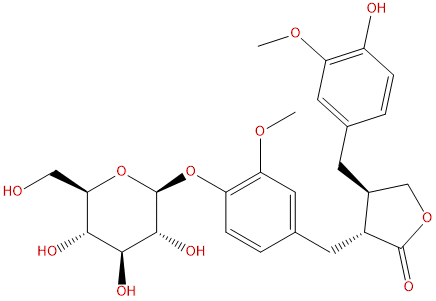
Matairesinoside (CAS No. 23202-85-9) is a kind of lignans natural product from plants, which has attracted extensive attention in the field of natural product pharmacology due to its significant biological activity. As a natural compound with antibacterial, antioxidant and virus cell fusion inhibitory activities, Arhat rosin shows potential application value in anti-inflammatory, antiviral and neuroprotective pharmacological effects. Its structure is based on the (-) - matairenol skeleton, and is endowed with unique physicochemical properties and biological activity through modification with β - D-glucosyl groups. In recent years, with the in-depth study of plant lignans, the pharmacological mechanism, molecular targets and pharmaceutical evaluation of Arhat rosin have gradually become clear, laying a solid foundation for its clinical transformation. The purpose of this paper is to systematically review the chemical structure, plant origin, pharmacological activity, mechanism of action, pharmaceutical properties and future application prospects of Arhat rosin, hoping to provide theoretical basis and practical guidance for related research.
Podocarpine glycoside is a kind of lignans. Its core structure is (-) - matairesinol, and its molecular weight is 520.5310. Its structural characteristics are mainly manifested by glycosylation modification through a β - D-glucose residue on one phenolic hydroxyl group of matairesinol, forming β - D-glucoside. This structure endows Arhat rosin with high polarity and water solubility (2.3281), and its topological polar surface area (TPSA) is 164.37 Ω², indicating that it has a strong polar group, which has an important impact on its biological activity and pharmacokinetics. The LogP value is 0.6907, indicating that it has moderate lipid solubility, which is conducive to the penetration of molecules in biological membranes without excessive hydrophobicity, balancing the requirements of solubility and membrane permeability.
In addition, Arhat rosin does not have hERG channel inhibitory activity, suggesting that its risk of cardiac toxicity is low; The Ames test result is 0.0, indicating no significant genotoxicity risk. The low permeability of the blood-brain barrier may limit its direct effects in the central nervous system, but this also reduces potential central nervous system side effects. Overall, the physical and chemical properties of Arhat rosin provide a good basis for its use as a drug candidate molecule.
Podocarpine glycosides are mainly found in the genus Matairesia, which is one of the unique secondary metabolites of the genus. This type of plant is widely distributed in East Asia and Southeast Asia, traditionally used in traditional Chinese medicine for anti-inflammatory and antibacterial treatment. The extraction of Arhat rosin usually uses polar solvent (such as methanol, ethanol or water ethanol mixed solvent) to extract the dried plant powder, and purification is carried out in combination with liquid-liquid distribution and column chromatography technology.
The specific extraction process generally includes:
After drying and crushing the plant materials, reflux extraction is carried out with 70% ethanol for 2-3 hours, and repeated 2-3 times to ensure sufficient release of the components.
2. Combine the extraction solutions, concentrate to an appropriate volume, and use liquid-liquid extraction to remove fat soluble impurities.
3. Separate by silica gel column chromatography or reverse phase C18 column chromatography, and monitor purity by high performance liquid chromatography (HPLC).
4. Finally, high purity rosin glycoside was obtained by preparative HPLC.
In recent years, new technologies such as ultrasonic assisted extraction and microwave assisted extraction have also been applied to the extraction of Arhat rosin, which improves the extraction efficiency and purity, reduces the use of organic solvents, and conforms to the concept of green chemistry.
Podocarpine rosin showed broad-spectrum antibacterial activity, and had inhibitory effect on a variety of Gram positive and negative strains. In vitro experiments have shown that its minimum inhibitory concentration (MIC) is in the micromolar range and can effectively inhibit the growth of common pathogenic bacteria such as Staphylococcus aureus and Escherichia coli. The antibacterial mechanism may be related to its disruption of bacterial cell membrane integrity and inhibition of cell wall synthesis, but the specific molecular mechanism still needs further clarification.
As lignans, Arhat rosin has significant free radical scavenging capacity. Its phenolic hydroxyl structure and sugar modification endow it with strong electron donor ability, which can effectively eliminate superoxide anion radicals, hydroxyl radicals, and hydrogen peroxide. The in vitro antioxidant capacity has been validated through various methods such as DPPH, ABTS, and FRAP, demonstrating strong antioxidant potential and helping to alleviate the pathological progression of oxidative stress-related diseases.
Arhat rosin showed unique activity in inhibiting virus cell fusion, especially for envelope viruses such as influenza virus and coronavirus. Its mechanism of action may involve interfering with the binding of virus surface glycoproteins to host cell receptors, blocking the process of virus invasion, and thereby inhibiting virus replication and spread. This activity provides a new approach for its development as an antiviral drug.
Arhat rosin showed significant anti-inflammatory effect in a variety of inflammatory models. It can inhibit the release of inflammatory mediators such as IL-6 and TNF - α, reduce the activation of inflammatory signaling pathways, and alleviate inflammatory reactions. Relevant in vivo and in vitro experiments show that Arhat rosin can effectively alleviate tissue damage caused by inflammation, which has potential value in treating inflammatory diseases.
The pharmacological action of Arhat rosin is closely related to its multi-target regulation, especially in the field of anti-inflammatory. Its main molecular targets include:
Through multi target synergy, rosin glycosides can effectively regulate inflammatory response, reduce oxidative stress, inhibit pathogen infection, and show comprehensive pharmacological advantages.
Arhat rosin showed ideal characteristics in the aspect of pharmaceutical properties. Its molecular weight is 520.5310, slightly higher than the recommended upper limit of 500 Da by Lipinski rules, but its LogP (0.6907) and TPSA (164.37 Å ²) are both within a reasonable range, indicating that it has good water solubility and moderate lipid solubility, which is conducive to absorption and distribution in vivo.
The low permeability of the blood-brain barrier suggests that it mainly acts on peripheral tissues, reducing the risk of central nervous system side effects. The hERG channel inhibition test was negative, reducing the risk of cardiac toxicity. The Ames test is non mutagenic and has high safety.
In terms of pharmacokinetics, the glycoside structure of Arhat rosin may affect its oral bioavailability, and the glycoside bond may be hydrolyzed under the action of intestinal flora or intestinal enzymes, releasing the active mother nucleus (-) - matairesinol. This process may both enhance activity and affect pharmacokinetic parameters. There is currently limited research on pharmacokinetics in vivo, and in the future, it is necessary to focus on its absorption, distribution, metabolism, and excretion (ADME) characteristics, especially the glycoside hydrolysis kinetics and activity evaluation of metabolites.
Based on the multiple pharmacological activities of Arhat rosin, especially its potential in anti-inflammatory, antibacterial and antiviral fields, its clinical application prospects are broad. At present, the demand for treatment of chronic inflammatory diseases, infectious diseases and viral diseases is growing. As a candidate molecule of natural product medicine, rosiroside has the following application advantages:
Future research should focus on its preclinical pharmacokinetic and toxicological evaluation, dosage form development and clinical trial design to promote the clinical transformation of Arhat rosin. In addition, structural modifications and optimization of drug delivery systems will also promote the improvement of its efficacy and safety.
As a kind of natural lignans with multiple biological activities, rosin glycosides show a wide range of pharmacological potential with its unique chemical structure and good pharmaceutical properties. Its application research in anti-inflammatory, antibacterial, and antiviral fields continues to deepen, revealing its multi-target mechanism of action and molecular target specificity. Although the research on its pharmacokinetics and clinical application is still in its infancy, Arhat rosin is undoubtedly an important candidate molecule in the development of natural product drugs. In the future, through systematic pharmacological evaluation and clinical verification, rosin glycoside is expected to become a new natural drug, serving the prevention and treatment of various diseases, and promoting the development and innovation of natural product pharmacology.
