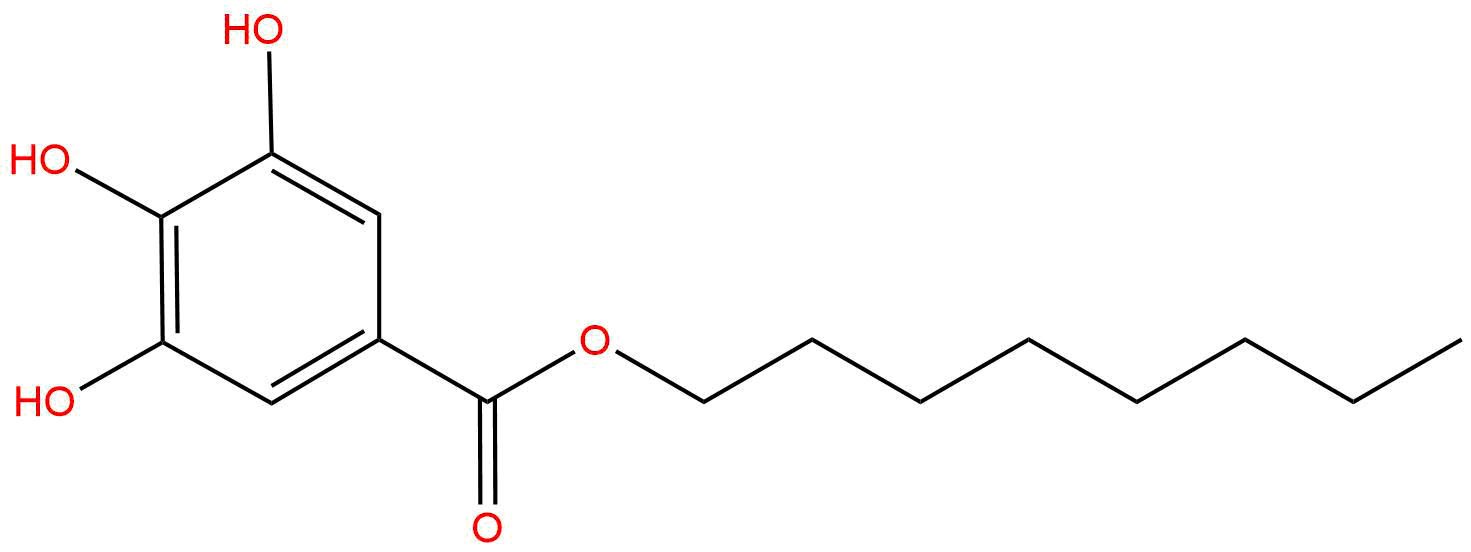


Product name: Octyl gallate
Synonym name:
Catalogue No.: BP3279
Cas No.: 1034-01-1
Formula: C15H22O5
Mol Weight: 282.336
Botanical Source:
Physical Description:
Type of Compound: Aliphatics
Purity: 95%~99%
Analysis Method: HPLC-DAD or/and HPLC-ELSD
Identification Method: Mass, NMR
Packing: Brown vial or HDPE plastic bottle
The product could be supplied from milligrams to grams. Inquire for bulk scale.
We provide solution to improve the water-solubility of compounds, thereby facilitating the variety of activity tests and clinic uses.
For Reference Standard and R&D, Not for Human Use Directly.
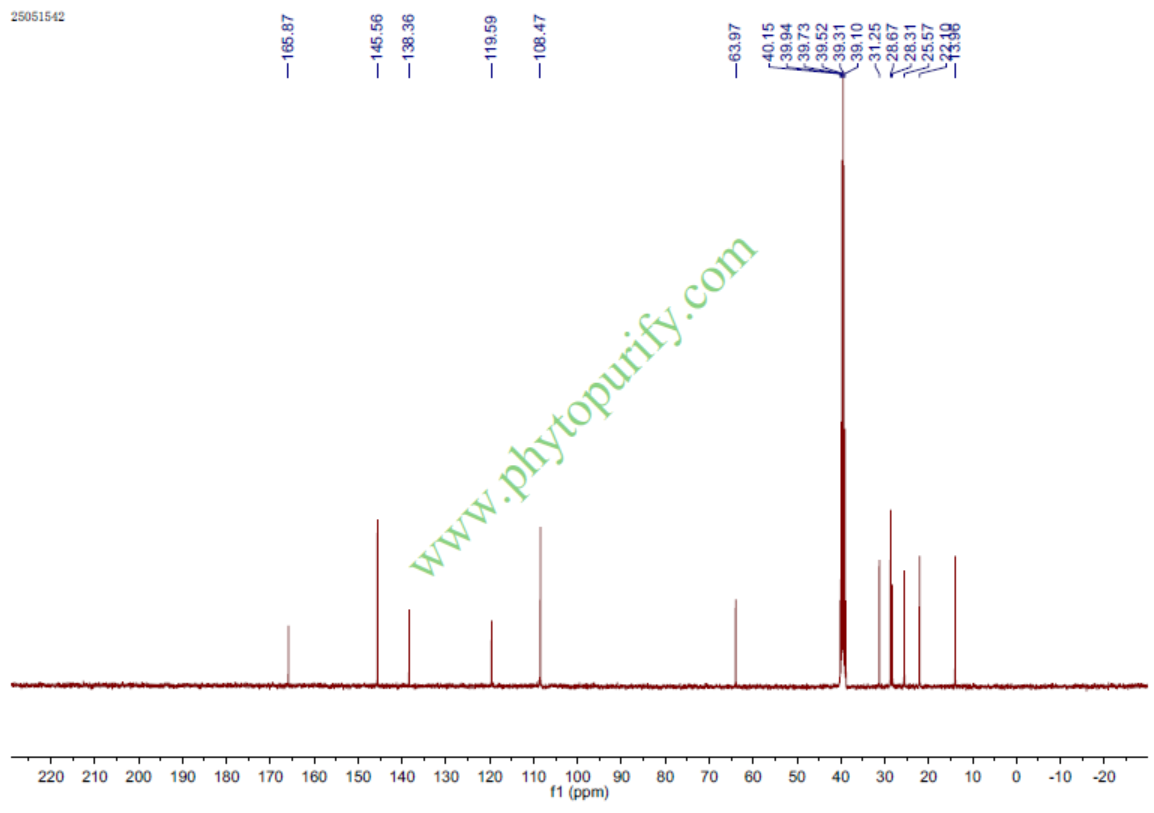
NMR of Octyl gallate
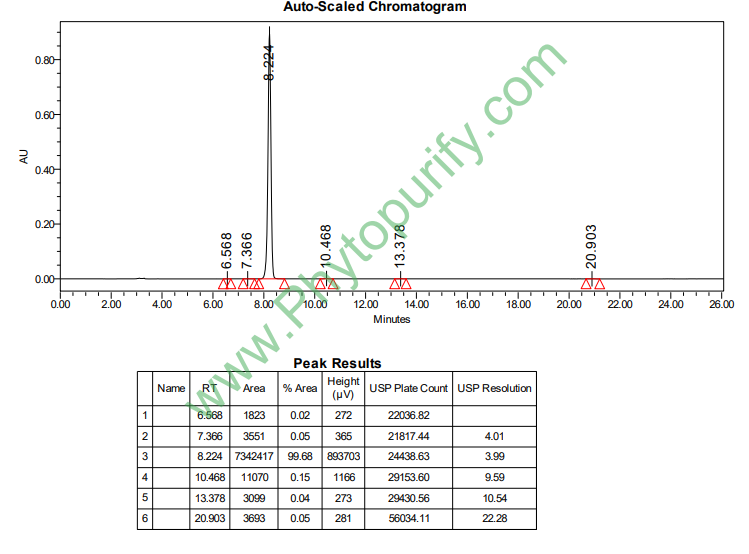
HPLC of Octyl gallate
Storage conditions:Short-term storage at 2~8℃, long-term storage at -20 ~ -80℃
86.9900
4.4780
4.1886
.1388
1.8672
1.9056
Low
91.2777
2.0882
Yes
Yes
Yes
No
No
Yes
0.0
No
No
No
No
In the field of natural product chemistry and pharmacology research, gallic acid and its ester derivatives have attracted much attention due to their extensive biological activities. Octyl gallate (OG), also known as Progallin O, with the chemical name 3,4,5-trihydroxybenzoic acid octyl ester, is an important alkyl gallate ester. Its CAS number is 1034-01-1. For a long time, OG has been widely used as an additive (E311) in the food and cosmetics industry worldwide due to its excellent antioxidant and antibacterial properties, to delay oil rancidity and product deterioration. However, recent studies have continuously revealed that the biological functions of OG go far beyond preservation and preservation. A large number of in vitro and in vivo studies have shown that OG exhibits significant activity in antiviral, anti-inflammatory, neuroprotective, and potential anti-tumor aspects, especially its antiviral effects against herpes simplex virus type 1 (HSV-1), vesicular stomatitis virus (VSV), and poliovirus, providing convincing evidence for its transformation from food additives to therapeutic drug molecules. In addition, its unique, selective, and sensitive fluorescence properties also provide the possibility for developing OG based molecular probes and biological imaging tools. This article aims to systematically review the chemical properties, sources, pharmacological activities, molecular mechanisms of action, pharmacological parameters, and clinical application prospects of octyl gallate, in order to provide comprehensive academic references for the in-depth development and utilization of this compound.
The molecular formula of octyl gallate is C15H22O5, with a molecular weight of 282.3360 g/mol. Its chemical structure is composed of a core of gallic acid (3,4,5-trihydroxybenzoic acid) and an eight carbon straight chain alkyl group (octyl) connected by ester bonds. This structure cleverly combines the hydrophilicity of polyphenolic hydroxyl groups with the lipophilicity of long-chain alkyl groups.
The key physicochemical properties are as follows:
1. solubility OG exhibits typical parental characteristics. Three adjacent phenolic hydroxyl groups give it a certain degree of water solubility (about 0.1388 mg/mL), while the long chain of octyl gives it good lipid solubility. Its lipid water partition coefficient (LogP) is 4.4780, indicating that OG is more soluble in organic solvents and lipid environments, which facilitates its penetration into cell membranes.
2. Acidity and stability The three phenolic hydroxyl groups on the benzene ring give it weak acidity and facilitate the formation of intramolecular hydrogen bonds, which is closely related to its antioxidant activity. Under alkaline conditions, ester bonds may undergo hydrolysis, producing gallic acid and octanol.
3. Spectral characteristics One of the most distinctive properties of OG is its fluorescence properties. The conjugated system in its molecular structure enables it to emit fluorescence at specific excitation wavelengths, and this fluorescence signal has selectivity and sensitivity to the polarity, viscosity, and binding with specific biomolecules of the microenvironment, making it potentially applicable in the fields of biosensing and imaging.
4. Topological Polarity Surface Area (TPSA)Its TPSA is 86.99 Å ², which is relatively small. Combined with its moderate LogP value, it suggests that it may have good membrane permeability.
These physicochemical properties are the basis for its subsequent biological activity and pharmacokinetic behavior.
Octadecyl gallate is not a widely present major component in nature, but as a derivative of gallic acid, its natural precursor - gallic acid - is widely present in various plants, such as galls of galls in the Rhus family, tea, oak bark, pomegranate, grape, and various Chinese medicinal herbs (such as rhubarb and elm). At present, commercialization and laboratory acquisition of OG are mainly achieved through the following two channels:
Numerous studies have confirmed that octyl gallate has diverse pharmacological activities, far exceeding its traditional understanding as an antioxidant.
antioxidant activity This is the most classic and core activity of OG. The three adjacent phenolic hydroxyl groups on its benzene ring are potent hydrogen donors that can effectively scavenge free radicals (such as superoxide anions, hydroxyl radicals, and peroxide radicals), interrupt the lipid peroxidation chain reaction, and protect cell membranes and biomolecules (such as DNA and proteins) from oxidative damage. Research has shown that the antioxidant capacity of OG is stronger than its parent gallic acid and some short chain alkyl esters (such as propyl ester and butyl ester), which is attributed to the enhanced dispersion and localization ability of octyl long-chain in the lipid phase, making it easier to approach the sites where lipid peroxidation occurs.
Antiviral activity OG exhibits broad-spectrum and significant antiviral potential. Research shows that OG can effectively inhibit Herpes simplex virus type 1 (HSV-1)The replication may occur by interfering with virus adsorption or entering the early stages of host cells. Correct Vesicular stomatitis virus (VSV)and Poliovirus, OG also exhibits strong inhibitory effects, which may be related to the destabilization of the viral envelope or capsid, or interference with the synthesis of viral RNA. These findings suggest that OG may serve as a lead compound for the development of novel antiviral drugs.
Antibacterial activity OG has inhibitory effects on various bacteria and fungi, including Staphylococcus aureus, Escherichia coli, Bacillus subtilis, and some yeast. Its antibacterial mechanism may be related to the destruction of microbial cell membrane integrity, inhibition of key enzyme activity, and indirect impact of its antioxidant effect on microbial metabolism.
Anti inflammatory and immune regulatory activity In cellular and animal inflammation models, OG has been shown to inhibit the production of pro-inflammatory mediators such as nitric oxide, prostaglandin E2, tumor necrosis factor - α, interleukin-6, etc. This effect is closely related to its regulation of related signaling pathways.
Neuroprotective activity Based on its strong antioxidant and anti-inflammatory abilities, OG has shown protective effects in cellular and animal models of neurodegenerative diseases such as Parkinson's disease and Alzheimer's disease. It can alleviate neuronal damage caused by oxidative stress and inflammatory reactions, and improve cognitive and motor function deficits.
Other potential activities Preliminary studies also suggest that OG may have activities such as inhibiting the proliferation of certain tumor cells, protecting the liver from chemical damage, and regulating glucose and lipid metabolism, but further research is needed in these areas.
The multiple pharmacological activities of OG stem from its interactions with various biomolecules and signaling pathways. Its core mechanism revolves around anti-oxidative stress Expand and extend to multiple levels such as anti-inflammatory and antiviral.
Direct antioxidant and enzyme regulation:
Anti inflammatory mechanism:
Antiviral mechanism:
Inhibition of Tyrosinase (TYR):
Based on the provided pharmacological parameters and existing research, the preliminary evaluation of the pharmacological properties of OG is as follows:
Pharmacokinetic study Relatively limited. Based on its ester bond structure, OG is likely to be rapidly hydrolyzed by esterases in vivo, producing gallic acid and octanol. Gallic acid can be absorbed and further metabolized into methylated or sulfated/glucuronic acid complexes, which are excreted through urine. Octanol can be oxidized and metabolized. Therefore, the oral bioavailability of OG may not be high, and its pharmacological effects may be partially attributed to its metabolite gallic acid. Future research needs to clarify the absorption, distribution, metabolism, and excretion (ADME) process of the prototype drug of OG in vivo.
From a mature food additive to a therapeutic drug, octyl gallate has unique advantages and challenges.
Application Prospects:
1. Localized antiviral/antibacterial agents In view of its good skin permeability and anti HSV-1 activity, OG is expected to be developed into cream, gel and other topical preparations for the treatment of herpes labialis and genital herpes. Its antibacterial properties can also be used to treat skin bacterial or fungal infections.
2. Adjuvant therapy for inflammation related diseases As an antioxidant and anti-inflammatory agent, OG may be used as a dietary supplement or adjuvant medication for the adjuvant management of chronic inflammatory diseases such as arthritis and colitis.
3. Preventive agents for neurodegenerative diseases Its neuroprotective activity makes it potential for preventing or delaying the progression of Parkinson's disease and Alzheimer's disease, which may be applied in the form of functional foods or health products.
4. Functional cosmetic ingredients Combining its antioxidant, anti-inflammatory, and tyrosinase inhibitory activities, OG has been applied in anti-aging, whitening, and sun protection skincare products. In the future, its efficacy monitoring products based on fluorescence characteristics can be further developed.
5. Chemical preventive agent Continuous low-dose intake in food and health products may reduce the risk of oxidative stress-related diseases (such as cancer and cardiovascular disease) through their antioxidant mechanisms.
6. Biological probes and imaging agents Its selective fluorescence properties need to be further explored, or molecular probes can be developed for detecting specific redox states or metal ions within cells.
Challenges and Prospects:
1. Bioaccumulation and Formulation Optimization Improving oral bioavailability is key. The strategy includes developing prodrugs (such as preparing more easily hydrolyzed esters), using nanocarrier systems (liposomes, nanoemulsions, polymer nanoparticles) to package and improve solubility, stability, and targeting.
2. Deep analysis of the mechanism of action In particular, the specific molecular targets of its antiviral and potential anti-tumor effects need to be clarified to guide rational drug design.
3. System security evaluation Although it has a good safety record as a food additive, as a long-term medication, comprehensive preclinical toxicology studies (acute toxicity, long-term toxicity, reproductive toxicity, etc.) and standardized clinical trials are required.
4. Structural modification and development of analogues Using OG as the lead compound, by modifying the alkyl chain length and introducing other functional groups, it is expected to obtain new derivatives with stronger activity, higher selectivity, and better pharmacokinetic properties.
Octyl gallate is a bridging molecule that connects the food industry and the pharmaceutical industry. It is not only an efficient antioxidant preservative, but also a treasure compound with multiple pharmacological activities. From clearing free radicals to regulating the Nrf2 core defense pathway, from inhibiting herpes virus to protecting neurons, OG exhibits its versatile characteristics. Although there are still challenges in terms of bioavailability, target accuracy, and system safety on the road to mature therapeutic drugs, its clear mechanism of action, good safety substrate, and unique physicochemical properties (such as fluorescence characteristics) have laid a solid foundation for its deep development in multiple directions such as therapeutic drugs, functional products, and biological tools. Future research should focus on using modern pharmaceutical technologies to improve its delivery efficiency, and using chemical biology methods to further elucidate its interactions with disease-related targets, in order to fully unleash the therapeutic potential of this natural derivative and benefit human health.
