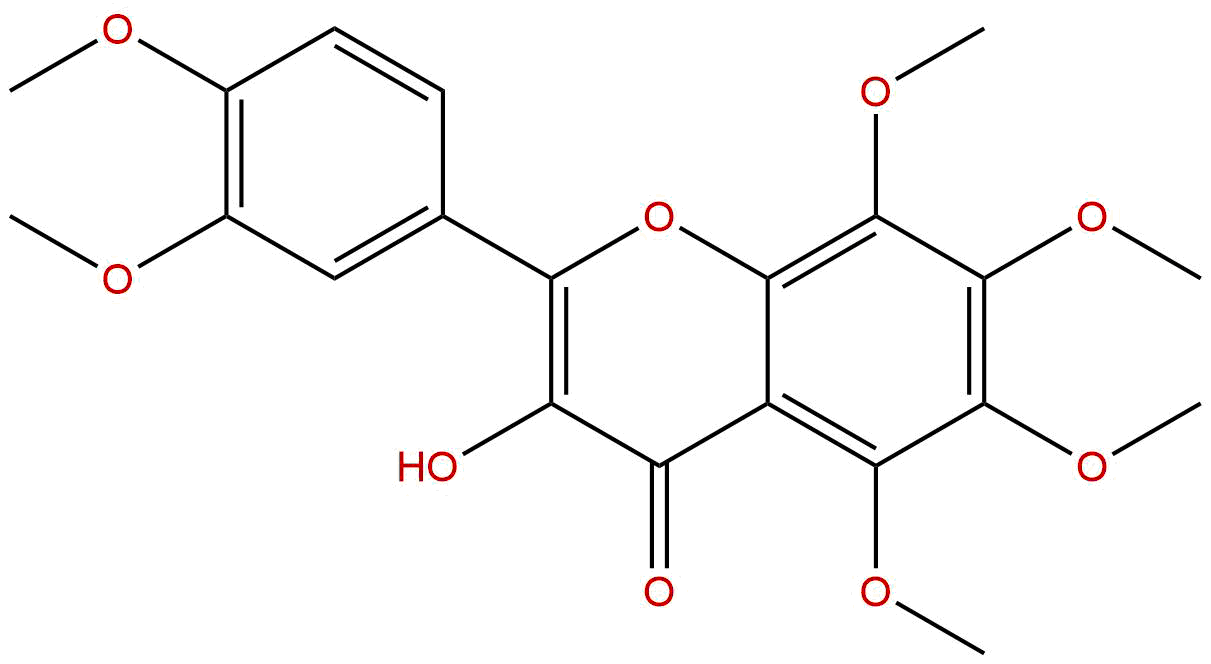


Product name: Natsudaidain
Synonym name: 3-Hydroxy-5,6,7,8,3',4'-hexamethoxyflavone
Catalogue No.: BP4653
Cas No.: 35154-55-3
Formula: C21H22O9
Mol Weight: 418.398
Botanical Source:
Type of Compound: Flavonoids
Purity: 95%~99%
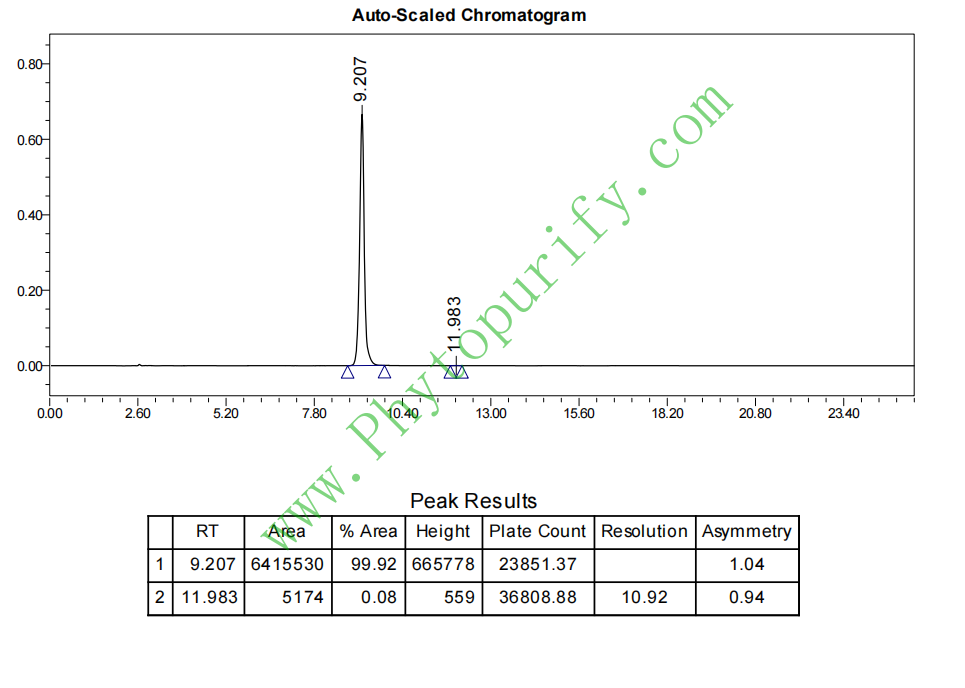
Analysis Method: HPLC-DAD or/and HPLC-ELSD
Identification Method: Mass, NMR
Packing: Brown vial or HDPE plastic bottle
Storage: Store in a well closed container, protected from air and light. Put into refrigerate or freeze for long term storage.
Whenever possible, you should prepare and use solutions on the same day. However, if you need to make up stock solutions in advance, we recommend that you store the solution as aliquots in tightly sealed vials at -20℃. Generally, these will be useable for up to two weeks.
The product could be supplied from milligrams to grams
Inquire for bulk scale.
For Reference Standard and R&D, Not for Human Use Directly.
HPLC of Natsudaidain
Storage conditions:Short-term storage at 2~8℃, long-term storage at -20 ~ -80℃
105.8200
2.2680
2.2530
.0348
2.9895
18.1405
Low
87.3990
2.5700
Yes
No
Yes
No
Yes
No
0.6
Yes
No
No
Yes
Allergic diseases, such as allergic rhinitis, asthma and atopic dermatitis, have become a global public health problem. Their incidence rate is increasing year by year, which seriously affects the quality of life of patients. Traditional anti allergic drugs such as antihistamines and glucocorticoids have certain therapeutic effects, but they are often accompanied by limitations such as drowsiness, drug resistance, and adverse reactions from long-term use. Therefore, searching for efficient and low toxicity new anti allergic lead compounds from natural products has always been an important direction in drug development. Flavonoids are widely present in the plant kingdom and have attracted much attention for their diverse biological activities. Among them, multi methoxy flavonoids have become one of the hotspots in natural product chemistry and pharmacology research due to their unique chemical structure and significant pharmacological activity. Naringin, as a typical multi methoxy flavonoid, has gradually revealed its potential anti allergic and other biological activities since its discovery in citrus plants. This article aims to systematically review the chemical properties, plant sources, pharmacological activities, mechanisms of action, pharmacological evaluation, and clinical application prospects of naringin, in order to provide comprehensive academic references for the in-depth research and development of this compound.
Naringin, chemical name 3,5,6,7,8,3 ′, 4 ′ - heptamethoxyflavone, CAS number 35154-55-3, molecular formula C22H26O9, molecular weight 418.3980. Its core structure is the flavonoid nucleus, which is formed by connecting two benzene rings (A ring and B ring) through a central oxygen-containing heterocyclic ring (C ring). Its characteristic is that there are seven methoxy (- OCH3) substituents on the benzene ring, located at positions 3, 5, 6, 7, and 8 of the A ring and at positions 3 'and 4' of the B ring. This highly methoxylated structure is the key that distinguishes it from other flavonoids and profoundly affects its physicochemical properties and biological activity.
From the analysis of physical and chemical properties, a high proportion of methoxy substitution endows naringin with strong lipophilicity. The calculated lipid water partition coefficient (LogP) is 2.2680, indicating that the compound has moderate lipophilicity, which facilitates transmembrane transport and interaction with hydrophobic targets. Its topological polar surface area (TPSA) is 105.8200 Å ², reflecting the surface area of polar atoms in the molecule, and the value is moderate. However, its water solubility is relatively low, about 0.0348 mg/mL, which to some extent limits its bioavailability in aqueous media. In addition, the predictive model shows a lower ability to cross the blood-brain barrier, suggesting that the risk of central nervous system related side effects may be relatively low. In the early safety evaluation, the hERG inhibition test was negative, indicating a low potential risk of cardiac toxicity; The Ames test result is 0.6, indicating a low risk of mutagenicity and providing preliminary safety evidence for its further development.
Naringin mainly comes from citrus plants in the Rutaceae family. Research has shown that it is distributed in various citrus peels, leaves, and seeds, especially in varieties such as grapefruit, lime, and lemon where its content is relatively high. As a traditional medicinal and edible resource, the accumulation of flavonoids in citrus plants is influenced by various factors such as variety, place of origin, harvest season, and plant parts. Usually, the content of methoxyflavonoids in the fruit peel is higher than that in the flesh.
Organic solvent extraction is commonly used to extract naringin from plant materials. Polar solvents such as methanol, ethanol, and acetone are widely used due to their good solubility in flavonoids. The conventional process includes heating and refluxing the dried and crushed citrus peel with an appropriate solvent (such as 70-80% ethanol) or ultrasound assisted extraction, followed by filtration and concentration to obtain the crude extract. To further enrich and purify naringin, it is necessary to combine multiple chromatographic separation techniques. The crude extract is usually first separated by macroporous adsorption resin or silica gel column chromatography to remove impurities such as sugars and pigments. Subsequently, fine separation was performed using preparative high-performance liquid chromatography, medium pressure liquid chromatography, or repeated silica gel column chromatography, using gradient elution systems such as petroleum ether ethyl acetate and chloroform methanol. Finally, structural identification and purity confirmation were performed using techniques such as nuclear magnetic resonance and mass spectrometry. In recent years, green extraction techniques such as supercritical fluid extraction and microwave-assisted extraction have also been explored to improve extraction efficiency and selectivity.
Numerous in vitro and in vivo pharmacological studies have confirmed that naringin has a wide range of biological activities, among which its anti allergic activity is the most prominent and has research value.
1. Anti allergic activity
Naringin has shown significant inhibitory effects in various allergic reaction models. In animal models such as passive skin allergic reactions and mouse allergic rhinitis, naringin can dose dependently alleviate allergic symptoms such as increased vascular permeability, scratching behavior, nasal symptoms, etc. Its function involves multiple key steps in allergic reactions: inhibiting degranulation of mast cells and eosinophils, reducing the release of inflammatory mediators such as histamine and leukotrienes; Downregulate the expression of Th2 cytokines (such as IL-4, IL-5, IL-13) to regulate immune balance, inhibit eosinophil infiltration and excessive IgE production.
2. Anti inflammatory activity
Inflammation is the core pathological process of allergic diseases. Naringin exerts anti-inflammatory effects by inhibiting the production of pro-inflammatory factors such as tumor necrosis factor - α (TNF - α) and interleukin-6 (IL-6), as well as suppressing the expression of inducible nitric oxide synthase (iNOS) and cyclooxygenase-2 (COX-2). This is closely related to its regulation of related signaling pathways.
3. Other potential activities
In addition to anti allergic and anti-inflammatory effects, research also suggests that naringin may have antioxidant and anti-tumor activities. Its antioxidant capacity is derived from the free radical scavenging properties of the flavonoid structure itself. Partial cell experiments have shown that it has a proliferative inhibitory effect on certain cancer cell lines, but its anti-tumor mechanism and efficacy still need to be further explored.
The pharmacological effects of naringin, especially its anti allergic effects, are achieved by acting on multiple molecular targets and regulating complex cellular signaling networks.
1. Inhibition of mast cell activation
Mast cells are the core effector cells of type I allergic reactions. One of the key mechanisms by which naringin has anti allergic effects is to inhibit the activation of mast cells triggered by the cross-linking of antigens with high affinity receptor Fc ε RI through IgE. Research has shown that naringin can significantly inhibit the phosphorylation activation of p38 mitogen activated protein kinase (p38 MAPK). P38 MAPK is an important signaling molecule in mast cells, involved in regulating the transcription and translation of various inflammatory mediator genes such as TNF - α and COX-2. By inhibiting the p38 MAPK pathway, naringin effectively blocks the production of TNF - α and COX-2, thereby reducing the inflammatory response.
2. Multi pathway regulation of allergy related targets
According to its relevant target information, the mechanism of action of naringin exhibits multi-target characteristics:
* Regulating lipoxygenase and thromboxane pathway Possible interference with leukotriene synthesis by affecting ALOX5 (5-lipoxygenase) activity; The potential effect on TBXA2R (thromboxane A2 receptor) may affect platelet aggregation and bronchial constriction.
* Antagonistic histamine receptor May act as an antagonist of HRH1 (histamine H1 receptor), directly blocking the sensitizing effect of histamine.
* Regulating Th2 immune response By affecting the production or signaling of Th2 cytokines such as IL4, IL5, and IL13, the Th1/Th2 imbalance in allergic states can be corrected. Among them, inhibition of transcription factor STAT6 (signal transducer and activator of transcription factor 6) may be the key to its downregulation of IL-4/IL-13 signaling, as STAT6 is a downstream key molecule of these cytokine signals. In addition, the regulation of thymic stromal lymphopoietin (TSLP) is also worth paying attention to, as TSLP is an important epithelial cytokine that initiates allergic inflammation.
* Inhibition of IgE mediated sensitization By affecting the expression or function of FCER1A (IgE high affinity receptor alpha chain), it may weaken the binding of allergens to effector cells at the source.
This multi-target mode of action enables naringin to intervene in the allergic process from multiple levels such as sensitization, mediator release, and inflammatory response, which may have a more comprehensive therapeutic effect and lower resistance risk than single target drugs.
Although naringin exhibits excellent pharmacological activity, its successful development as a drug largely depends on its pharmacological properties, namely "pseudo pharmacological" and pharmacokinetic properties.
1. Preliminary analysis of drug properties
Based on its physicochemical parameters: molecular weight 418.4 (<500), LogP 2.27 (ideal range 1-3), TPSA 105.8 (<140 Å ²), naringin basically meets the Lipinski "Five Rules" and other preliminary criteria for drug properties, indicating its potential for oral absorption. However, its low water solubility (0.0348 mg/mL) is the main physicochemical barrier affecting its oral bioavailability. Low water solubility may lead to slow and low degree of dissolution in the gastrointestinal tract, thereby limiting absorption.
2. Pharmacokinetic challenges and strategies
At present, there are relatively limited research reports on the pharmacokinetics of naringin system, which is an urgent gap that needs to be filled in its development process. Based on its structural characteristics, it can be predicted that it may face pharmacokinetic challenges:
* absorb Lipophilicity is beneficial for passive diffusion, but low water solubility is the bottleneck that limits absorption. The use of preparation techniques such as nanocrystals, solid dispersions, liposomes, or cyclodextrin inclusion complexes to improve their dissolution and solubility is an effective strategy for improving oral absorption.
* distribution Moderate LogP values are beneficial for tissue distribution, but their lower blood barrier permeability limits central function and may also reduce the risk of central side effects. The binding rate and tissue-specific distribution with plasma proteins need to be experimentally clarified.
* Metabolism Flavonoids are typically substrates for cytochrome P450 enzymes (especially CYP1A2, CYP3A4) and II binding enzymes (such as UGT, SULT). Multiple methoxy groups in the structure of naringin may undergo demethylation metabolism, generating active or inactive metabolites. It is crucial to clarify its main metabolic pathways, metabolic enzymes, and potential drug drug interactions.
* excretion It is expected that its metabolites will mainly be excreted through bile and urine.
3. Early safety
The existing preliminary data (no hERG inhibition, negative Ames test) provides preliminary support for its safety, but a comprehensive preclinical safety evaluation, including acute toxicity, chronic toxicity, reproductive toxicity, etc., still needs to be systematically carried out.
As a natural multi methoxy flavonoid with clear anti allergic activity, naringin has broad clinical application prospects, but the road is also full of challenges.
1. Potential application directions
* Development of new anti allergic drugs Develop oral or topical formulations for diseases such as allergic rhinitis, allergic asthma, urticaria, atopic dermatitis, etc. Its multi-target mechanism of action may be applicable to patients with poor efficacy of existing single target drugs.
* Anti inflammatory adjuvant therapy Based on its inhibitory effects on COX-2, TNF - α, etc., it may be used to treat certain chronic inflammatory diseases.
* Functional foods and health products As an active ingredient in citrus extract, it can be used to develop food or dietary supplements with anti allergic health functions.
2. Challenges faced
* Depth of drug efficacy and mechanism Current research mainly focuses on phenomenon observation and preliminary pathway exploration, and the direct interaction evidence with specific targets such as STAT6 and TSLP, as well as the precise regulatory mechanism in complex immune networks, still need to be further elucidated.
* Drug bottleneck Low water solubility and unknown systemic pharmacokinetic properties are the main obstacles that constrain its conversion into drugs.
* Resources and Synthesis Extracting content from plants is limited and costly. Therefore, developing efficient and economical chemical or biological synthesis methods is crucial for ensuring raw material supply and structural modification.
* Lack of clinical evidence Currently, all data comes from preclinical studies, and there is an urgent need to design rigorous clinical trials to validate its safety, efficacy, and optimal medication regimen in humans.
3. Future prospects
Future research should focus on: ① using chemical biology methods (such as molecular docking, surface plasmon resonance, co crystallization, etc.) to accurately identify their direct target proteins; ② Conduct preclinical pharmacokinetic and toxicological studies on the system, and optimize its bioavailability using formulation strategies; ③ Optimize and modify the structure, while retaining the core pharmacophore, to improve its solubility, metabolic stability, and other drug defects, and synthesize derivatives or analogues with greater potential for development; ④ Explore its potential for combination therapy with other anti allergic drugs in order to generate synergistic effects and reduce their respective dosages and side effects.
Naringin, as a natural multi methoxy flavonoid gifted by citrus plants, has shown great potential as a novel anti allergic candidate drug due to its unique chemical structure and multi-target anti allergic mechanism. It effectively regulates mast cell activation and Th2 immune response by inhibiting p38 MAPK phosphorylation and other pathways, achieving encouraging results in experimental models. However, the road from lead compounds to successful drugs is still long. The inherent low water solubility, unclear systemic pharmacokinetic behavior, and lack of clinical validation are the main challenges currently faced. Future research requires close collaboration among multiple disciplines such as pharmacology, medicinal chemistry, and pharmacy, while deepening understanding of the mechanisms and focusing on addressing the bottleneck of drug development. Through continuous scientific exploration and technological breakthroughs, naringin and its derivatives are expected to bring safer and more effective treatment options for allergic disease patients in the future, while also providing valuable paradigms for the research and development of other natural products.
