| Catalog No | Package | Original Price | Price | Inventory | Quantity | Operating |
|---|---|---|---|---|---|---|
| BP3412-20mg | 20mg | $20.00 | Sign in |
|


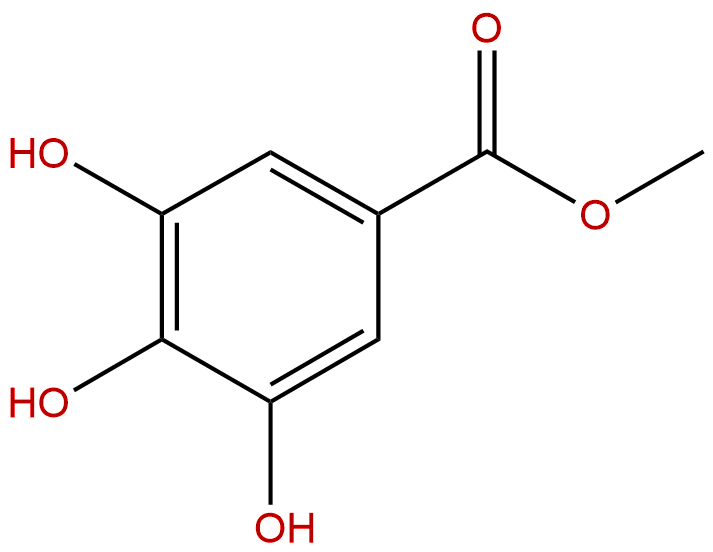
Product name: Methyl gallate
Synonym name:
Catalogue No.: BP3412
Cas No.: 99-24-1
Formula: C8H8O5
Mol Weight: 184.147
Botanical Source:
Physical Description:
Type of Compound: Phenols
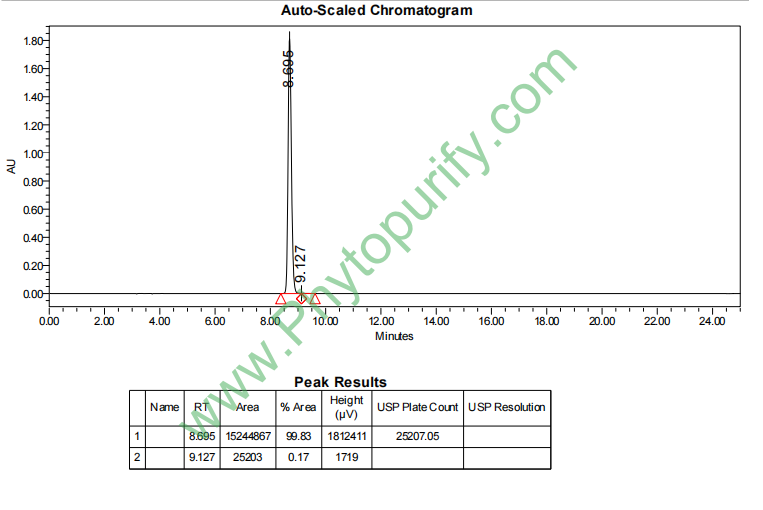
Purity: 95%~99%
Analysis Method: HPLC-DAD or/and HPLC-ELSD
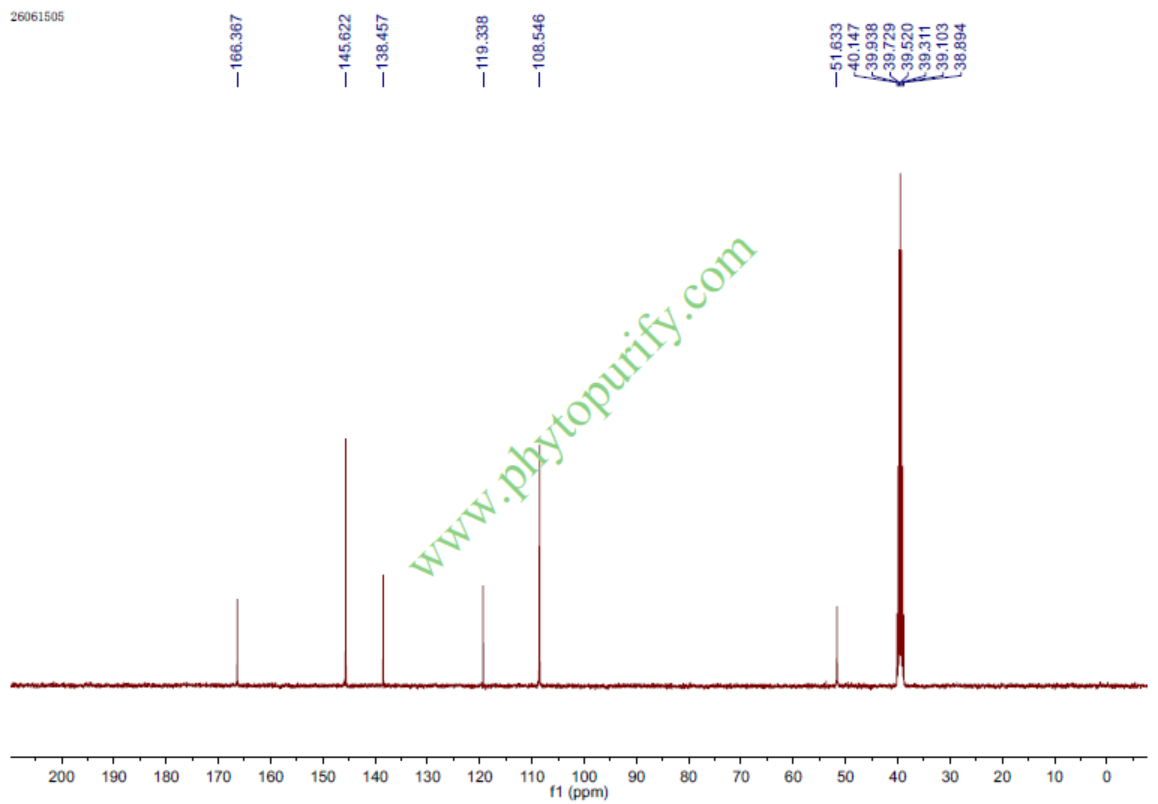
Identification Method: Mass, NMR
Packing: Brown vial or HDPE plastic bottle
The product could be supplied from milligrams to grams. Inquire for bulk scale.
We provide solution to improve the water-solubility of compounds, thereby facilitating the variety of activity tests and clinic uses.
For Reference Standard and R&D, Not for Human Use Directly.
HPLC of Methyl gallate
NMR of Methyl gallate
Storage conditions:Short-term storage at 2~8℃, long-term storage at -20 ~ -80℃
86.9900
1.2261
.7111
7.1270
3.4752
1.3412
Low
64.7000
2.0549
Yes
Yes
No
No
Yes
No
0.6
Yes
No
Yes
Yes
Natural products have always been an important treasure trove for innovative drug discovery, among which plant phenolic compounds have attracted much attention due to their wide range of biological activities. Methyl gallate (MG), also known as 3,4,5-trihydroxybenzoic acid methyl ester, is a simple phenolic acid ester compound widely present in various medicinal plants. Its CAS number is 99-24-1 and it is a methylated derivative of gallic acid. Early research mainly focused on its role as a natural antioxidant, but with the deepening of modern pharmacological research, the pharmacological activities of MG in various aspects such as anti-cancer, anti-inflammatory, antibacterial, and even antiviral (such as anti-HIV-1) have gradually been revealed, showing great potential as a lead compound or therapeutic agent. This article aims to systematically review the chemical properties, plant sources, pharmacological activities, molecular mechanisms of action, pharmacological evaluation, and clinical application prospects of methyl gallate, in order to provide comprehensive academic references for the in-depth research and development of this compound.
The molecular formula of methyl gallate is C8H8O5, with a molecular weight of 184.1470 g/mol. Its chemical structure consists of a methyl benzoate skeleton, with three hydroxyl groups replacing the 3, 4, and 5 positions of the benzene ring. This adjacent triphenylhydroxyl structure is the key pharmacophore for its strong antioxidant activity. This structure enables it to serve as both a hydrogen donor and a stable free radical through single electron transfer, which is the chemical basis for its many biological activities.
In terms of physicochemical properties, the lipid water partition coefficient (LogP) of MG is 1.2261, indicating that it has a certain degree of lipophilicity, but overall it still leans towards hydrophilicity. Its topological polar surface area (TPSA) is 86.99 Å ², reflecting the proportion of polar hydroxyl groups in its molecule. The water solubility data is 7.1270 (usually referring to logS or related solubility parameters, the specific unit depends on the model), indicating that it has a medium to high solubility in water, which is beneficial for its absorption and distribution in organisms. These basic physicochemical parameters provide a basis for its subsequent pharmacokinetic and pharmacological analysis.
Methyl gallate is widely distributed in nature and is a secondary metabolite of many plants. It is commonly found in the following families and genera of plants: Euphorbiaceae (such as Eucommia ulmoides and Phyllanthus urinae), Sapindaceae (such as mangoes and cashews), Rosaceae (such as roses and raspberries), Rosaceae (such as walnuts), and Theaceae (such as tea leaves). In these plants, MG often coexists with other polyphenolic compounds such as gallic acid and tannic acid.
The extraction of MG from plant materials mainly depends on its polarity and solubility. The conventional extraction methods include:
1. Solvent extraction method The most commonly used method is to use methanol, ethanol, acetone, or water alcohol mixed solvents for extraction, reflux, or ultrasound assisted extraction. Methanol and ethanol are commonly used due to their high extraction efficiency for phenolic substances.
2. Advanced Extraction Technology To improve extraction efficiency and selectivity, technologies such as microwave-assisted extraction (MAE), supercritical fluid extraction (SFE, commonly CO2 entraining modifier), and pressurized liquid extraction (PLE) have also been applied.
The crude extract after extraction usually requires further separation and purification steps, such as liquid-liquid extraction (enrichment with organic phases such as ethyl acetate), column chromatography (silica gel, Sephadex LH-20, macroporous adsorption resin, etc.), and high performance liquid chromatography (HPLC) preparation, to obtain high-purity MG monomers.
Numerous in vitro and in vivo studies have confirmed that methyl gallate has diverse and significant pharmacological activities.
antioxidant activity One of the core activities of MG. Its adjacent triphenylhydroxyl structure can effectively scavenge various free radicals such as DPPH, ABTS, superoxide anions, hydroxyl radicals, etc., and exhibits strong iron ion reduction ability. In cellular and animal models, it can significantly reduce oxidative stress markers such as ROS and MDA, and enhance the activity of endogenous antioxidant enzyme systems.
anti-inflammatory activity Research has shown that MG can effectively inhibit the production of nitric oxide (NO) and prostaglandin E2 (PGE2) by macrophages (such as RAW 264.7) induced by stimuli such as lipopolysaccharide (LPS), and downregulate the expression of pro-inflammatory cytokines (such as TNF - α, IL-1 β, IL-6). It has shown good anti-inflammatory effects in animal inflammation models, such as carrageenan induced foot swelling and acetic acid induced increased vascular permeability in mice.
anticancer activity: MG has growth inhibition and apoptosis induction effects on a variety of human cancer cell lines, including breast cancer (MCF-7), lung cancer (A549), liver cancer (HepG2), prostate cancer (PC-3), colon cancer (HT-29), etc. Its function is not limited to inducing cell apoptosis, but also involves inhibiting cell proliferation, migration, invasion, and cell cycle arrest.
Antibacterial and antiviral activity MG has inhibitory effects on various Gram positive bacteria (such as Staphylococcus aureus) and Gram negative bacteria (such as Escherichia coli), and its mechanism may be related to the destruction of bacterial cell membrane integrity, inhibition of biofilm formation, or interference with bacterial enzyme systems. Of particular note is its antiviral potential, as studies have reported that MG can inhibit the activity of HIV-1 reverse transcriptase and integrase, thereby interfering with the replication cycle of HIV-1 virus.
Other activities In addition, the study also suggests that MG may have potential activities such as liver protection, neuroprotection, and anti diabetes complications, which are closely related to its core role of antioxidant and anti-inflammatory.
The multiple pharmacological activities of methyl gallate stem from its diverse regulation of cellular signaling pathways and its effects on specific molecular targets.
Antioxidant and cellular defense pathways The antioxidant effect of MG is not only achieved through direct clearance of free radicals, but more importantly, through activation Nuclear factor E2 related factor 2 (NRF2, encoded by NFE2L2 gene) Signal pathway. MG can promote the dissociation and translocation of NRF2 from the cytoplasm to the nucleus, where it binds to antioxidant response elements, thereby upregulating the expression of a series of phase II detoxifying enzymes and antioxidant proteins, including Heme oxygenase-1 (HMOX1)、Superoxide dismutase (SOD1, SOD2)、Catalase (CAT) and Glutathione peroxidase 1 (GPX1) Wait, the system enhances the antioxidant defense ability of cells.
Anti inflammatory and anti-cancer related pathways:
Direct enzyme inhibition As mentioned earlier, MG can directly inhibit HIV-1 reverse transcriptase and integrase, as well as certain key enzymes required for bacterial growth, which are its direct targets for antiviral and antibacterial effects.
Based on its physicochemical properties and preliminary biological data, a preliminary evaluation of the pharmacological properties of methyl gallate is conducted
Methyl gallate, as a natural small molecule with multiple targets and functions, has broad clinical application prospects but also faces challenges.
Potential application directions:
Challenges and Prospects Faced:
Methyl gallate, as a natural phenolic compound with simple structure but rich biological activity, has shown remarkable potential in various fields such as antioxidant, anti-inflammatory, anticancer, antibacterial and antiviral. Its mechanism of action involves the regulation of key signaling pathways such as NRF2, NF - κ B, MAPK, as well as the inhibition of specific targets such as MMPs and HIV-1 enzymes, reflecting the characteristics of multi-target action. Despite issues such as low blood-brain barrier permeability and potential metabolic challenges in drug development, its good preliminary safety indicators (low hERG inhibition, negative Ames test) have laid the foundation for further development. Future research should focus on improving its pharmacokinetic properties through medicinal chemistry and pharmacology, and conducting systematic preclinical and clinical studies. Methyl gallate is not only a promising candidate molecule in itself, but also an important lead compound, providing valuable structural and mechanistic insights for the development of novel drugs for the treatment of various human diseases.
